
Girls in STEM Activities: 25+ Ideas for Ages 5 to 13
The best STEM activities for girls are hands-on, low-pressure and open-ended: a marble run built from recycled tubes, a paper circuit that lights an LED, a science journal where every question counts. Below you will find activities sorted by type and age, plus the simple adult moves that turn a one-off project into lasting confidence.
TL;DR
- Start with household-material projects (towers, balloon racers, oobleck, paper circuits). They cost little and work for ages 5 to 13 with small tweaks.
- Mix science, building, coding and art. Girls who see STEM as creative and useful stay curious longer.
- Let kids record observations in a science journal, and praise the questions as much as the results.
- Bring in real women scientists and inventors as role models, then let girls invent something of their own.
- Adjust for different learning needs: fewer steps, more tactile materials, and reading and writing built in rather than bolted on.
Table of Contents
- Why activities matter more than lectures
- Kitchen-table science for ages 5 to 13
- Building, robotics and coding projects
- Blend science with art and story
- Use women in STEM as role models, not just names
- From activity to invention
- How to build confidence while she builds
- Our perspective
- Ready-made help: kits, books and meeting Ava
- A simple weekly plan
- FAQ
- Sources
Why activities matter more than lectures
Most girls do not lose interest in science because they cannot do it. They lose interest because they stop seeing themselves in it. A project that ends with a working device, a surprising result or a page of their own notes gives a child evidence, in her own hands, that she is a person who figures things out.
That idea sits behind a lot of university outreach. The STEM Girl Day program at UT Austin frames household experiments as a way to build an engineering mindset, investigate science concepts, strengthen math skills and practice problem-solving. Research on a middle school computer science program points the same direction: a 2020 study of the BRIGHT-CS program found that for girls of color, messages about equity combined with open talk about overcoming personal challenges helped turn early confidence into genuine self-efficacy.
In plain terms: the activity is the vehicle, and the message around it is the engine. Choose projects that can succeed, and talk about struggle as a normal part of the work.
Kitchen-table science for ages 5 to 13
You do not need a lab. UT Austin’s at-home list sorts household-material projects by grade band, which helps adults pick simpler builds for younger girls and more complex ones for grades 4 to 6. Its ideas include marshmallow towers, balloon racers, water xylophones, lung models, paper circuits, oobleck, marble mazes, volcanoes, pocket solar systems, Mars rovers, hovercrafts and gliders.

The National PTA’s STEM-at-home collection adds family-friendly options such as balloon boats, bubble experiments and glove gardens. And Scientific American’s Bring Science Home activities are written for children ages 6 to 12 to do with a parent, using household items in about 30 minutes or less, which makes them a good fit for a weeknight.
Ages 5 to 7: sensory and short
Younger girls do best with projects that give a result within ten minutes and let them use their hands.
- Oobleck exploration. Is it a solid or a liquid? Let her squeeze it, drip it and decide.
- Balloon boats or racers. Change one thing (balloon size, boat shape) and race again.
- Glove garden. Plant seeds in a clear glove and watch roots form over days.
- Bubble experiments. Predict which wand shape makes which bubble, then test it.
- Sink or float basket. Collect ten household objects, guess, then check.
For every one of these, ask “What do you think will happen?” before the start and “What surprised you?” after. Those two questions are the scientific method at kindergarten scale.
Ages 8 to 10: build, test, improve
This is the sweet spot for engineering challenges, where girls can fail, tweak and try again.
- Marshmallow and spaghetti towers. Set a height goal and a time limit.
- Marble roller coasters. Pipe insulation or paper tubes work well. Measure how changing the slope changes the speed.
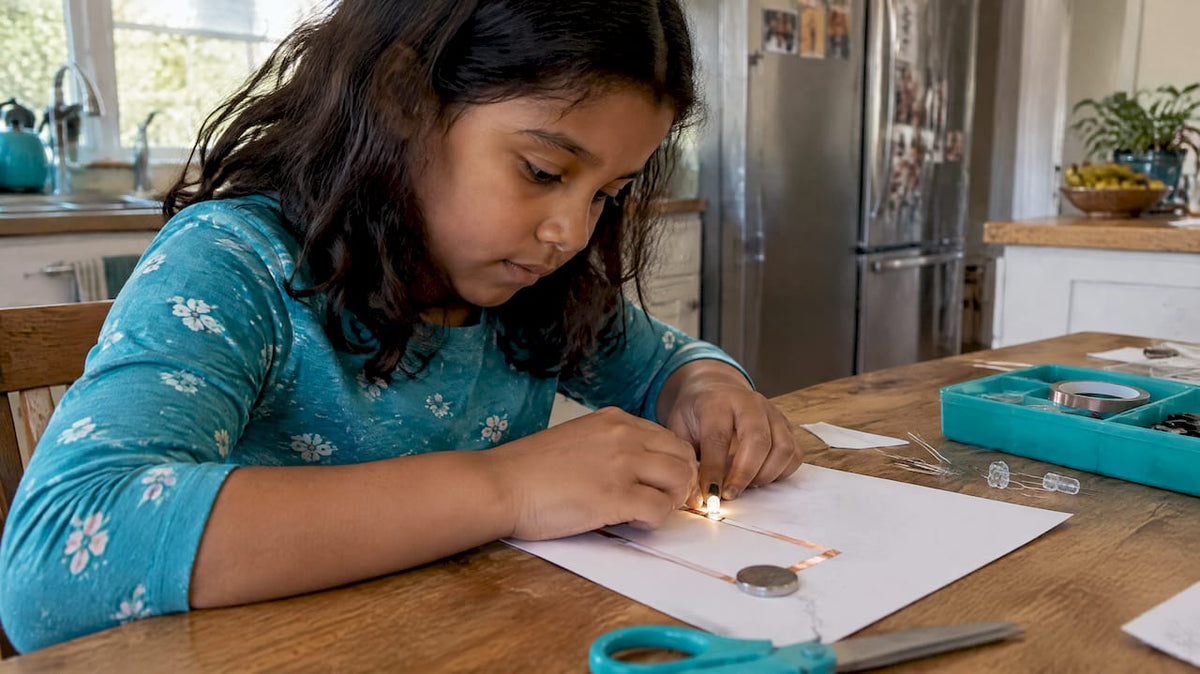
- Paper circuits. A coin battery, copper tape and an LED turn a greeting card into a glowing one.
- Water xylophone. Tune glasses of water to a scale and play a song.
- Lung model. A bottle, a balloon and a straw show how breathing works.
Our own age-tagged engineering projects guide sorts builds by age if you want a ready-made ladder from easy to harder.
Ages 11 to 13: design like an engineer
Older girls often want real constraints and real stakes. Give them a problem rather than a recipe.
- Wind-powered car. Which sail design travels farthest?
- Bridge challenge. Hold the most weight with a fixed amount of paper and tape.
- Homemade speaker. Learn how electricity and magnets make sound.
- Seismograph. Build one, then test how well it records a simulated tremor.
- Recycling sorter. Design a system that separates materials by size or weight.
These all appear on the Washington State University Extension’s at-home STEM list, which covers ages 5 to 14 and identifies many engineering challenges as suited to grades 4 to 8.
Building, robotics and coding projects
Girls who say “I’m not a computer person” often change their minds when code controls something they made. A few ways in:
- Unplugged robots (ages 5 to 10). One person is the “robot” and follows written instructions to make a sandwich. Every missing step becomes a funny, memorable bug. WSU Extension marks this as a K to 5 activity.
- Block coding (ages 8 to 13). The same WSU list points families to Scratch, CS First and 4-H Code Your World for free ways to start.
- Cardboard automata and simple machines. Cams, levers and gears made from recycled material connect engineering to art.
- Mars-rover obstacle course. Build a course from household items, then “program” a friend to drive through it with written commands.
If your group wants more structured collaboration ideas, group study maths activities show how to run a 30 to 40 minute session where students work through problems together, which transfers neatly to STEM challenge days.
For classrooms with tight budgets, our recycled STEM projects for teachers cover ages 5 to 13 using materials that are usually headed for the bin.
Blend science with art and story
STEAM, with the A for art, is often where girls light up. Designing a poster for a wind-powered car, illustrating a life cycle, or drawing a blueprint before building all keep creative strengths in play while building technical skill. Try a few of the ten projects in our art-integrated STEM guide, or add role play with a scientist dress-up setup: a lab coat and a name badge change how a child carries herself at the table.

Writing belongs here too. A science journal is one of the simplest, most powerful tools. Good Housekeeping’s experiment roundup suggests students use journals to record observations, questions, hypotheses, experiments, results and conclusions. For a girl who dislikes writing, shrink the task: one drawing, one sentence, one “next time I will…”.
Use women in STEM as role models, not just names
A poster of a famous scientist is fine. A project connected to what she did is better. Pick one woman, read a short picture-book biography, and run an activity tied to her work: a bridge challenge for an engineer, a night-sky observation for an astronomer, a seed-growing log for a botanist. Then ask, “What problem was she trying to solve, and what problem would you like to solve?”

Local role models count as much as historical ones. A mom who is a nurse, a neighbor who works at a utility company, a high school robotics captain: invite them to show a real tool and say how they got started. Girls hear “people like me do this” when the person in front of them is within reach.
From activity to invention
Once a girl has built a few things from instructions, give her a blank page. Open-ended prompts turn her from follower into inventor:
- What annoys you at home or school that a gadget could fix?
- Design a backpack, a lunch box or a desk for someone who has a different need than you.
- Improve one thing about last week’s project and prove it works with a test.
Have her sketch it, list materials, build a rough prototype, test it and write what she would change. A simple “invention certificate” at the end makes it official. Real-world problems, like keeping a classroom plant alive over a holiday or cutting lunchroom waste, show how STEM serves her own community.
How to build confidence while she builds
The adult’s behavior shapes the experience more than the materials do. A few habits that work:
- Let her hold the tools. Resist reaching in. If you must help, ask “Do you want a hand or an idea?”
- Praise process. “You tried three different ramps” tells her what to repeat. “You’re so smart” does not.
- Normalize failure. Call a collapsed tower “data.” Then ask what the data says.
- Name challenges openly. The BRIGHT-CS findings suggest that being honest about obstacles, alongside a message that she belongs, helps confidence become real self-belief.
- Keep the group friendly. Mixed-skill teams with clear roles (builder, recorder, tester, reporter) stop one confident child from taking over.
Adapting for different learners
Children with dyslexia, dysgraphia, ADHD or other learning differences are often brilliant builders and noticers. Swap long written instructions for pictures and demonstrations, allow oral or drawn reporting, break projects into short steps, and choose tactile materials. We have gathered ideas in our guides to literacy-first, neurodivergent-friendly hands-on STEM and mess-free science experiments for classrooms where cleanup time is limited.
Our perspective
Team Genius Squad began with a real family journey through dyslexia and dysgraphia. We watched a child who was bright, curious and creative feel that school did not have a place for the way her mind worked. What changed things was not another worksheet. It was getting her hands on real experiments, putting on a lab coat, and being treated as a scientist.
That is why we build around what we call the E³ Method: Engage, Encourage, Empower. Engage means starting with something a child can touch and see. Encourage means celebrating the attempt, the question and the reflection, not only the right answer. Empower means giving her a role, such as scientist, creator or problem-solver, that she can carry out of the activity and into the rest of her life.
We also believe STEM works best when it includes reading, writing and reflection, so children who struggle with those skills practice them inside something they love. Different minds can build the future, and the girls in your home or classroom are proof of it. Our founding story, inspired by young STEM entrepreneur Ava N. Simmons, is a reminder that a girl with a big idea and the right support can go far.
— Tita
Ready-made help: kits, books and meeting Ava
If you would rather skip the gathering and shopping, our screen-free experiment kits are designed for ages 5 to 13, with role-play lab coats, books, puzzles and accessories that help children step into the role of an innovator. A good starting point for electricity fans is the Shocking Electric Science kit.
For a live spark, children can meet Ava, the STEM Ambassador. Her 30-minute one-on-one Zoom experiment is $50, the virtual group entrepreneurship experience is $550, and the in-person group STEM experience is $1,100. Groups like scout troops, libraries and classrooms often find these a memorable way to introduce a young role model.
A simple weekly plan
Consistency beats grand events. Here is a rhythm that fits most households and classrooms:
| Day | Activity type | Example | Time |
|---|---|---|---|
| Monday | Science | Oobleck or sink-or-float | 20 min |
| Wednesday | Engineering | Marble run or bridge challenge | 30 min |
| Friday | Create and share | Journal page, invention sketch or role-model story | 20 min |
Keep one shelf or box of supplies (tape, cardboard, tubes, string, cups, balloons, markers) so starting is easy. Seasonal themes help too; our Earth Day STEM activities and gravity experiments give you a fresh angle without extra planning. For more on helping a child see herself as a scientist, read our identity-driven STEM ideas, and for a larger list of experiments, try our 30 hands-on science projects at home.
FAQ
What are good STEM activities for girls who say they don’t like science?
Start with what she already loves and attach science to it. A girl who loves art can design and decorate a marble run, and one who loves animals can build a habitat and test it. Keep the first project short and make sure it works, since early success matters most.
How do I choose activities for different ages?
Look for projects sorted by grade band, as UT Austin’s and WSU Extension’s lists are. Younger children do well with sensory, ten-minute projects, while grades 4 and up can handle engineering challenges with measuring and redesign. You can often use the same idea at both levels by adding variables for older kids.
Do girls need screens to learn coding?
No. Unplugged activities, such as writing instructions for a robot that makes a sandwich, teach sequencing and debugging without a device. When you are ready for screens, free tools like Scratch and CS First are common next steps.
How can teachers include girls in STEM without singling them out?
Design the whole class activity so every child has a meaningful role, rotate those roles, and connect lessons to a variety of real scientists and engineers. Use journals or short reflections so quieter students can share their thinking in their own way.
Sources
- Summer STEM Girl Day: At Home Activities, UT Austin
- STEM Activities To Do At Home, Washington State University Extension
- STEM at Home Activities, National PTA
- Bring Science Home, Scientific American
- 45 Easy, At-Home Science Experiments for Kids, Good Housekeeping
- BRIGHT-CS program research study, 2020

Leave a comment
This site is protected by hCaptcha and the hCaptcha Privacy Policy and Terms of Service apply.