Low Cost, Neurodivergent Friendly Gravity Experiments for Ages 4–11
A short set of safe, hands-on gravity experiments for kids ages 4 to 11 follows, each one built to work with things already in the kitchen drawer. Parents and educators can run these six activities in a living room or classroom, and every one includes a simple materials list, clear steps, and the specific science concept it teaches. The goal is simple: give kids a reason to ask “why did that happen?” and then let them find out for themselves.
TL;DR:
- Parachute experiments demonstrate how surface area and design affect fall speed, with activities suitable for children as young as six.
- The coffee filter race visually teaches air resistance, showing that stacked filters fall more slowly than a single filter.
- Impact crater activities illustrate how increasing drop height or object mass results in larger craters, modeling meteorite impacts.
- Comparing flat and crumpled paper reveals that shape, not weight, influences how quickly objects fall due to air resistance.
- Using sealed tubes with feathers and coins provides a simple, visual mini vacuum demonstration of gravity and air resistance effects.
Table of Contents
- 1. Try the classic egg drop parachute challenge
- 2. Race coffee filters to learn about drag
- 3. Build impact craters with flour and marbles
- 4. Compare flat paper to crumpled paper
- 5. Run a parachute design challenge with changing shapes
- 6. Seal a feather and a coin together for a mini vacuum demo
- What gravity actually is, in kid-friendly terms
- Keeping experiments safe and results reliable
- Why Tita and Team Genius Squad trust hands-on science
- Why small discoveries build lasting confidence
- Bring these experiments home with less prep
- Where to find more activity guides
- Sources
- FAQ
1. Try the classic egg drop parachute challenge
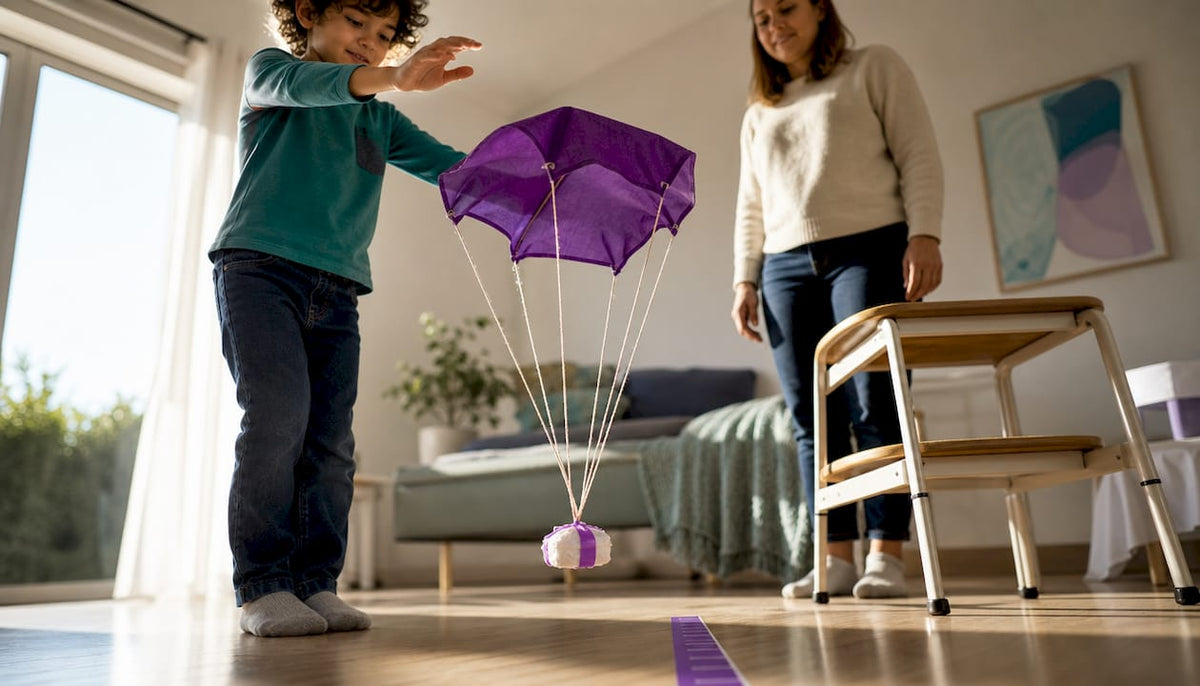
Give a child a plastic egg or a small wrapped object standing in for a payload, a plastic bag or piece of fabric, and four pieces of string, and they have everything they need to build a working parachute. Tie the string corners to the fabric, attach the payload, and test the drop from a stable height like a stepladder or a second-story window with a spotter below. Time the fall with a stopwatch and compare it to a drop with no parachute at all.
This activity teaches how surface area slows a falling object down, and it is a favorite starting point because NASA’s own parachute challenge materials show it can run in about 90 minutes with basic supplies. Kids ages 6 and up can usually manage the whole build alone, while younger children do well with an adult handling the knots. For more design variations, the egg drop challenge ideas guide offers scaffolding for different skill levels.
2. Race coffee filters to learn about drag
Drop a single coffee filter and time how long it takes to reach the floor, then stack two or three filters together and drop them from the exact same height. The stacked filters will fall faster, and that difference is the whole lesson: more surface area relative to weight means more air resistance and a slower fall. This is one of the simplest ways to make “drag” a word a seven-year-old actually understands, and the Physics Classroom’s coffee filter lab recommends graphing filter count against fall time so kids can see the pattern build.
- Materials: a pack of coffee filters, a stopwatch, a chair or step stool for a consistent drop height.
- Time: 15 to 20 minutes, ideal for ages 4 to 8.
3. Build impact craters with flour and marbles
Fill a shallow box with flour or fine sand, smooth the top, and drop objects of different sizes and weights from different heights to see what kind of crater each one leaves. A marble dropped from a foot up makes a small dent, while the same marble dropped from three feet up, or a heavier ball dropped from the same height, digs a deeper, wider crater. According to the Lunar and Planetary Institute, increasing either the drop height or the mass of the object generally increases both the size and depth of the resulting crater, which is exactly how scientists model real meteorite impacts.

Pro Tip: Use a ruler to measure crater width and a straw to gently blow away loose flour before measuring depth, so results stay consistent between trials.
4. Compare flat paper to crumpled paper
Hand a child two identical sheets of paper, crumple one into a tight ball, and drop both from the same height at the same time. The crumpled ball hits the ground first every time, even though both sheets weigh the same. This one small demonstration makes air resistance visible without any extra materials, and it sets up every later experiment by showing that shape, not weight, is often what changes how fast something falls.

5. Run a parachute design challenge with changing shapes
Once kids understand the basic parachute idea, challenge them to build two or three versions with different canopy sizes or shapes and test which one falls slowest. Keep the payload identical across every version so the only thing changing is the canopy itself, then record each drop time in a simple table. NASA’s classroom guidance on slowing down in space notes that these design challenges work well as group projects with built-in measurement and redesign cycles, which makes them a strong fit for a classroom of mixed ages.
- Cut canopies in three different sizes from the same material.
- Attach the same payload to each and drop from the same height.
- Record the time for each, then compare which canopy size wins.
6. Seal a feather and a coin together for a mini vacuum demo
A clear plastic tube with a feather and a coin inside, sealed at both ends, lets kids see the difference between falling with air resistance and falling without it. When the tube is upright, tip it over and both objects tumble down at very different speeds, the coin dropping fast and the feather drifting. For younger children who should not handle a sealed tube alone, a parent or teacher can simply demonstrate it and ask the child to predict what will happen before each trial, which keeps the activity interactive even without hands-on building.

What gravity actually is, in kid-friendly terms
Gravity is the pull that pulls everything toward the ground, from a dropped crayon to a jumping child. Scientists measure that pull near Earth’s surface as an acceleration of about 9.8 meters per second, according to The Physics Classroom, which is the “g” adults sometimes mention.
Without air in the way, every object falls at the same rate no matter how heavy it is, which is why a feather and a hammer famously landed together on the Moon during an Apollo demonstration. On Earth, air resistance changes that outcome because it pushes back against objects with more surface area, like a crumpled sheet of paper versus a flat one.
- Egg drop and parachute challenge: teaches surface area and drag.
- Coffee filter race: teaches terminal speed.
- Impact craters: teaches how mass and velocity affect force.
- Flat versus crumpled paper: teaches air resistance in its simplest form.
Keeping experiments safe and results reliable
Every drop experiment needs a clear landing zone, a supervising adult, and a firm rule against loose or uncoated weights, since some classroom guidance specifically warns against using uncoated lead and recommends safer substitute weights instead. Good science also means changing only one variable at a time such as height, mass, or shape, so kids can actually see what caused the result, a principle education researchers point to as standard practice for classroom testing.
- Pick one consistent drop height and stick with it across every trial.
- Use a stopwatch and a simple table to record times side by side.
- Break multi-step builds into smaller tasks for children who need extra structure.
Pro Tip: Let a child act as the “official timer” with a badge or role card. It turns a measurement task into a job they take seriously.
Why Tita and Team Genius Squad trust hands-on science
Tita writes for a company built around the E³ Method: Engage, Encourage, Empower. That framework guides every kit from first experiment to final reflection, pairing hands-on activities with role play and short writing prompts so kids process what they discovered, not just what they did. Kits are designed with neurodivergent learners in mind, breaking multi-step builds into clear, portioned tasks with badges and certificates that mark real progress.
Why small discoveries build lasting confidence
Watching a child realize a crumpled ball of paper beats a flat sheet to the ground, every single time, is a small moment that sticks. Some kids need the steps broken into pieces, others want to redesign their parachute five times before they are satisfied, and both approaches count as real science. Celebrating that first “I figured it out” moment matters more than getting the textbook answer right away.
— Tita
Bring these experiments home with less prep
Running six experiments from scratch means gathering flour, coffee filters, string, and fabric scraps, then writing your own instructions on the fly. Team Genius Squad’s Experiment Kits arrive with materials already sorted, step cards written for kids to follow independently, and role-play elements like lab coats that turn a drop test into a mission.

- A kit built around forces and motion maps directly onto the parachute and crater activities above, with certificates to mark each completed challenge.
- Families who want live guidance instead of a self-led kit can book Meet Ava, a STEM Ambassador session where a young entrepreneur walks kids through an experiment in real time.
Browse the full shop collection to find a kit or session that fits your next science afternoon.
Where to find more activity guides
- NASA’s parachute challenge: a full activity packet with safety notes and timing guidance.
- Lunar and Planetary Institute impacts activity: detailed crater-measurement steps for classrooms.
- The Physics Classroom: plain-language background on free fall and air resistance.
Sources
- Lunar and Planetary Institute — Impacts activity
- NASA — Eggstronaut parachute challenge
- The Physics Classroom — Free fall and air resistance
FAQ
What are 10 easy science experiments for kids?
Beyond the six gravity experiments above, easy at-home options include a baking soda volcano, a rainbow milk and dish soap demo, growing crystals from salt water, a homemade lava lamp, and a simple density tower using oil, water, and syrup. Each uses common household materials and needs only light adult supervision.
How can I explain gravity to kids in a simple way?
Gravity is the invisible pull that brings everything back down to the ground, whether it is a ball, a leaf, or a dropped shoe. A simple way to show it is dropping two different objects side by side and asking a child to predict which lands first, then explaining that air, not gravity, usually causes the difference.
What are some fun games about gravity?
Parachute drop races, where kids build and test different designs against a stopwatch, turn gravity into a competitive game. Crater-making in a flour tray, where kids guess which object will leave the biggest mark before dropping it, works well as a prediction game too.
What are 5 examples of gravity?
Gravity is at work when an apple falls from a tree, when a ball tossed in the air comes back down, when rain falls from clouds, when a dropped phone hits the floor, and when the Moon stays in orbit around Earth. Each example shows the same pull acting at a different scale.
How long does a gravity experiment usually take with kids?
Most of the experiments above take 15 to 30 minutes, though a full parachute design challenge with multiple redesigns can run closer to 90 minutes, based on NASA’s own classroom timing. Shorter activities like the paper drop or coffee filter race work well for younger children with shorter attention spans.

Leave a comment
This site is protected by hCaptcha and the hCaptcha Privacy Policy and Terms of Service apply.