Neurodivergent Friendly Screen Free STEM Camp at Home for Parents
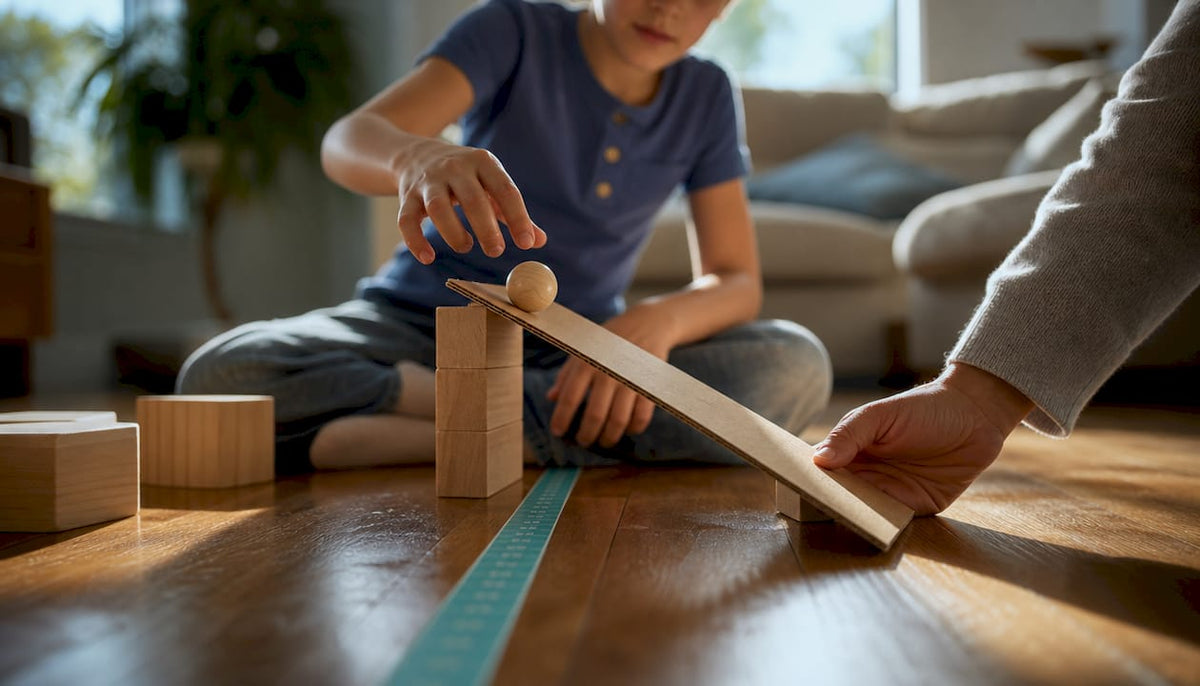
The best way to run a STEM camp at home is with a short, themed, hands-on schedule that swaps screens for real materials and real questions, informed by guidance on sensory play and child development. It works for ages 5 to 13, flexes for mixed-age groups, and needs no special equipment. Pick a 3-day or 1-week template below, gather basic supplies from around your kitchen and garage, and you can start tomorrow.
TL;DR:
- Most supplies for home STEM camps are household items like tape, containers, and recyclables, eliminating the need for shopping trips.
- Activities are designed with flexible age ranges and can be adjusted in complexity to suit children from ages 5 to 13, with an emphasis on hands-on, screen-free learning.
- A typical day includes warming up with puzzles, engaging in a main project, participating in mini-challenges, and reflecting through journaling or drawing to reinforce learning.
- Facilitator prompts such as predicting, observing, explaining, and troubleshooting foster problem-solving and normalize failure as part of the scientific process.
- Kits like those from Team Genius Squad streamline preparation, include reflection prompts, and support children with learning differences by providing tactile, identity-driven materials.
Table of Contents
- Sample Schedules: 3-Day and 1-Week STEM Camp at Home
- What Supplies Do You Actually Need?
- 12 Hands-On STEM Projects by Discipline
- How Do You Facilitate Instead of Just Supervise?
- Why Reflection Journals Turn Experiments Into Lasting Learning
- Safety Basics and Quick Fixes When Experiments Flop
- The E³ Method Behind Confident At-Home Scientists
- Where Team Genius Squad Fits Into Your Camp Week
- Sources
- FAQ
Sample Schedules: 3-Day and 1-Week STEM Camp at Home
A themed day works because kids know what’s coming, and that predictability actually fuels bigger creative risks once the structure feels safe. NASA JPL’s family activity library organizes projects by science, engineering, technology, and math, which maps neatly onto a themed-day rotation.
Here’s a daily rhythm that holds up whether you’re running three days or seven:
- Warm-up (15–20 minutes): a quick puzzle, riddle, or “predict what happens” question to get brains moving.
- Main project (30–60 minutes): the core build or experiment for the day’s theme.
- Mini-challenge (15–30 minutes): a fast twist on the main project, often a redesign or a race.
- Literacy and reflection (10–20 minutes): journaling, drawing, or narrating what happened and why.
- Free exploration (open-ended): leftover materials, no instructions, just curiosity.
For a 3-day camp, cover one science day, one engineering day, and one combined tech/math day. For a full week, give each discipline its own day and add a fifth “invention day” where kids combine two prior projects. Younger children (ages 5 to 7) do better with shorter main projects and longer free exploration; older kids (ages 10 to 13) can stretch the mini-challenge into a real iteration cycle.
What Supplies Do You Actually Need?
You don’t need a shopping trip to start a home science experiments week. Most of what you need is already in a junk drawer or recycling bin.
Keep these reusable basics on hand:
- Measuring cups and spoons
- Masking tape, painter’s tape, and clear tape
- White glue, glue sticks, and a hot glue gun (adult-operated)
- Scissors and a ruler
- Assorted containers: jars, cups, and small bins
For kit-only materials, substitute freely: cardboard boxes stand in for foam board, kitchen baking soda and vinegar replace chemistry-kit reagents, and cereal boxes cut into strips work as well as commercial building beams. Keep a labeled bin of clean recyclables (bottle caps, cardboard tubes, straws) so setup takes minutes instead of a store run.
12 Hands-On STEM Projects by Discipline
These twelve family STEM projects cover science, engineering, technology, and math, and each one includes an age range, quick steps, a learning goal, and a question to ask mid-activity. Science Buddies and TeachEngineering both offer deeper versions of several of these if your crew wants to go further.
- Pizza-box solar oven (ages 7–13): line a box with foil, angle a flap, melt a marshmallow. Goal: heat transfer. Ask: “Why does the angle matter?” Extension: track temperature over time with a thermometer.
- Density jar (ages 5–10): layer honey, dish soap, water, and oil. Goal: density and liquid layering. Ask: “What do you think will float?”
- Balloon rocket (ages 5–9): thread a straw on string, tape a balloon, release. Goal: thrust and Newton’s third law. Ask: “What made it go farther?”
- Popsicle-stick catapult (ages 8–13): build a lever with a spoon and rubber bands, launch pom-poms. Goal: levers and force. Extension: measure distance and graph results.
- Paper roller coaster (ages 9–13): build a marble track from paper tubes and tape. Goal: gravity and momentum. Ask: “Why did the marble stop here?”
- Simple circuits (ages 8–13, low-voltage battery only): connect a coin battery, LED, and copper tape. Goal: closed-circuit electricity. Ask: “What happens if we flip the LED?”
- Bridge-building challenge (ages 7–13): span two chairs with straws and tape, test weight limits with coins. Goal: structural engineering. This mirrors the straw-bridge scaffolding TeachEngineering recommends for elementary design thinking.
- Unplugged coding logic game (ages 5–10): give verbal or card-based step commands to move a “robot” sibling across a grid. Goal: sequencing and computational thinking, no devices required.
- Measurement scavenger hunt (ages 5–8): find five objects longer than a hand span, five shorter. Goal: comparative measurement.
- Safe slime chemistry (ages 6–12): mix glue, water, and saline solution for a polymer reaction. Goal: states of matter. Ask: “Why does it stretch instead of tear?”
- Design-a-roller-coaster on paper (ages 9–13): sketch a coaster with labeled hills, loops, and speed notes. Goal: energy transfer and planning before building.
- Data-logging mini-project (ages 8–13): track daily sunlight, plant growth, or temperature for a week and chart it. Goal: data collection and pattern recognition.
Simplify any activity by removing a step; add challenge by introducing a constraint, like “build it with only five pieces of tape.”
How Do You Facilitate Instead of Just Supervise?
The adult’s job during a STEM camp at home isn’t to have the answer. It’s to ask the question that makes a kid look closer. Guides on running a DIY science camp point out that parents who lean into a facilitator role, rather than an instructor role, build stronger problem-solving habits in their kids.
Use prompts like these throughout any activity:
- Predict: “What do you think will happen when we add the vinegar?”
- Observe: “What do you notice that’s different from what you expected?”
- Explain: “Why do you think that happened?”
- Improve: “What would you change if we tried this again?”
Normalize failure out loud. A collapsed bridge or a rocket that only goes two feet is data, not defeat, and the same DIY camp guidance recommends building reflection time into every session specifically so failed trials turn into lessons instead of frustration.
Pro Tip: Keep a sticky note nearby labeled “Fail List.” Every flopped experiment gets written down with one line about what the child would try next. It turns disappointment into a running record of scientific thinking.
You’ll know it’s working when a child starts iterating without being told to, or when they can explain their own results in their own words. Those two signs matter more than a perfect result.
Why Reflection Journals Turn Experiments Into Lasting Learning
Pairing every experiment with a short reflection is what separates a one-off activity from real STEM learning resources. Kids remember what they wrote down or drew far longer than what they merely did, and this literacy integration is where families driving STEM learning at home tend to get the biggest return on a small time investment.
A one-page template works for almost any age:
- Observation: “What did I see happen?”
- Explanation: “Why do I think it happened?”
- Next question: “What do I want to try next?”
For kids who struggle with writing, especially those with dyslexia or dysgraphia, swap words for drawings, labels, voice memos, or speech-to-text. National PTA’s STEM at Home resources pair experiments with printable literacy supports for exactly this reason. Try storytelling prompts too. Have a child narrate the experiment as if they’re a scientist reporting a discovery, then pair it with a related picture book at bedtime. More examples of role-play and narration live in this STEM storytelling guide.
Safety Basics and Quick Fixes When Experiments Flop
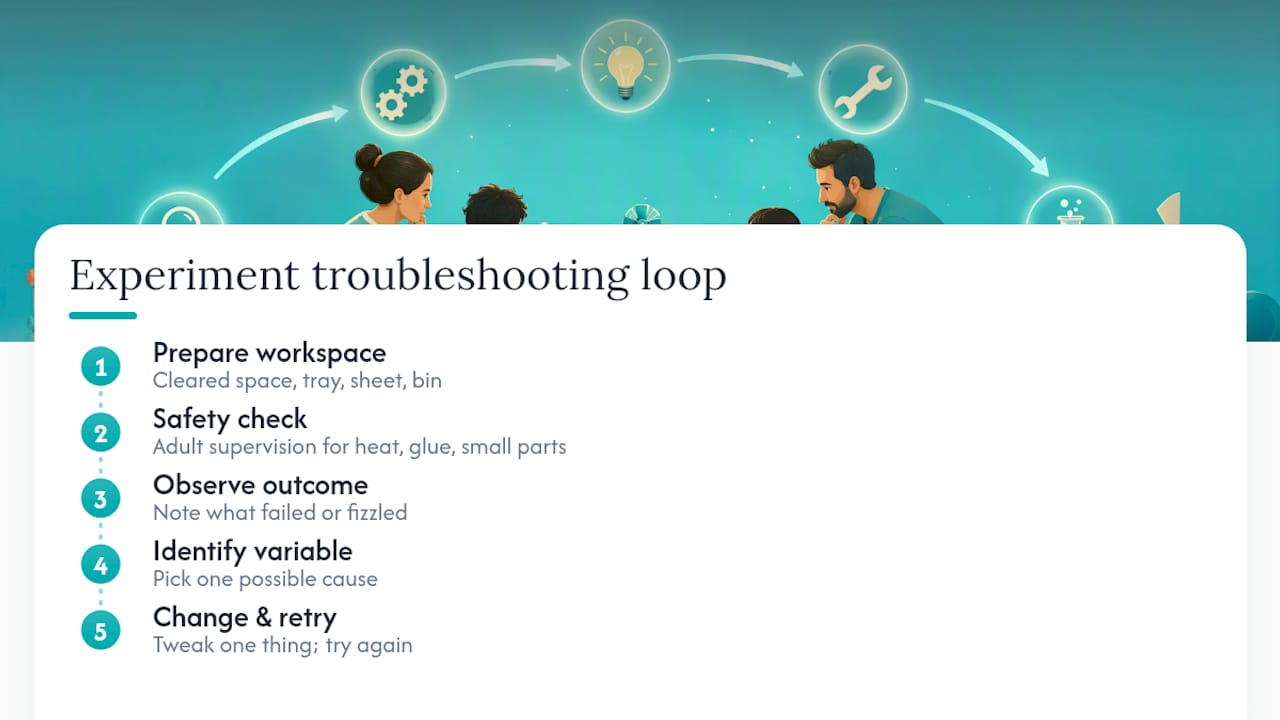
Adult supervision matters most during heat sources, glue guns, and anything involving small parts around children under 7. Keep a damp cloth, paper towels, and a trash bin within reach before you start, and protect surfaces with an old sheet or tray.
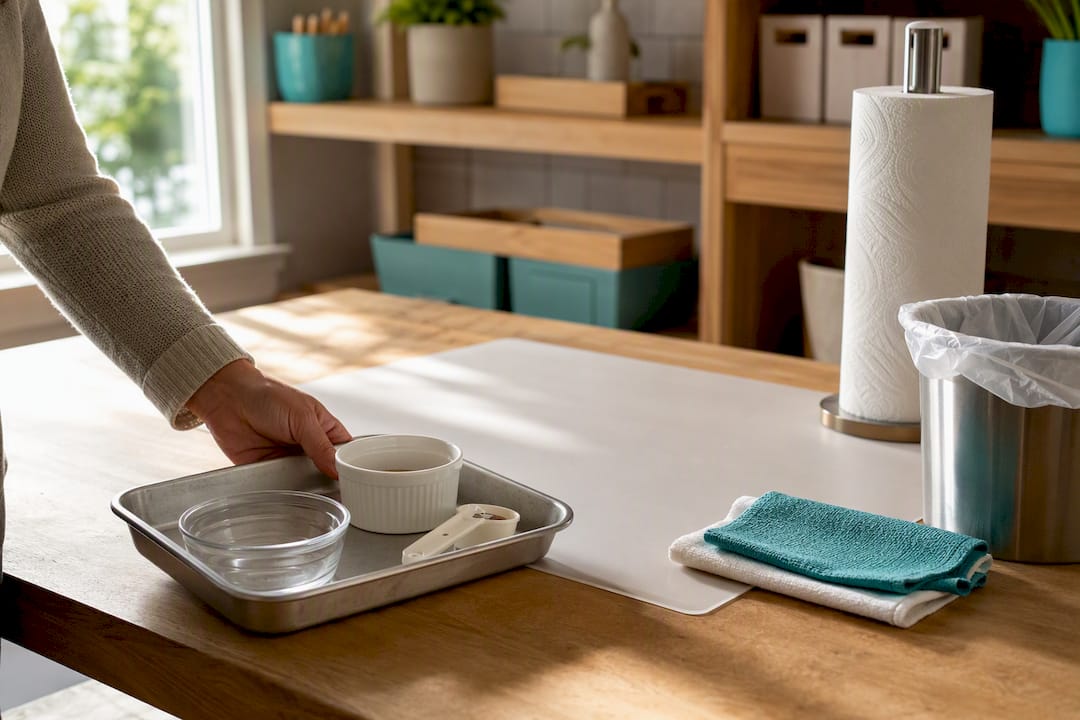
Run through a fast prep check: cleared workspace, materials tray set out, cleanup plan agreed on before the mess starts. When a reaction fizzles, don’t scrap the day. Ask what variable might have gone wrong, tweak one thing, and try again. A flat volcano or a rocket that doesn’t launch is often the most valuable ten minutes of the whole session, because troubleshooting is itself the science.
The E³ Method Behind Confident At-Home Scientists
The E³ Method, Engage, Encourage, Empower, is the backbone I’d point any parent toward, kit or no kit. Engage with a hook question, encourage through the messy middle, then empower by letting the child own the result and explain it in their own words. A simple lab coat or a hand-drawn “certified young scientist” badge does more for a reluctant learner’s confidence than any perfect experiment outcome. You don’t need our kits to run this. You need the sequence.
Where Team Genius Squad Fits Into Your Camp Week
If gathering supplies and writing activity steps is the part that eats your Sunday night, a ready-made kit removes that friction entirely. Team Genius Squad’s experiment kits come with the hands-on materials, role-play pieces like lab coats and badges, and built-in reflection prompts already mapped to the E³ Method, so a themed day is ready to run in minutes instead of an evening of prep.

The Science Solar Energy Kit with Mirror Disk slots directly into a solar-themed day from the schedule above, and the Mini Fab Science Lab works well as a compact starter for a 3-day camp. Each kit is designed screen-free and identity-driven, built from a real family’s experience with dyslexia and dysgraphia, so kids who struggle with traditional worksheets still get a full path from experiment to reflection. Browse the full kit collection and pick the theme that matches your week.
Sources
- STEM at Home Activities - STEM + Families - Programs | National PTA
- STEM activities for families | JPL Education
- TeachEngineering
FAQ
How Long Should a STEM Camp at Home Last Each Day?
Plan for about one to two hours per day, split between a warm-up, main project, mini-challenge, and reflection, with extra free-exploration time if kids stay engaged.
Can I Run This With Kids of Different Ages Together?
Yes. Pair younger kids on the observation and building steps while older kids take on measurement, data logging, or the design write-up, so everyone contributes at their level.
What if We Don’t Have Special Science Supplies?
Almost every activity here uses household substitutes like cardboard, tape, baking soda, and kitchen containers, or you can start with a ready kit like Team Genius Squad’s experiment kits to skip the shopping list entirely.
How Do I Know if My Child Is Actually Learning?
Watch for curiosity that carries into the next question, willingness to redo a failed attempt, and the ability to explain what happened in their own words, whether spoken, drawn, or written.
Are Virtual STEM Resources Worth Adding to an At-Home Camp?
Occasional virtual STEM activities, like a NASA mission video or a recorded lab demo, can supplement a screen-free week, but the core learning should stay hands-on to build the tactile and identity-based confidence a home STEM camp is built for.


Leave a comment
This site is protected by hCaptcha and the hCaptcha Privacy Policy and Terms of Service apply.