

10 Quick Rainy Day STEM Projects for Parents With Age Based Prompts
Here are 10 hands-on, screen-free STEM activities you can run indoors right now, each with materials, timing, and a learning target attached. Every project uses household basics you likely already own, takes 10 to 60 minutes, and includes a variation to stretch it for older kids. Grab a towel for the mess and get ready to learn alongside your child.
TL;DR:
- Most activities take between 10 and 60 minutes, with simpler projects like circuits completing in under 10 minutes.
- Variations such as adjusting ratios, materials, or testing conditions enhance learning for older children and maintain engagement across ages 5 to 13.
- Using household items like baking soda, vinegar, balloons, and paper towels allows these projects to be set up quickly and with minimal mess.
- Building a STEM kit with pre-measured materials and clear prompts can streamline preparation and boost independent exploration.
- Emphasizing iteration and hypothesis testing encourages deeper curiosity and problem-solving rather than aiming for perfect initial results.
Table of Contents
- 10 Indoor STEM Projects You Can Start in the Next 10 Minutes
- Building a Rainy Day STEM Box So You’re Always Ready
- Adjusting Activities for Ages 5 to 13
- What These Projects Actually Teach (and How to Facilitate Them)
- A Quick Note from the Editor’s Desk
- Ready-Made STEM Kits for Parents Who’d Rather Skip the Prep
- Where to Find More Rainy Day Science Ideas
- Sources
- FAQ
10 Indoor STEM Projects You Can Start in the Next 10 Minutes
Rainy day science fun works best when the setup is fast and the payoff is immediate. These 10 hands-on STEM projects cover chemistry, physics, weather, engineering, circuits, and sound, so no single rainy afternoon ever feels repetitive.
1. Baking Soda Volcano Mix baking soda, dish soap, and vinegar with a splash of red food coloring inside a small bottle set on a tray. It takes a short time and teaches acid-base reactions and gas production. Mess level: moderate, keep it on a tray. Variation: have older kids test how ratio changes eruption height and record results.
2. Elephant Toothpaste Foam Adults combine hydrogen peroxide, dry yeast, and dish soap in a bottle for a rapid foam eruption that demonstrates a catalyst speeding up a chemical reaction. This one takes a short time and needs adult handling since it uses higher-concentration peroxide. Variation: race two bottles with different yeast amounts and time the reaction.
3. Balloon-Powered Car Tape a balloon to a straw, thread it through a bottle-cap-and-skewer chassis, and let it fly across the floor. It takes a short time to build and teaches Newton’s third law through direct propulsion. Variation: swap wheel sizes or balloon shapes and measure distance traveled.
4. Paper Bridge Load Test Fold, roll, or accordion-pleat paper into a bridge spanning two stacks of books, then test how many coins it holds. This quick engineering challenge, similar in spirit to the Egg Drop Challenge parents run for structural thinking, teaches load distribution and structural design. Variation: add tape or paperclip reinforcement and chart how much weight each design holds.
5. Rain Cloud in a Jar Fill a jar with water, top it with shaving cream “clouds,” and drip food coloring on top to watch colored “rain” fall through. It takes a short time and visualizes precipitation and density differences. Low mess. Variation: ask kids to predict which color drips fastest and why.

6. Walking Water Density Tower Line up cups with colored water, connect them with folded paper towels, and watch water travel by capillary action, or layer honey, dish soap, water, and oil for a density tower. Both take 30 to 60 minutes and build understanding of molecular movement and liquid density. Variation: add a small object to each layer and predict where it settles.
7. Egg-Drop Alternative with Soft Payloads Build a protective capsule from straws, cotton balls, and tape around a water balloon or marshmallow instead of a raw egg, then drop it from a stairwell. This 30 to 45 minute family engineering challenge typically supports strong multi-age engagement that teaches impact protection and design iteration. Variation: limit older kids to five materials to force creative problem-solving.
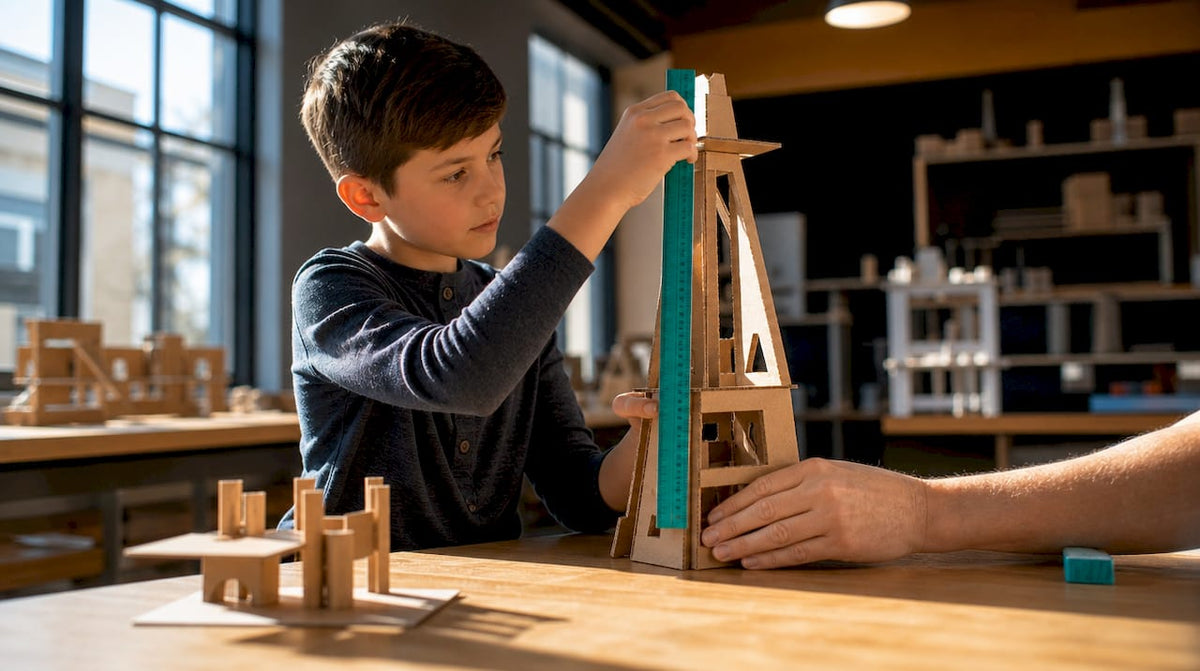
8. Straw and Tape Towers Give each child 20 straws and a roll of tape, then challenge them to build the tallest freestanding tower in a short amount of time. It teaches triangulation and load-bearing structure with almost no mess. Variation: add a fan test afterward to see whose tower survives wind.
9. LED Coin-Cell Circuit Tape an LED’s legs to a coin cell battery, matching positive and negative sides, to light it up quickly. It’s a gentle, low-mess introduction to simple circuits and polarity. Variation: add copper tape to build a switch or a paper circuit greeting card.
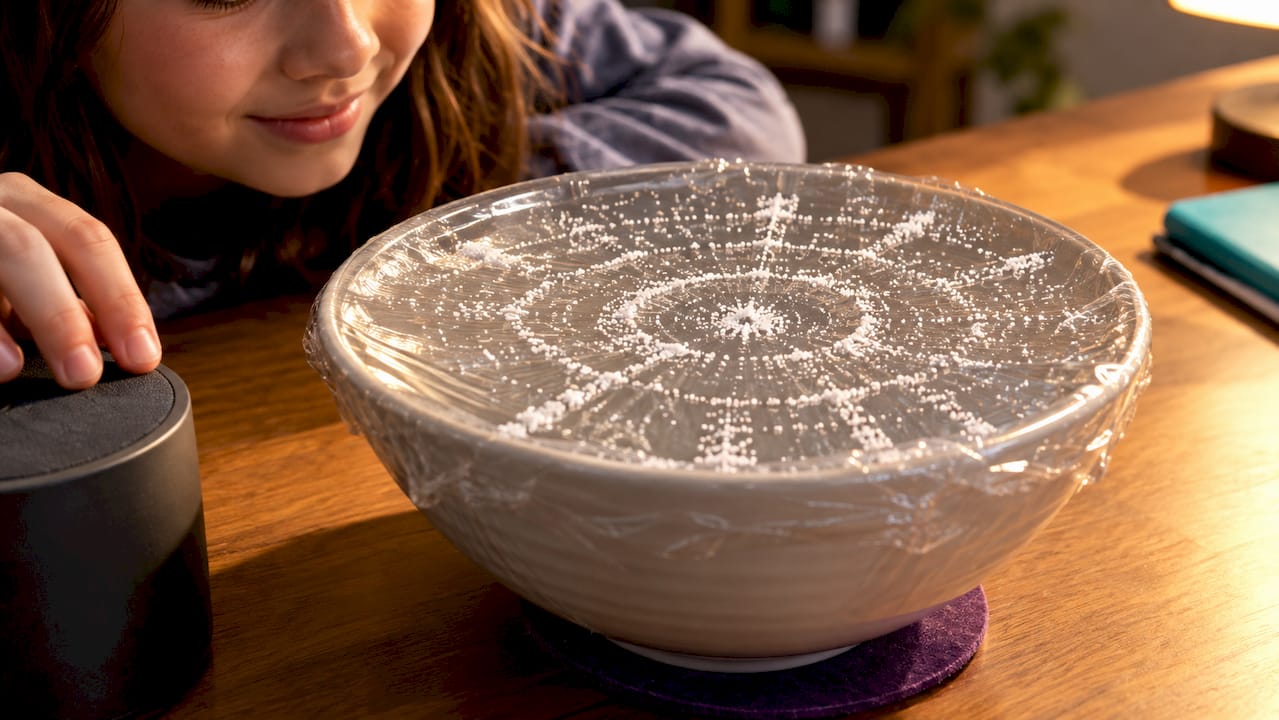
10. DIY Sound Visualizer Stretch plastic wrap tightly over a bowl, sprinkle salt or glitter on top, and play music near it to watch the grains dance into patterns. This project, inspired by the Chladni plate experiment, takes a moderate amount of time and works well for ages roughly 8 to 14 since it involves reasoning about vibration and frequency. Variation: test different sounds and pitches and compare the resulting patterns.
Building a Rainy Day STEM Box So You’re Always Ready
A dedicated STEM box means zero scrambling once the rain starts. Stock it with baking soda, vinegar, balloons, tape, straws, plastic cups, food coloring, rubber bands, coin-cell batteries, and small LEDs. Swap in whatever you have on hand. Cardboard for tape, dish soap for glue.
- Cover the table with a plastic tablecloth or tray before starting anything liquid-based
- Pre-measure dry ingredients into small cups the night before to cut setup time in half
- Keep a stack of old towels within reach instead of running to the kitchen mid-experiment
- Set a visible timer for cleanup so the project doesn’t quietly take over the whole afternoon
Pro Tip: Store your STEM box near the door you use most, so grabbing it becomes as automatic as grabbing an umbrella.
Adjusting Activities for Ages 5 to 13
Age changes what a project is really teaching, not just how hard it is.
- Ages 5–7: Simplify instructions to one step at a time, focus on sensory observation (“What does it feel like?”), and stay hands-on with every step.
- Ages 8–10: Add measurement, comparing distances, heights, or reaction times, and let them predict outcomes before testing.
- Ages 11–13: Introduce variables and hypothesis testing. Ask them to change one factor and defend why they expect a certain result.
- For mixed-age groups, give older kids a “data recorder” role and younger kids a “materials manager” role so everyone has real ownership.
What These Projects Actually Teach (and How to Facilitate Them)
Every activity on this list builds a specific skill: iteration, hypothesis testing, careful observation, or basic measurement. The value isn’t the finished volcano or tower. It’s the thinking that happens when a design fails and gets rebuilt.
Ask open-ended questions instead of giving answers. “What do you notice?” and “What would happen if we changed this?” do more for curiosity than any correct answer you could hand over. PBS Parents recommends this co-learner approach, treating parents as fellow investigators rather than instructors. Engineering challenges like the egg-drop alternative work especially well across ages because they typically run 30 to 60 minutes and hold multiple age groups’ attention at once. For a deeper activity bank once your family works through this list, Science Buddies offers hundreds of short, at-home projects with clear instructions.
The most valuable learning moments come from iteration and from analyzing designs that failed. Encouraging a child to test, observe, and redesign teaches more than a perfect first attempt ever could.
The E³ Method, Engage, Encourage, Empower, used here is built around this exact idea: kids learn best when they’re treated as scientists in training, not students waiting for the right answer.
A Quick Note from the Editor’s Desk
I’ve watched enough kitchen-table experiments to know the magic isn’t in the materials. It’s in the moment a child says, “Wait, what if I try it this way instead?” For neurodivergent kids especially, a quiet, predictable “innovation station,” same table, same tray, minimal noise, often unlocks focus that a chaotic playroom never will. Try rotating a simple “challenge of the week” card on the fridge. It keeps rainy-day learning a habit instead of a scramble.
— Tita
Ready-Made STEM Kits for Parents Who’d Rather Skip the Prep
Not every rainy afternoon leaves time to hunt down baking soda, batteries, and food coloring, and that’s exactly what certain STEAM kits solve. Such kits often arrive with hands-on components already sorted, plus role-play lab coats, badges, and reflection prompts that turn an experiment into an identity-building experience for kids ages 5 to 13.

Built on the E³ Method, Engage, Encourage, Empower, some kits are screen-free and designed so a child finishes the box seeing themselves as a scientist, not just someone who followed steps. If circuits caught your child’s attention on this list, the Shocking Electric Science kit builds on that curiosity safely. For a broader starting point, browse the full experiment kits collection and pick the one that matches what lit your child up this week.
Where to Find More Rainy Day Science Ideas
- NASA JPL family STEM activities: multi-age engineering challenges with clear timing guidance
- PBS Parents simple science activities: dozens of topic-organized projects built for parent-child co-learning
- Science Buddies STEM activities: a large bank of short, step-by-step at-home projects
- DIY Chladni plate experiment: the sound visualizer project explained in full detail
Sources
- STEM activities for families — NASA JPL
- Simple science activities — PBS Parents
- STEM activities — Science Buddies
- DIY Chladni plate experiment — STEAM Powered Family
FAQ
What are some STEM activities about weather?
Rain cloud in a jar, walking water density towers, and evaporation experiments using wet paper towels on a sunny windowsill all teach weather concepts using kitchen materials.
What are fun things to do at home on a rainy day?
Beyond STEM projects like balloon cars and paper bridges, rainy days work well for indoor scavenger hunts, board games, baking, and building forts, but hands-on science activities tend to hold attention longest because they involve a clear goal and a testable result.
What are some fun STEM activities for kids?
Balloon-powered cars, LED coin-cell circuits, and DIY sound visualizers rank among the most engaging because they combine a quick build with a visible, satisfying result.
What are some fun activities to do on rainy days?
A mix of short chemistry reactions, quick engineering builds, and one longer project, like the straw tower or density tower, keeps a rainy afternoon varied instead of repetitive.
How long do these STEM activities usually take?
Most run 10 to 60 minutes depending on complexity, with simple circuit builds finishing in under 10 minutes and engineering challenges like the egg-drop alternative stretching closer to an hour.

Leave a comment
This site is protected by hCaptcha and the hCaptcha Privacy Policy and Terms of Service apply.