Parents: 10 age ramped math games without screens, identity driven
Parents and educators can start playing effective, screen-free math games today with almost no setup. Dot-card subitizing works well for ages 4 to 7, a number-path lily-pad hop suits ages 4 to 6, Sock Toss builds number combinations for ages 5 to 9, and a card game like Cassino sharpens addition for ages 7 and up. Each one teaches number sense, subitizing, basic operations, or spatial reasoning using items already in the house, and free printable versions exist for most of them.
TL;DR:
- Dot-card subitizing and number-path hop games are suitable for children aged 4 to 7 with minimal prep and target quick number recognition and counting skills.
- Sock Toss can help children practice number combinations and cardinality for ages 5 to 9, with simple household items like socks and a basket.
- Card games like Cassino and the Pairs Math Game complement the list by developing addition and number comparison skills with just a standard deck or printable materials.
- Most games adapt easily to different age levels by expanding number ranges or adding verbal explanations, ensuring ongoing development.
- Free printable resources and low-prep kits are available, making it easy for parents and educators to incorporate hands-on math activities into daily routines.
Table of Contents
- 10 practical screen-free math games and what they practice
- Playable rules and quick setups for six priority games
- How to adapt, assess, and extend games by age and learning goal
- Low-prep materials, household substitutes, and free printables
- How Team Genius Squad brings hands-on math to life
- Letting kids lead builds the confidence that sticks
- Bring these games home with ready-made kits
- Direct downloads and authoritative hubs to save now
- Sources
- FAQ
10 practical screen-free math games and what they practice
Every child develops number sense differently, so having options by age and skill matters more than finding one perfect game. Below is a working shortlist that covers counting, subitizing, operations, and spatial reasoning, along with who each game suits best.
- Dot-card and finger games: build subitizing and quick number recognition for ages 4 to 7, no-prep once you have a deck of dot cards, great for one-on-one or small groups.
- Number path or lily-pad hop: teaches counting and one-to-one correspondence for ages 4 to 6, low-prep with tape or paper squares on the floor, best for individual or paired play.
- Sock Toss: practices cardinality and finding number combinations for ages 5 to 9, no-prep with paired socks, works well solo or in a small group.
- Cassino (card capture): strengthens addition and number combinations for ages 7 to 12, low-prep with a standard deck, ideal for two players.
- Nim or a substitution game: introduces strategy and subtraction logic for ages 8 and up, low-prep with matchsticks or counters, best for two players.
- Make-your-own cardboard puzzles: develops spatial reasoning and pattern recognition for ages 6 to 12, low-prep with recycled cardboard, works for individual or group projects.
- Pairs Math Game: reinforces addition to 100 for ages 8 to 12, printable and free, suited to pairs or small groups.
- Match or More-Less card games: builds comparison and number order for ages 5 to 8, no-prep with a standard deck, fits groups of two to four.
- Two-color counter games: teaches early combinatorics for ages 6 to 10, low-prep with dried beans or buttons painted on one side, works well individually or in pairs.
- Measurement and spatial play: practices estimation and spatial vocabulary for ages 5 to 13, no-prep using household objects, flexible for solo or family play.
Playable rules and quick setups for six priority games
These six games give you the most math practice for the least setup time, and each one includes a way to turn the play into a quick check of what a child actually understands.
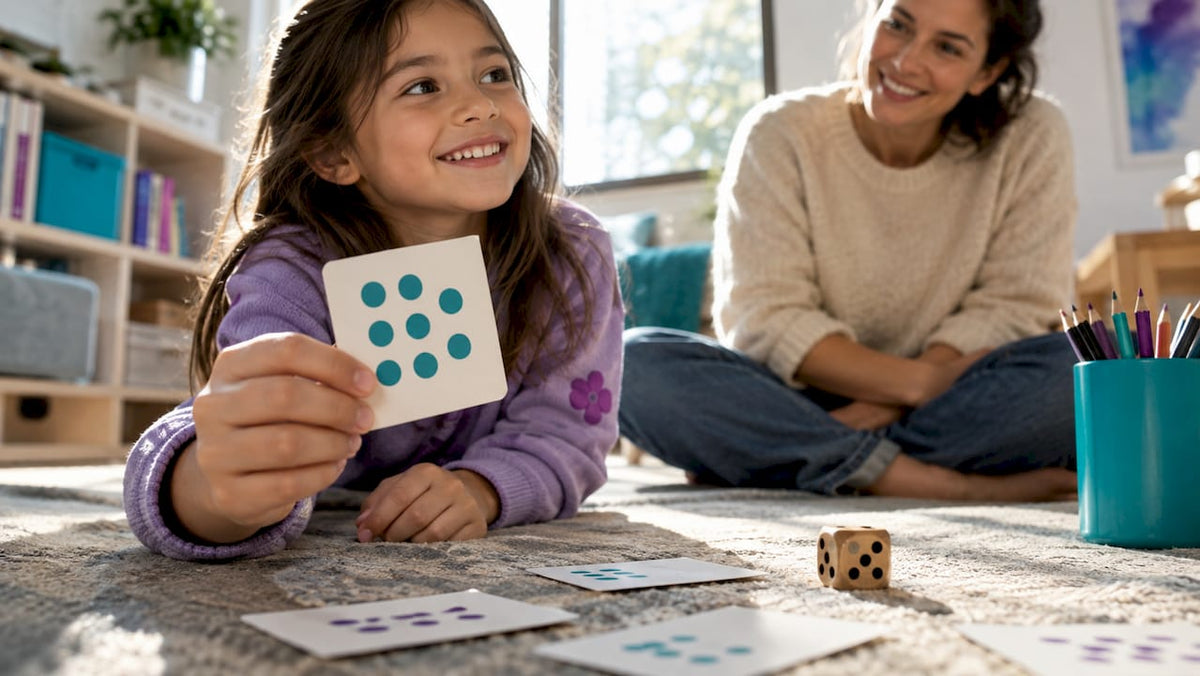
1. Dot-card subitizing. Materials: a set of index cards with dot patterns from 1 to 10, arranged in lines, dice patterns, and scattered groups. Setup: shuffle the deck and sit facing your child. Steps: 1) Flash one card for two seconds. 2) Ask “how many, and how do you know?” 3) Repeat with varied arrangements. 4) Move faster as recognition improves. 5) End with a round where the child flashes cards for you. Session length: 10 to 15 minutes. Adaptations: beginners use linear dot patterns only, middle learners add scattered arrangements, advanced learners subitize two cards and add them mentally. Pro Tip: Ask “did you count or did you just see it?” to catch the moment a child shifts from counting to true subitizing.
2. Number-path hop. Materials: paper squares numbered 1 to 10 taped in a line on the floor. Setup: place the path and give your child a small object to move square by square. Steps: 1) Roll a die or draw a number card. 2) Hop or move that many spaces. 3) Say the number landed on aloud. 4) Ask what number comes next. 5) Repeat toward 20 for advanced players. Session length: 10 minutes. Adaptations: beginners count each hop aloud, middle learners count on from their current spot, advanced learners predict the landing square before moving. Pro Tip: Use a floor path rather than a tabletop line so younger children can feel the counting through movement, which reinforces the connection between number and quantity.
3. Sock Toss. Materials: five to ten paired socks rolled into balls and a basket. Setup: set a target number, then toss socks into the basket to find combinations that add up to it. Steps: 1) Choose a target, such as 5. 2) Toss socks one at a time, counting how many land in. 3) Record combinations that reach the target. 4) Try a new combination. 5) Repeat with a higher target. Session length: 15 minutes. Adaptations: beginners work with targets up to 5, middle learners try 10, advanced learners record every possible combination for a number. Pro Tip: Ask “what’s another way to make that number?” each round to build flexible thinking about number composition.
4. Cassino. Materials: a standard deck of cards. Setup: deal four cards to each player and four face up on the table. Steps: 1) Capture table cards that match or sum to a card in your hand. 2) Play a card if no capture is possible. 3) Track captured cards. 4) Deal new hands when both are empty. 5) Score at the end based on captures. Session length: 20 minutes. Adaptations: beginners capture single matching cards only, middle learners add simple sums, advanced learners combine multiple cards into one capture. Pro Tip: Have the child explain their capture out loud before taking it, which turns each move into a small math proof.
5. Nim with matchsticks. Materials: 15 to 20 matchsticks or counters. Setup: place sticks in a pile between two players. Steps: 1) Take turns removing one, two, or three sticks. 2) Whoever takes the last stick loses. 3) Play again and vary the starting count. 4) Try changing the removal limit. 5) Discuss what patterns seem to win. Session length: 10 minutes. Adaptations: beginners play with a small pile and open removal, middle learners strategize with the fixed one-two-three rule, advanced learners try to find the winning pattern themselves. Pro Tip: Resist explaining the winning strategy. Let repeated play reveal the pattern, since discovering it builds far more number sense than being told.

6. Two-color counter puzzles. Materials: 10 to 20 flat counters painted a different color on each side, or dried beans marked with a marker. Setup: scatter counters and sort by color to find combinations. Steps: 1) Toss the counters. 2) Count how many landed on each color. 3) Write the combination as a number sentence. 4) Toss again and compare results. 5) Look for all combinations that make the same total. Session length: 10 minutes. Adaptations: beginners work with five counters, middle learners use ten, advanced learners predict likely splits before tossing. Pro Tip: Keep a running tally sheet so the child can see every combination discovered across several sessions.
How to adapt, assess, and extend games by age and learning goal

Every one of these games scales up or down with three simple moves: widen the number range, ask for a verbal explanation instead of a physical answer, or add a manipulative when a child is stuck on an abstract question. A child who breezes through dot cards up to 10 is ready for cards up to 20, and a child who struggles with mental addition might need counters back on the table before trying it in their head.
Three quick checks tell you when a child is ready to move on:
- They explain their answer in a full sentence without needing to recount.
- They solve a problem a different way when asked for a second method.
- They predict an outcome correctly before checking it with counters or a path.
Roughly 55 free, screen-free games with printable materials live at Young Mathematicians, which is a useful place to pull a fresh challenge once a child masters the basics. Extensions can pair two children in a challenge round, add a journaling prompt asking them to draw their strategy, or fold in measurement by having kids estimate distances before confirming with a ruler.
Low-prep materials, household substitutes, and free printables
Most of these games run on things already in a junk drawer. Socks, pom-poms, dried beans, buttons, and bottle caps all work as counters, and a deck of cards covers half the list by itself.
- Number paths: floor tape or paper squares are recommended over open number lines for children ages 3 to 5, according to number path guidance from NAEYC.
- Dot cards: index cards with varied dot arrangements build subitizing faster than linear patterns alone, per NAEYC’s dot card and finger game guide.
- Sock Toss: the full printable activity, including target combinations, is available as a free PDF from Young Mathematicians.
- Matchstick and counter puzzles: a portable set of nine puzzles using two-color counters and matchsticks is outlined in the MoMath travel kit.
Keep a small bin with cards, counters, and a printed dot-card set so a game is ready in under two minutes.
How Team Genius Squad brings hands-on math to life
Team Genius Squad builds every kit around a method called E³ Method: Engage, Encourage, Empower. A math session becomes a lab coat moment where a child steps into the role of a young mathematician rather than a student completing a worksheet, and that shift in identity often changes how willingly a child tackles a hard problem.
Kids who see themselves as capable problem-solvers approach a tough number puzzle differently than kids who see themselves as struggling with math.
A 20 to 30 minute session works best when you open with a role-play prompt, run one game from this list, and close by asking the child to teach the rules back to you, a technique also encouraged by Young Mathematicians’ Game Shuffle for reinforcing understanding through explanation.
Letting kids lead builds the confidence that sticks
The strongest math sessions I have seen happen when a child takes over as the rule-explainer or invents a new twist on a familiar game. Handing over that control, especially alongside an identity-driven prop like a badge or a lab coat, turns a math game into proof that a child can think like a mathematician. Finger counting and physical manipulatives are not shortcuts to outgrow. Research summarized by NAEYC shows they support number reasoning well into later learning.
— Tita
Bring these games home with ready-made kits
If you want the prep work done for you, Team Genius Squad’s experiment kits build on a hands-on approach, with role-play props and identity-building touches included.

- Experiment kits that pair hands-on materials with story-driven challenges.
- Lesson plans for structuring a session around a specific math or science goal.
- Role-play props like lab coats and badges that turn practice time into an identity moment.
These kits complement the free games here rather than replace them. Browse the full shop to find a kit that fits your child’s next challenge.
Direct downloads and authoritative hubs to save now
- Young Mathematicians: over 55 free games with printables in English, Spanish, and Portuguese.
- NAEYC number path games: teacher tips on counting and one-to-one correspondence.
- Pairs Math Game: a free printable addition game for ages 8 to 12.
Sources
- Young Mathematicians (EDC)
- Play Games, Learn Math! Number Path Games | NAEYC
- Play Games, Learn Math! Dot card and finger games | NAEYC
- MoMath Math Travel Kit (Activity PDF)
FAQ
What are some offline math games I can play?
Dot-card subitizing, Sock Toss, number-path hops, and card games like Cassino all work well with minimal setup. Each targets a different skill, from quantity recognition to addition, and most use materials already at home.
Why was Coolmath Games banned?
Some schools restrict Coolmath Games and similar sites as part of broader device and internet-use policies rather than because of a specific safety finding. Screen-free alternatives sidestep that issue entirely while still building the same number sense and problem-solving skills.
What are the top 10 math games?
A strong screen-free lineup includes dot-card games, number-path hops, Sock Toss, Cassino, Nim, cardboard puzzles, the Pairs Math Game, Match or More-Less, two-color counter games, and measurement play. Each one targets a specific skill like subitizing, addition, or spatial reasoning.
What are good free math games?
The Young Mathematicians hub offers more than 55 free, printable games, and the Pairs Math Game is a free printable option for children ages 8 to 12. Both require no screens and minimal setup.

Leave a comment
This site is protected by hCaptcha and the hCaptcha Privacy Policy and Terms of Service apply.