Parents: 8 Quick Scientist Dress Up Ideas That Spark STEAM Play
These eight scientist costume ideas are quick, low-cost, and safe enough for a school hallway or a living room floor, and most come together in about 20 minutes with things already in your closet. We pulled this list together as Team Genius Squad, guided by lab-safety basics from the American Chemical Society. Below you’ll find eight costumes with props, a role prompt, and a time and cost estimate for each.
TL;DR:
- Most quick scientist costumes can be assembled in about 20 minutes using household items like oversized shirts, goggles, and simple props.
- Adding specific tasks or prompts to costumes, such as recording findings or sketching fossils, significantly enhances the educational value of dress-up.
- Safety essentials include using closed-toe shoes and avoiding hazardous props like real chemicals or sharp objects to ensure safe play.
- Budget-friendly DIY props like printable badges, cardboard robots, and makeshift test tubes can be created with under $15 at a dollar or craft store.
- Ready-made options, such as full lab coat sets and experiment kits, provide a quick alternative that integrates role-play and hands-on learning.
Table of Contents
- 1. Easy scientist costume ideas kids can wear today
- 2. Quick DIY tweaks and supplies for fast props
- 3. Keeping dress-up safe and comfortable for kids
- 4. Turning the costume into real STEAM play
- 5. Why identity-driven costumes build real confidence
- Ready-made scientist costumes and kits for busy parents
- FAQ
- Sources
1. Easy scientist costume ideas kids can wear today
Here are eight roles that read clearly from across a classroom and give your child a story to act out, not just an outfit to stand in.
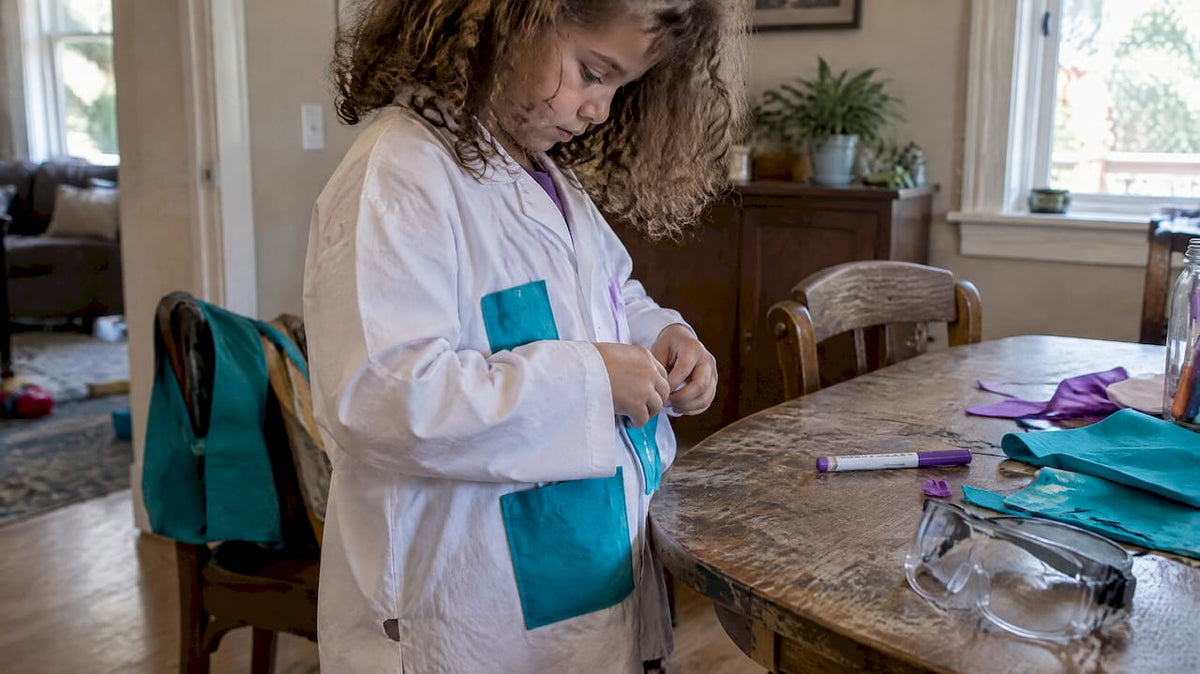
- Chemist or bench scientist. Use an oversized white button-up shirt as the lab coat, since it drapes like the real thing and is easy to move in. Add a clipboard and a pair of sunglasses as goggles, then hand your child a prompt: “You just mixed two liquids and they turned blue. Write down what happened.” Assembly takes a short time and costs close to nothing if the shirt is already in the house.
- Paleontologist. Dust a brown shirt and pants with flour for a “dig site” look, then pack a small brush and a rock (or a chicken bone from the recycling bin) as the fossil. Prompt: “You found a bone no one has seen before. Sketch it and give it a name.” Budget a short time.
- Marine biologist. A blue shirt, a swim mask pushed up on the forehead, and a clipboard turn any kid into a researcher on deck. Prompt: “You just spotted a glowing squid at night. Record where you saw it and what color it was.” This idea pairs well with the story-driven approach that EatHealthy365 recommends for STEM career day looks, where a specific task makes the costume far more memorable than a generic outfit. About 15 minutes, mostly free.
- Astronomer. Pair dark clothing with a cardboard telescope (a wrapping-paper tube works) and glow-in-the-dark star stickers on a shirt or jacket. Prompt: “You discovered a new star. Name it and describe its color.” Around 20 minutes.
- Robotics engineer. A silver or gray shirt, a tool belt made from a fabric strip and pouches, and a name badge finish the look fast. Prompt: “Your robot’s arm just stopped working. Explain what you’re fixing.” A short time.
- Field ecologist. Khaki or green clothing, a magnifying glass, and a small notebook clipped to a belt loop complete this one. Prompt: “You found tracks near the trail. Sketch them and guess which animal made them.” A short time.
- Data scientist. A button-up shirt, a laptop prop cut from cardboard, and a lanyard badge make this role instantly readable. Prompt: “Your numbers show something strange. What pattern do you notice?” A short time.
- Lab technician. An oversized shirt, a clipboard, and a homemade test tube rack (egg carton with cut-down cardboard tubes) finish this costume quickly. Prompt: “A sample just came in for testing. What do you check first?” About 20 minutes.
- Safety goggle substitutes: regular sunglasses, swim goggles, or cardboard frames cut to shape.
- Lab coat substitute: any oversized white or light-colored button-up shirt from a closet or thrift bin.
2. Quick DIY tweaks and supplies for fast props
A few small projects make these costumes look finished without eating up your evening. According to Crafting a Fun Life, a full scientist costume built from a lab coat or oversized shirt, simple goggles, and a homemade badge typically comes together in about 20 minutes using items already on hand.
- DIY test tubes: Cut clear plastic tubing into short lengths, or reuse small condiment bottles with lids for a sturdier, safer option than thin straws or glass.
- Printable name badge: Print a simple template with your child’s name and “scientist” title, then clip it to a shirt pocket or hang it on a lanyard.
- Cardboard robot box: Cut arm holes into a cereal-box-sized piece of cardboard, reinforce the edges with duct tape, and attach adjustable elastic straps so it stays comfortable during play.
- Mission patch: Print a small circular design and iron it onto a shirt sleeve or coat pocket for an instant badge of authority.
A single trip to the dollar store or the craft aisle of a general retailer usually covers tubing, badges, iron-on sheets, and stickers for well under $15, matching the low-cost materials range that Crafting a Fun Life outlines for simple costume builds.
Pro Tip: Sew or glue a few felt pockets onto an oversized shirt, then use fabric markers to add fake stains or equations. It takes five extra minutes and makes the “lab coat” look worn-in and real.

3. Keeping dress-up safe and comfortable for kids
Dress-up play should feel like play, not a hazard course, so a few safety habits borrowed from real labs go a long way; for guidance on choosing safe costume textures and materials, see our tips on sensory play and child development. ACS sample lab safety guidelines emphasize closed-toe shoes and proper eye protection as basic personal protective equipment, and those same habits reduce real risks at a school party or a crowded hallway.
Closed-toe shoes matter more than they look like they would. They protect little feet from stubbed toes, dropped props, and the general chaos of a classroom full of excited kids in costume.
- Choose sunglasses or cardboard-frame goggles instead of anything with small, detachable parts that could become a choking hazard.
- Skip hazardous props entirely, including dry ice, real chemicals, or anything sharp-edged.
- Tie back long hair and secure loose fabric so nothing catches on furniture or classroom equipment.
- Supervise any hands-on “experiment” moments and stick to washable, reusable props.
One safety guideline carries directly into dress-up play: ACS lab safety guidance recommends closed-toe shoes and appropriate eye protection as standard lab PPE, a simple rule that transfers easily to a classroom costume parade.
4. Turning the costume into real STEAM play
A costume becomes a learning moment the second it gets a task attached to it. EatHealthy365 points out that building a costume around a specific action, like documenting a glowing deep-sea creature, makes the play richer and more memorable than a static outfit ever could.
- “You just found a fossil. Record the location, sketch the find, and tag it for the museum.”
- “Your robot’s sensor is giving strange readings. Walk me through what you’d check first.”
- “You’re testing a new liquid. Predict what will happen before you pour it.”
- “A storm is coming. Record the wind direction and cloud shapes you see.”
- “Your data shows a sudden spike. What question would you ask next?”
Pairing a prompt with a short hands-on science project turns five or ten minutes of dress-up into a real mini-experiment. Favor roles like paleontologist, ecologist, or engineer over the exaggerated “mad scientist” look, since real careers give kids a broader, truer picture of what scientists actually do.
5. Why identity-driven costumes build real confidence
A costume is never just fabric. When a child puts on a lab coat and a badge, something shifts, because now they aren’t pretending to be a scientist, they’re trying one on as part of who they are. We design Team Genius Squad role-play tools with that shift in mind, especially for kids who learn differently and need a hands-on way to see themselves as capable.
— Tita
Ready-made scientist costumes and kits for busy parents
For parents who want the look finished without a craft-store run, we offer two ready-made paths. Our Kids Lab Coats collection gives you a proper coat, badge, and accessories in one order, saving the cutting, sewing, and printing altogether. Our Experiment Kits extend the costume into guided activities, so the role-play prompts above come with real materials instead of improvised stand-ins.

- Kids Lab Coats: a full coat and badge set ready to wear, no assembly required.
- Experiment Kits: guided hands-on activities that match the scientist roles above.
Browse the full shop collection to find the right starting point for your child’s next scientist adventure.
FAQ
How do you dress like a scientist?
Start with an oversized white button-up shirt as a lab coat substitute, add goggles made from sunglasses or cardboard, and finish with a clipboard or name badge. This basic combination reads clearly as a scientist costume and typically comes together in about 20 minutes using household items.
What is a good dress for a scientist?
A loose-fitting white or light-colored shirt works best, since it mimics a real lab coat and stays comfortable during active play. Closed-toe shoes are a smart addition, since lab safety guidance treats proper footwear as basic protective equipment.
What are some famous scientist costumes?
Common classroom favorites include chemists, paleontologists, marine biologists, and astronomers, each built around recognizable props like goggles, fossils, or a telescope. Choosing a specific real-world role instead of a generic “mad scientist” look helps kids connect with an actual STEM career.
How to make a DIY scientist costume?
Combine an oversized shirt, simple goggles, and a homemade badge, then add one or two props like a cardboard test tube rack or a mission patch. Most of these projects use dollar-store or craft-aisle supplies and finish in well under half an hour.
What props make a scientist costume more engaging for kids?
Props that support a task, like a clipboard for recording findings or a magnifying glass for inspecting a “specimen,” turn a costume into a story instead of just an outfit. Pairing the costume with a short role-play prompt, such as recording a fossil find, makes the play more dynamic and educational.
Sources
- Easy to Make DIY Scientist Costume for Kids — Crafting a Fun Life
- Sample lab safety guidelines and safety acknowledgment forms — American Chemical Society (ACS)
- Great STEM career day costume ideas for girls — EatHealthy365

Leave a comment
This site is protected by hCaptcha and the hCaptcha Privacy Policy and Terms of Service apply.