Science Bulletin Board Ideas for Grades K-8 Classrooms
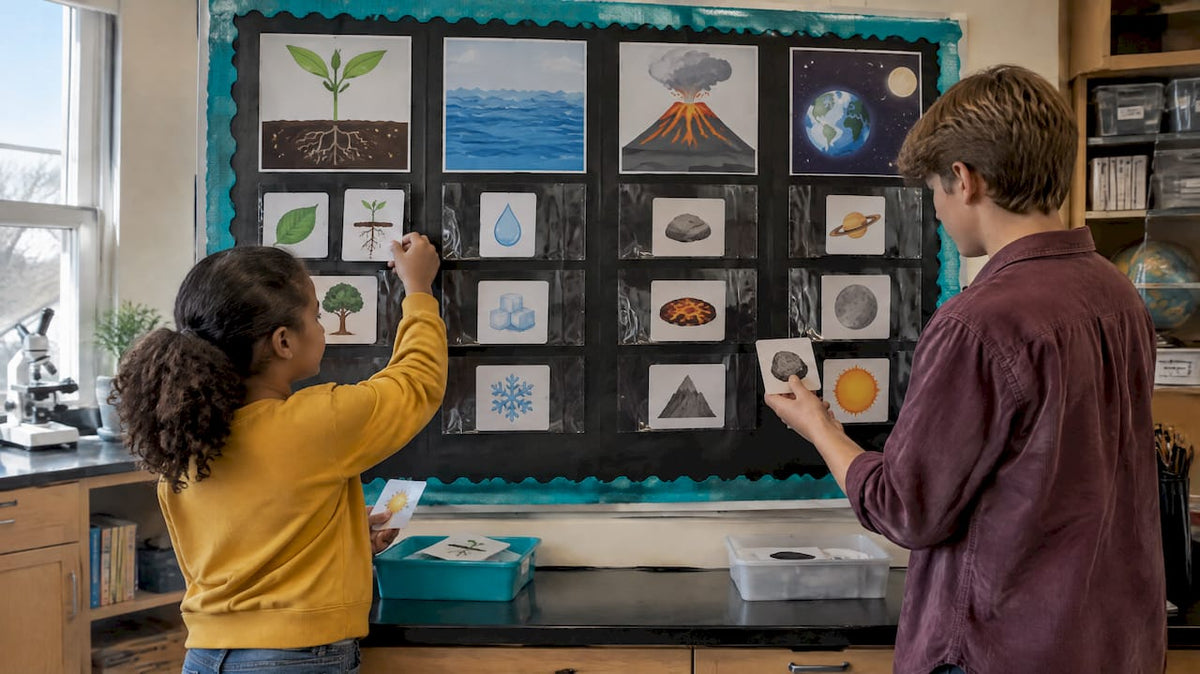
The best science bulletin board is one children can touch, add to and talk about, not one they walk past. Below are classroom-tested displays for ages 5 to 13: boards that sort, match, grow, ask questions and celebrate the kids who made them. You will also find a simple setup routine, ideas for adapting each board by grade, and ways to make the wall welcoming for children who struggle with reading and writing.
TL;DR
- Choose interactive over decorative: sorting, matching, sequencing and question boards keep children coming back to the wall.
- Give every board one purpose, a big readable heading and plenty of white space. Clutter is the fastest way to lose a young reader.
- Let students build the board. Their drawings, notebook pages and questions are the content.
- Adapt by age: checklists and pictures for ages 5 to 8, vocabulary, arrows and career research for ages 9 to 13.
- Pair the display with a hands-on experiment so the wall records real discovery.
Table of Contents
- Start with the purpose, not the theme
- Interactive science bulletin board ideas that kids actually use
- STEM bulletin board ideas for ages 5 to 13
- Match the board to the age group
- Connect science to reading and writing
- Seasonal and topic boards that change with your unit
- Tie the wall to real inquiry
- Materials and setup that make a board look clean
- Make the board work for different minds
- Our perspective: a wall that says “you belong here”
- Bring the board to life with a hands-on experiment
- FAQ
- Sources
Start with the purpose, not the theme
Before you pick a theme, decide what the board is for. A board can review vocabulary, show a process, track a class investigation, or celebrate student thinking. The National Inventors Hall of Fame encourages boards that connect to learners’ strengths, goals and interests, which is a useful test: if a child cannot find themselves somewhere on the wall, the board is working for the teacher and not for the class.
A board with a clear purpose also tells you how to build it. A vocabulary wall needs big words and pictures. A question wall needs space and sticky notes. An investigation board needs sections that follow the steps of the work.
Interactive science bulletin board ideas that kids actually use
These are the ideas worth the staple gun. Each one asks a child to do something.
Sequence the scientific method
Post the steps of a scientific investigation as large cards: question, prediction, test, observe, explain. Mix up the cards in a pocket or on a Velcro strip and let students put them back in order. A sequencing board like this is one of the classroom favorites because it doubles as a quick review and a reference during labs. For ages 5 to 7, use pictures: a magnifying glass for observe, a question mark for ask.

Sort the properties of matter
Collect small objects or picture cards (a rock, a balloon, a cup of water, a sponge) and have children sort them under headings like solid, liquid and gas. Teach Simple also suggests pulling words out of a Venn diagram so students put them back in the right area. A hula-hoop Venn diagram on the floor, photographed and posted, extends the idea into movement.
Build a living DNA or food web board
For upper elementary and middle school, magnets or Velcro let students match DNA base pairs, and the same guide suggests having students make animals and arrows to build a food web. Children draw and cut their own organisms, then connect them with yarn or arrows. Every new pair or link is a small act of understanding, and a wrong placement becomes a conversation instead of a mark on a page.
A 3-D solar system
Raised planets made from foam balls or papier-mâché give the board real depth, and Teaching Expertise describes a version where students write facts to go with each planet. Assign each child or small group a planet, then have them add one surprising fact and one question. Children who prefer building to writing get to contribute with their hands first, and the words follow.
A plant-growth observation board
Plant seeds in clear cups, then post weekly drawings and measurements next to them. Teach Simple suggests a growing board where students compare how their seeds develop. Use a simple chart with a column for each week and room for a sketch. Kindergarteners can draw what they see. Fifth graders can graph height.

The Wonder Wall
Dedicate a section where students post questions on sticky notes. Engineer Does Education describes a Wonder Wall where the class then investigates and answers them. Pick one question a week to test together. Over a semester, the wall becomes a record of everything your students were curious about, and a ready-made source of project topics.
Famous scientific failures
Teach Simple lists a “famous scientific failures” board among its science ideas. It is a gentle way to show that mistakes are part of discovery. Add a corner where students post their own “it did not work, so we tried this” stories from class experiments.
STEM bulletin board ideas for ages 5 to 13
STEM boards lean on identity and attitude as much as content. STEM educator Naomi Meredith recommends a growth-mindset board, a visual definition of STEM, a STEM alphabet and an affirmation mirror, and each is easy to run in a single afternoon.
- Growth mindset board: Post “not yet” statements and student examples of something that took several tries.
- Visual STEM definition: Show what science, technology, engineering, art and math look like with photos of your own class at work.
- STEM alphabet: One word per letter, with a student drawing, so the board becomes a vocabulary wall.
- Affirmation mirror: A mirror with a headline such as “This is what a scientist looks like.” Children see themselves in the role.
- Seasonal displays: Miss Tech Queen suggests snowflakes where students write favorite STEM activities, or hot-air-balloon pieces for “With STEM I Can…” career reflections.
If you want a ready rhythm of themes across the year, our guide to monthly STEM themes that help neurodivergent kids create and write pairs well with a board you change each month.
Match the board to the age group
One display rarely suits a six-year-old and a twelve-year-old. Teaching Expertise suggests checklists and simple displays for younger students, with complex definitions and arrows for older ones. Here is how that plays out in practice.
| Age group | Best board types | What students add |
|---|---|---|
| 5 to 7 | Lab-tools checklist, plant-growth chart, five-senses sort | Drawings, stickers, one-word labels |
| 8 to 10 | Food web, solar system, Wonder Wall, vocabulary wall | Short fact cards, labeled diagrams, questions |
| 11 to 13 | Inquiry board, DNA match, careers display, periodic table | Research notes, procedures, reflections |
For middle school, Gizmos recommends researching careers connected with the current unit and displaying the findings, along with vocabulary, discussion questions and journal prompts. The same source describes an inquiry board that posts procedures, background information, questions, student results and reflection, and changes as the class moves through the 5E sequence, from engagement to elaboration and evaluation.
Connect science to reading and writing
A science board is one of the easiest places to practice literacy without calling it literacy. Science4Us describes cross-curricular boards that link science with literature, showing student work, book titles, comprehension questions and STEM connections. Another idea from the same source is to display notebook entries and vocabulary as prompts for discussion.
Try a “Read like a scientist” corner: a shelf or pocket under the board holds a few picture books, and children post a sticky note with one thing the book taught them. If you are building that shelf, books that connect science and literature can give you a starting point for diverse stories to feature. You can also draw on our own tips in STEAM literacy integration for educators and parents and our post on 15-minute maker challenges for STEM picture books.
Student notebooks make perfect board content. Our walkthrough of science notebook setup for K to 8 shows how one class can keep notebooks every learner can use, and the best page from each week can be pinned up.
Seasonal and topic boards that change with your unit
The National Inventors Hall of Fame recommends seasonal science boards featuring weather, local wildlife, plants and animals, along with student artwork and writing. Teaching Muse says topical boards can change with the unit, from the rock cycle to cells to human-body systems, and it recommends a rotating famous-scientist spotlight.
A simple year-round plan:
- Early fall: “Meet the scientists in our class” with photos and questions each child wants to answer.
- Late fall: Weather and seasons, with a student-made weather log.
- Winter: States of matter, with snowflake observations.
- Spring: Plant growth and life cycles.
- End of year: A museum board with each child’s favorite experiment.
The scientist spotlight is worth doing well. Choose a mix of people so every child can picture themselves in the role: inventors, doctors, engineers, and young innovators close to their own age.
Tie the wall to real inquiry
NASA’s My NASA Data lesson on Earth system science designates a classroom bulletin board for posting resources and sharing learning examples over time, while students use picture sorting and models of the geosphere, biosphere, hydrosphere and atmosphere. The takeaway for any teacher: the board is not the finale of a lesson, it is where the lesson lives. Add to it a little at a time.
A few ways to do that:
- Post the question at the start of a unit and leave it up for the whole unit.
- Add one student prediction, one result and one “what surprised us” card per experiment.
- Use real photos of your class doing the work, not clip art.
- Keep a small “what we still wonder” box at the bottom.
For the experiments themselves, see our K to 8 STEAM activities that run 30 to 60 minutes and our project-based STEM activities that solve real problems.
Materials and setup that make a board look clean
You do not need a big budget. You need discipline. Science4Us recommends vibrant colors, clear headings, readable lettering and an uncluttered layout focused on one skill or topic, plus a durable fabric background and ribbon borders. Gizmos adds that large boards work well divided into labeled sections, with an obvious purpose for each.
A setup checklist:
- Background: Fabric over paper, because it does not fade or tear when you change displays.
- Border: A single color. Skip the busy patterns.
- Title: Big, high-contrast letters readable from the back of the room.
- Sections: Three or four at most, each labeled.
- Movable parts: Velcro dots, magnets, or pockets for pieces students handle.
- Reach: Keep interactive pieces at child height.
- Rotation: Refresh every unit, or at least every month, so the board stays interesting.
Make the board work for different minds
Children who struggle with reading or writing often have the best questions. A board can invite them in or push them out. A few choices make the difference:
- Pair every key word with a picture.
- Use a clear, spaced font and short lines of text.
- Let students contribute through drawing, building or photos, not only writing.
- Offer a way to answer aloud, such as a QR-free “tell me about it” conversation at the board.
- Celebrate effort and process, such as “I tried three ways,” not just right answers.
This is the thinking behind our own kits too. If you want a deeper look, read our post on literacy-first, neurodivergent-friendly hands-on STEM for kids 5 to 13.
Our perspective: a wall that says “you belong here”
We started Team Genius Squad because of a real family journey with dyslexia and dysgraphia. We saw how quickly a bright child can decide that science is for someone else when the page is hard. That is why we think a bulletin board is more than decoration. It is a daily message about who gets to be a scientist.
In our E³ Method (Engage, Encourage, Empower), the wall plays all three roles. It engages with something to touch or sort. It encourages by showing the work of children in the room, not only the work of famous adults. And it empowers when a child sees their own question or discovery posted next to a real scientist’s name.
So when we plan a board, we ask three things: can a child take part without reading a paragraph, can they see a person like themselves, and will they be proud to point to their piece? If the answers are yes, the board is doing its job. Lab coats, badges and certificates on a “Scientist of the Week” corner are a small way to turn that pride into identity.
— Tita
Bring the board to life with a hands-on experiment
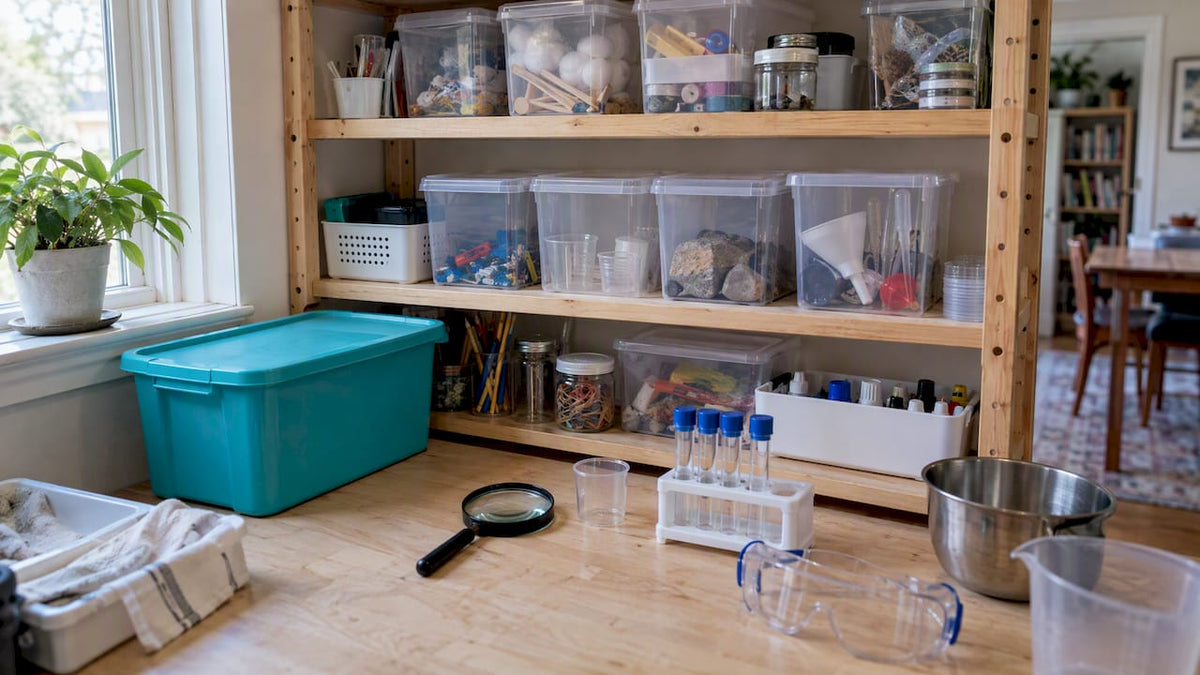
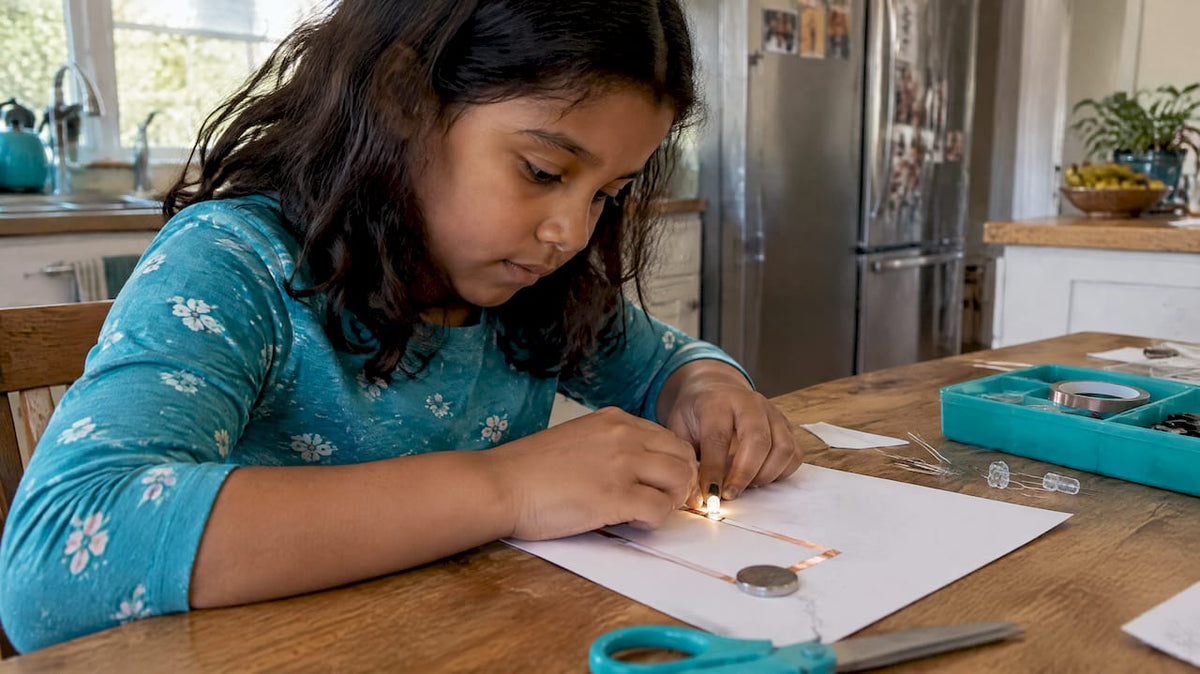
A board is at its best when it records something the class actually did. Our experiment kits are hands-on and screen-free, built for ages 5 to 13, and each one gives you photos, results and questions to post. The Just Add Sugar S.T.E.M. Experiment Kit and the solar energy kit with mirror disk are two easy starting points for a display on matter or energy. For a living-scientist moment, Meet Ava sessions bring our young STEM ambassador to your group: a 30-minute 1-on-1 Zoom experiment is $50, a virtual group entrepreneurship experience is $550, and an in-person group STEM experience is $1,100. Add the photos and student reflections to your board afterward. Our STEM books and puzzles can fill the reading shelf beneath it.
FAQ
What are some creative ideas for a science bulletin board?
Try a sequence-the-scientific-method board, a sortable properties-of-matter display, a 3-D solar system, a plant-growth chart or a class Wonder Wall. Each asks students to place, build or add something. Pick one that fits your current unit and rotate it when the unit ends.
What is the difference between a science and a STEM bulletin board?
A science board usually focuses on content such as cells, matter or the solar system. A STEM board adds technology, engineering and math, and often highlights mindset, careers and design thinking. In practice the two overlap, and many classrooms combine them in one display with sections.
How do I make a science bulletin board interactive?
Use pieces students can move: Velcro, magnets or pockets. Good formats include matching DNA pairs, building a food web with arrows, sorting by the five senses, or a question wall of sticky notes. Keep movable parts at child height.
How often should I change a science bulletin board?
Change it when your unit changes, or at least monthly. Keep one permanent section, such as a vocabulary wall or Wonder Wall, so children have something familiar to add to all year.
How can I include students who find reading and writing hard?
Pair words with pictures, use short lines of text and let students contribute by drawing, building or photographing. Celebrate process as well as answers. A board that accepts many kinds of contributions invites more children to take part.
Sources
- Creative Bulletin Board Ideas for Your Classroom, National Inventors Hall of Fame
- 28 Science Bulletin Board Ideas For Your Classroom, Teaching Expertise
- 21 Fun & Fascinating Science Bulletin Board Ideas, Teach Simple
- How a Wonder Wall will Encourage Every Student to Think, Engineer Does Education
- 6 STEM Classroom Bulletin Board Ideas, Naomi Meredith
- 6 STEM Bulletin Board Ideas, Miss Tech Queen
- Bulletin Board Ideas for Middle School, Gizmos
- Engaging Elementary Bulletin Board Ideas, Science4Us
- Science Bulletin Board Ideas for Easy Print-and-Go Displays, Teaching Muse
- What Is Earth System Science?, NASA My NASA Data

Leave a comment
This site is protected by hCaptcha and the hCaptcha Privacy Policy and Terms of Service apply.