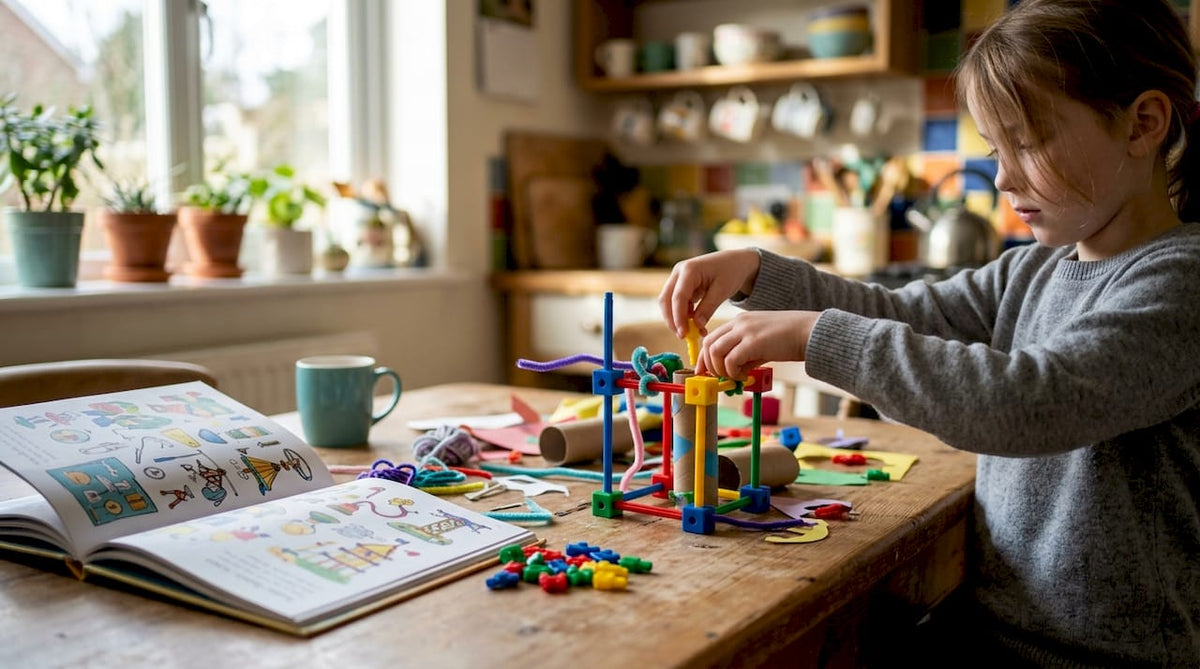
15 Minute Maker Challenges for STEM Picture Books at Home or School
Here are the STEM picture books worth adding to your shelf right now, each one paired with a low-prep activity that turns story time into hands-on discovery. This shortlist covers ages 3 to 8, spans science, technology, engineering, and math, and closes with a way to extend the learning past the last page.
TL;DR:
- Many STEM picture books target ages 3 to 8 and effectively introduce complex concepts through engaging stories and hands-on activities.
- Pairing books with simple, low-prep experiments reinforces understanding and builds skills in inquiry, iteration, and measurement.
- Diverse character representation in STEM books encourages children from all backgrounds to see themselves as inventors, scientists, and engineers.
- Consistent storytelling and activity routines, such as weekly themes and immediate follow-up, promote long-term interest and learning.
- Using tactile kits linked to stories, like circuits or solar energy experiments, transforms reading into active, empowering exploration.
Table of Contents
- STEM Picture Books That Belong on Every Shelf
- Why Picture Books Are a Legitimate STEM Tool, Not Just Entertainment
- Read-Aloud Routines and Hands-On Activities to Pair With Each Book
- How Hands-On STEAM Kits Deepen What a Book Starts
- Common Misconceptions That STEM Picture Books Quietly Correct
- What Makes a STEM Picture Book Actually Good
- The Four STEM Disciplines, and How Picture Books Handle Each One
- Building a Simple STEM Reading Routine at Home or in the Classroom
- The Real Payoff: Interest and Literacy, Together
- A Note on Where to Start and How to Pace It
- Turn Story Time Into Build Time With a STEAM Kit
- Sources
STEM Picture Books That Belong on Every Shelf
Great stem picture books do two jobs at once. They tell a story worth finishing, and they hand your child a real STEM concept they can turn around and test themselves. Most titles worth your time target ages 3 to 8, which lines up with when kids are naturally curious about how things work and brave enough to try building something themselves, according to the NGC Project.
Here is a working list, organized loosely by age and discipline, that holds up in both a classroom and a living room.
- Ada Twist, Scientist by Andrea Beaty (ages 4 to 8). Part of The Questioneers series, this book follows a relentlessly curious girl who investigates a bad smell in her house using real scientific inquiry. Pair it with a “smell detective” activity: hide three scented items in opaque cups and have your child hypothesize, then test.
- Rosie Revere, Engineer by Andrea Beaty (ages 4 to 8). Rosie fails at building a flying machine, again and again, before it finally works. After reading, challenge kids to build a paper airplane, test its flight three times, and adjust one variable each round.
- Iggy Peck, Architect by Andrea Beaty (ages 4 to 8). Iggy builds structures from anything he can find. Follow up with a tabletop bridge challenge using index cards and tape, testing how much weight the bridge holds before it buckles.
- Baby Loves Structural Engineering! by Ruth Spiro (ages 0 to 3). Part of the Baby Loves Science board book series, this title introduces load, force, and stability in toddler-friendly language. Stack blocks into a tower with your toddler and talk through why some towers fall and some do not.
- Boxitects by Kim Smith (ages 4 to 7). Two rival kids compete in a cardboard-building contest and learn that collaboration beats competition. Give your child a stack of recycled boxes and 15 minutes to build anything they want, then talk about what worked.
- A Computer Called Katherine by Suzanne Slade (ages 6 to 9). A biography of Katherine Johnson, the NASA mathematician whose calculations helped send astronauts into orbit. Follow it with a simple math activity: estimate and then measure how far a paper rocket travels across the room.
- What Do You Do With an Idea? by Kobi Yamada (ages 4 to 8). Not a STEM book in the traditional sense, but a powerful growth-mindset companion for any invention story. Ask your child to draw their own “idea” and describe one step they would take to make it real.
- Ada Lovelace, Poet of Science or similar biography titles (ages 5 to 9) introduce the history of computing and technology through a real historical figure, giving kids a concrete example of “technology” beyond screens.
- Bridge to the Stars-style engineering storybooks and other bridge- or tower-building narratives (ages 5 to 8) work well with a sink-or-float extension. Gather five household objects, predict which sink or float, then test.
- Lucy’s Engineering Adventure, produced by ASHRAE to introduce kids to heating, cooling, and refrigeration careers, is a solid pick when you want a book that ties directly to a specific engineering field most kids never hear about, according to Reading Is Fundamental.
- Diverse STEM biographies and story collections that center scientists and engineers from a range of backgrounds and cultures round out any list. Educator-curated collections built specifically around representation, like this one, are worth browsing for titles that fit your child’s specific interests.
For a broader marketplace snapshot of what is currently popular and easy to find, Bookshop.org’s curated STEM list is a reliable cross-check before you buy. If you would rather grab several titles at once, Teamgeniussquad’s STEM book bundle groups several of these categories together for exactly this kind of read-and-build routine.
Why Picture Books Are a Legitimate STEM Tool, Not Just Entertainment
Story time and STEM time are not competing activities. They are the same activity, done right. Books that introduce a STEM concept through narrative let a child absorb literacy skills and technical thinking in the same sitting, which is exactly why educators lean on them so heavily, according to Edutopia.
The mechanism is simple once you see it. A well-built STEM story mirrors the engineering design process almost beat for beat: a character has a problem, plans a solution, builds a version of it, tests whether it works, and revises when it doesn’t. Rosie Revere’s flying machine fails four times before it succeeds. That is not a plot device. It is the design cycle, dramatized.
Reading these stories through what educators call a “literary lens” does something else too: it normalizes failure. Kids watch a character try, flop, and try again without shame, which quietly builds the perseverance that real engineering work demands.
Representation matters here as much as content accuracy. When a child sees a scientist who looks like them, talks like them, or comes from a similar background, the idea “I could do that” gets a lot more concrete. Diverse STEM book lists exist specifically to close that gap for kids who rarely see themselves cast as the inventor or the problem solver.
Read-Aloud Routines and Hands-On Activities to Pair With Each Book
A story is only half the lesson. The activity afterward is where the concept sticks. Try this sequence: read the book in a few minutes, run the paired activity for a short time, then ask one reflection question. That pacing respects attention spans without cutting the fun short.
Here are seven activities, one per common book type:
- Building/structure books (Iggy Peck, Boxitects). Objective: test stability. Materials: index cards, tape. Steps: stack cards into a tower, add weight one book at a time, note when it falls. Reflect: what made it fall?
- Invention/failure books (Rosie Revere). Objective: practice iteration. Materials: paper, tape. Steps: fold a paper airplane, fly it, adjust one fold, fly again. Reflect: which version flew farther?
- Investigation books (Ada Twist). Objective: practice the scientific method. Materials: three cups, household scents. Steps: hide scents, guess, sniff, confirm. Reflect: what surprised you?
- Math/space biographies (A Computer Called Katherine). Objective: estimate and measure. Materials: paper, ruler or tape measure. Steps: build a paper rocket, launch it, measure the distance. Reflect: was your estimate close?
- Toddler concept board books (Baby Loves Structural Engineering). Objective: introduce load and balance. Materials: wooden blocks. Steps: stack, test stability, rebuild. Reflect: which shape held the most weight?
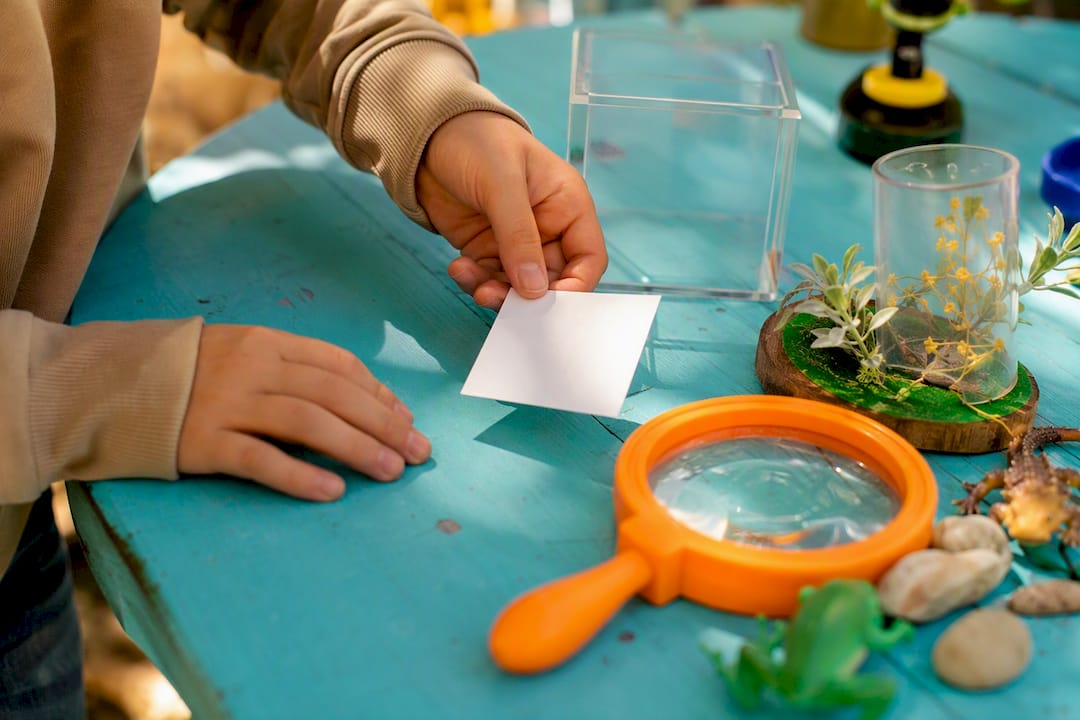
- Nature/biology books. Objective: observe and sort. Materials: leaves or rocks from outside. Steps: collect five, sort by one trait, sort again by a different trait. Reflect: which sorting was harder?
- Low-prep option for busy caregivers. Objective: sink or float prediction. Materials: a bowl of water and five random household objects. Steps: predict, test, record. Reflect: what pattern did you notice?
Each activity follows the same template: objective, materials, three steps, then a reflection question, a structure practitioners rely on because it scales across almost any book theme, according to a TERC blog on storybook STEM.
Pro Tip: Keep a small “maker bin” of tape, paper, cups, and string near your bookshelf. When a book sparks an idea mid-read, you want the materials within arm’s reach, not in another room.
For more structured lesson plans built around this exact read-then-build model, Teamgeniussquad’s STEM storytelling examples walk through several full sequences.
How Hands-On STEAM Kits Deepen What a Book Starts
A book plants the idea. A kit lets a child live inside it. That is the logic behind Teamgeniussquad’s E³ Method, which stands for Engage, Encourage, Empower, and it maps almost perfectly onto the read-aloud-then-activity sequence you just built. The story engages curiosity. A guided hands-on challenge encourages the child to attempt a real build. Completing it, especially after a few failed tries, empowers them to see themselves as a builder, not just a reader.
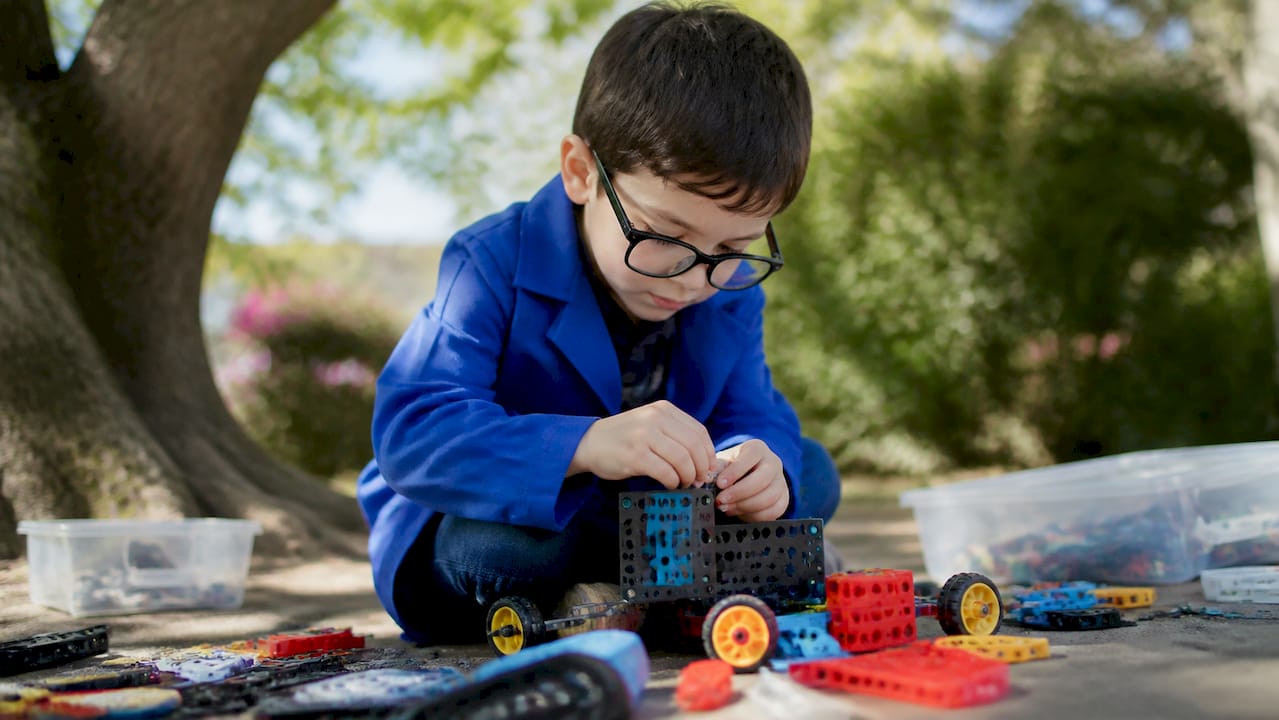
The role-play layer matters more than it looks like on the surface. When a child puts on a lab coat or earns a badge after finishing an experiment, that is not decoration. It gives a child a physical marker of identity: “I am someone who does this,” which is a sturdier motivator than a gold star on a worksheet, especially for kids who struggle in traditional classroom settings. Teamgeniussquad’s approach grew out of a real family’s experience with dyslexia and dysgraphia, which shapes why the kits lean so heavily on tactile, screen-free building rather than worksheets alone.
Common Misconceptions That STEM Picture Books Quietly Correct
The biggest misconception is that STEM is a subject you either get or you don’t. Books like Rosie Revere dismantle that by showing a character fail repeatedly and keep going anyway, which reframes struggle as part of the process instead of proof you are bad at it.
A second misconception, especially among caregivers, is that STEM requires expensive equipment or a science background to teach. It doesn’t. Most of the activities above use tape, paper, and cups. The book does the conceptual heavy lifting; you just need fifteen minutes and a few things from the recycling bin.
Third, many parents assume “technology” means screens. Biographies like A Computer Called Katherine correct that by showing technology as math, calculation, and problem solving long before personal computers existed. Kids come away understanding that technology is a category of tools and thinking, not a synonym for a tablet.
Finally, there is a quiet misconception that engineering is a boys’ subject and science is reserved for a certain kind of kid. Diverse, character-driven series work directly against that by putting girls, kids of color, and kids with disabilities at the center of the invention story, not on the sidelines of it, an intentional design choice behind many current diverse STEM book collections.
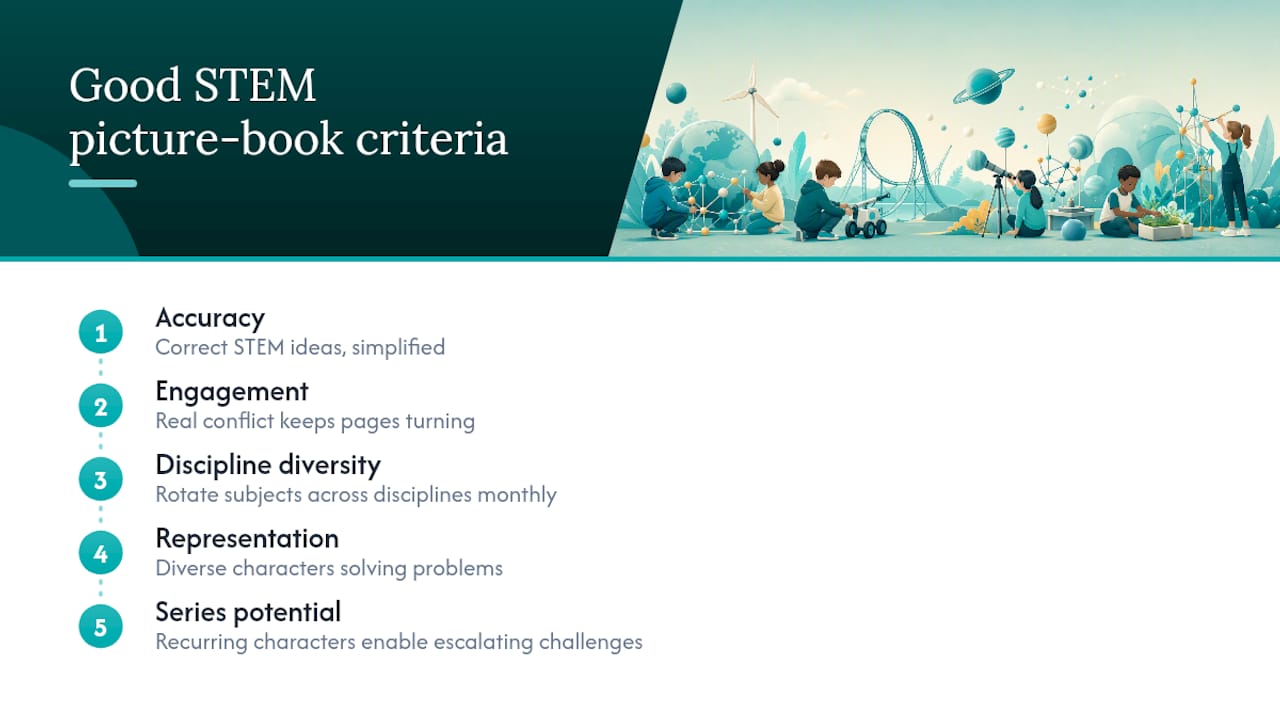
What Makes a STEM Picture Book Actually Good
Not every book with a rocket on the cover teaches real science. A handful of criteria separate the ones worth your shelf space from the ones that just look the part.
Accuracy first. The STEM content inside should hold up. A book about bridges should get load and balance roughly right, even in simplified form; a biography should stick to what its subject actually did. Series built with input from actual engineers and scientists, like Baby Loves Science, tend to hold this line more reliably than one-off titles chasing a trend.
Engagement second. A technically accurate book that bores a five-year-old teaches nothing, because nobody finishes it. The best titles wrap the concept inside a real conflict: Rosie’s machine crashes, Ada’s smell mystery has no obvious answer, Iggy’s materials keep running out. Tension is what keeps a page turning.
Discipline diversity third. A shelf stacked entirely with rocket ships covers engineering and physics but skips biology, math, and computing entirely. Rotate titles so your child sees a mathematician, a builder, a naturalist, and an inventor over the course of a month, not just an astronaut.
Representation fourth. Look for characters across genders, races, and abilities solving problems, not just observing them. This is less about optics and more about whether a specific child can picture themselves as the one holding the tools.
Series potential fifth. Books with recurring characters, like The Questioneers, let you scaffold harder challenges over time because the child already trusts and understands the character, which the DuPage Children’s Museum’s Questioneers exhibit leans into directly with its hands-on programming.
The Four STEM Disciplines, and How Picture Books Handle Each One
Good STEM libraries spread across all four letters, not just the flashy ones.
Science shows up most often as investigation: a character notices something odd, forms a guess, and tests it. Ada Twist is the clearest example, but any book where a character asks “why” and then checks their answer counts.
Technology gets misunderstood most, since it is not just gadgets. Biographies about calculators, early computers, or communication tools, like A Computer Called Katherine, show technology as a category of problem-solving tools that predate screens by decades.
Engineering dominates the picture-book market right now, largely thanks to The Questioneers and similar series. These books almost always dramatize the design cycle: plan, build, test, fail, revise, succeed. It is the easiest discipline to spot because the failure and rebuild arc is so visual.
Math is the hardest discipline to find in story form, which makes titles that manage it, counting books, measurement stories, and biographies of mathematicians like Katherine Johnson, worth prioritizing when you spot them. If your shelf is engineering-heavy and math-light, that is the gap to fill next.
A balanced shelf rotates through all four every few weeks rather than clustering around whichever discipline happens to have the most colorful covers.
Building a Simple STEM Reading Routine at Home or in the Classroom
The routine matters more than any individual book. Consistency is what turns a nice story into an actual learning habit.
Start small: one book, one activity, once a week is enough to build momentum without burning out either you or your child. Trying to do a maker challenge every single day usually collapses within two weeks.
Keep a rotating shelf of five to seven titles instead of a massive library. A smaller, well-curated set gets reread and revisited, which matters, since kids often absorb more on a second or third reading than the first.
Let your child choose the activity variation. If a book suggests testing sink-or-float with five objects, let them pick the objects. Ownership over small decisions increases how invested they are in the outcome.
For classrooms, batch by theme for a week or two: a “building week” using Iggy Peck and Boxitects, a “failure and iteration week” using Rosie Revere. This lets you reuse the same maker bin materials across multiple lessons instead of restocking constantly. Teamgeniussquad’s literacy integration tips walk through a few more structured versions of this if you want a ready-made weekly plan.
One last practical note: start the activity while the story’s ending is still fresh. Waiting until the next day loses most of the momentum a good book just built.
The Real Payoff: Interest and Literacy, Together
STEM picture books do double duty, and that is exactly why they are worth the shelf space. Reading builds vocabulary, comprehension, and narrative sense. The paired activity builds curiosity, tolerance for failure, and early technical vocabulary, at the same time, in the same twenty minutes.
Teachers who lead with a story before a hands-on task report higher engagement once the building starts, because the narrative gives kids a reason to care about the outcome before they even pick up a material, a pattern noted by Mackin’s classroom research on STEM engagement. A child who just watched Rosie’s flying machine crash four times approaches their own paper airplane differently than a child who was just handed paper and told to fold it.
The literacy side compounds too. Kids exposed early to STEM vocabulary, words like “hypothesis,” “prototype,” “iterate,” carry that vocabulary into later science classes with far less friction than kids meeting those words cold in fourth grade. The book is doing quiet, long-term work well beyond the read-aloud itself.
None of this requires a science degree or a full classroom budget. It requires a decent book, fifteen spare minutes, and a willingness to let a build go wrong the first time.
A Note on Where to Start and How to Pace It
If you are staring at this list wondering where to begin, keep it simple. For ages 3 to 5, start with Baby Loves Structural Engineering! and a block-stacking session. For ages 6 to 8, start with Rosie Revere, Engineer and the paper airplane challenge.
Keep the story to 5 or 10 minutes and the activity to 10 or 20, longer than that and younger kids lose the thread. Close every session with one question: “What would you try differently next time?” That single question does more for a growth mindset than any sticker chart.
Pick one book this week. Just one. Momentum matters more than volume.
— Tita
Turn Story Time Into Build Time With a STEAM Kit
Once a book gets your child asking “how does that actually work,” a Teamgeniussquad kit gives them a real answer to build, not just imagine. The Shocking Electric Science Experiment Kit pairs naturally with any electricity-themed story, letting kids test circuits right after closing the book. The Science Solar Energy Kit with Mirror Disk extends space and energy stories into a real solar experiment, and the STEM-STEAM Electricity Lab Experience Bundle works well for a classroom running multiple sessions across a week.

Every kit runs on the E³ Method, so the same engage, encourage, empower sequence you just built with a book and a maker challenge carries straight into a guided experiment, complete with a lab coat and badge that give the moment some real weight. No screens, no long prep list, just materials already sorted and steps a beginner reader can follow. Browse the full experiment kit collection and pick one that matches the book on your nightstand this week.
Sources
- Picture books break stereotypes: STEM and beyond — NGC Project
- The magic of STEM-related read-alouds — Edutopia
- The Questioneers exhibit — DuPage Children’s Museum
- Storybook STEM maker activities — TERC blog

Leave a comment
This site is protected by hCaptcha and the hCaptcha Privacy Policy and Terms of Service apply.