STEAM Literacy Integration Tips for Educators and Parents
When you are trying to help a child ages 5 to 13 grow as both a thinker and a communicator, the best steam literacy integration tips do not come from choosing between reading time and experiment time. They come from refusing to separate the two. Most educators and caregivers feel the pull of a packed schedule and wonder whether adding STEAM means sacrificing literacy, or vice versa. The good news is that the research, and the real stories coming out of classrooms and kitchens, show these two worlds belong together. Here is exactly how to make that happen.
Table of Contents
- Key takeaways
- 1. What makes STEAM literacy integration work
- 2. Inquiry-based interactive read-alouds paired with STEAM challenges
- 3. Picture books as launch pads for play-based STEAM exploration
- 4. Community-facing STEAM-literacy projects
- 5. Choosing the right strategy for your setting and goals
- My honest take on STEAM and literacy integration
- Ready to bring STEAM and literacy to life at home or in your classroom?
- FAQ
Key takeaways
| Point | Details |
|---|---|
| Literacy and STEAM belong together | Combining reading, writing, and hands-on exploration deepens comprehension and problem-solving at the same time. |
| Picture books are your best starting point | Use children’s books as open invitations for curiosity and design, not step-by-step craft guides. |
| Writing is a thinking tool, not an assignment | Journals, sketches, and reflections help children process what they discover and build their own voice. |
| Community projects raise the stakes | Real audiences and social impact give children genuine reasons to read, write, design, and build with pride. |
| Flexibility beats rigid adherence | Mix and match strategies based on your child’s age, your available materials, and your learning goals. |
1. What makes STEAM literacy integration work
Before you try any specific strategy, it helps to understand what separates integration that actually works from activities that just happen to involve both a book and some tape. Strong steam literacy integration tips share a few foundational qualities, and once you see them clearly, you can apply them to almost any subject or age group.
The first quality is that literacy is never bolted on. When writing serves as inquiry, reflection, and communication rather than just a worksheet at the end of an activity, children develop voice and agency alongside knowledge. The National Council of Teachers of English makes clear that writing should transform learning, not just document it. That distinction matters enormously when you are planning a session.
Here is what to look for in any STEAM literacy activity you consider:
- Shared starting points. Picture books, poems, and nonfiction texts give every child a common story world to draw from before the hands-on exploration begins.
- Open-ended questions. “What do you wonder?” and “What would you try?” open more doors than “Follow these steps.”
- Language development woven in. Vocabulary from the text should appear naturally in the building, experimenting, and reflecting phases, not just during reading.
- Authentic audiences. Writing a set of instructions for a classmate, making a sign for a community project, or explaining a design to a parent gives literacy work real purpose.
- Space for iteration. Children who test, fail, revise, and try again are doing both engineering and writing in the truest sense.
Pro Tip: Keep a shared vocabulary wall near your workspace. As children read and then experiment, ask them to add words from the story that helped them understand a problem or a solution. This one habit reinforces STEM literacy strategies across every session.
The role of literacy in STEAM is not decorative. It is structural. Language gives children the framework to describe what they observe, predict what might happen, and explain what they built and why.
2. Inquiry-based interactive read-alouds paired with STEAM challenges
One of the most powerful steam literacy integration tips available to any educator or caregiver is also one of the simplest to set up. You read a book aloud, but you stop at the right moments, and those pauses become the engine for engineering thinking and literacy comprehension at the same time.
Pausing at problem moments during a read-aloud to ask children to define the character’s problem, name the constraints, and brainstorm solutions blends literacy practice and engineering design in a single, focused conversation. Children are not just listening. They are thinking critically, using story language, and imagining possible outcomes before they ever touch a material.
Here is a simple sequence to follow:
- Choose a picture book where a character faces a real problem that requires design thinking. Books about animals building homes, inventors solving community challenges, or explorers navigating new environments all work well.
- Stop at the moment the problem becomes clear. Ask: “What is the character trying to solve? What do they have to work with? What are the rules they have to follow?”
- Let children sketch or talk through possible solutions before you continue reading.
- After the story, give them materials to prototype their best idea.
- Bring the story language back after building. Ask children to revisit vocabulary and themes from the text to explain or revise their design.
That last step is what researchers call a design-then-language loop, and it is where literacy and STEAM reinforce each other most deeply. Children use the story’s words to sharpen their explanations, and their explanations reveal how well they understood the story.
Pro Tip: After prototyping, ask children to write or dictate a “designer’s note” explaining one choice they made. Even two sentences connect their hands-on work to literacy in a way that sticks.
3. Picture books as launch pads for play-based STEAM exploration
Knowing how to integrate literacy with STEAM through play means resisting the urge to turn every beautiful picture book into a scripted craft activity. Picture books work best as invitations to wonder, not as lesson scripts to be followed page by page. When you let a book spark curiosity rather than direct behavior, children bring far more of themselves to the exploration.

Think about the difference between saying “Now we will build what the character built” versus placing loose materials near the book and asking “What do you think would happen if you tried something like this?” The second invitation opens the door to imagination, personal interpretation, and genuine problem-solving.
What this looks like in practice:
- Set up a provocation. After reading, arrange materials on a table without instructions. Let children decide what to make, test, or explore based on what moved them in the story.
- Listen before you lead. When a child is deep in play inspired by a book, literacy lives in that story language they bring to their building and imagining. Your job is to observe and document what you hear.
- Ask, don’t tell. Pose questions like “What did the character do when that happened?” or “How might you test that idea?” These keep the story alive in the STEAM play without taking over.
- Revisit the book. Encourage children to go back to the text when they get stuck. This builds reading-for-purpose, one of the deepest literacy skills there is.
- Celebrate the process. A child who spent twenty minutes building and rebuilding a bridge inspired by a book has practiced engineering design and story comprehension simultaneously, even if the final structure fell down.
Children who learn how to combine STEAM and literacy through play-based exploration develop a relationship with books that goes beyond decoding. They start to see stories as sources of problems worth solving and worlds worth building.
4. Community-facing STEAM-literacy projects
There is something that shifts in a child when their work has a real audience beyond the classroom or kitchen table. Community-facing projects are among the most underused steam literacy integration tips for educators and caregivers, and the results they produce are extraordinary.
Consider what happened when students in York designed, built, and stocked 10 little free libraries, collecting over 1,000 books for their neighborhood. In that single project, children practiced woodworking and structural design, wrote descriptions for the libraries, researched the communities they wanted to serve, and experienced the civic pride of seeing strangers stop to read the books they had gathered. STEAM and literacy were not separate subjects. They were one living project.
“Public-facing literacy projects create authentic audiences and raise motivation, connecting STEAM design and build practices with literacy skill development in ways that worksheets simply cannot replicate.”
Here is how to start a community-facing STEAM literacy project in your setting:
- Identify a real need. Talk with your students or children about a problem in your school, neighborhood, or community that they care about.
- Connect reading and research. Before designing anything, read books, articles, and community stories related to the problem. This is literacy with genuine stakes.
- Design and build with purpose. Whether it is a little library, a school garden sign, or a weather station for a local park, the build phase has meaning because the audience is real.
- Write for the public. Labels, instructions, letters to community members, and descriptions of the project all become authentic literacy tasks that children take seriously.
- Celebrate and reflect. Document the project with photos and writing that children can share with families, connecting home and school literacy in a lasting way.
Caregiver scaffolding tools like journals and coaching bookmarks can extend this community energy into home conversations, helping families stay connected to the learning their children are doing.
5. Choosing the right strategy for your setting and goals
Not every approach fits every situation, and part of knowing how to integrate literacy and STEAM well is making honest choices based on what you actually have: time, materials, space, and the specific child or group in front of you.
| Strategy | Best for | Materials needed | Literacy focus | STEAM focus |
|---|---|---|---|---|
| Interactive read-aloud + STEAM challenge | Structured classroom or home sessions | Picture books, building materials | Comprehension, vocabulary | Engineering design process |
| Play-based exploration | Open-ended learning time, ages 5 to 8 | Loose parts, story books | Oral language, narrative thinking | Science inquiry, creative design |
| Community-facing project | Group settings, older children ages 8 to 13 | Research materials, build supplies | Writing for audience, research | Design, build, civic problem-solving |
When you are pressed for time, the interactive read-aloud strategy delivers strong results with minimal setup. When your child needs more open play, the picture-book provocation approach gives them freedom to lead. And when you have a few weeks and a motivated group, community projects produce the kind of learning that children remember for years.
Pro Tip: You do not have to pick one strategy and stick with it. Start a unit with a read-aloud, let it grow into free play exploration, and then channel that curiosity into a small community project. That progression mirrors how using the engineering design process improves outcomes in science education, moving from structured learning into applied, meaningful challenge.
The most flexible educators and caregivers mix these approaches based on how their children respond, not on a rigid weekly schedule. Iteration is as important in your teaching practice as it is in the engineering design cycle.
My honest take on STEAM and literacy integration
I have spent years watching children light up when a story becomes something they can build, test, and share. What I have learned is that the biggest mistake adults make is treating literacy as the serious work and STEAM as the fun reward. Children see through that framing immediately, and it diminishes both.
What actually works is treating writing as a thinking tool from day one. When a child sketches a design and then writes two sentences explaining their choice, they are not completing an assignment. They are processing what they know and discovering what they still need to figure out. That is writing as inquiry, and it is far more powerful than any worksheet.
I have also seen how much it matters for children, especially those who learn differently, to have story worlds that feel like theirs. When a picture book gives a child permission to imagine themselves as the problem-solver, the builder, the scientist in the story, the literacy and STEAM connection becomes personal. And personal connections are the ones that last.
My advice to every educator and caregiver reading this: trust the child’s curiosity more than the lesson plan. Set up the invitation, ask the questions, and then get out of the way. The integration will happen naturally when you give it room to breathe.
— Tita
Ready to bring STEAM and literacy to life at home or in your classroom?
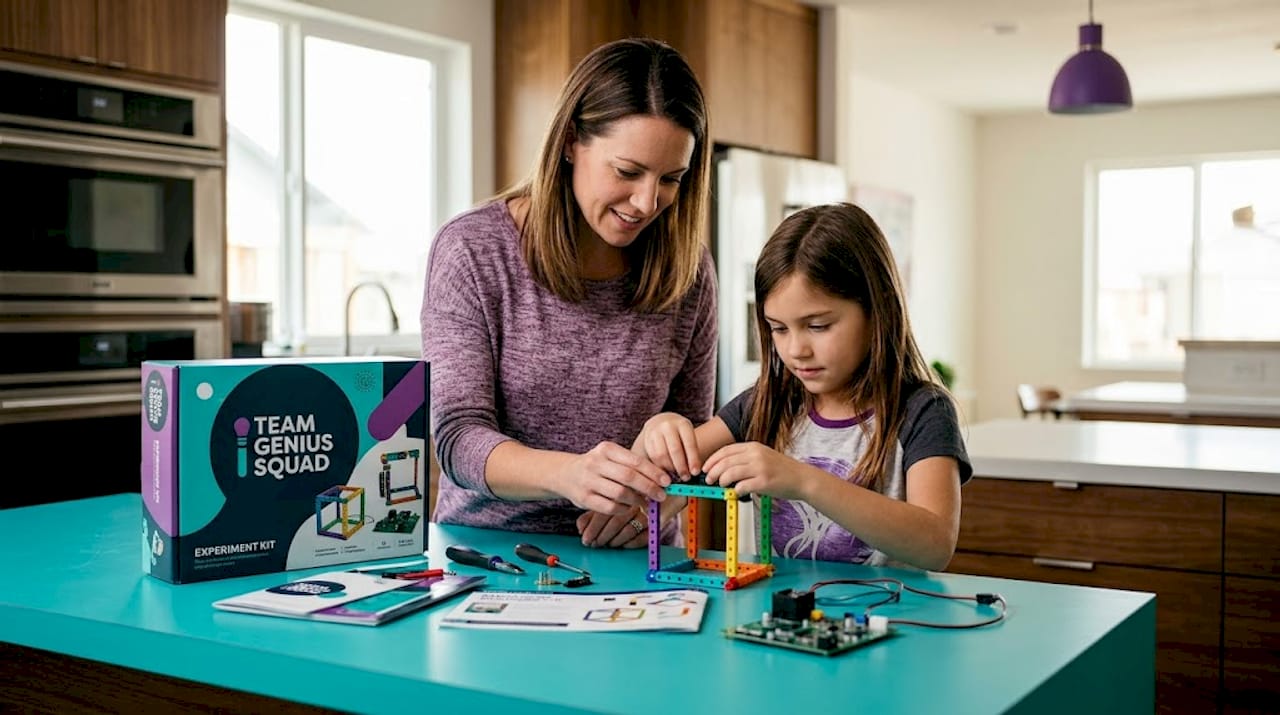
Teamgeniussquad was built for exactly this kind of learning. Inspired by a real family’s experience with dyslexia and dysgraphia, every Teamgeniussquad kit combines hands-on experiments with reading, writing, and reflection so that children build confidence and skills at the same time. The E³ Method — Engage, Encourage, Empower — guides children from curiosity to discovery to pride in what they have created.

Whether you are looking for curated STEAM books and puzzles to spark your next read-aloud challenge or a full experiment kit that brings the engineering design process to your kitchen table, Teamgeniussquad has you covered. You can also explore the STEAM book bundle designed to inspire young minds across ages 5 to 13. Every resource is screen-free, purposeful, and ready to unlock your child’s inner genius.
FAQ
What is STEAM literacy integration?
STEAM literacy integration means combining science, technology, engineering, art, and math activities with reading, writing, and language skills so that children develop both simultaneously. Rather than treating them as separate subjects, educators and caregivers use stories, writing, and reflection to deepen STEAM thinking and use STEAM challenges to give literacy skills real purpose.
Why combine STEAM and literacy for children ages 5 to 13?
Embedding literacy within STEAM addresses the common worry that STEAM activities take time away from reading and writing by showing that the two naturally support each other. Children who read, write, and build together develop stronger comprehension, vocabulary, and problem-solving skills than those who practice these skills in isolation.
How do picture books support STEAM learning?
Picture books provide a shared story world that drives curiosity and inquiry rather than prescribing specific steps, making them ideal starting points for open-ended STEAM exploration. They give children vocabulary, context, and characters to think alongside as they design, test, and reflect.
What role does writing play in STEAM activities?
Writing in STEAM contexts should function as a tool for thinking and reflection, not just a final product. When children sketch, journal, and explain their designs, they are processing their understanding and communicating discoveries in ways that strengthen both their literacy skills and their scientific reasoning.
How can caregivers support STEAM literacy integration at home?
Caregivers can use family literacy night strategies like reciprocal journals, where children teach what they learned and caregivers record notes, to extend STEAM literacy learning beyond school. Reading a picture book together and then setting out loose materials for open-ended exploration is one of the simplest and most effective approaches available at home.


Leave a comment
This site is protected by hCaptcha and the hCaptcha Privacy Policy and Terms of Service apply.