
STEAM vs STEM Explained for Parents and Educators
If you’ve ever heard a teacher say “We’re doing STEAM now” and wondered what changed, you’re not alone. The steam vs stem explained debate trips up even experienced educators, largely because the most common shorthand is wrong. STEAM is not simply STEM with art class tacked on at the end. The difference runs deeper than an added letter, touching on how children think, how they learn to solve problems, and which kids get to feel like they belong in a science room. This guide breaks it all down so you can make informed decisions for the children in your life.
Table of Contents
- Key Takeaways
- Steam vs STEM explained: the core definitions
- What research says about cognitive benefits
- How classroom practice actually differs
- Common misconceptions about the “A” in STEAM
- Practical steps for educators, parents, and caregivers
- My take on the STEAM vs STEM debate
- Bring STEAM to life with Teamgeniussquad
- FAQ
Key Takeaways
| Point | Details |
|---|---|
| STEAM adds the “A” for Arts | Arts in STEAM means design thinking and empathy, not decoration or craft time. |
| Research backs STEAM’s benefits | Well-structured STEAM programs produce 34% higher creative problem-solving scores versus poorly scaffolded approaches. |
| Scaffolding matters deeply | Without proper structure, STEAM can cause cognitive overload that reduces technical mastery by 12%. |
| STEM builds technical mastery | STEM education focuses on subject-specific precision and is still essential for foundational technical skills. |
| Mindset beats methodology labels | Whether you call it STEM or STEAM, the educator’s approach to inquiry and creativity determines real outcomes. |
Steam vs STEM explained: the core definitions
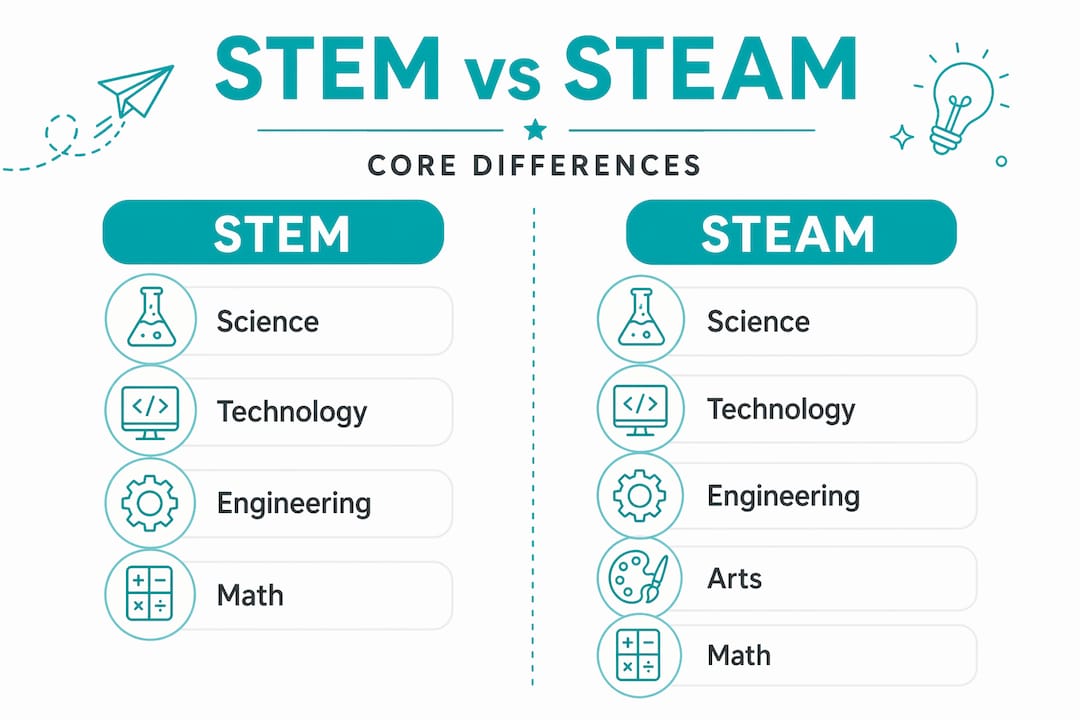
STEM stands for Science, Technology, Engineering, and Mathematics. It describes an educational philosophy that prioritizes these four disciplines, often taught with an emphasis on technical accuracy, data, and measurable outcomes. The goal is to build analytical thinkers who can solve quantifiable problems, code programs, design systems, and work with precision. STEM education, at its best, develops deep subject mastery in each of those four domains.
STEAM adds one letter and one enormous idea. The “A” stands for Arts, and according to design thinking researchers, it encompasses design thinking, communication, and empathy. These are not soft extras. They are the human-centered skills that determine whether a technically correct solution actually works in the real world.
Here is a clear side-by-side comparison:
| Category | STEM | STEAM |
|---|---|---|
| Focus | Technical mastery in four disciplines | Transdisciplinary, integrating arts with STEM |
| Learning style | Subject-specific, structured | Project-based, inquiry-driven |
| Assessment | Technical accuracy and test scores | Creativity, process, iterative thinking |
| Role of arts | Separate or absent | Functional component of problem solving |
| Best for | Building deep technical skills | Building creative, adaptive thinkers |
The pedagogical shift matters here. STEM is largely discipline-specific, meaning a math lesson is a math lesson. STEAM is transdisciplinary by design, meaning children work across subject lines simultaneously to solve a real problem. That requires a completely different classroom structure, and a very different mindset from the adult in the room.
What research says about cognitive benefits
The evidence for STEAM’s impact on young learners is growing. Preschool children who participated in 32 STEAM activities over 8 weeks showed significant improvements in problem-solving skills, with a high effect size of d = 1.29 for digital literacy. That is not a marginal result. It suggests that structured STEAM experiences build cognitive skills that go well beyond memorizing facts or following procedures.
However, the research also comes with an important caveat. Poorly scaffolded STEAM programs may cause a 12% drop in technical mastery due to cognitive overload, while well-integrated programs lead to 34% higher creative problem-solving scores. This is perhaps the most underreported finding in the STEAM vs STEM debate. STEAM is not automatically better. It is only better when it is done with intention.
Here is a quick breakdown of benefits and potential pitfalls for each approach:
STEAM benefits:
- Builds creative problem-solving and design thinking across subjects
- Develops communication and empathy alongside technical skills
- Supports children who learn differently or struggle in traditional formats
- Prepares kids for careers that require cross-disciplinary collaboration
STEM benefits:
- Develops deep technical precision in math, coding, engineering, and science
- Provides a clear, measurable framework for skill progression
- Builds strong foundational knowledge before broader integration
Pitfalls to watch for:
- STEAM without structure can overwhelm novice learners
- STEM without creativity can discourage children who think in non-linear ways
- Both approaches can inadvertently exclude kids if course access remains unequal
Pro Tip: If a child seems frustrated during a STEAM project, check the complexity before assuming the child isn’t capable. Cognitive overload looks a lot like disengagement.
How classroom practice actually differs
Walk into a STEM-focused classroom and you will likely see students working through defined problems with known solutions. A math worksheet, a structured coding exercise, a chemistry experiment with a correct result. The teacher is often the authority, guiding students toward technical accuracy. Assessment reflects that same structure: right or wrong, scored and recorded.

Walk into a well-run STEAM classroom and the energy is different. Children might be building a prototype of a water filtration system and also drawing a diagram explaining their design choices to a hypothetical community. Or they might be designing a bridge out of limited materials while writing a report for an imaginary city council. Inquiry-driven STEAM learning is a pedagogical shift where arts become functional components supporting real-world problem solving, not decoration.
Here is how that difference plays out in practice for educators and caregivers:
- Project framing. STEM projects often start with a defined question. STEAM projects start with a real-world scenario that has no single right answer.
- Roles in the classroom. In STEAM, children take on identities as designers, communicators, and builders, not just students completing an assignment.
- Assessment approach. STEAM assessment focuses on process and iterative thinking, meaning children are evaluated on how they revise and reflect, not just on whether the final product works.
- Collaboration patterns. STEAM typically involves more group work and peer critique, mirroring how professional teams actually function.
- Integration of reflection. STEAM asks children to articulate why they made choices, developing metacognitive awareness alongside technical skill.
Pro Tip: For children ages 5 to 8, start STEAM projects with very simple open-ended prompts like “How would you design a house for someone who can’t use stairs?” The design thinking kicks in naturally, even without a formal art lesson.
Common misconceptions about the “A” in STEAM
The biggest misunderstanding about STEAM is that the “A” stands for arts as in paintings and collages. When a school says “we added arts to STEM,” they often mean students are decorating their science posters. That is not STEAM. That is STEM with stickers.
The functional role of arts in STEAM includes design thinking, communication, and empathy. These are not creative electives. They are the same skills that engineers use when designing accessible products, that scientists use when communicating research to the public, and that coders use when building software for real human users. The arts teach children how to think about people, not just problems.
Here are the myths worth addressing directly:
- “Arts are decorative in STEAM.” False. Arts in STEAM teach children to consider user experience, visual communication, and human-centered design.
- “STEM and art are opposites.” False. Both require iteration and prototyping, the same process of testing, failing, and refining that defines both scientific inquiry and artistic creation.
- “STEAM is just for creative kids.” False. STEAM gives analytical thinkers a fuller toolkit, and creative thinkers a technical foundation they might not find in traditional STEM.
- “STEM is more rigorous than STEAM.” This depends entirely on implementation. The STEAM-5E framework promotes integration with metacognitive, dialogic, and collaborative processes in upper primary education, which is academically demanding by any standard.
The most important shift is understanding that adding arts to STEM is not about making science more fun. It is about making problem solving more human.
Practical steps for educators, parents, and caregivers
Knowing the difference between STEAM and STEM is useful. Knowing how to act on that difference is what changes outcomes for children. Here are concrete ways to bring these ideas to life at home or in the classroom.
For educators:
- Build scaffolding into every STEAM project. Start with structured steps before opening up creative choices. Scaffolding prevents cognitive overload by letting children manage complexity in stages.
- Assess the process, not just the product. Ask children to journal about what they tried, what failed, and what they changed. That reflection is where real STEAM learning lives.
- Pair STEAM activities with reading and writing. A child who designs a bridge and then writes a letter explaining why their design is best is developing literacy, engineering, and communication at once.
For parents and caregivers:
- You do not need fancy equipment to support STEAM at home. Ask your child to design a solution to a household problem using what is in the recycling bin, then talk through why they made their choices.
- Look for hands-on, screen-free options that let children touch, build, test, and revise. Tactile learning is especially powerful for children who struggle in traditional reading-heavy environments.
- Celebrate wrong answers. In STEAM, a failed experiment is data, not defeat. That reframe alone can change how a child feels about learning.
For children ages 5 to 13, great STEAM activities include:
- Building a model city and explaining the design decisions
- Conducting kitchen science experiments and writing up findings
- Prototyping a product that solves a problem they notice at school
- Exploring STEAM books and puzzles that blend reading comprehension with scientific thinking
Pro Tip: For neurodivergent learners, STEAM’s emphasis on multiple modes of expression, drawing, building, speaking, and writing, often removes the barriers that traditional STEM creates. The arts component is not a bonus for these kids. It is often the door that lets them in.
My take on the STEAM vs STEM debate
I want to be honest about something most articles in this space won’t say plainly: the acronym debate is the least interesting part of this conversation.
In my experience working with and observing children in STEAM learning environments, the label on the program matters far less than the mindset of the adult running it. I’ve seen STEM programs produce wildly creative, confident learners because the educator asked open-ended questions and celebrated uncertainty. I’ve also seen STEAM programs that were just arts and crafts with a periodic table on the wall.
What actually moves children forward is when an adult frames a problem as genuinely unsolved, then hands the child the tools to wrestle with it. That is true whether the classroom calls itself STEM or STEAM. The difference between steam vs stem explained well or poorly comes down to whether the adult believes the child is capable of real inquiry.
The research supports something I’ve felt intuitively for a long time. The arts are not about making science softer. They are about making thinkers more complete. A child who can design, communicate, and empathize will solve problems that a technically precise but narrowly trained child cannot. I’ve watched kids who struggled in traditional learning environments light up the moment they were allowed to draw their hypothesis or build a model instead of fill in a blank. That is not a soft outcome. That is a child discovering they are capable.
Stop debating the letter. Start asking whether the learning experience you are offering gives every child a way in.
— Tita
Bring STEAM to life with Teamgeniussquad

Teamgeniussquad designs hands-on, screen-free discovery kits built specifically for children ages 5 to 13, and every kit is powered by the E³ Method: Engage, Encourage, Empower. Whether your child is curious about electricity, chemistry, or engineering, these kits transform abstract concepts into real experiments they conduct themselves. Children step into the role of scientist through lab coats, badges, and storytelling tools that build identity alongside knowledge. The STEM-STEAM Electricity Lab Bundle is one of the most popular starting points, combining real circuit experiments with creative reflection activities. You can also browse the full range of hands-on experiment kits designed to build confidence through discovery, not just instruction.
FAQ
What is the main difference between STEAM and STEM?
STEM focuses on Science, Technology, Engineering, and Mathematics as distinct technical disciplines. STEAM integrates Arts into that framework, making the “A” a functional component that includes design thinking, communication, and empathy, not just creative electives.
Does adding arts to STEM actually improve learning outcomes?
Yes, when done with proper scaffolding. Research shows well-integrated STEAM programs produce 34% higher creative problem-solving scores, though poorly structured programs can reduce technical mastery by 12%.
What does the “A” in STEAM actually stand for?
The “A” represents Arts in a broad sense, including design thinking, visual communication, and human-centered empathy. It is not limited to drawing or painting and is meant to make technical problem solving more applicable to real human needs.
Is STEAM or STEM better for young children ages 5 to 13?
Both have value. STEAM tends to be more accessible for children who learn through multiple modalities, including tactile, visual, and narrative styles. STEM builds strong technical foundations. The best approach depends on the child, the educator’s skill, and whether the program is properly scaffolded for the age group.
Can parents support STEAM learning at home without special equipment?
Absolutely. Simple open-ended challenges, like designing a structure from household materials or writing up a kitchen experiment, create genuine STEAM experiences. Pairing hands-on discovery kits with reflection activities takes that learning even further.



Leave a comment
This site is protected by hCaptcha and the hCaptcha Privacy Policy and Terms of Service apply.