STEM Storytelling Examples for Parents and Educators
Three screen-free STEM storytelling formats work immediately for children ages 5–13: a mission-based challenge (the child is a scientist sent on a rescue or exploration mission), an artifact-driven story object (the child builds a physical toy that tells a story, like a thaumatrope or shadow puppet), and a mystery investigation (an unexplained phenomenon becomes a case the child must solve). Science Buddies and Vivify STEM both recommend these as high-engagement entry points that pair craft, science, and narrative without a screen in sight.
Quick age notes:
- Ages 5–7: mission-based challenge with a simple prop (a “mission badge” and one-step task)
- Ages 8–10: artifact project with a short written or drawn story log
- Ages 11–13: mystery investigation with a hypothesis, evidence log, and final narrative report
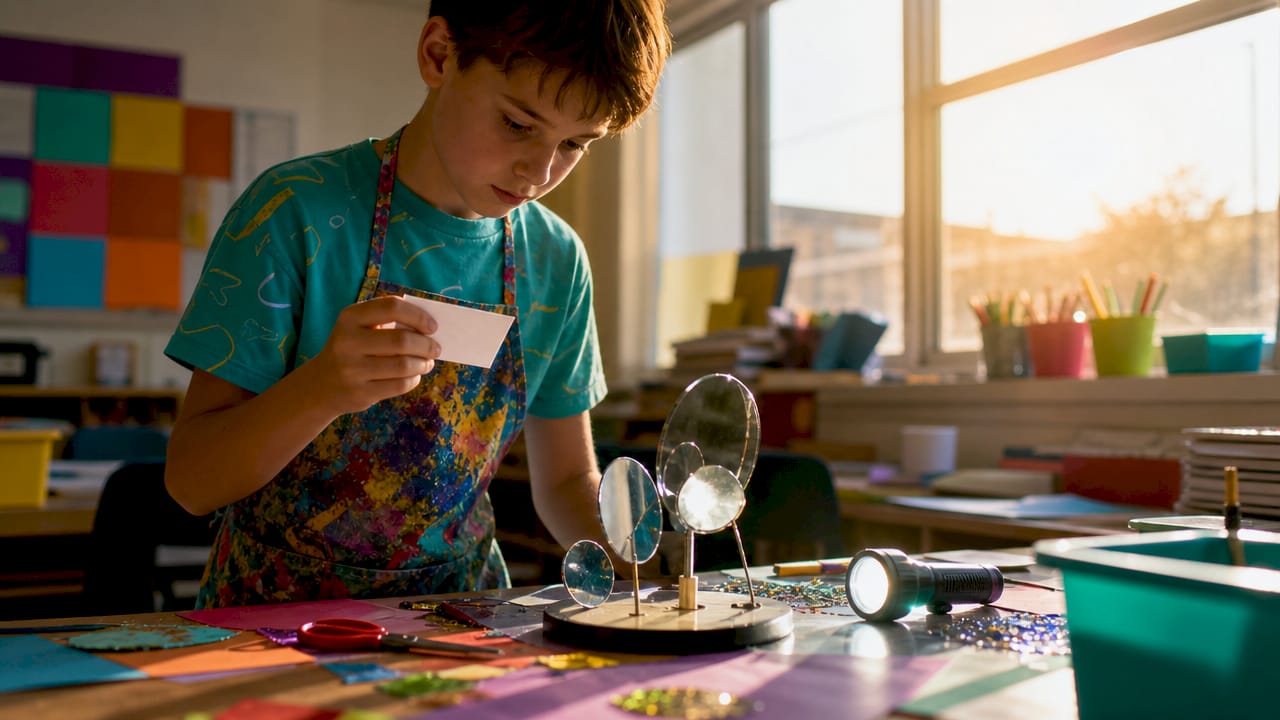
Start in 5 minutes: Write a one-sentence mission on an index card (“You are a solar engineer. The city has lost power. Build a reflector to capture sunlight and save the day.”), hand it to the child with a mirror and a flashlight, and let the story begin. For a ready-to-run STEAM activity guide that maps these formats to age bands, Teamgeniussquad’s parent resource is a strong starting point.
Table of Contents
- Why does storytelling make STEM learning stick?
- Six screen-free activity templates you can run this week
- How do you design a student-centered STEM story from scratch?
- How do you adapt activities for different ages and learning needs?
- What do materials, time, and costs actually look like?
- How do hands-on kits and role-play deepen storytelling outcomes?
- Key Takeaways
- Why screen-free, identity-driven kits are worth defending
- Teamgeniussquad kits bring these templates to life
- Sources and further reading
Why does storytelling make STEM learning stick?
Narrative scaffolds make abstract phenomena tangible and memorable. When a child is cast as the hero of a Mission-to-Mars challenge, the physics of thrust and gravity stop being definitions to memorize and become plot problems to solve. Research published in an MDPI special issue on STEM disciplines confirms that embedding scientific concepts within established narratives helps students model and visualize abstract phenomena, particularly in optics and systems thinking, where cause-and-effect chains are otherwise invisible.
“Storytelling is not only a communication tool; it is an avenue for identity work that helps underrepresented learners see themselves as creators rather than passive recipients.” — Times Higher Education
The identity dimension matters just as much as comprehension. Narrative-based STEM practice helps students narrate their own learning journeys, which builds confidence and belonging, especially for neurodivergent and underrepresented children. Vivify STEM’s multi-session mission sequences use a consistent narrator and mission framing across lessons precisely because that continuity sustains engagement when a single experiment would not. The SciComm Society’s hook-hero-arc framework adds another layer: when children identify as the hero of a scientific story, failed experiments become plot twists rather than personal failures, and persistence follows naturally.
Six screen-free activity templates you can run this week
Mission-based templates
1. Rescue the Alien Lander (Ages 5–13) Materials: index cards, aluminum foil, tape, cotton balls, a small toy figure, ruler Steps: (1) Read the mission card aloud: “An alien lander has crash-landed. Design a cushion system to protect the crew.” (2) Children sketch their design. (3) Build the cushion from foil and cotton. (4) Drop the lander from a low height and record results. (5) Iterate and narrate what changed. Time: 20 min (quick), 45 min (full lesson with redesign), 90 min (multi-session with written mission log) Age mods: Ages 5–7 use pre-cut foil strips; older children measure drop height and estimate impact force. Learning goals: Engineering design cycle, cause-and-effect reasoning Reflection prompt: “What was the hardest part of your mission? What would you change on the next launch?”
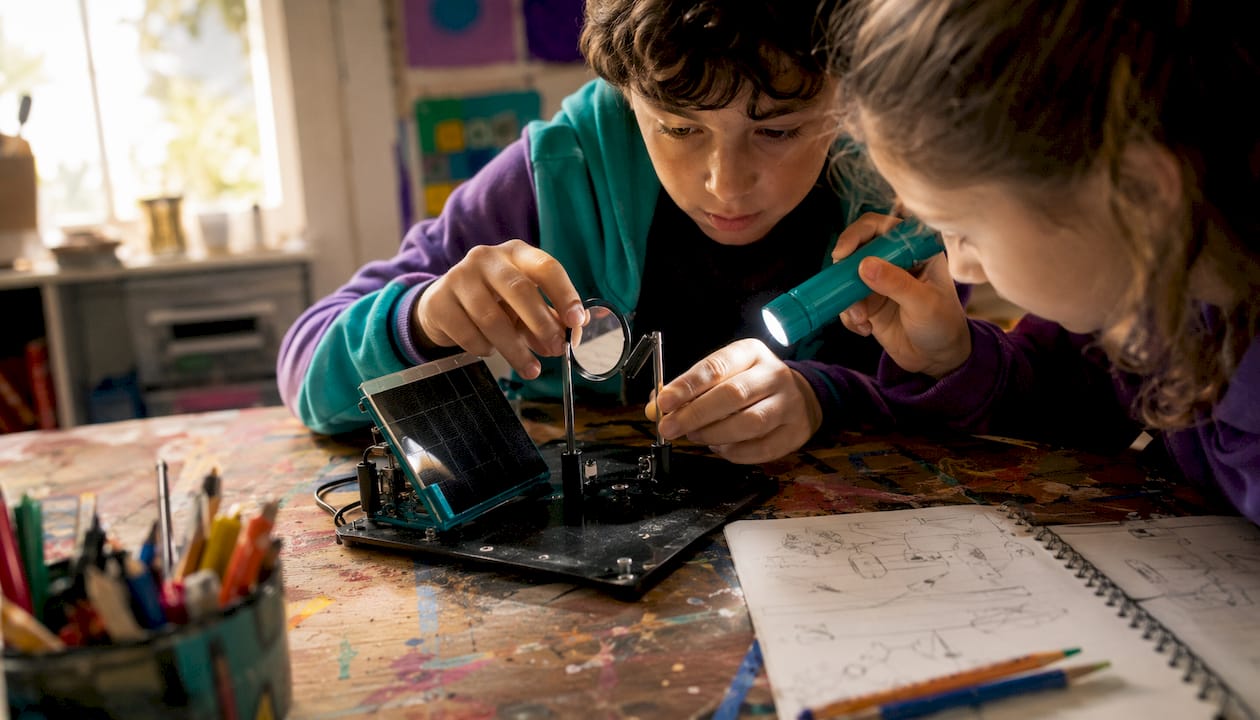
2. Solar Power Station (Ages 8–13) Materials: mirror disk or reflective card, flashlight, graph paper, pencil Steps: (1) Mission card: “You are a solar engineer. Map where sunlight travels.” (2) Angle the mirror and trace the reflected beam on graph paper. (3) Predict where the beam will land if the mirror rotates 10 degrees. (4) Test and record. (5) Write a one-paragraph “field report.” Time: 20–45 min Age mods: Ages 8–10 draw the path; ages 11–13 measure angles and write equations. Learning goals: Optics, scientific prediction, data recording
3. Environmental Detective (Ages 8–13) Materials: magnifying glass, soil sample, water, coffee filter, notebook Steps: (1) Mystery card: “Something is changing the water. Find the clue.” (2) Filter the soil sample through the coffee filter into water. (3) Observe and record color, particles, smell. (4) Form a hypothesis. (5) Present findings as a detective’s case report. Time: 45–90 min Learning goals: Observation, hypothesis formation, scientific writing
Artifact-focused templates
4. Shadow-Puppet Optics Play (Ages 5–10) Materials: cardstock, scissors, a flashlight, a white wall or sheet Steps: (1) Children draw and cut a character. (2) Hold the puppet between the flashlight and the wall. (3) Move it closer and farther; observe shadow size. (4) Create a two-minute story using the shadow. (5) Explain why the shadow changed size. Time: 20–45 min Learning goals: Light and shadow, spatial reasoning, narrative sequencing Reflection prompt: “How did you use science to make your story more dramatic?”
5. Thaumatrope Storyteller (Ages 6–11) Materials: cardstock circle, two rubber bands, markers Steps: (1) Draw one image on each side of the circle (a bird, then a cage). (2) Attach rubber bands to each side. (3) Spin and observe the illusion. (4) Write the “science behind the magic” in three sentences. (5) Share the story of how the illusion works. Time: 20–30 min Learning goals: Persistence of vision, optical science, science communication *Science Buddies lists thaumatropes as one of the most accessible artifact projects for pairing craft and narrative.
6. Cardboard Automaton Hero (Ages 9–13) Materials: cardboard, brass fasteners, rubber bands, markers, scissors Steps: (1) Design a character with one moving part (an arm that waves). (2) Build using fasteners as pivot points. (3) Write the character’s origin story on the back. (4) Demonstrate the mechanism and explain how the pivot works. (5) Iterate to add a second movement. Time: 45–90 min Learning goals: Simple machines, mechanical reasoning, creative writing
Pro Tip: When a build fails, say “That’s a plot twist, not a mistake.” Reframing failure as a story event keeps children in the problem-solving mindset and models scientific iteration naturally.
| Activity | Science Concept | Literacy Skill | Age Range |
|---|---|---|---|
| Rescue the Alien Lander | Engineering design | Oral narration | 5–13 |
| Solar Power Station | Optics / reflection | Field report writing | 8–13 |
| Environmental Detective | Earth science | Case report | 8–13 |
| Shadow-Puppet Optics Play | Light and shadow | Story sequencing | 5–10 |
| Thaumatrope Storyteller | Persistence of vision | Science explanation | 6–11 |
| Cardboard Automaton Hero | Simple machines | Origin story writing | 9–13 |
How do you design a student-centered STEM story from scratch?
A research-first workflow converts storytelling from a gimmick into a genuine inquiry scaffold. The five-stage process: Identify the hero and problem → Research and model → Design and build → Test and iterate → Narrate and reflect.
Sample prompts by stage: Research (“What do engineers actually do when a bridge fails?”), Design (“Sketch three possible solutions before you pick one”), Narrate (“Write the moment your design surprised you”). For educators who want a rubric, score scientific reasoning and narrative clarity on separate columns so technical rigor and creative expression both get credit, a structure Meridian Stories recommends explicitly. The identity-driven STEAM educator guide from Teamgeniussquad extends this framework with classroom implementation notes.
Facilitation tip: Resist answering the child’s design questions directly. Instead, ask “What does your story need to happen next?” That one reframe keeps ownership with the child and the narrative moving forward.
How do you adapt activities for different ages and learning needs?
Every template above scales with a few targeted adjustments. The core principle: reduce steps, not richness.
Modification checklist:
- Provide a visual schedule (numbered picture cards) for children who need predictability
- Break each build into two-minute chunks with a clear stopping signal
- Offer nonverbal reflection options: drawing the story, recording a voice memo, or a physical show-and-tell
- Replace written logs with observation stamps or sticker charts for ages 5–7
For neurodivergent learners, artifact-based narration is especially powerful. A child who struggles with long written reports can build an automaton and explain the mechanism aloud, demonstrating technical mastery without the barrier of extended writing. Case examples show students building physical objects to narrate their learning, which increases both engagement and self-efficacy.
Role-play elements add identity without performance pressure. A simple lab-coat script (“You are now Chief Engineer. Your mission begins.”), a printed badge, and a completion certificate at the end of the session signal that the child has become something, not just done something. For identity-driven STEM ideas organized by age, Teamgeniussquad’s resource library is worth bookmarking.
Scaling one template two ways: A 6-year-old doing Shadow-Puppet Optics Play uses pre-cut puppet shapes and narrates the story verbally. A 12-year-old doing the same activity measures shadow ratios, writes a hypothesis about distance and size, and presents findings as a short science communication video.
Pro Tip: For a child who needs an extra challenge, add a constraint mid-session (“Your mission just changed: you can only use one hand”). Constraints push creative thinking without requiring new materials.
What do materials, time, and costs actually look like?
Most of these activities cost very little. The table below reflects typical household availability and approximate purchase costs in the US.
| Material | Household? | Approx. Cost | Notes |
|---|---|---|---|
| Cardstock / cardboard | Usually yes | $5 | Cereal boxes work perfectly |
| Aluminum foil | Yes | — | Standard kitchen roll |
| Brass fasteners | Sometimes | $3–$5 | Hardware or craft store |
| Mirror disk / reflective card | No | $5–$10 | Or use a compact mirror |
| Flashlight | Yes | — | Any household flashlight |
| Rubber bands | Yes | —–$1 | |
| Magnifying glass | Sometimes | $3–$8 | |
| Kit items (lab coat, badges) | No | $15 | Teamgeniussquad kits include these |
Time blocks: A 20-minute session covers one build-and-narrate cycle. A 45-minute lesson adds a redesign round and a written reflection. A 90-minute or multi-session project includes research, building, testing, and a final story presentation.
Safety notes: Brass fasteners have sharp points; supervise ages 5–7 during assembly. Hot glue guns (optional upgrade) require adult handling for children under 10. Small parts in automaton builds are a choking risk for children under 4.
Budget tip: Swap kit mirror disks for compact mirrors from a dollar store. Swap cardstock for cereal box panels. The science does not change.
How do hands-on kits and role-play deepen storytelling outcomes?
Physical kits and role-play props do something a worksheet cannot: they make the child’s identity as a scientist visible. When a child puts on a lab coat, pins on a mission badge, and receives a completion certificate, the story stops being pretend and starts being real.
| Activity | Essential Kit Pieces | Optional Props |
|---|---|---|
| Rescue the Alien Lander | Foil, cotton, mission card | Mission badge, lab coat |
| Solar Power Station | Mirror disk kit, flashlight | Field report pad |
| Thaumatrope Storyteller | Cardstock, rubber bands | Completion certificate |
| Cardboard Automaton Hero | Cardboard, brass fasteners | Engineer badge, origin-story booklet |
Teamgeniussquad’s E³ Method (Engage → Encourage → Empower) maps directly onto the storytelling arc. Engage is the mission card moment. Encourage is the facilitated build, where the adult asks questions rather than giving answers. Empower is the certificate and the narration, where the child presents what they discovered. Role-play lives in all three stages, but it peaks at Empower, when the child stands in front of their artifact and explains it as a scientist would.
The brand’s founding story matters here. Teamgeniussquad was inspired by a real family journey with dyslexia and dysgraphia, and the kits were designed specifically so that a child who struggles with reading and writing can still experience full scientific success through tactile artifact creation. The physical object anchors confidence in a way that a written test cannot.
Key Takeaways
Story-driven, screen-free STEM activities work best when the child is cast as the hero, the build is the evidence, and the reflection is the final chapter.
| Point | Details |
|---|---|
| Start with one mission | A single index-card mission prompt launches any of the six templates in under five minutes. |
| Use one artifact activity | Thaumatropes, shadow puppets, and automata make abstract science concepts visible and shareable. |
| Add one identity element | A badge, lab coat, or certificate shifts a child’s self-perception from “doing an experiment” to “being a scientist.” |
| Adapt, don’t simplify | Reduce steps and add visual schedules for younger or neurodivergent learners without removing the science. |
| Teamgeniussquad kits | Screen-free kits with the E³ Method pair role-play props with hands-on experiments for ages 5–13. |
Why screen-free, identity-driven kits are worth defending
The conventional wisdom in STEM education still leans heavily on digital tools, apps, and coding platforms as the markers of a “modern” learning experience. That framing quietly sidelines the children who learn best by touching, building, and narrating. Tactile artifact creation supports writing, sequencing, and self-efficacy in ways that screen-based activities rarely replicate, because the child’s hands are doing the thinking alongside their mind.
Teamgeniussquad’s approach, grounded in the E³ Method and inspired by a real family’s experience with dyslexia and dysgraphia, is a direct response to that gap. The kits are not a lower-tech substitute for digital learning. They are a different and often more powerful route to scientific identity, particularly for children whose strengths do not show up on a reading-speed test. When a child builds a solar reflector, writes a field report in their own words, and pins on a mission badge, they are not just learning science. They are becoming someone who does science. That distinction is what every educator and parent in this space should be protecting.
Teamgeniussquad kits bring these templates to life
The six templates in this guide map directly to what Teamgeniussquad builds: screen-free, hands-on STEAM kits designed for children ages 5–13, with role-play props built in. The Science Solar Energy Kit is a natural fit for the Solar Power Station mission, complete with a mirror disk and guided experiment. The Team Genius Squad STEM Puzzle pairs narrative play with hands-on problem solving, making it a strong first kit for families just starting out.
Every kit ships with the E³ Method built into the experience, so parents and educators do not need to design the facilitation from scratch. If you are ready to run your first story-driven STEM session this week, the Solar Energy Kit is the place to start. Visit shop.teamgeniussquad.com to find the kit that fits your child’s age and curiosity.
Sources and further reading
- Science Buddies: Storytelling STEM Activities — activity ideas for thaumatropes, shadow puppets, flipbooks, cardboard automata, and invisible ink; printable templates available
- Meridian Stories: A Teacher’s Guide to STEM Storytelling — research-first workflow, rubric design, and facilitation prompts for educators
- MDPI Special Issue: Storytelling in STEM Disciplines — academic grounding for narrative scaffolds and identity development
- Times Higher Education: Storytelling in STEM — connecting concepts, confidence, and identity; neurodivergent-friendly approaches
- SciComm Society: Practical Storytelling Guide for Scientists — hook, hero, and emotional arc techniques
- Teamgeniussquad: Identity-Driven STEM Ideas for Kids Ages 5–13 — age-banded activity ideas and confidence-building frameworks
- Teamgeniussquad: What Is Identity-Driven STEAM? A Guide for Educators — classroom implementation and E³ Method overview
- GeniusHub Learning — extended instructional support for families running multi-session story-driven STEM projects

,%20an%20artifact-driv...)
Leave a comment
This site is protected by hCaptcha and the hCaptcha Privacy Policy and Terms of Service apply.