5 Minute Exit Tickets for K–8 Science Reflection Questions
This page hands you a categorized bank of science reflection questions for grades K through 8, built for teachers and parents who need something usable today. You’ll find prompts sorted by the thinking they invite, quick exit ticket formats, sentence starters, and grade-level scaffolds you can copy straight into a notebook or slide.
TL;DR:
- Reflection questions should be tailored to grade levels, using visual prompts for younger students and evidence-based prompts for older students.
- Using specific routines like quick exit tickets and design step reflections helps teachers identify student understanding and plan targeted follow-ups.
- Incorporating visual, writing, and metacognitive prompts encourages deeper reflection without increasing cognitive load for students.
- Consistent reflection routines combined with hands-on kits reinforce learning and foster identity development as young scientists.
- Sorting student responses into understanding categories provides immediate guidance for instruction and supports continuous learning progress.
Table of Contents
- Science Reflection Questions Sorted by Thinking Type
- Exit Tickets and 3-2-1: Reflection in Under Five Minutes
- Reflection Prompts for Engineering Design and Group Work
- Adapting Reflection Prompts by Grade Band: K-2, 3-5, 6-8
- Building a Reflection Routine That Actually Informs Instruction
- Team Genius Squad’s E³ Method in Action
- Why Reflection Builds More Than Science Knowledge
- Pair Reflection Routines With Hands-On Science Kits
- Sources
Science Reflection Questions Sorted by Thinking Type
Not every reflection question does the same job. Some pull out process thinking. Others check for evidence. A few build emotional awareness about teamwork. Sorting your science reflection questions by category means you grab the right tool instead of reaching for the same three prompts every week.
Process prompts ask students to narrate their own thinking:
- What did you try first, and what happened?
- What would you change if you did this experiment again?
- Where did you get stuck, and how did you get unstuck?
Content and evidence prompts push students toward the data itself, an approach that echoes formal scientific inquiry practices:
- What evidence supports your explanation?
- What data did you collect, and how sure are you of your conclusion?
- What surprised you about the results?
Metacognitive prompts track how thinking shifted over the course of a lesson. The California Academy of Sciences recommends sentence starters like “I used to think, now I think” specifically because they force students to name the change rather than just restate a fact.
- I used to think _____, now I think _____ because _____.
- What question do you still have?
- What’s one thing you’ll remember about today’s lesson?
SEL and collaboration prompts matter as much as the science, especially after group labs:
- What role did you play on your team today?
- How did it feel when your idea worked or didn’t work?
- Who helped you understand something better, and how?
Keep a handful from each category taped inside your teacher binder or pinned to a classroom folder. You’ll rotate them without ever writing a new prompt from scratch.
Exit Tickets and 3-2-1: Reflection in Under Five Minutes
An exit ticket is a short task students complete right after an activity, and NSTA recommends keeping it under five minutes and narrow in scope, one Science and Engineering Practice or Crosscutting Concept at a time. That constraint is the whole point. A tighter question gets you a clearer answer.
Two formats cover most classroom needs:
- The 3-2-1 science variant: 3 things you learned, 2 things you’re still wondering about, 1 question you’d ask a scientist.
- The micro-exit ticket: one content question (“What’s one fact you learned about magnets?”) paired with one process question (“What part of today’s lab was hardest?”).
Pro Tip: Sort exit tickets into three quick piles while students pack up: “got it,” “partial,” and “needs a re-teach.” That two-minute sort tells you exactly who needs a follow-up conversation tomorrow, without grading a single paper at home.
Reflection Prompts for Engineering Design and Group Work
Engineering design challenges deserve their own set of reflection questions because the goal isn’t a single right answer. It’s iteration. Map your prompts to the steps students actually followed:
- Ask/Imagine: What was the problem you were trying to solve?
- Plan/Create: What was your biggest challenge while building?
- Improve: What worked, and what would you change on your next attempt?
For group work, add prompts that surface individual contribution alongside team dynamics:
- What was your specific role in the group?
- Did your team agree easily, or did you have to work through disagreement?
- What’s one thing a teammate did that helped the group succeed?
Private notebook reflection works best for honest self-assessment, especially about conflict. Save group sharing for celebrating wins or comparing design solutions across teams.
Adapting Reflection Prompts by Grade Band: K-2, 3-5, 6-8
A first grader and an eighth grader can’t answer the same reflection question the same way, so the scaffold has to shift even when the core question stays similar.
- K-2: Rely on visual prompts and short oral sentence starters. Try “Draw what you saw” paired with “I felt _____ when _____.” Keep it to one drawing and one sentence.
- Grades 3-5: Combine drawing with short writing using a “Write It, Draw It” structure. Prompt example: “Draw your experiment, then write one sentence about what surprised you.”
- Grades 6-8: Shift to evidence-based, revision-oriented prompts. “I used to think _____, now I think _____ because the data showed _____” works well here, since older students can articulate the reasoning behind a change in thinking.
Pairing a visual task with a short sentence starter improves both the quantity and clarity of reflection for younger and neurodivergent students without adding extra cognitive load.
Building a Reflection Routine That Actually Informs Instruction
A reflection question is only useful if you do something with the answer. Pick one routine and stick with it rather than trying all three at once:
- Mini-debriefs: the last 10 minutes of a session, used to catch immediate confusion.
- Weekly notebook reviews: a slower read-through where you look for patterns across five days of entries.
- Mid-project check-ins: useful during multi-day builds, where reflection shapes the next work session.
Reflection works best as a continuous habit rather than a one-time wrap-up, and having students re-read their own past entries helps them notice their own learning trajectory. Sorting responses into quick piles (understood it, partially got it, missed it) takes two to five minutes per class and points you straight to tomorrow’s mini-lesson.
Pro Tip: For students who freeze up at open-ended prompts, offer a sentence frame and a visual option side by side. Letting a student choose between “write” and “draw” removes the barrier without lowering the expectation.
Team Genius Squad’s E³ Method in Action
Here’s how one hands-on session might run using the E³ Method: Engage with a solar energy experiment, Encourage as students test and adjust their setup, then Empower with reflection: “What did you discover about how mirrors capture sunlight?” and “If you built this again, what’s one change you’d make?”
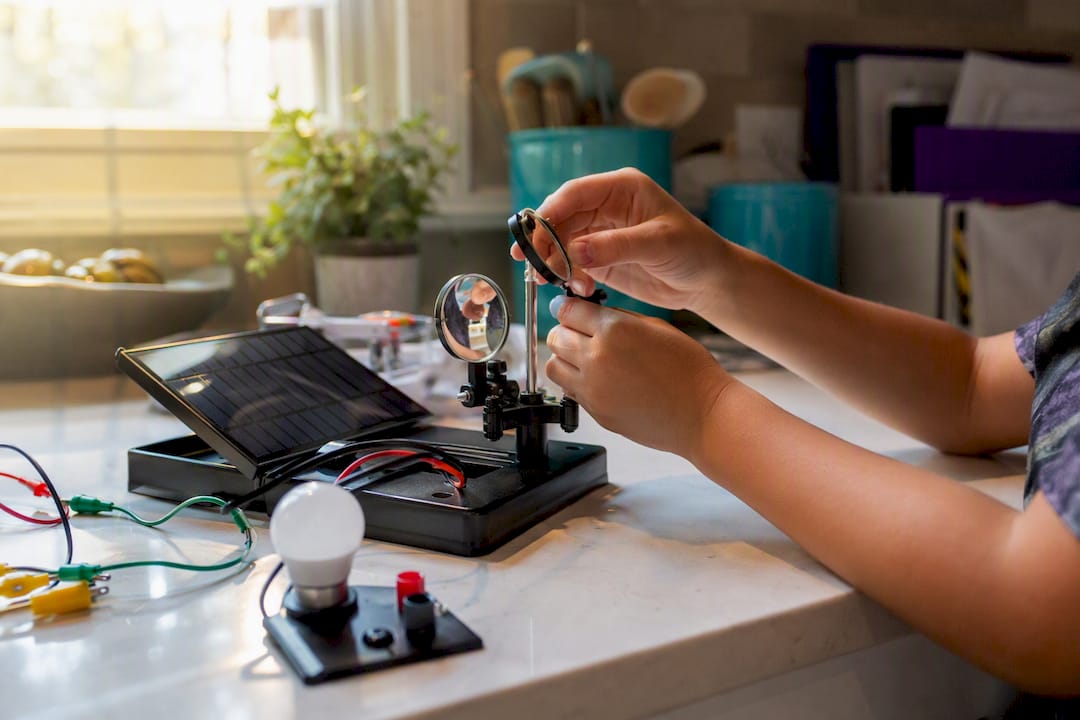
Collect answers on an exit ticket and in the science notebook, then pick one visible teacher action, maybe a follow-up demo on reflection angles, based on what shows up most often. This kind of identity-driven role-play helps kids see themselves as the scientist behind the discovery, not just a participant in someone else’s lesson.
Why Reflection Builds More Than Science Knowledge
Kids who reflect regularly start describing themselves differently. Not “I’m bad at science,” but “I used to think I couldn’t figure this out, now I think I just needed another try.” That shift in language is the real payoff, and it shows up faster than most standardized measures ever will.
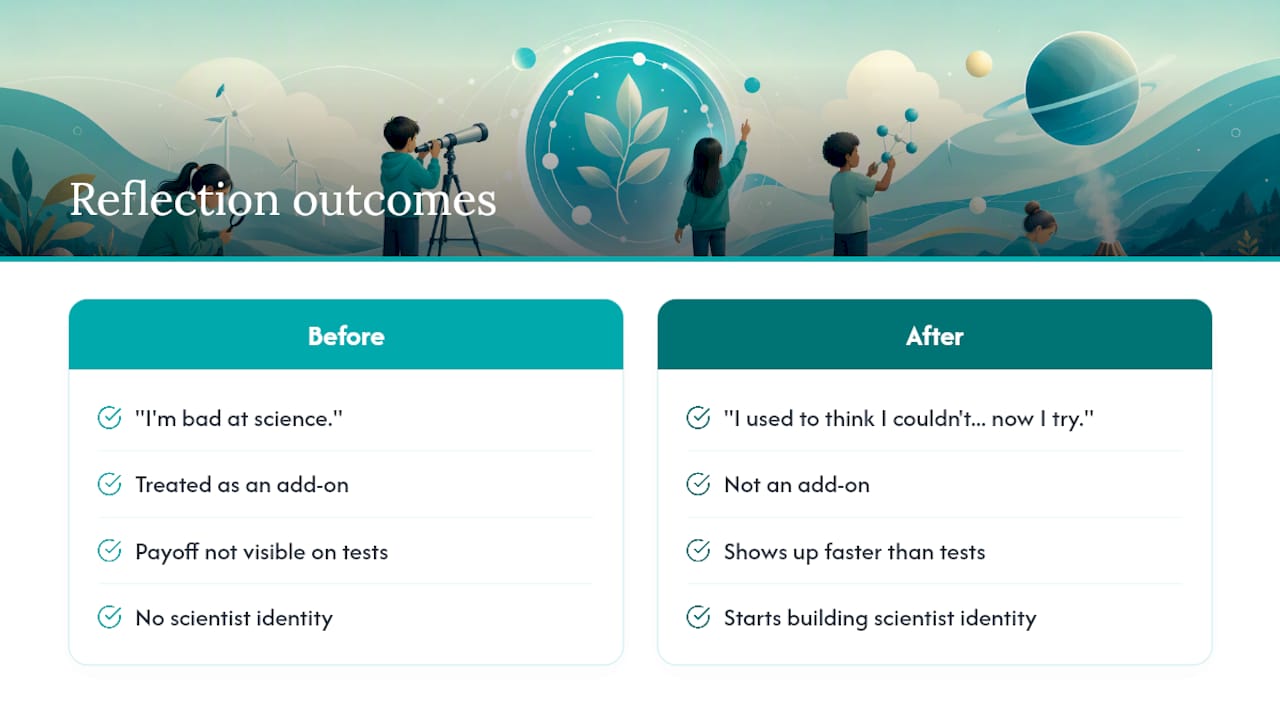
Reflection isn’t an add-on to a lesson. It’s where a student starts building an identity as someone who thinks like a scientist.
— Tita
Pair Reflection Routines With Hands-On Science Kits
Reflection questions work best when there’s something worth reflecting on, and that’s where a hands-on kit earns its place in the routine. Team Genius Squad builds each experiment with clear steps, story frames, and role-play moments that naturally set up a strong reflection question at the end, instead of you scrambling to invent one after the mess is cleaned up.
If you’re looking for a ready sequence, the lesson plans pair kits with built-in reflection activities, and a kit like the Science Solar Energy Kit with Mirror Disk gives you a concrete design challenge to reflect on right away. Browse the lesson plans page and pick one sequence to try during your next science block.

Leave a comment
This site is protected by hCaptcha and the hCaptcha Privacy Policy and Terms of Service apply.