12 Magnet Experiments for Kids That Turn Curiosity Into Confidence
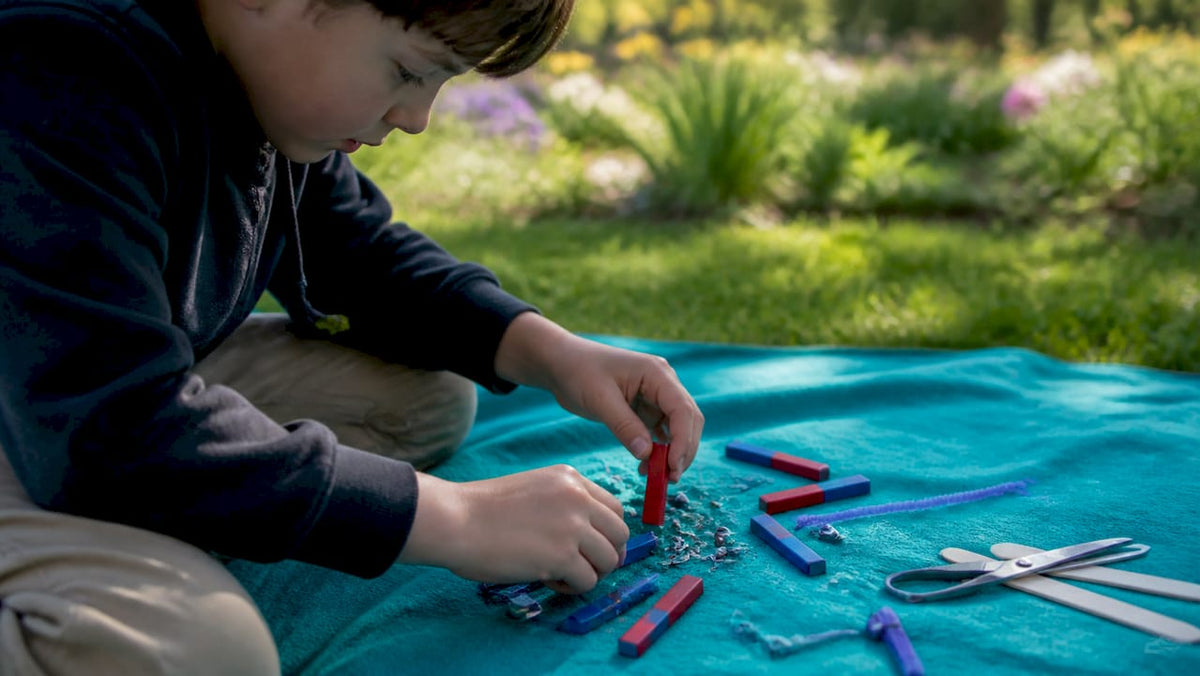
This article hands you a ready-to-run set of magnet experiments for kids, sequenced for preschool through early elementary and built on a simple predict-test-observe method. Every activity below uses household-friendly supplies, includes a safety note where it matters, and points to age-appropriate adult help. Start with the numbered list below and pick whichever one matches what you already have on hand.
TL;DR:
- Repetition enhances learning, so children should try each magnet activity three to four times before progressing.
- Safe magnet play for young kids involves low-strength, grip-friendly magnets, with strong neodymium magnets reserved for older children under supervision.
- Starting with prediction and explanation, rather than demonstrations, builds stronger understanding and critical thinking in magnetism lessons.
- Older children can explore measurement and engineering concepts by graphing magnetic forces and racing magnet-powered cars for practical learning.
- Using ready-made kits that include guided activities and scaffolds supports confidence-building and accommodates neurodivergent learners.
Table of Contents
- The Best Magnet Experiments For Kids To Try Today
- Which Magnets And Materials Are Safe For Young Kids?
- How Do You Teach Magnetism So It Actually Sticks?
- How Can You Extend Magnet Experiments For Older Kids?
- Why Prediction Beats Demonstration Every Time
- Turn These Experiments Into A Confidence-Building Kit
- Where To Find More Magnet Activities And Curriculum Support
- Sources
The Best Magnet Experiments For Kids To Try Today
Each entry gives supplies, quick steps, what to expect, and the science behind it. Start wherever your child’s curiosity points first.
-
Magnet Maze. Draw a maze on paper, tape it over a shallow box, and drop a paperclip inside. Move a bar magnet underneath to guide the clip through the path. Preschoolers need help holding the box steady; elementary kids can build their own maze. The clip follows the magnet because the magnetic field passes right through the paper and cardboard.
-
Magnet Scavenger Hunt. Give kids a magnetic wand and send them around the house or classroom hunting for objects that stick. Sort finds into “magnetic” and “not magnetic” piles using a tray or muffin tin. This is one of the best magnet activities for preschoolers because it builds intuitive categories before kids ever hear the word “ferromagnetic.”
-
Magnetic Fishing. Attach paperclips to paper fish, drop them in a bin, and use a magnet tied to string as a fishing rod. Kids “catch” fish by dangling the magnet close. Adults should watch toddlers closely since the string and small clips are choking hazards.
-
Floating Paperclip Levitation. Hold a magnet above a paperclip and slowly lift it until the clip hangs in midair, suspended by invisible force. Tape the magnet to a shelf edge for a hands-free version. Expect a few tries before the balance point clicks. A levitating spinner demonstrates the same principle in a ready-made format if you want a polished version afterward.
-
Magnetic Painting. Drop washable paint blobs on paper, place small magnetic marbles or clips in the paint, then drag them with a magnet from underneath. The result is swirled, unpredictable art. Keep small magnetic pieces away from children under three.
-
Magnet-Powered Car. Tape a magnet to a toy car and use a second magnet to push or pull it across the table without touching it. Kids quickly discover that flipping the magnet reverses whether it pushes or pulls. Framing this as a race with a sibling or classmate boosts engagement more than a solo trial.
-
Simple Compass. Rub a sewing needle along a magnet 20 times in one direction, then float it on a small piece of foam in a bowl of water. The needle rotates to point north. This works best for elementary-age kids since it requires patience and fine motor control.
-
How Strong Is This Magnet? Line up paperclips end to end and see how many a single magnet can hold in a chain before it drops one. Compare a small magnet against a larger one and record the counts. MIT’s magnetic force lab manual uses a similar setup for older students measuring force against distance.
-
Build a Simple Electromagnet. Wrap insulated copper wire around an iron nail, strip the wire ends, and connect them to a AA battery. The nail temporarily picks up small metal objects. This one requires strict adult supervision at every step, from handling wire ends to managing the battery connection.
-
Magnet Sensory Bottle. Fill a clear bottle with water, oil, and small magnetic beads or iron filings, then seal the lid tightly (consider gluing it shut). Kids move a magnet along the outside to watch the beads travel. It’s a calming, screen-free activity that also works well for kids who need a sensory break between more active experiments.
- Older-kid bonus: magnetic slime, made by mixing iron filings into clear glue-based slime, reacts to a strong magnet and is worth trying with supervised older children.
- Cross-curricular bonus: pair the magnet maze with a story about a character navigating a maze, using low-cost craft supplies from simple clothespin crafts for the maze walls.
Pro Tip: Run one experiment at a time and let kids repeat it three or four times before moving on. Repetition is where the real “aha” moment happens, not the first try.
Which Magnets And Materials Are Safe For Young Kids?
Bar magnets and magnetic wands work well for preschoolers because they’re low-strength and easy to grip. Disc magnets and neodymium magnets are far stronger and better reserved for elementary-age kids under direct supervision, since neodymium magnets carry real ingestion and pinch hazards when swallowed or snapped together near fingers.
- Never leave small magnets unattended with children under five.
- Keep all magnets away from electronics, credit cards, and pacemakers or other medical devices.
- Glue or tape sensory bottle lids shut before handing them over.
- Supervise every step of the battery-and-wire electromagnet build.
- Buy magnetic wands or bar magnet sets from a toy or teacher-supply store rather than pulling loose magnets from household junk drawers, which often hide sharp edges.
How Do You Teach Magnetism So It Actually Sticks?
Start every activity with a guess, not a demonstration. Ask kids which of five objects on the table will stick to the magnet and why, before they test a single one. TeachEngineering’s research on prediction-and-testing shows this order builds stronger critical thinking than watching an adult demonstrate first, and it corrects wrong assumptions faster than a lecture ever could.
- Rotate kids through stations in pairs so no one waits long for a turn.
- Hand out a one-page record sheet where kids draw or write “predicted” versus “actual” results.
- Use challenge cards (“find 5 magnetic objects in under 2 minutes”) to add friendly pressure.
- Check for target vocabulary by the end: magnetism, poles, attract, repel.
Pro Tip: Ask “why do you think that?” after every prediction, right or wrong. The reasoning matters more than the guess.
How Can You Extend Magnet Experiments For Older Kids?
Turn the paperclip chain test into a real measurement task: graph how many clips a magnet holds at different distances and watch the pull weaken fast as the gap grows. Race magnet-powered cars for a lightweight engineering challenge, or pair magnetic painting with a short writing prompt about the artwork for a literacy tie-in. Real-world hooks make the biggest difference for older kids: household motors, speakers, and compasses all run on the same magnetic principles as the CERN magnet challenge, which links classroom-scale experiments to accelerator magnets that are millions of times stronger.
- Measurement: distance vs. force with paperclip counts.
- Engineering: magnet-car race with a stopwatch.
- Literacy: a short “what I discovered” reflection page.
Why Prediction Beats Demonstration Every Time
Most magnet activities you’ll find online skip straight to the fun part. Show the trick, watch the kids gasp, move on. That approach entertains, but it doesn’t build understanding, and it definitely doesn’t build the kind of confidence that carries over into the next experiment.
What actually works is messier and slower: a kid guessing wrong about whether a plastic spoon sticks to a magnet, testing it, and realizing their assumption was off. That small moment of being wrong, then figuring out why, does more for a child’s scientific identity than ten flawless demonstrations. It’s also the exact gap our E³ Method was built around: Engage first through a real question, Encourage the messy middle where wrong guesses happen, then Empower the kid to explain what they learned in their own words. Kids who struggle with reading or writing, in particular, often shine in this format because the learning happens through hands, not pages.
— Tita
Turn These Experiments Into A Confidence-Building Kit
Running these experiments one supply run at a time works fine for a rainy afternoon. But if you want the full E³ Method experience without hunting down wire, magnets, and record sheets yourself, Teamgeniussquad packages it for you.

Our S.T.E.M. Wave Wires Magnet Experiment Lab Kit includes the magnets, guided prediction cards, and a role-play lab coat and badge so kids step into the identity of a real scientist while they work, not just follow instructions. Every kit is designed for ages 5 to 13 with neurodivergent-friendly scaffolds built in, since the brand grew out of a real family’s experience with dyslexia and dysgraphia. Educators looking for ready-made scaffolding and assessment rubrics can grab our lesson plans to pair directly with the activities above. Browse the full experiment kits collection and get one on the way before the next rainy afternoon hits.
Where To Find More Magnet Activities And Curriculum Support
- TeachEngineering offers classroom-tested activities and the prediction-and-testing method used throughout this article.
- CERN’s magnet challenge connects kid-friendly experiments to real particle-accelerator magnets.
- National MagLab’s “Try This at Home” hub lists safe, family-tested magnet activities.
- MIT OpenCourseWare’s lab manual gives older students formal measurement procedures.
- 3M Science at Home’s “Push & Pull” activities suit K to 2 classrooms with clear, grade-aligned steps.
- Pair any activity with a book from our STEM books and puzzles collection or a literacy warm-up from Icon Literary’s songs for kids for a smoother classroom transition.
Sources
- TeachEngineering: prediction-and-testing activity
- National MagLab: Try this at home
- MIT OCW: Magnetic force and fields lab manual
- 3M Science at Home: Push & Pull

Leave a comment
This site is protected by hCaptcha and the hCaptcha Privacy Policy and Terms of Service apply.