Team Building Experiments for Kids: 10 Fun Ideas
Team building experiments for kids are structured, collaborative activities that teach children to communicate, solve problems, and trust their teammates through hands-on challenges. These activities go far beyond simple games. Teamwork skills like active listening, patience, and respectful communication are life skills that children carry into every classroom and relationship. The most effective children’s teamwork activities prioritize cooperation over competition, giving every child a real role and a real stake in the outcome. Teamgeniussquad builds this same philosophy into every screen-free STEAM kit it creates, using the E³ Method to move kids from curiosity to confidence.
What are essential design criteria for effective kids’ team building experiments?
The best fun team exercises for kids share a set of design principles that separate a forgettable afternoon from a genuine learning moment. Getting these right before you run any activity saves time and frustration for everyone in the room.
Clear constraints drive creative thinking. Material limits and stability rules like allowing only 30 marshmallows or requiring a structure to hold weight for 10 seconds teach children that real problems have real boundaries. Constraints force kids to plan, negotiate, and adapt rather than just play freely. That tension is exactly where learning happens.
Small teams produce big results. Limiting group size to 2–3 children keeps every child accountable and actively involved. Larger groups often let quieter kids disappear into the background. Smaller teams are especially valuable for shy or neurodivergent children who need space to contribute without being overshadowed.
The other non-negotiable design elements include:
- Structured rules that reward cooperation. Frame success as a shared outcome, not a personal win.
- A facilitator who coaches, not directs. Ask open-ended questions and let children work through friction themselves.
- A reflection phase after every activity. This is where the real learning gets locked in.
Pro Tip: Before starting any group activity, spend two minutes naming the team’s shared goal out loud. Children who understand the “why” behind a challenge engage more deeply and stay focused longer.
Reflection is not optional. Asking questions like “What was your design strategy?” after an experiment turns a 20-minute activity into a lasting lesson. Children who articulate what worked and what failed internalize those lessons far more effectively than children who simply move on to the next task.
10 fun and effective team building experiments for kids aged 5–13
These ten collaborative projects for kids cover a wide range of ages, materials, and skill sets. Each one is designed with clear constraints and a built-in reflection opportunity.
1. Marshmallow bridge challenge
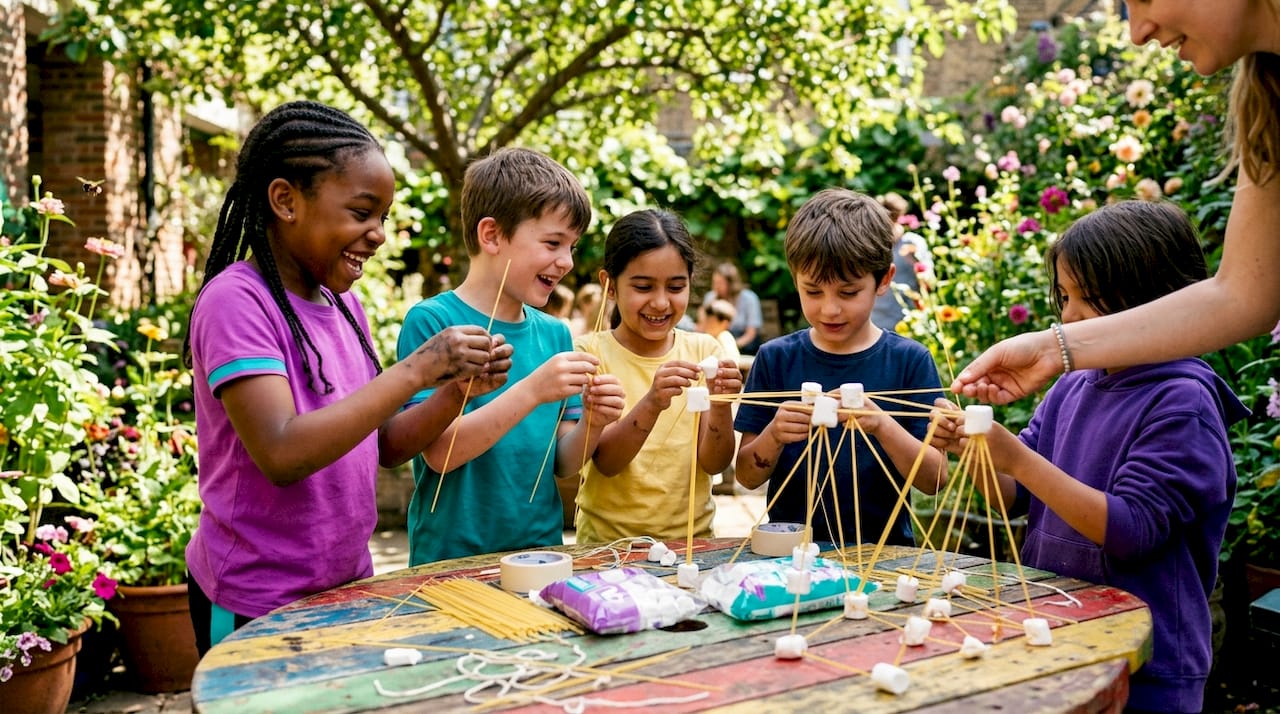
Materials: Marshmallows, dry spaghetti, tape, string. Time: 25–30 minutes. Teams build the longest bridge possible using only the materials provided, then test it by placing a small weight in the center. This experiment teaches structural thinking, negotiation, and shared decision-making. The constraint of fixed materials forces children to prioritize and compromise.
2. Blindfold obstacle course
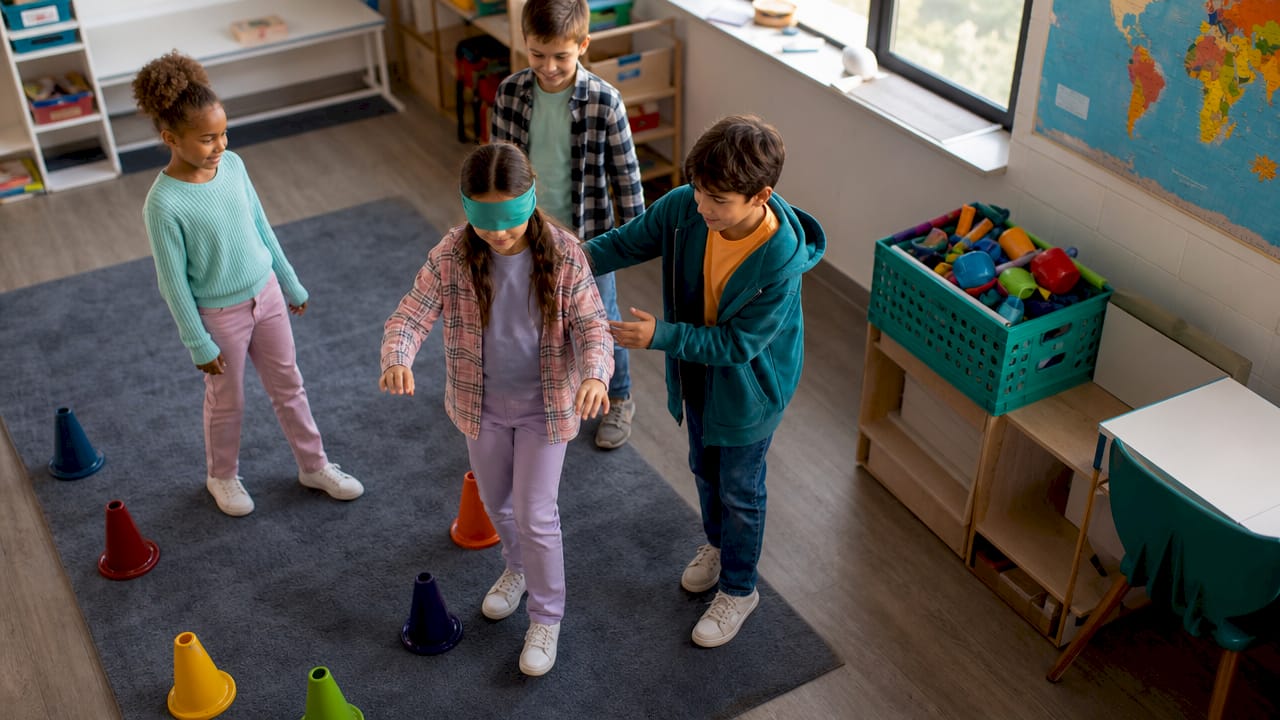
Materials: Blindfolds, cones or household objects. Time: 20 minutes. One child wears a blindfold while a partner guides them through a course using only verbal instructions. This is one of the most direct interactive teamwork challenges for building trust and precise communication. Switch roles so every child experiences both sides of the dynamic.
3. Hula hoop pass
Materials: One hula hoop per team. Time: 15 minutes. Children stand in a circle holding hands and pass a hula hoop around the circle without breaking their grip. The activity sounds simple and quickly reveals how well a group listens and adapts. It works beautifully for ages 5–8 as an opening warm-up.
4. Spaghetti tower
Materials: Dry spaghetti, marshmallows, tape. Time: 20 minutes. Teams build the tallest freestanding tower they can in a set time. The challenge teaches children to test ideas quickly, accept failure without blame, and rebuild. Debrief with: “What did you change after your first attempt?”
5. Puzzle assembly race
Materials: Two identical puzzles, timer. Time: 20–25 minutes. Split a puzzle between two teams and challenge them to assemble their version first. Then combine both teams to assemble a larger puzzle together. The second phase shifts the dynamic from competition to full cooperation, which is a powerful contrast for children to experience directly.
6. Teddy bear bridge
Materials: Paper, tape, scissors, a small stuffed animal. Time: 25 minutes. Teams build a bridge strong enough to hold a stuffed animal using only paper and tape. This experiment is a gentler version of the marshmallow bridge and works well for ages 5–7. The emotional connection to the stuffed animal raises the stakes in a fun, low-pressure way.
7. Egg drop challenge
Materials: Straws, tape, cotton balls, plastic bags, one egg per team. Time: 30–35 minutes. Teams design a protective casing for a raw egg that survives a drop from a set height. This is one of the most memorable experiments for group bonding because the stakes feel real. Children aged 9–13 especially love the engineering problem and the dramatic test moment.
Pro Tip: For younger children, substitute a water balloon for the egg. The visual result is equally dramatic and completely mess-free.
8. Human knot
Materials: None. Time: 10–15 minutes. Children stand in a circle, reach across, and grab two different hands. The group then works together to untangle itself without releasing any hands. This activity requires constant communication and spatial reasoning. It is one of the fastest ways to show a group that talking clearly and listening carefully are the same skill.
9. Relay race with a twist
Materials: Spoons, small balls, cones. Time: 20 minutes. Run a standard relay race but add a rule: if any team member drops the ball, the whole team restarts from the beginning. This rule shifts the mindset from individual speed to collective care. Children quickly learn to cheer for their slowest teammate rather than race ahead.
10. Paper tower with limited tape
Materials: 10 sheets of paper, 30 centimeters of tape per team. Time: 20 minutes. Teams build the tallest freestanding tower using only the materials listed. The tape limit is the critical constraint. Designing experiments with material limitations lets children simulate real-world engineering challenges safely while building creative problem-solving alongside teamwork.
How to facilitate and maximize learning from teamwork activities
Running these activities well matters as much as choosing the right one. Effective facilitators coach rather than direct, using open-ended questions to guide children through friction instead of solving problems for them. This approach builds self-regulation and empathy alongside the specific skill each activity targets.
Mixed-age group facilitation requires flexible routines that give older children leadership opportunities while protecting younger children’s ability to contribute meaningfully. A simple rule like “everyone speaks before anyone speaks twice” levels the playing field without singling anyone out.
Best practices for facilitators:
- Set behavior expectations before you start. Listening, thinking before acting, and helping others are the three rules that create a positive collaborative atmosphere in any group.
- Use open-ended questions throughout. “What could you try next?” works better than “Try doing it this way.”
- Protect every child’s voice. Redirect dominant personalities gently and invite quieter children by name.
- Build in a structured debrief. Spend at least five minutes after every activity asking what worked, what did not, and what the group would do differently.
- Reduce stress before it starts. Frame every experiment as an exploration, not a test. Children take more creative risks when failure feels safe.
Simple, structured activities that foster belonging help children see their classmates as reliable teammates rather than just peers in the same room. That shift in perspective is the real goal of every activity on this list.
Pro Tip: After a debrief, ask each child to name one thing a teammate did well. This habit builds a culture of recognition that carries over into everyday classroom interactions.
Comparing experiments by age, time, and skills
| Experiment | Age Range | Time | Core Skills | Group Size |
|---|---|---|---|---|
| Marshmallow bridge | 7–13 | 25–30 min | Engineering, negotiation | 2–3 |
| Blindfold obstacle course | 6–13 | 20 min | Trust, communication | 2 |
| Hula hoop pass | 5–8 | 15 min | Listening, coordination | 4–8 |
| Spaghetti tower | 7–13 | 20 min | Creative problem-solving | 2–3 |
| Teddy bear bridge | 5–7 | 25 min | Cooperation, basic engineering | 2–3 |
| Egg drop challenge | 9–13 | 30–35 min | Engineering, shared risk | 2–4 |
| Human knot | 6–13 | 10–15 min | Communication, spatial reasoning | 5–10 |
| Paper tower | 6–13 | 20 min | Creativity, resource management | 2–3 |
Key Takeaways
The most effective team building experiments for kids combine clear material constraints, small group sizes, and a structured reflection phase to build lasting collaboration and problem-solving skills.
| Point | Details |
|---|---|
| Constraints create learning | Fixed material limits and time rules push children to plan, negotiate, and adapt. |
| Small teams maximize participation | Groups of 2–3 children keep every child accountable and actively involved. |
| Reflection locks in the lesson | Asking “what worked?” after every activity turns a game into a lasting skill. |
| Coaching beats directing | Facilitators who ask questions instead of giving answers build self-regulation and empathy. |
| Cooperation beats competition | Activities framed around shared success increase participation and trust across all age groups. |
Why the reflection phase is the most underrated part of any group activity
I have run children’s teamwork activities in classrooms, after-school programs, and family settings for years, and the pattern is always the same. Adults spend 90% of their energy choosing the right activity and about 30 seconds on the debrief. That ratio is backward.
The reflection phase is where children actually learn to name what they did. A child who can say “I noticed I kept interrupting, so I tried waiting” has just practiced metacognition. That is a skill most adults still struggle with. The activity itself is just the context.
My honest advice: pick any three activities from this list and run them with the same group over three weeks. Keep the debrief questions consistent. You will see children start to reference earlier sessions on their own. “Remember when we tried that and it didn’t work? Let’s not do that again.” That sentence is the whole point.
I also want to say something about neurodivergent children specifically. Smaller teams and clear constraints are not accommodations. They are just better design. Every child in a group of two has to contribute. Every child with a material limit has to think. The activities that work best for children who struggle in traditional settings also happen to work best for every other child in the room. That is not a coincidence. It is good design.
— Tita
Teamgeniussquad’s hands-on kits bring these experiments to life
Teamgeniussquad takes the design principles behind the best children’s teamwork activities and builds them directly into ready-to-use STEAM kits for ages 5–13. Each kit uses the E³ Method (Engage, Encourage, Empower) to guide children from their first experiment to a genuine sense of accomplishment, with no screen time required.

Parents and educators who want structured, constraint-based experiments without the prep work will find everything they need in Teamgeniussquad’s experiment kits collection. For a hands-on introduction to STEAM teamwork, the STEM Electricity Lab Bundle pairs collaborative problem-solving with real science concepts. Every kit is designed to make children feel like scientists, not just students.
FAQ
What age group benefits most from team building experiments?
Children aged 5–13 all benefit, but the activity design should match the age. Simpler, movement-based activities like the hula hoop pass work best for ages 5–8, while constraint-heavy engineering challenges like the egg drop suit ages 9–13.
How many children should be in a team for these experiments?
Groups of 2–3 children produce the highest levels of participation and accountability. Larger groups often allow quieter children to disengage without anyone noticing.
How do I adapt these activities for neurodivergent kids?
Keep teams small, state expectations clearly before starting, and frame every experiment as an exploration rather than a test. Coaching with open-ended questions rather than giving direct instructions supports self-regulation and reduces anxiety.
How long should a team building session last for kids?
Most activities run 15–35 minutes, and a full session including setup, the activity, and a structured debrief fits comfortably into 45–60 minutes. Shorter sessions work better for children under age 7.
Do these experiments require expensive materials?
Most activities on this list use household or classroom supplies like paper, tape, marshmallows, and string. The egg drop challenge is the most material-intensive, and even that costs under a few dollars per team.

Leave a comment
This site is protected by hCaptcha and the hCaptcha Privacy Policy and Terms of Service apply.