3rd Grade Science Projects: 12 Ideas Kids Can Run
The best 3rd grade science projects ask one question a child can answer by building, testing and writing down what happened. Below you will find twelve of them, grouped by forces and motion, life science, Earth and weather, and kitchen science, with the materials, the steps, and a simple way to turn any of them into a fair test. Most need nothing more than paper, foil, a ruler and a notebook.
TL;DR
- Pick a project that matches what third graders study: forces and motion, magnets, life cycles, weather and Earth materials.
- Keep it to one question, one thing you change, and at least three trials, recorded in a notebook or on paper.
- Start with the foil boat, the ramp or the seed bag if you want a project that works the first time.
- An adult handles anything hot, sharp or chemical, and eye protection comes out whenever liquids or heat are involved.
- Writing and drawing the results is half the science, and it is where many kids gain the most confidence.
Table of Contents
- What third graders are actually learning in science
- How to choose a project your child will finish
- Forces and motion projects
- Life science projects
- Earth and weather projects
- Kitchen science
- Turn any project into a fair test
- Safety and adult help
- Our perspective: confidence comes before the correct answer
- Bring a kit or a scientist to the project
- FAQ
- Sources
What third graders are actually learning in science
A good project starts from what the child is already studying. The NGSS Grades 3-5 topic guide places weather and weather hazards, organism traits and life cycles, forces and motion, and magnetic interactions in third grade. Students also practice asking questions, investigating, using data, explaining evidence and designing solutions.
That last list matters more than the topics. A third grader who can say “I wondered what would happen, I tried it three times, and here is what I saw” is doing real science, whether the project is a magnet or a muffin.
University and museum curricula show the same pattern. Michigan State’s TETRAD third-grade units build projects around squirrels and adaptation, moving toys, birds and habitat, and garden design, ending in models, bird feeders and a garden plan. Illinois State’s third-grade science lessons include fish habitats, weather data, a solar-system model, sundials and shadows, and plant-growth conditions. The ideas below follow those same threads.
How to choose a project your child will finish
Before you pick, run through four quick checks.
- Interest. A child who loves soccer will happily test how ball pressure changes a bounce. Start with what they already talk about.
- Time. Aim for a project that takes one to three sittings of 30 to 45 minutes. Long projects fade.
- Materials. If you have to shop for more than two things, choose another project. PBS KIDS for Parents makes the point that children can explore science without fancy laboratory equipment, as long as a trusted adult guides them.
- A measurable result. Pennies held, centimeters traveled, days until sprouting. Numbers give a third grader something to write down and compare.
For children who find writing hard, let them dictate, draw a labeled picture, or use a simple table with boxes already drawn. The science stays the same while the barrier drops.
Forces and motion projects
1. The foil cargo boat
This is the most reliable first project. The Pacific Science Center’s Boats Afloat activity asks kids to design an aluminum-foil boat, test how many pennies it carries and record each trial on paper.
Materials: aluminum foil, scissors, a shallow container, water, pennies or washers, paper and a pencil.
Steps:
- Fill the container with water.
- Place a flat sheet of foil on the water, add pennies one at a time, and record how many it holds before sinking.
- Shape a 5-by-5-inch piece into a boat with raised sides.
- Load it with pennies the same way and record the count.
- Redesign it (taller walls, wider base) and test again.
The science: according to the same guide, gravity pulls the boat down while buoyancy pushes up, and a boat floats when it displaces enough water. Your child does not need those words on day one. “The wide boat holds more” is a great finding.
2. The friction ramp
Prop a board on a stack of books and mark a start line. Roll a toy car down the bare board and measure how far it travels, then cover the ramp with a towel, sandpaper or foil and repeat, three times per surface. Take the average of each surface and rank them from slowest to fastest.
For more ideas on this theme, our gravity experiments for ages 4 to 11 are low cost and friendly to different learning styles.
3. Paper airplane design test
Fold three identical planes. Throw each five times in a hallway and measure the distance. Then add one paper clip to the nose and repeat, adding more clips until performance drops. The variable is the weight, and everything else (the throw, the paper, the place) stays the same.
4. Magnet strength challenge
Magnetic interactions are a named third-grade topic, so this one fits school directly. Ask: which household objects does a magnet pick up, and through how many sheets of paper can it still hold a paper clip? Stack paper one sheet at a time and count.
We have collected twelve more in our magnet experiments for kids. If your child wants to see magnetism do something surprising, the Science Levitating Spinner turns magnetic levitation into a hands-on investigation.
5. Parachute drop
The Exploratorium’s K-5 Science Snacks include teacher-tested activities on parachutes, shadows, bubbles, static electricity, sound and motion. A simple version: tape string to the corners of a plastic bag or cloth square, attach a washer, and drop it from the same height while changing the canopy size. Time the fall with a phone timer and record three drops per size.
Life science projects
6. Seeds in a bag
Dampen a paper towel, slip it into a clear zip-top bag, and tuck three bean seeds on top. Make two bags: tape one to a sunny window and put the other in a dark closet. Each morning, measure root and shoot length with a ruler and draw what you see. This matches the plant-growth conditions explored in the Illinois State curriculum above.
7. Bird feeder and bird count
Build a feeder from a recycled carton, hang it where you can see it, and count visitors for ten minutes at the same time on three days. Then change one thing, such as the seed type, and count again. This echoes the bird and habitat units in the MSU curriculum. Our recycled STEM projects for teachers have more ways to build with materials headed for the bin.

8. Bee hotel
National Geographic reports on a third-grade teacher whose class researched bees and built bee hotels to meet habitat needs. A smaller home version: research what local solitary bees need, build a simple shelter, and keep a weekly observation log. It turns a project into a service to the neighborhood, which is a powerful feeling for an eight-year-old.
Earth and weather projects
9. Soil detectives
NASA’s Our World: Dirt guide is designed for grades 3 to 5 and uses soil samples, observation, comparison and Venn diagrams to connect rocks, soil and the Moon. The lesson lists 20 minutes of teacher preparation and two 50-minute classes, which can shrink to one class if some work happens at home. At home, collect soil from three spots (garden, playground, roadside), spread each on white paper, and compare color, texture and what is in it with a magnifier. Finish with a Venn diagram.
10. Sun and color: the albedo test
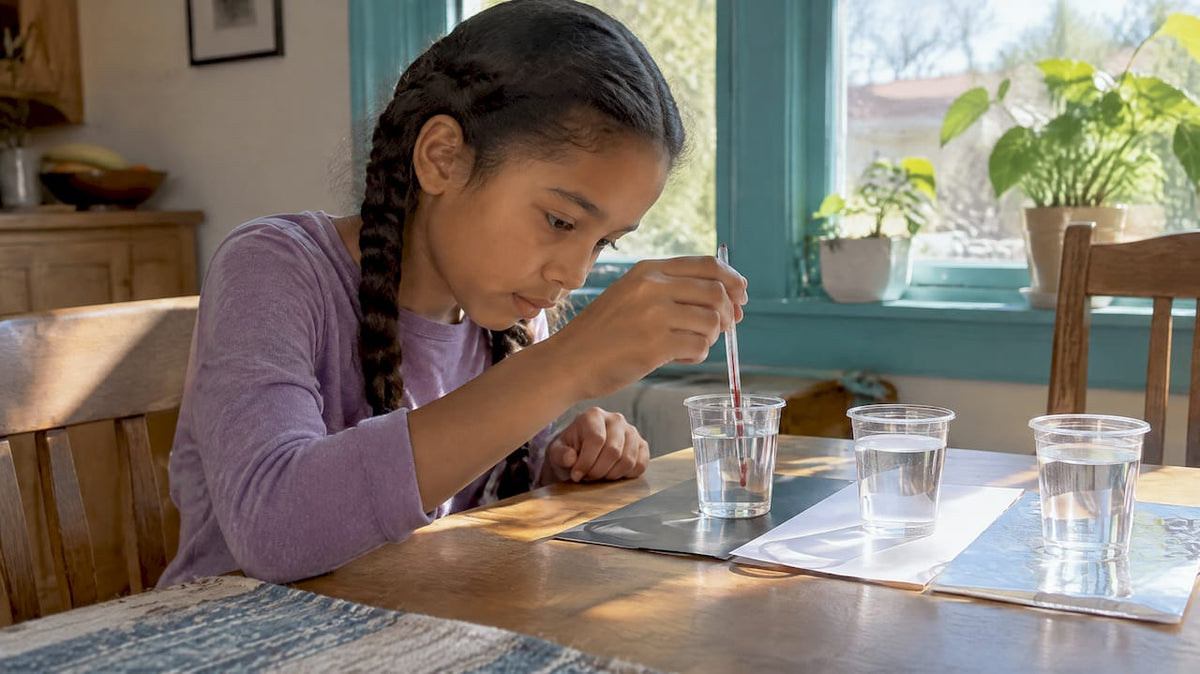
NASA describes its Warm Up Experiment as a free K-5 lesson on albedo that links light and thermal energy to Earth’s climate. Place identical cups of cool water on white, black and silver paper in the sun, check the temperature every ten minutes, and chart it. Cups of water are safe and the result is dramatic.
If your child wants to go further with sunlight, the Science Solar Energy Kit with Mirror Disk lets them explore harnessing solar power with their own hands.
11. Weather log
Weather is a core third-grade topic. National Geographic’s third-grade resource defines weather as short-term atmospheric conditions and climate as long-term patterns, measured through temperature, precipitation, wind, humidity, cloudiness and pressure. Have your child record temperature, sky and wind for two weeks, then graph it and write one sentence about what the pattern tells them. Add a homemade rain gauge from a clear bottle and a ruler.
Kitchen science
12. Slime states of matter
Mixing, stretching and testing slime shows how materials can behave like both solids and liquids. Ask: what happens to stretchiness if you change one ingredient amount? Keep a table of each batch. If you want the measuring done for you, our Diving into Slime, Gel, and Goop kit packages the investigation for kids.
Turn any project into a fair test
This is the step that moves a craft into a science project. Use this five-line frame:
- Question: Which boat shape holds the most pennies?
- Prediction: I think the wide boat will hold more.
- Change one thing: Boat shape. Keep the foil size, water and pennies the same.
- Test three times and record every result.
- Explain: What happened, and what would I try next?
The Boats Afloat guide models this well. It asks students to try other materials, think about what the boat might be used for, connect the use to the design, and draw each design with the changes and reasons recorded. NASA’s Dirt guide uses a similar rhythm in its 5E model: start from what children already think, gather observations through comparison, then explain and evaluate.
A sample results table
| Boat design | Trial 1 | Trial 2 | Trial 3 | Best |
|---|---|---|---|---|
| Flat sheet | ||||
| Square boat | ||||
| Wide, low sides | ||||
| Narrow, tall sides |
Draw it on paper before you start, so your child can fill the boxes without worrying about layout.
Presenting at a fair or in class
A third grader’s board needs a title, the question, a short list of materials, numbered steps, a photo or drawing, a results table or graph, and two or three sentences of explanation. Practice saying it out loud once. Confidence comes from having said the words before.
Safety and adult help
Third graders need an adult nearby for every project, and the level of help depends on the activity.
- Adult handles: anything hot, sharp or hazardous, including scissors for stiff materials and any heat source. A school science safety guide for young students puts it plainly: an adult handles these.
- Eye protection: wear it whenever liquids, glassware or heat are involved. The same guide notes that everyday glasses are not enough for splashes and points to goggles marked Z87 and D3, as referenced from the NSTA.
- Read first: go through every step and caution together before touching anything.
- Food and science do not mix: do not taste experiment materials, and wash hands afterward. Slime ingredients, soil and seeds all belong in this category.
- Water and electricity: keep outlets and cords away from any water-based test.
If your child has a skin sensitivity or allergy, check each material with your pediatrician or school nurse before you begin.
Our perspective: confidence comes before the correct answer
At Team Genius Squad, we started from a family journey with dyslexia and dysgraphia, and it changed how we look at science projects. A child who struggles to write a neat report can still design a boat that holds 40 pennies, and that success is real. We built our E³ Method (Engage, Encourage, Empower) around that idea: first draw the child into hands-on discovery, then encourage each attempt, then help them see themselves as a scientist.

So when we suggest a third grade project, we look for three things. It should be tactile and screen-free. It should let the child win something early, even a small thing. And it should connect doing with reading, writing and reflecting, so that the notebook is part of the fun, not a chore at the end. A lab coat and a badge are not gimmicks either: when a child steps into the role, they act like one.
Our founder, young STEM entrepreneur Ava N. Simmons, says it best by living it: different minds can build the future. Let your child test, fail, redesign and try again. That loop is the project.
— Tita
Bring a kit or a scientist to the project
If you would rather skip the supply hunt, our experiment kits bring the materials, the role play and the literacy pieces together, and our STEM books and puzzles help kids read and reflect on what they find. For electricity, the STEM-STEAM Electricity Lab Experience Bundle is a natural step after a magnet project.
Want a live spark? Ava offers a 30-minute one-on-one Zoom STEM experiment for kids ages 5 to 13 at 50 USD, plus group sessions for classrooms and clubs. You can see all the options on our shop page.
More ideas for teachers and parents are in our low prep science experiments by grade, NGSS STEM activities and 30 hands-on science projects for home.
FAQ
What is an easy science project for a 3rd grader?
The foil cargo boat is hard to beat. It needs foil, water, a container and pennies, takes about 30 minutes, and gives a clear number to record. Kids can redesign and retest right away.
How long should a 3rd grade science project take?
Plan on one to three sittings of 30 to 45 minutes each, plus time to make a simple display. Plant projects take longer because you observe over days, so start those first and run a quicker project alongside.
How much should a parent help?
Help with safety, reading directions and managing sharp or hot items, but let your child choose the question, make the predictions and write or draw the results. If writing is a struggle, they can dictate while you scribe.
Which science topics fit best for 3rd grade?
Forces and motion, magnets, life cycles and traits, and weather are all part of the NGSS third-grade topics. Earth materials like soil and light and heat are also common in classroom units.
Sources
- NGSS Grades 3-5 By Topic
- MSU TETRAD 3rd Grade Curriculum
- Illinois State Third Grade Science
- PBS KIDS for Parents: Simple Science Activities
- Pacific Science Center: Boats Afloat
- Exploratorium: Science Snacks for K-5
- National Geographic: Educator Spotlight on bees
- NASA eClips: Our World: Dirt
- NASA Science: Warm Up Experiment (Albedo)
- National Geographic: All About Climate, 3rd grade
- Science Safety: Lab Rules for Kids

Leave a comment
This site is protected by hCaptcha and the hCaptcha Privacy Policy and Terms of Service apply.