Neurodiversity in Education: A Practical Guide for Teachers
You can make most classrooms neuroinclusive this week by applying Universal Design for Learning (UDL), a strengths-based mindset, and a few targeted moves that cost nothing but intention. The research is clear: when you design for the widest range of learners from the start, every student benefits, not just those with documented differences.
Two highest-impact moves to prioritize right now:
- Clarify your expectations in writing and post them visually so students with executive-function differences, ADHD, or anxiety can reference them independently.
- Add one flexible assessment option this unit so students can demonstrate mastery through building, drawing, presenting, or writing.
Your one-week starter checklist:
- Post a visual daily schedule and learning objectives in the same spot every day.
- Identify one student who seems disengaged and ask what format helps them learn best.
- Add a quiet corner or low-stimulation option to your room layout.
- Review one upcoming assignment and offer at least two ways to complete it.
- Send a brief welcome note home inviting families to share how their child learns best.
- Read your school’s IEP and 504 summary for each student before the week ends.
- Choose one UDL strategy from this guide to try in your next lesson.
Table of Contents
- What does neurodiversity mean for teachers?
- High-impact classroom strategies organized by UDL
- How to start this semester: checklist and communication templates
- What does the research actually show?
- Key Takeaways
- The piece of neuroinclusion most educators overlook
- Classroom tools that put these strategies into practice
- Useful sources and further reading
What does neurodiversity mean for teachers?
Neurodiversity is the idea that variation in human brain function and behavior is a natural, expected part of human diversity, not a defect to be corrected. The term was coined by sociologist Judy Singer in the late 1990s and has since become a cornerstone of inclusive teaching strategies across K–12 and higher education.
A few terms you will encounter regularly:
Neurodivergent describes a person whose brain processes information differently from what is considered typical, including students with ADHD, autism spectrum disorder (ASD), dyslexia, dysgraphia, dyscalculia, Tourette syndrome, or giftedness. Neurotypical refers to individuals whose neurological development aligns with dominant societal standards. Neither term is a diagnosis; both are identity-affirming descriptors.
Masking is the effortful process of suppressing or camouflaging neurodivergent traits to fit in, common in autistic students and those with ADHD. It is exhausting and often invisible to teachers, which is why a student who “seems fine” in class may be struggling significantly by the end of the day.
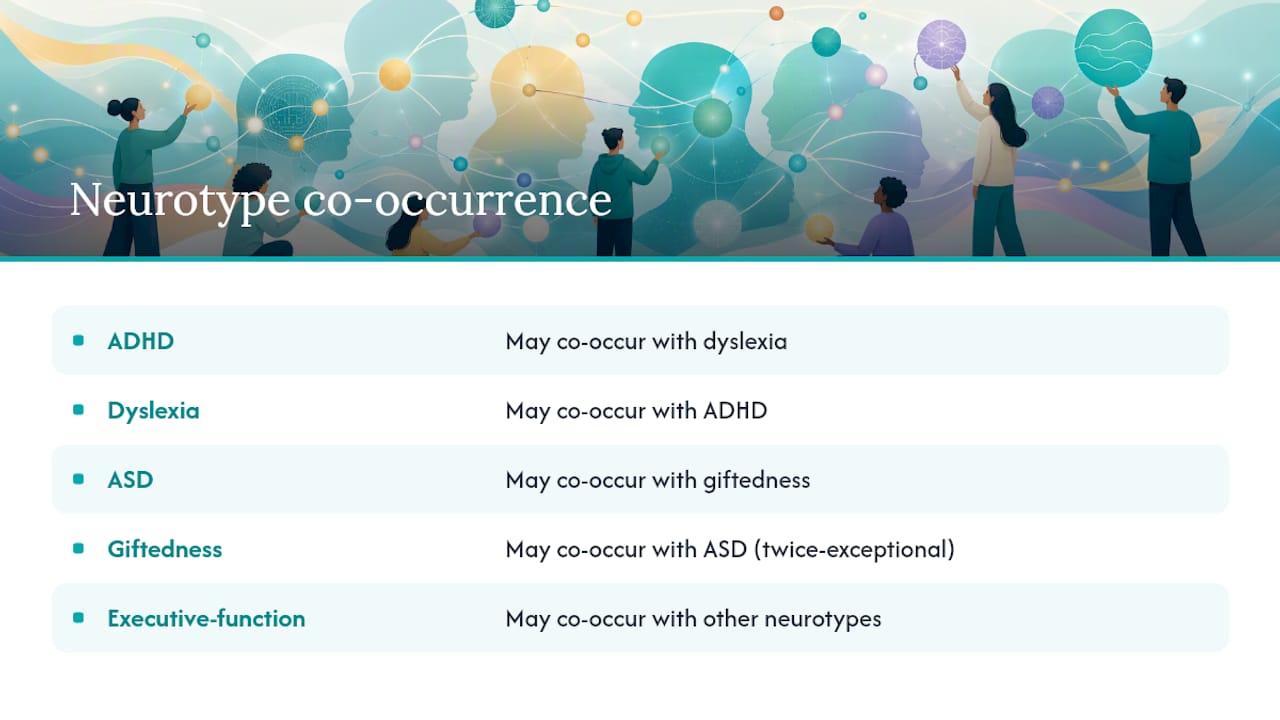
Co-occurrence means that many students carry more than one neurotype simultaneously. A student with dyslexia may also have ADHD; a gifted student may also be autistic. Planning for single profiles misses this reality.
Strengths-based practice means starting with what a student can do and building from there, rather than cataloging deficits. As Northwestern University’s Searle Center frames it, the goal is to reshape the learning context to fit the learner, not to fix the learner to fit the context.
For practical planning purposes, the profiles you are most likely to support include students with ADHD, ASD, dyslexia, executive-function differences, and twice-exceptional (gifted and neurodivergent) learners.
High-impact classroom strategies organized by UDL
Universal Design for Learning is the organizing principle behind the most effective inclusive teaching strategies in U.S. classrooms today. Developed by CAST and widely endorsed by the U.S. Department of Education, UDL asks teachers to build flexibility into three areas from the start: how students engage with learning, how content is represented, and how students demonstrate what they know.
Engagement: sparking and sustaining motivation
- Set transparent expectations. Before every assignment, share the purpose, the task, and the criteria for success in writing. UW–Madison’s L&S Instructional Design Collaborative documents that this practice improves outcomes for students with and without documented disabilities.
Representation: reaching every learner’s brain
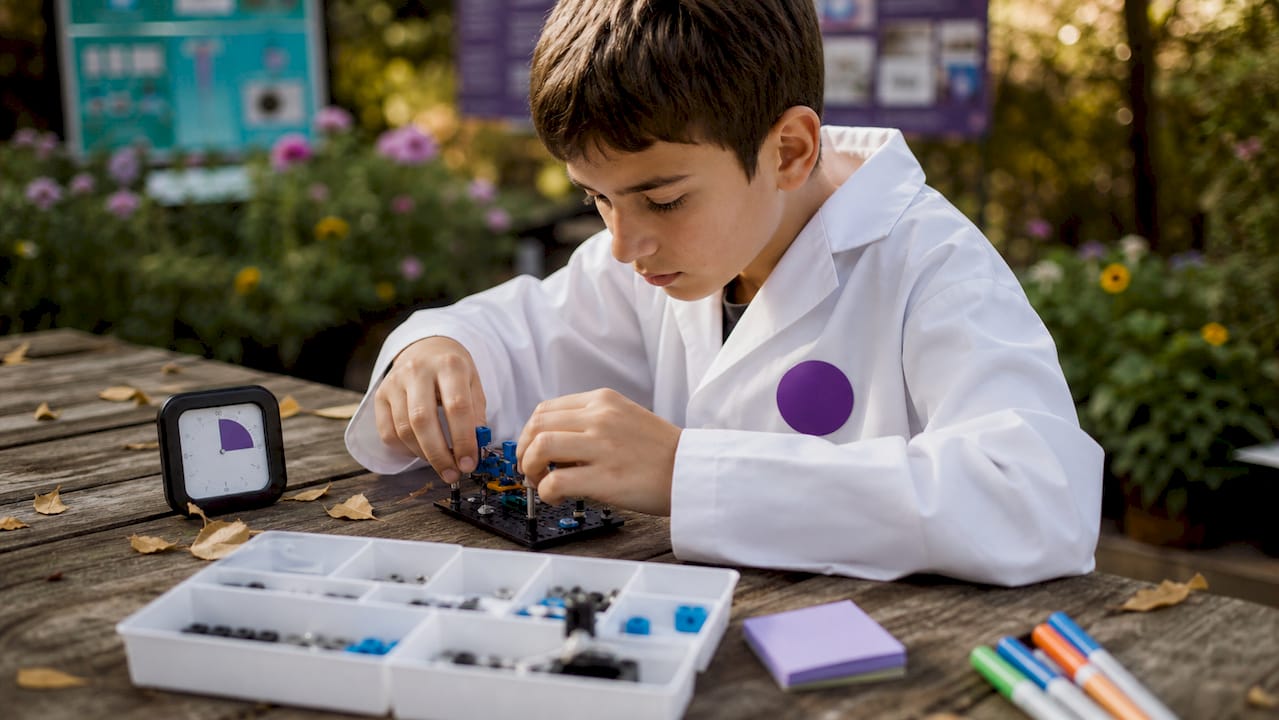
- Use tactile and hands-on materials. Screen-free, physical tools, such as experiment kits, manipulatives, and role-play props, activate learning pathways that slides and worksheets cannot reach. Hands-on STEAM tools are particularly effective for students who struggle in traditional learning environments.
How to start this semester: checklist and communication templates
Moving from strategy to practice takes a concrete plan. The checklist below is realistic for a single educator working within a standard school schedule.
First-month implementation checklist:
- Pull every IEP and 504 plan for your students and note the three most common accommodation types across your class.
- Redesign one major assignment to offer two submission formats.
- Add a visual daily agenda to your board or slide deck template.
- Set up a quiet work option in your room (a corner, a study carrel, or noise-canceling headphones).
- Draft and post your neuroinclusive syllabus paragraph (template below).
- Schedule a 10-minute check-in with your school’s disability services coordinator or special education lead.
- Send a family communication (template below) within the first two weeks.
- Identify two students who may benefit from a strengths-based conversation and schedule brief one-on-ones.
Copy-ready syllabus paragraph:
Family communication template:
A note on documentation: formal accommodations listed in an IEP or 504 plan are legally binding and must be implemented as written. Co-created supports, such as a student’s preferred seating or a self-selected timer, are flexible agreements that do not require formal documentation but should be noted in your own records. Keep all disability-related information confidential; share only what a colleague needs to support the student directly.
The University of Michigan’s CRLT offers additional instructor resources and PD-style practices that translate well into K–12 professional development planning.
What does the research actually show?
The evidence base for strengths-based and UDL approaches is consistent: shifting from a deficit model to one that reshapes the learning environment improves both retention and well-being for neurodivergent students. That said, the research has real limits worth knowing.
A systematic review published in npj Mental Health Research found that most higher-education interventions focus on academic adjustments rather than mental-health supports or strength-based designs, and very few involve neurodivergent students in co-creating those supports. The gap between what students need and what institutions provide is widest in the social-emotional domain.
A rapid review published in Journal of Postsecondary Education and Disability found that U.S.-centric research shows modest evidence for long-term outcomes and highlights the need for institution-level design and transition supports, not just classroom-level tweaks.
Research published in the London Review of Education argues that sustainable inclusion requires whole-school culture change, not just individual accommodations. Participatory studies recommend lived-experience-led training and warn against epistemic injustice, the practice of dismissing neurodivergent students’ own accounts of what helps them.
| Research area | Finding | Implication for practice |
|---|---|---|
| Academic adjustments | Most interventions focus here | Add social-emotional supports alongside academic ones |
| Student co-creation | Rarely included in intervention design | Invite students to help shape their own supports |
| Neurotype coverage | Literature skews toward ADHD and autism | Plan for dyslexia, dysgraphia, dyscalculia, and gifted profiles too |
| Long-term outcomes | Evidence is modest | Use multiple short-cycle measures, not just end-of-year grades |
Research gap to act on: Co-created supports, where neurodivergent students help design the accommodations and classroom structures that affect them, consistently show better sustained outcomes. Yet they remain rare in practice. Asking a student “What would help you most in this unit?” takes two minutes and costs nothing.
The practical implication is that celebrating different minds and building identity-affirming environments is not a soft add-on. It is where the evidence points most clearly.
Key Takeaways
Inclusive classrooms built on UDL, strengths-based practice, and genuine co-creation with students produce better outcomes for neurodivergent and neurotypical learners alike.
| Point | Details |
|---|---|
| UDL is the organizing framework | Apply multiple means of engagement, representation, and action/expression to reach every learner. |
| Strengths-based stance matters | Shifting from deficit to strength improves retention and well-being for neurodivergent students. |
| Co-creation closes the gap | Asking students what helps them is a high-impact, low-cost practice most classrooms skip. |
| Research gaps are real | Most studies focus on ADHD and autism; plan broadly for dyslexia, dysgraphia, and gifted profiles too. |
| Teamgeniussquad kits support UDL | Screen-free, tactile STEAM kits map directly to multi-sensory representation and identity-driven engagement. |
The piece of neuroinclusion most educators overlook
The conventional wisdom in professional development is that neuroinclusion is primarily about accommodations: extra time, preferential seating, reduced assignments. Those tools matter, but they address the symptom rather than the structure. The deeper shift, and the one the research keeps pointing toward, is designing the learning environment so that fewer students need individual accommodations in the first place.
What that means in practice is less about paperwork and more about identity. A student who has spent years being told, implicitly or explicitly, that their brain is broken does not need a longer test window. They need an experience of genuine competence, a moment where their way of thinking produces something real and visible. Hands-on, tactile learning, the kind that lets a student build, test, and see results, creates those moments in ways that worksheets rarely do.

The research on epistemic injustice is worth sitting with. When we discount what neurodivergent students tell us about their own experience, we do not just miss useful information. We reinforce the message that their perspective does not count. Co-creation is not a progressive nicety; it is a corrective to a pattern that has caused measurable harm.
The educators who make the most difference are not the ones with the most elaborate accommodation plans. They are the ones who ask good questions, listen to the answers, and build from what they hear.
Classroom tools that put these strategies into practice
The strategies in this guide work best when students have materials that match the way they learn, and that is exactly where Teamgeniussquad’s screen-free STEAM experiment kits come in. Built from a real family journey with dyslexia and dysgraphia, every kit is designed to give children ages 5–13 a genuine experience of scientific competence, not just exposure to content.
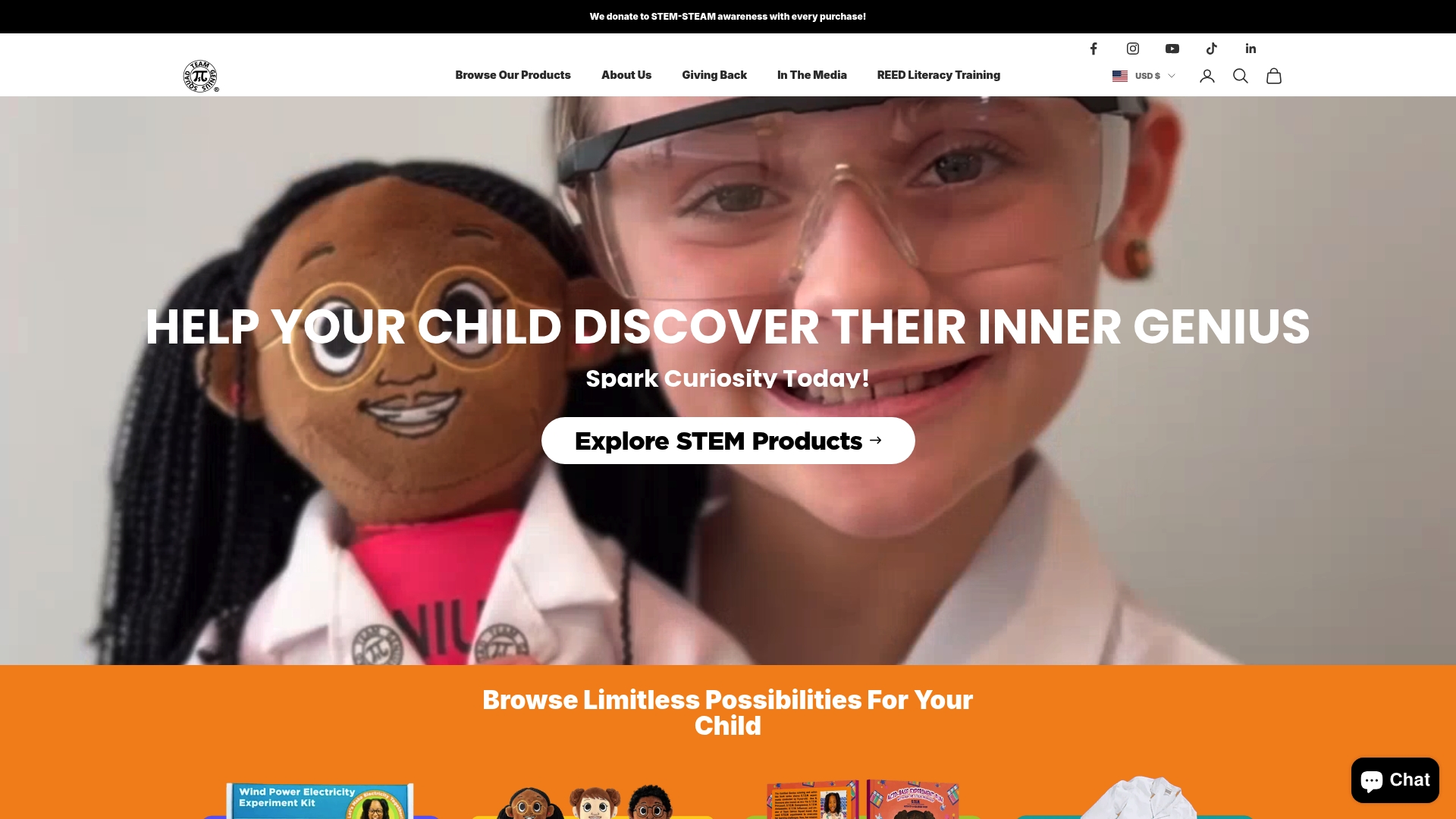
Three ways the kits map directly to UDL in your classroom:
Tactile STEAM kits for multi-sensory representation. Each kit delivers content through physical materials, role-play, and hands-on experimentation, offering the multiple representations that neurodivergent learners need. A student who cannot access a concept through text alone often grasps it immediately when they can hold, build, and test it.
Role-play badges and lab coats for identity-driven engagement. When a student puts on a lab coat and earns a scientist badge, they are not just playing. They are rehearsing an identity. For students who have internalized the message that school is not for them, that moment of “I am a scientist” can shift the entire arc of their relationship with learning.
Structured mini-labs for executive-function scaffolding. Each experiment follows a clear, step-by-step sequence with a defined beginning, middle, and end, giving students with ADHD or executive-function differences the predictable structure that makes independent work possible.
Browse the full collection of hands-on experiment kits to find the right fit for your grade level and learning goals, or explore STEAM activities for special needs for ready-to-use differentiation ideas you can bring into your next lesson.
Useful sources and further reading
These resources are among the most practical and well-evidenced available for U.S. educators working on neuroinclusion.
- Supporting Neurodivergent Student Success: Searle Center — Northwestern University
- A systematic review of higher education-based interventions to support the mental health and wellbeing of neurodivergent students | npj Mental Health Research
- Choose More Inclusive Teaching Strategies — L&S Instructional Design Collaborative – UW–Madison
- Inclusive teaching strategies | CRLT, University of Michigan

,%20a%20strengths-based%20mindset,%20and%20a%20few%20targeted%20moves%20that%20cost%20nothing%20but%20intention.%20The%20res...)
Leave a comment
This site is protected by hCaptcha and the hCaptcha Privacy Policy and Terms of Service apply.