Creative Problem Solving: A Practical Guide for Kids and Educators
Creative problem solving (CPS) is a structured process that deliberately alternates divergent idea generation with convergent evaluation to produce original, useful solutions, and according to the Creative Education Foundation, it is a proven method for redefining problems, generating innovative responses, and taking action.
Three things to know right away:
- When to use it: CPS works best when a problem’s root cause is unclear, when conventional approaches have stalled, or when a team needs to generate genuinely new options rather than refine existing ones.
- Core stages: Most models follow a sequence of Clarify, Ideate, and Develop, with divergent thinking (generating many ideas without judgment) always preceding convergent thinking (evaluating and selecting the best ones).
- One quick example: A classroom teacher who cannot figure out why students disengage uses CPS to reframe the challenge as “How might we make every student feel like the expert in the room?” and generates a dozen fresh approaches before selecting two to pilot.
Three anchors you will encounter throughout this guide:
- Creative Education Foundation (CEF): The organization that formalized CPS as a teachable, learnable process
- Alex Osborn and the Osborn–Parnes model: The originating framework, developed in the 1950s, that gave CPS its structure
- Brainstorming: The most recognized divergent thinking tool within CPS, though only one part of the full process
Key Takeaways
Creative problem solving is most powerful when divergent and convergent thinking are kept strictly separate, and when the problem is framed as a question before any ideas are generated.
| Point | Details |
|---|---|
| CPS definition | A structured process alternating divergent idea generation and convergent evaluation to produce original, useful solutions. |
| When to use CPS | Choose CPS when the root cause is unclear, conventional approaches have stalled, or genuinely new options are needed. |
| Core session rule | Keep divergence and convergence strictly separate; mixing modes prematurely collapses creative output. |
| Child-friendly application | “How might we” framing and hands-on kits build CPS habits in children ages 5–13, including neurodivergent learners. |
| Teamgeniussquad | Kits and lesson plans scaffold the full CPS cycle using the E³ Method, giving children a repeatable path from curiosity to confident conclusion. |
Table of Contents
- Why creative problem solving matters more than you might think
- How divergent and convergent thinking actually work together
- What are the main CPS models and their stages?
- How to run a CPS session today, step by step
- Which CPS tools and techniques should you use?
- Common CPS mistakes and how to avoid them
- How to adapt CPS for children at every age
- Copyable templates and “How might we” starters you can use right now
- Why process discipline is the real creative skill
- Teamgeniussquad kits put CPS into children’s hands
- Sources
Why creative problem solving matters more than you might think
Most people reach for the first solution that comes to mind. That instinct is efficient for routine problems, but it fails badly when the challenge is complex, ambiguous, or genuinely new. Harvard Business School Online notes that CPS is especially valuable when a problem’s specific cause is unclear, and that it supports adaptation and innovation in ways that standard analytical methods cannot.
The practical benefits span several contexts:
- Ill-defined problems: CPS treats problem-finding as seriously as solution-finding. Teams often discover mid-session that they were solving the wrong problem entirely.
- Team adaptability: Working through a CPS session trains the habit of rethinking approach, not just producing one novel idea. Experts frame this as a leadership competency, not a one-time creative exercise.
- Learning outcomes for children: Open-ended “How might we” framing shifts children’s attention from finding the right answer to exploring possibilities, which builds curiosity and confidence, particularly for learners who struggle in traditional environments.
- Product ideation and cross-functional teams: CPS gives diverse groups a shared language and process, reducing the friction that comes when engineers, marketers, and educators try to solve the same problem from different angles.
A product team stuck on a packaging redesign, a fifth-grade class puzzling over how to reduce cafeteria waste, a nonprofit rethinking donor engagement: all three are CPS-ready scenarios. What they share is ambiguity about the best path forward, which is exactly where CPS earns its place.
Pro Tip: Use CPS when you can honestly say “we don’t fully understand the problem yet.” If the root cause is clear and the solution is known, a standard checklist or process improvement tool will get you there faster.
How divergent and convergent thinking actually work together
The single most important mechanical insight in CPS is this: divergent thinking and convergent thinking must be kept strictly separate. Mixing them, even briefly, collapses creative output.
Dovetail’s CPS overview describes the process as grounded in alternating these two modes. Divergent thinking means generating as many ideas as possible without evaluating any of them. Convergent thinking means stepping back, applying criteria, and selecting the most promising options. The moment someone says “that won’t work” during a brainstorm, the group shifts into convergent mode prematurely, and the ideas stop flowing.
Divergent tools (use during idea generation):
- Brainstorming: rapid, judgment-free idea listing
- Mind mapping: visual branching from a central challenge
- SCAMPER: a structured prompt set (Substitute, Combine, Adapt, Modify, Put to other uses, Eliminate, Reverse)
Convergent tools (use during evaluation):
- Evaluation matrix: score ideas against weighted criteria
- Dot voting: each participant places a limited number of votes on preferred ideas
- “Yes-and” language: extend an idea before critiquing it, preserving momentum
Operational rules every CPS session needs:
- Defer judgment during divergence, no exceptions
- Ask questions rather than making declarations (“What if we…?” not “We should…”)
- Use “yes-and” to build on ideas rather than “but” to block them
- Restate the problem as a question before generating solutions
Here is what improper mode-mixing looks like in practice: a team brainstorming new product features starts well, then one member says “we tried that last year and it failed.” Two others nod. The group narrows to three safe ideas in under four minutes. The session ends with nothing genuinely new. The fix is not a personality change; it is a process rule enforced by the facilitator.
Pro Tip: Post a visible sign at the front of the room during divergence that reads “No evaluation yet.” Physical reminders reduce the instinct to critique, especially in groups that are new to CPS.
What are the main CPS models and their stages?
Several named models organize the CPS process, and choosing the right one depends on your context, your time budget, and your participants’ experience level.
The Osborn–Parnes model
Alex Osborn, the advertising executive who coined the term “brainstorming” in the 1940s, and Sidney Parnes, who extended the framework through the Creative Education Foundation, developed the original structured CPS model. It moves through six stages: Objective Finding, Fact Finding, Problem Finding, Idea Finding, Solution Finding, and Acceptance Finding. Each stage alternates divergent and convergent phases, making it thorough but time-intensive. It suits longer innovation sprints and formal workshops.
The Clarify–Ideate–Develop model
A leaner, three-component version used widely in education and short workshops. Clarify means understanding the challenge and reframing it as a productive question. Ideate means generating a wide range of possible solutions. Develop means selecting, refining, and planning for implementation. This model answers the PAA question “What are the three components of CPS?” directly: Clarify, Ideate, Develop.
The classic 5-stage creative process
Drawn from Wallas’s 1926 model of creative thought, this sequence describes how creative breakthroughs tend to emerge:
- Preparation: Gather information, define the problem, and research constraints
- Incubation: Step away and let the subconscious process the challenge
- Illumination: The insight arrives, often unexpectedly
- Evaluation: Assess whether the insight is genuinely useful and feasible
- Implementation: Turn the idea into action
This answers the PAA question “What are the 5 stages?” The Wallas model is descriptive rather than prescriptive, meaning it explains how creativity happens rather than giving a step-by-step facilitation guide. Pair it with the Osborn–Parnes or Clarify–Ideate–Develop model for a session you can actually run.
The ASQ problem-solving framework adds a practical layer: define the problem, diagnose root cause, identify and implement solutions, and sustain results. This maps well onto the Clarify–Ideate–Develop model and is especially useful when CPS is being combined with quality improvement work.
How to run a CPS session today, step by step
You do not need prior facilitation training to run a productive CPS session. What you need is a clear agenda, a willingness to enforce the divergence/convergence separation, and about 60–90 minutes.
Materials: sticky notes, markers, a whiteboard or large paper, a timer, and a printed problem statement.
Participant roles: one facilitator (enforces rules, keeps time), one recorder (captures all ideas), and three to eight participants.
Step-by-step session agenda
-
Frame the challenge (10 minutes). Write the problem as a “How might we” question. Example: “How might we help students who finish early stay engaged without distracting others?” Share it with the group and invite two or three clarifying questions, but no solutions yet.
-
Diverge: generate ideas (15 minutes). Set a timer. Every participant writes one idea per sticky note, as many as possible. No talking, no evaluating. Aim for quantity. Post all notes on the wall.
-
Cluster and read aloud (10 minutes). Group similar ideas together. Read each cluster aloud. No judgment yet; this is still divergent territory.
-
Converge: dot vote (10 minutes). Give each participant five dot stickers. They place dots on the ideas they find most promising. Dots can be split or stacked. Tally the results.
-
Develop the top ideas (15 minutes). Take the two or three highest-voted ideas and apply “yes-and” to each: what would make this stronger? What constraint does it need to work within?
-
Define next steps (10 minutes). For each developed idea, name one concrete action, one person responsible, and one deadline. Write these on a separate sheet.
| Phase | Time | Mode |
|---|---|---|
| Frame the challenge | 10 min | Convergent setup |
| Diverge: generate ideas | 15 min | Divergent |
| Cluster and read aloud | 10 min | Neutral transition |
| Converge: dot vote | 10 min | Convergent |
| Develop top ideas | 15 min | Convergent/generative |
| Define next steps | 10 min | Convergent action |
For a 30-minute version, compress framing to five minutes, skip clustering, and limit dot voting to three dots per person. For a multi-session format, run framing and divergence in session one, clustering and voting in session two, and development plus planning in session three.
Pro Tip: If the group runs dry of ideas before the timer ends, use the SCAMPER prompt set to restart flow: ask “What could we substitute?” or “What could we reverse?” and watch the ideas return.
Which CPS tools and techniques should you use?
CPS draws from a broad toolbox, and matching the right technique to the right moment matters more than using every tool available. An evidence-based review by Vernon, Hocking, and Tyler (2016) found that while CPS training can improve performance, empirical support for specific tools is meaningful but limited to a subset of techniques, so pairing tools with context-specific judgment is the more reliable approach.
| Technique | Best use | Group or solo | Approx. time | Skill level |
|---|---|---|---|---|
| Brainstorming | Rapid idea generation | Group | 10–20 min | Beginner |
| Mind mapping | Exploring connections visually | Solo or group | 15–30 min | Beginner |
| SCAMPER | Modifying existing products or ideas | Solo or group | 20–30 min | Beginner |
| TRIZ | Solving technical contradictions | Group | 60–90 minutes | Advanced |
| Prototyping | Testing ideas quickly | Group | 30–60 min | Intermediate |
| “Yes-and” | Building on others’ ideas | Group | Ongoing | Beginner |
One-sentence exercise prompts:
- Brainstorming: Set a timer for eight minutes and write every possible answer to “How might we make this simpler?” without stopping.
- SCAMPER: Pick one object in the room and ask what happens if you eliminate its most obvious feature.
- TRIZ: Name two things your solution must do that seem to contradict each other, then search for a principle that resolves the contradiction.
- Mind mapping: Write your challenge in the center of a blank page, then branch outward with every word, image, or association it triggers.
- Prototyping: Build a rough physical or paper version of your idea in under 20 minutes, then show it to someone who was not in the session.
TRIZ, developed in the Soviet Union by Genrich Altshuller, extracts principles from past inventions to accelerate predictable innovation and pairs well with quality tools like Six Sigma when the challenge involves a technical contradiction. Practitioners also combine root-cause analysis tools such as the Fishbone diagram with CPS techniques when the solution must rework entire systems rather than fix a single process step. For prototyping and testing after ideation, open-source prototyping tools can help teams move from sticky notes to tangible models quickly and affordably.
Common CPS mistakes and how to avoid them
Even well-intentioned sessions fail when a few predictable errors go uncorrected. Knowing what to watch for is half the fix.
The most common pitfalls:
- Judging too early. Someone says “that’s not realistic” during divergence. The group self-censors. Fix: enforce the no-evaluation rule explicitly before the session starts.
- Jumping to the first good idea. The group latches onto the first idea that sounds workable and stops generating. Fix: set a minimum idea count (at least 20) before any evaluation begins.
- Poor question framing. “How do we fix the onboarding problem?” is too narrow. “How might we make every new user feel confident in their first five minutes?” opens more creative space.
- Unclear constraints. Without knowing what is off-limits (budget, timeline, technology), groups generate ideas they cannot use. Fix: state constraints at the start, not the end.
Best practices that raise the odds of a breakthrough:
- Frame every problem as a “How might we” question before the session begins
- Invite at least one outside perspective, someone unfamiliar with the problem, to the divergence phase
- Combine short-term and long-term solutions rather than choosing one or the other; ASQ recommends evaluating multiple alternatives before selecting a single path
- Revisit the problem statement after divergence; new ideas often reveal that the original framing was too narrow
What not to do:
- Do not skip the convergence phase and call brainstorming “done”
- Do not let the most senior person in the room speak first during divergence
- Do not run a CPS session without a designated facilitator who is not also a participant
Pro Tip: To deliberately increase novelty without losing usefulness, add a “wildest idea” round at the end of divergence. Ask everyone to share the idea they held back because it seemed too strange. Then apply “yes-and” to each one. The most useful breakthroughs often live one step away from the idea that felt too risky to say.
How to adapt CPS for children at every age
Children are natural divergent thinkers. The challenge is giving them just enough structure to move from “what if” to “what next,” and that is exactly where CPS shines as a learning framework. Open-ended “How might we” framing shifts children’s focus from finding the right answer to exploring possibilities, which builds curiosity and confidence, especially for neurodivergent learners who often thrive when there is no single correct response.
Ages 5–7: divergence through play
Activity: “The Silly Solutions Game.” Present a simple, funny problem (“How might we carry 100 balloons without using our hands?”) and let children shout out every answer they can think of. Draw the best ones together. This builds divergent thinking habits without any formal structure.

Ages 8–10: structured ideation
Activity: “Inventor’s Challenge.” Give a real-world problem (“How might we keep a sandwich cold without a refrigerator?”) and ask children to sketch three different solutions before picking their favorite. The sketch step mimics prototyping and introduces convergent evaluation naturally.
Ages 11–13: full CPS cycle
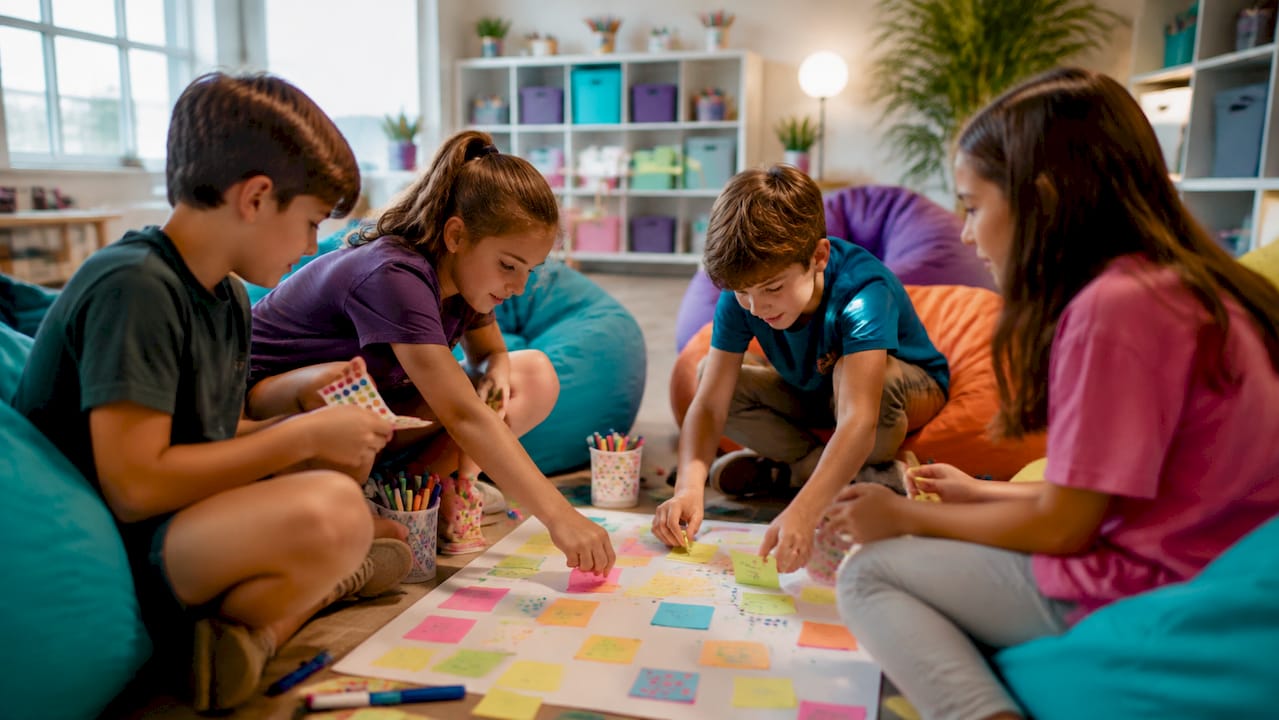
Activity: “Design a Better School Day.” Run a mini CPS session using sticky notes, dot voting, and a “How might we” question the group writes themselves. Assign roles: facilitator, recorder, timekeeper. Debrief by asking what surprised them about the ideas that got the most votes.
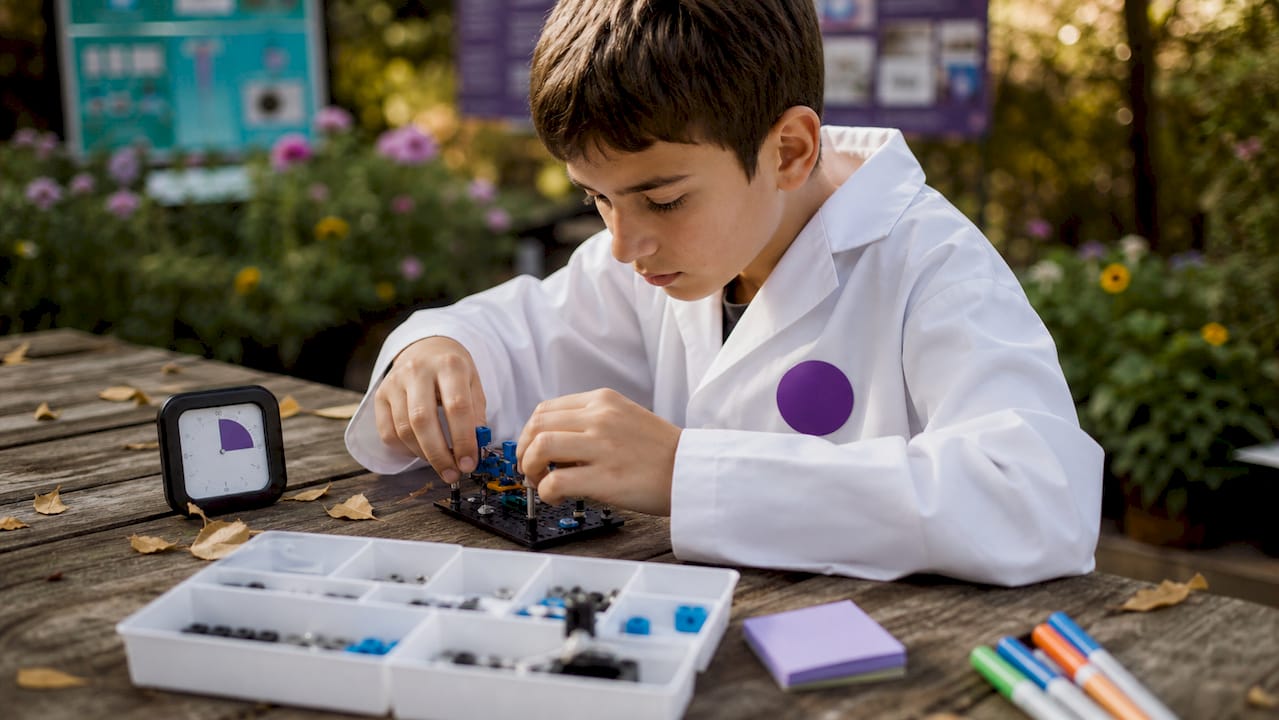
Hands-on kits support CPS habits in ways that worksheets cannot. When a child puts on a lab coat, picks up a badge, and conducts a real experiment, they are practicing the Engage phase of the E³ Method: they are curious, present, and willing to try. Iteration, the willingness to test an idea and adjust it, comes naturally when the materials invite it. For neurodivergent learners especially, tactile, screen-free discovery removes the barriers that written instructions and passive observation create. Hands-on STEAM approaches consistently support learners who struggle in traditional environments by giving them a different path to the same creative and analytical skills.
For neurodivergent learners, a few adaptations make CPS sessions more accessible: use visual timers instead of verbal countdowns, allow drawing or building as an alternative to writing ideas, keep groups small (two to three children), and celebrate every idea during divergence with equal enthusiasm. Practical strategies for supporting neurodivergent learners in STEAM contexts translate directly into better CPS facilitation at home and in the classroom.
Pro Tip: For children who freeze during divergence, give them a “permission slip” at the start of the session: a small card that reads “All ideas are welcome here.” Physical objects carry emotional weight for young learners in ways that verbal reassurance sometimes does not.
Copyable templates and “How might we” starters you can use right now
The fastest way to start a CPS session is to have your opening question ready before anyone sits down. These starters work for adults and children alike.
10 “How might we” starters:
- How might we make this experience feel easier for someone doing it for the first time?
- How might we solve this problem using only what we already have?
- How might we make this more fun without making it less effective?
- How might we help someone who learns differently feel equally capable here?
- How might we reduce the time this takes by half?
- How might we get more people involved without adding more meetings?
- How might we make the outcome visible so everyone can see progress?
- How might we test this idea in under 30 minutes?
- How might we combine two existing solutions into one better one?
- How might we design this so a 10-year-old could explain it to a friend?
A two-column session template:
| Step | What to do |
|---|---|
| Problem restatement | Write your challenge as a “How might we” question in one sentence |
| 6-minute divergent prompt | Set a timer; write or draw every possible answer, no filtering |
| 10-minute convergence checklist | Circle your top three ideas; ask: Is it feasible? Is it new? Does it solve the real problem? |
| Next step | Name one action you can take soon to test the top idea |
Session follow-up mini-checklist:
- Did you capture all ideas, including the ones that were not selected?
- Have you assigned one owner and one deadline to each next step?
- Is there a low-cost way to prototype or test the top idea before committing resources?
- Have you scheduled a 15-minute check-in to review what the test revealed?
Template in action: A parent and a 9-year-old use the template to tackle “How might we make homework feel less like a chore?” In six minutes, they generate 14 ideas: homework in a fort, homework with background music, homework traded with a sibling, homework done in costume. In the convergence checklist, they pick “homework in a different room each day” because it is feasible, new to their routine, and addresses the real problem (boredom, not difficulty). The next step: try it Monday and report back.
Why process discipline is the real creative skill
There is a persistent myth that creative people do not need structure. In practice, the opposite tends to be true. The most reliably creative teams are the ones with the clearest process rules, because those rules protect the conditions that creativity needs: safety to say something imperfect, time to generate before evaluating, and a shared language for moving from ideas to action.
The E³ Method that Teamgeniussquad builds into every kit reflects this same logic. Engage first, then Encourage iteration, then Empower children to own their conclusions. That sequence is not arbitrary; it mirrors the diverge-then-converge discipline at the heart of CPS. When children experience that sequence repeatedly through hands-on discovery, they internalize it as a way of thinking, not just a classroom activity.
Teamgeniussquad kits put CPS into children’s hands
Children learn creative problem solving the same way they learn anything else: by doing it, repeatedly, in a context that feels meaningful and safe.
Teamgeniussquad’s hands-on, screen-free STEAM kits give children ages 5–13 a structured path through exactly that kind of experience. Each kit is built around the E³ Method (Engage, Encourage, Empower), which mirrors the diverge-then-converge discipline of CPS: children explore a real scientific challenge, iterate through experiments, and arrive at conclusions they reached themselves. The Science Solar Energy Kit is one example of a hands-on tool that invites children to test, adjust, and test again, the same cycle a CPS session runs. Educators can pair kits with ready-made lesson plans designed to scaffold CPS skills across a full unit. To see the full range of kits and educational materials, visit the Teamgeniussquad store and find the right starting point for your child or classroom.
Sources
These are the primary references used throughout this guide, each offering a different depth of access to CPS theory and practice.
- What is CPS? | Creative Education Foundation
- What Is Creative Problem-Solving & Why Is It Important?
- What Is Problem Solving? Steps, Process & Techniques | ASQ
- An Evidence-Based Review of Creative Problem Solving Tools - David Vernon, Ian Hocking, Tresoi C. Tyler, 2016


%20is%20a%20structured%20process%20that%20deliberately%20alternates%20divergent%20idea%20generation%20with%20convergent%20evaluation%20to%20produce%20original,%20useful%20solutions,%20and%20according%20to%20th...)
Leave a comment
This site is protected by hCaptcha and the hCaptcha Privacy Policy and Terms of Service apply.