
Hands on Dysgraphia Writing Activities for Parents With Real Prompts
For children with dysgraphia, short multisensory activities plus low-pressure, real-audience writing and compensatory tools produce faster gains than long worksheet sessions. The winning combination is three-part: brief hands-on letter-formation practice, motivating writing tasks that feel like play instead of drills, and assistive tech that takes pressure off the hand. Brief, frequent sessions are more effective than occasional long ones, and every recommendation here echoes what occupational therapists already teach.
TL;DR:
- Short, multisensory activities like sand tracing, clay shaping, and textured letter stamps build hand strength and coordination without the pressure of traditional writing.
- Frequent, short practice sessions focused on letter formation and motor patterns are more effective for progress than infrequent, long sessions.
- Assistive technologies such as speech-to-text and keyboarding support ongoing writing output while handwriting skills develop gradually.
- Incorporating real-world, motivating tasks like postcards and comic captions can improve engagement and reduce anxiety around writing.
- Environmental modifications like slant boards, sensory tools, and alternative writing tools help address sensory sensitivities and improve handwriting consistency.
Table of Contents
- Hands-On Dysgraphia Writing Activities That Actually Work
- How to Sequence Practice So Progress Actually Sticks
- Assistive Tech That Takes the Pressure Off Writing
- What Occupational Therapists Want Parents to Know
- Fixing Spelling and Word-Retrieval Struggles
- Sharpening Hand-Eye Coordination for Writing
- Helping Kids Organize and Plan Their Writing
- Building Handwriting Speed Without Losing Legibility
- Managing Sensory Sensitivities That Affect Writing
- A Perspective on Confidence, Play, and Small Wins
- How Team Genius Squad Kits Support These Activities
- Sources
- FAQ
Hands-On Dysgraphia Writing Activities That Actually Work
The best dysgraphia writing activities share one trait: they separate the idea of writing from the physical effort of writing, at least at first. Kids with strong stories in their heads often shut down the moment a pencil enters the picture, so the activities below rebuild the connection between hand, eye, and letter one small step at a time.
-
Write in sand or shaving cream. Spread a thin layer on a tray or tabletop and have the child trace letters with a finger. There’s no pencil grip to fight and no pressure to mess up, since one swipe erases the “mistake.” A few minutes is often sufficient. Activities can be scaled by age and skill, starting from single letters and moving to words or spelling lists. A quick internal resource on shaving cream marbling shows how to set this up in under two minutes.
-
Roll clay into letters, or shape rope out of yarn or pipe cleaners. Rolling, pinching, and pressing clay builds the same hand muscles a pencil grip depends on, and forming a 3D letter forces a child to notice its actual shape rather than just copying a line. Short, regular sessions a few times per week can be effective. Younger children can focus on straight-line letters like L and T; older kids can attempt cursive loops.
-
Use letter stamps and textured tracing boards. Stamping delivers instant, satisfying feedback without any fine-motor strain, while textured letters (sandpaper, foam, or bumpy fabric) give tactile input that some dysgraphic kids need to “feel” a letter’s shape before they can reproduce it. Teamgeniussquad’s letter stamp sets pair well with a five-minute daily warmup before any handwriting task.
-
Send real postcards or run a secret-agent note hunt. A child writing a two-sentence postcard to a grandparent, or leaving coded clues around the house, isn’t thinking about penmanship. Motivating, real-audience tasks like these lower anxiety and boost engagement compared to repetitive worksheet practice. Keep it to one or two sentences for younger writers; older kids can write a full mystery clue with a rhyme.
-
Turn recipes and comics into writing prompts. Have the child write one step of a recipe after helping make it, or caption a three-panel comic strip they drew. Both tasks demand sequencing (first, then, next) without requiring paragraphs, which makes them ideal for practicing sentence structure in small bites.
-
Play fine-motor games: tweezers, threading beads, pegboards. Picking up pom-poms with tweezers or stringing beads onto a pipe cleaner builds the same pincer strength and hand control a pencil grip requires. These games double as calm-down activities, so they work well as a five-minute transition before any writing session.
-
Practice on a whiteboard with a fat marker. Big, sweeping strokes on a vertical surface use larger shoulder and arm muscles, which helps kids internalize a letter’s shape before shrinking it down to pencil-and-paper scale. This progression from big motor to small motor is a recognized step in dysgraphia treatment approaches.
-
Try short, timed dictation paired with speech-to-text. Use brief timed dictation sessions paired with writing the rehearsed sentence. Separating composition (talking) from transcription (writing) takes a huge cognitive load off the table.
Pro Tip: Rotating a few different activities weekly keeps engagement high. Novelty keeps a reluctant writer curious, and switching between big-motor (whiteboard) and fine-motor (clay) work trains different muscle groups without burning a child out on any single task.
How to Sequence Practice So Progress Actually Sticks
Consistency beats intensity. A repeatable schedule of five to ten minute sessions, three or four times a week, builds automatic letter formation faster than one long weekend cram.
- Progression order: start with sensory tracing (sand, shaving cream), move to guided tracing with numbered stroke cues, then assisted pencil work, and finally independent composing once the motor pattern feels familiar.
- Build automaticity with numbered stroke cues, “cover and recall” drills (trace it, cover it, write it from memory), and spaced recall that spreads practice across days rather than cramming it into one sitting, a method supported by structured dysgraphia intervention research.
- Fix the setup before fixing the child. A slant board or paper taped to a binder angled toward the child changes wrist position and often improves letter formation without retraining the grip itself.
- Watch for red flags. Persistent illegibility, hand pain, extreme avoidance of writing tasks, or a written output that’s shrinking rather than growing are all signs it’s time to loop in an occupational therapist.
Pro Tip: Keep a “before and after” folder of writing samples from the same simple sentence, repeated monthly. Progress in dysgraphia is often too gradual to notice day to day, but a side-by-side comparison from three months apart usually shows real improvement.
Assistive Tech That Takes the Pressure Off Writing
Compensatory tools aren’t a shortcut around learning to write. They’re a way to keep a child’s ideas flowing while handwriting skills catch up in the background.
- Speech-to-text lets a child dictate a story or answer out loud, which is especially useful for kids who have plenty to say but freeze up at the sight of a blank page. A tool like AmmarAI’s speech-to-text feature is a practical starting point for families new to dictation software.
- Keyboarding practice, even in short five-minute typing games, gives kids a long-term alternative output that doesn’t rely on fine-motor endurance.
- Record first, write later. Have the child record their answer on a voice memo app, then transcribe it afterward at their own pace. This cuts the mental juggling act of composing and handwriting at the same time.
- Word prediction and read-aloud tools support spelling and self-editing, catching errors a child might not notice on their own.
Introduce these as temporary supports during a hard homework stretch, or as long-term accommodations for formal writing assignments. Either way, keep short handwriting practice running alongside them so the underlying skill keeps building.
What Occupational Therapists Want Parents to Know
Most OT-endorsed strategies start with the body, not the pencil. Bilateral, cross-body movement, think windmill arm swings, catching a ball, or crawling games, wakes up the coordination between both sides of the brain that handwriting depends on, and a quick movement break before writing can measurably reduce the physical struggle that follows.
- Build shoulder and core strength through play, like wheelbarrow walks or climbing at the playground, since a wobbly core makes steady handwriting nearly impossible.
- Adjust wrist position with slant boards or paper taped at an angle rather than forcing a new grip cold.
- Use shorter pencils or broken crayon stubs to encourage a natural pincer grasp instead of a fisted one.
Nearly every clinician tip above shares a theme: change the environment before you correct the child. That philosophy is exactly why identity-driven kits that pair a hands-on experiment with a short writing prompt, like recording a hypothesis before running it, tend to get more repeat practice than a workbook ever will. When a child sees themselves as a scientist first, the writing that follows feels like part of the discovery instead of a chore layered on top of it.
Fixing Spelling and Word-Retrieval Struggles
Spelling trouble in dysgraphia usually isn’t about knowing the rules. It’s about the working-memory traffic jam that happens when a child has to recall a word’s sound, its spelling pattern, and its letter formation all at once, while also holding onto the sentence they meant to write.
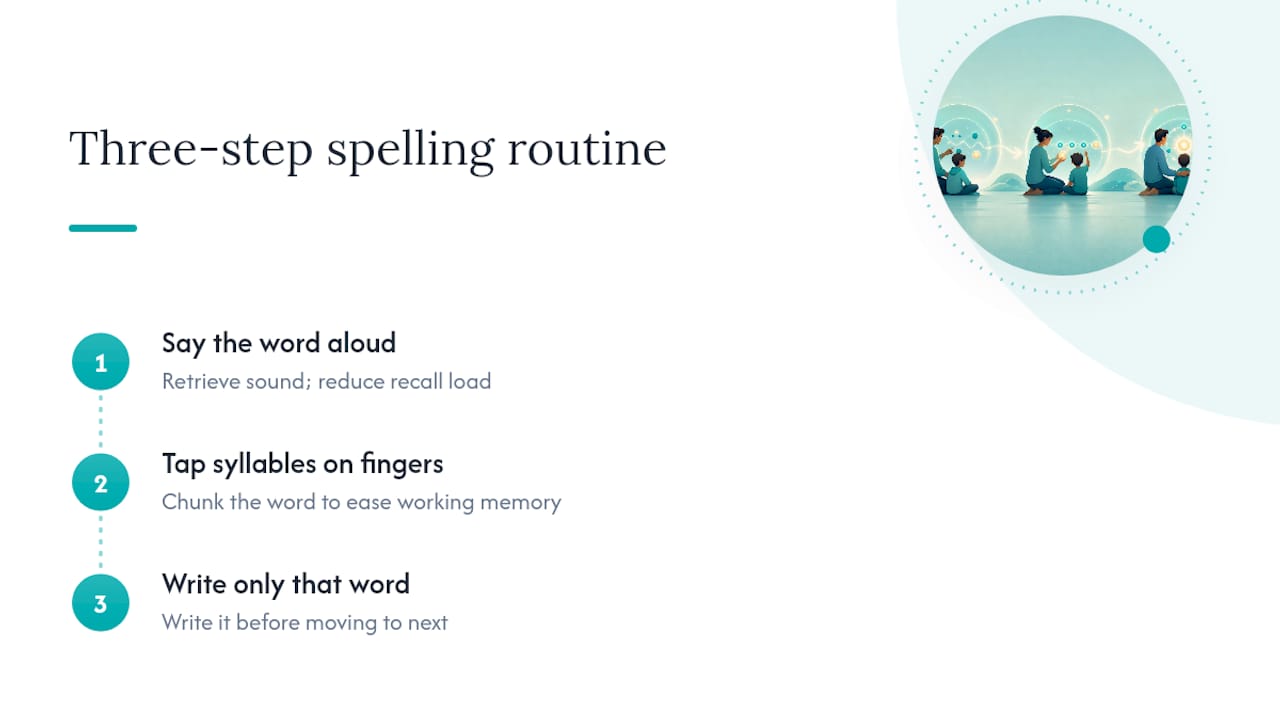
Break the load into separate steps. Have the child say the word out loud first, tap out its syllables on their fingers, then write just that one word before moving to the next. This keeps spelling from competing with sentence composition for the same mental bandwidth.
Word banks help enormously. Keeping a running list of frequently misspelled or hard-to-retrieve words, taped to a desk or written on a bookmark, removes the guessing game during an assignment. For word-retrieval gaps specifically (when a child knows what they mean but can’t find the word), picture-word association cards or a simple “tell me what it does” prompt often unlocks the term faster than waiting it out.
Multisensory spelling practice pays off too. Writing a spelling word in sand while saying each letter out loud engages sight, sound, and touch simultaneously, which tends to stick better than silent repetition. Pairing this with the letter-stamp and tracing activities covered earlier turns spelling practice into the same five-minute ritual as letter formation drills, rather than a separate, dreaded task.
Keep spelling lists short. Keeping spelling lists short and practicing them well is more effective than large, infrequent lists.
Sharpening Hand-Eye Coordination for Writing
Handwriting is a hand-eye coordination task before it’s a literacy task. A child has to track where the pencil tip is, compare it to a target line or letter shape, and adjust in real time, all while holding a pencil that may already feel awkward in their hand.
Catching and throwing games build this skill in a way that feels nothing like schoolwork. Rolling or tossing a ball back and forth forces the eyes to track a moving target and the hands to respond, which is the same visual-motor loop used when a pencil follows a line on paper.
Dot-to-dot puzzles and maze books are underrated tools here. They demand the eyes lead the hand along a defined path, which is precisely what handwriting requires when following a line or staying inside letter boundaries. Start with wide, simple mazes and work toward tighter, more complex ones as control improves.
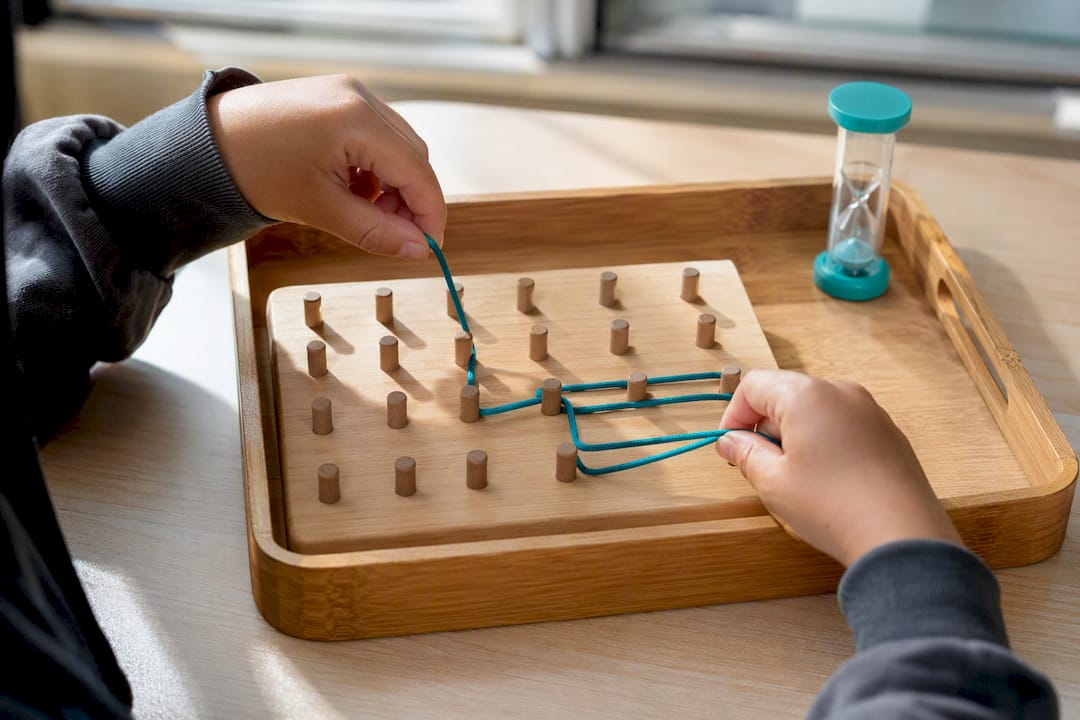
Pegboard and lacing card activities also translate directly to pencil control, since both require watching a small target (a hole or a peg) and guiding a hand to it precisely. Brief coordination warmups with pegboard activities can prime readiness for writing, the same way an athlete stretches before a game.
Ball-based bilateral games (bouncing a ball while catching it with alternating hands) tie hand-eye coordination back to the cross-body movement clinicians already recommend, giving a single activity double the benefit.
Helping Kids Organize and Plan Their Writing
A blank page is often the hardest part of writing for a child with dysgraphia, not because they lack ideas, but because organizing those ideas into a sequence feels like an entirely separate task on top of the physical act of writing.
Graphic organizers solve this by externalizing the planning step. A simple three-box chart (first, then, last) turns a vague assignment into a concrete checklist, and a “who, what, where” box works well for story writing. The goal is to get all the thinking done before the pencil touches paper, so writing becomes transcription of an already-formed plan rather than simultaneous thinking and writing.
Color-coding helps too. Assigning one color to the topic sentence, another to supporting details, and a third to the conclusion gives a visual map a child can follow without re-reading instructions every few minutes.
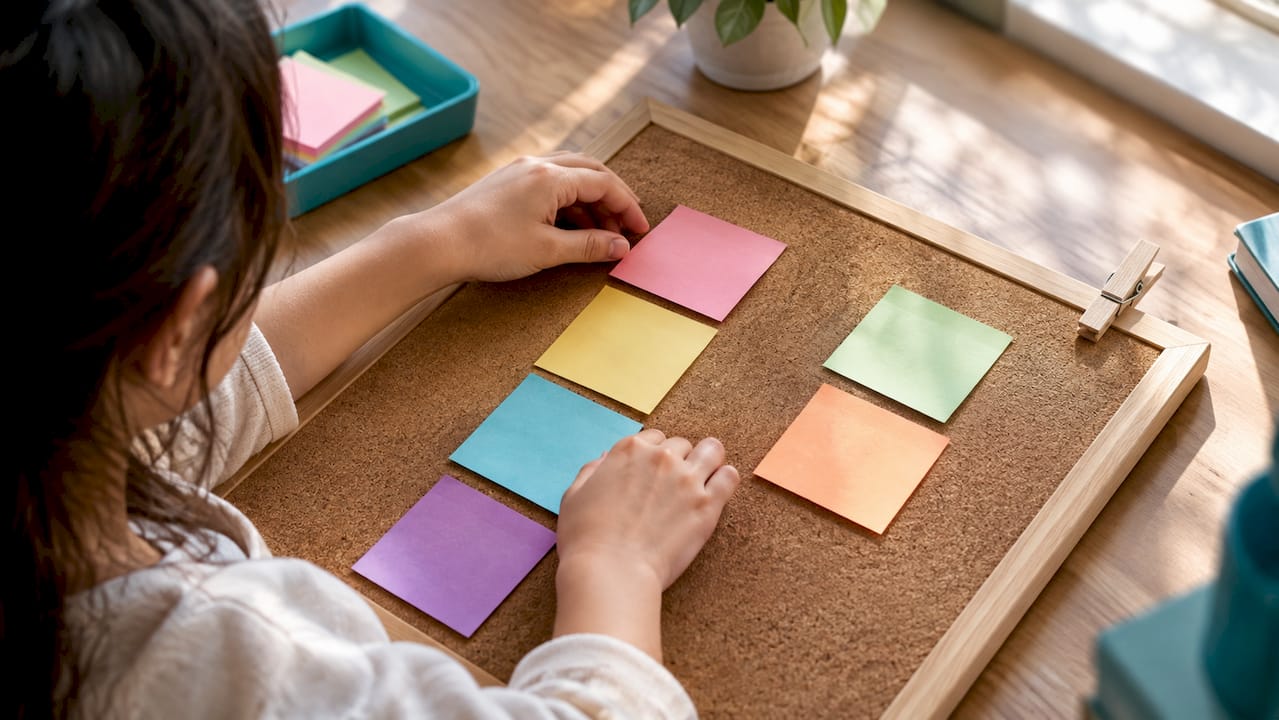
Sticky notes work as a low-tech planning tool for longer assignments. Have the child jot one idea per note, then physically arrange the notes in order before writing a single sentence. This turns an abstract organizational task into a hands-on sorting activity, which plays to the same tactile strengths that make sand tracing and clay letters effective.
Checklists for editing (Did I use capital letters? Did I add punctuation? Does it make sense?) reduce the executive-function burden of remembering every rule at once, letting a child focus on one revision pass at a time instead of trying to catch everything simultaneously.
Building Handwriting Speed Without Losing Legibility
Speed comes after accuracy, never before it. Pushing a child to write faster before their letter formation is automatic usually produces messier, harder-to-read work, not quicker work.
Timed copying drills can help build fluency once letter shapes become familiar. Give a child brief timed copying drills to encourage repeated practice, then track that count over several weeks. The goal isn’t perfection on any single attempt. It’s a slow, visible climb in repetitions, which builds confidence alongside fluency.
Rhythmic writing games work surprisingly well here. Writing letters or short words to a steady beat (a metronome app or clapping) trains the hand to move in consistent, efficient strokes instead of stopping and second-guessing after every letter. This mirrors the “numbered stroke cue” method used in structured handwriting programs, where a consistent sequence of movements gets reinforced through repetition.
Alternate between pencil and whiteboard marker during speed drills. Big-motor whiteboard writing lets a child practice quick, confident strokes without the fine-motor fatigue of a pencil grip, then those faster movement patterns often transfer back to paper.
Keep timed drills short: sixty to ninety seconds, a few times per session. Longer timed writing tends to trigger fatigue and frustration rather than fluency gains, which defeats the purpose entirely.
Managing Sensory Sensitivities That Affect Writing
Some kids with dysgraphia resist writing not because of the motor skill itself, but because something about the sensory experience feels wrong: the scratch of a pencil, the smell of a marker, the pressure of a desk chair against their back.
Test different writing tools before assuming a child dislikes writing altogether. Gel pens, mechanical pencils, and thicker triangular grips each feel different in the hand, and a child who resists a standard pencil might write happily with a different texture or weight entirely.
Pay attention to seating and workspace. A wobble cushion, a footrest, or a slightly reclined chair angle can settle a child who’s fidgeting because of postural discomfort rather than task avoidance. Fluorescent lighting and busy visual backgrounds can also overload some kids before they’ve written a single word, so a quiet, low-clutter writing spot often helps more than any pencil grip ever will.
Weighted lap pads or a firm surface underneath a worksheet can provide the calming pressure some sensory-sensitive kids need to settle into a task. Pair this with the multisensory activities covered earlier, since sand, clay, and shaving cream double as regulation tools, not just letter-formation practice.
If a child melts down specifically around writing tasks but stays calm during other fine-motor activities like building or drawing, that’s a useful clue the resistance is sensory or emotional, not purely a motor-skill gap, and worth mentioning to an occupational therapist.
A Perspective on Confidence, Play, and Small Wins
Plenty of kids with dysgraphia have brilliant stories stuck behind a hand that won’t cooperate, and that gap between idea and execution is exhausting for a child long before it’s frustrating for a parent. Progress rarely announces itself. It shows up as one slightly steadier letter, one finished postcard, one day the pencil didn’t get thrown across the room. Celebrate that. Pick two activities from this list that match what your child already loves, whether that’s secret missions or building things with their hands, and measure success in small, specific wins rather than a perfect page.
— Tita
How Team Genius Squad Kits Support These Activities
Some kits are built around hands-on experiments and short writing prompts, so a child can journal a hypothesis, record an observation, or caption a discovery the same way they’d caption a comic strip in the activities above, tied to something they just built or tested with their own hands.

A few ways the kits map directly onto what’s covered here:
- Some tactile experiment materials (like slime, gel, goop) can serve as sensory letter-formation practice, similar to sand or shaving cream tracing.
- Experiment journaling prompts may turn “record what happened” into low-pressure sentence writing, offering real-audience motivation similar to postcards and secret-agent notes.
- Lab-coat and badge role-play support identity-driven engagement that can help make a short writing task feel like part of a mission instead of homework.
Families ready for a structured starting point can explore the guided lesson-plan bundles, which pair STEAM experiments with literacy prompts and role-play elements built in. If your child gravitates toward mixing and pouring, the slime, gel, and goop experiment kit is a natural entry point that turns tactile play into a writing prompt by the end of the session.
Sources
For deeper reading on dysgraphia strategies, see Understood’s expert tips for helping children with dysgraphia, Additude’s guide to dysgraphia treatment, and the International Dyslexia Association’s overview of dysgraphia. For confidence-building strategies at home, Teamgeniussquad’s dyslexia learning tips offer related, practical guidance.
- 8 expert tips on helping your child with dysgraphia
- How to improve handwriting: Dysgraphia treatment (Additude)
- Understanding dysgraphia (IDA)
FAQ
Is dysgraphia a form of ADHD?
No. Dysgraphia is a distinct learning disability affecting writing ability, though it frequently occurs alongside ADHD, dyslexia, or other learning differences without being caused by any of them.
What are five common dysgraphia symptoms?
Common signs include illegible or inconsistent handwriting, awkward pencil grip, difficulty spacing letters and words, trouble organizing thoughts on paper, and slow, effortful writing compared to peers.
What are effective strategies for helping a child with dysgraphia?
Multisensory letter practice, fine-motor strengthening games, motivating real-audience writing tasks, assistive tech like speech-to-text, ergonomic adjustments such as slant boards, and short, frequent practice sessions all show strong results, and kits pairing hands-on STEAM activities with literacy prompts add another layer of engagement.
At what age does dysgraphia usually appear?
Dysgraphia often becomes noticeable in early elementary school, typically between ages 5 and 7, once formal handwriting instruction begins and a child’s writing struggles start to stand out compared to classmates.


Leave a comment
This site is protected by hCaptcha and the hCaptcha Privacy Policy and Terms of Service apply.