
40 Science Writing Prompts for Teachers & Parents, Age Tagged With E³
This article delivers dozens of ready-to-use science writing prompts organized by age band and by writing type, from kindergarten observation journals to high school science fiction essays. You’ll find two trusted frameworks woven throughout: sensory observation journals and the BEETLES Project’s “I Notice, I Wonder, It Reminds Me Of” method. Quick scaffolds and modification tips help you adapt every prompt for struggling or reluctant writers.
TL;DR:
- Most prompts should be matched to age, with short sensory prompts for young children and research-backed, longer tasks for high school students.
- Different prompt types develop specific skills, such as observation, argument, or imagination, and should be rotated weekly for balanced practice.
- Using hands-on experiments or kits alongside writing prompts enhances engagement and helps students produce more natural, detailed responses.
- Scaffolds like sentence starters, graphic organizers, and peer feedback support struggling writers and reinforce the Engage, Encourage, Empower framework.
- Timing of prompts varies from five minutes for quick responses to extended periods for journal or persuasive writing, optimized by appropriate scaffolds and routines.
Table of Contents
- Science Writing Prompts by Age and Grade Level
- Science Writing Prompts by Type and Purpose
- 40 Ready-to-Use Science Writing Prompts You Can Copy Today
- How to Use Science Writing Prompts for Maximum Impact
- The E³ Method Behind Every Prompt Choice
- Why Writing About Science Sticks With Kids
- Pair These Prompts With Hands-On Kits That Do the Talking
- Trusted Resources for Building Your Own Prompt Library
- Sources
- FAQ
Science Writing Prompts by Age and Grade Level
A first grader staring at a caterpillar needs a different invitation than a tenth grader debating climate policy. Matching the prompt to the developmental stage is what separates a productive five minutes of writing from a frustrated blank page.
Grades K-2 (ages 5-7): Keep these prompts short and sensory.
- “Draw and label three things you see outside your window.”
- “What sound does rain make? Write three words for it.”
- “If you were a bug for one day, what would you eat?”
- “Tell me about your favorite animal using your five senses.”
Grades 3-5 (ages 8-10): Introduce cause-and-effect thinking.
- “Why do you think leaves change color in fall? Write your best guess.”
- “Describe what happens when ice melts, step by step.”
- “What would happen if plants didn’t need sunlight?”
Grades 6-8 (ages 11-13): Push toward argument and evidence.
- “Should schools require recycling? Support your answer with two reasons.”
- “Explain photosynthesis to a five-year-old using an analogy.”
Grades 9-12 (ages 14-18): Demand research-backed reasoning and longer form.
- “Argue for or against gene editing in humans, citing at least one source.”
- “Write a lab report as a story told from the perspective of the beaker.”
For mixed-age groups, keep the question the same and adjust the required length. A bell ringer runs five minutes; homework can stretch to a full paragraph or page.
Science Writing Prompts by Type and Purpose
Different writing tasks build different muscles. An observation journal sharpens attention to detail. A persuasive essay demands evidence. Matching the type to your goal makes every prompt count.
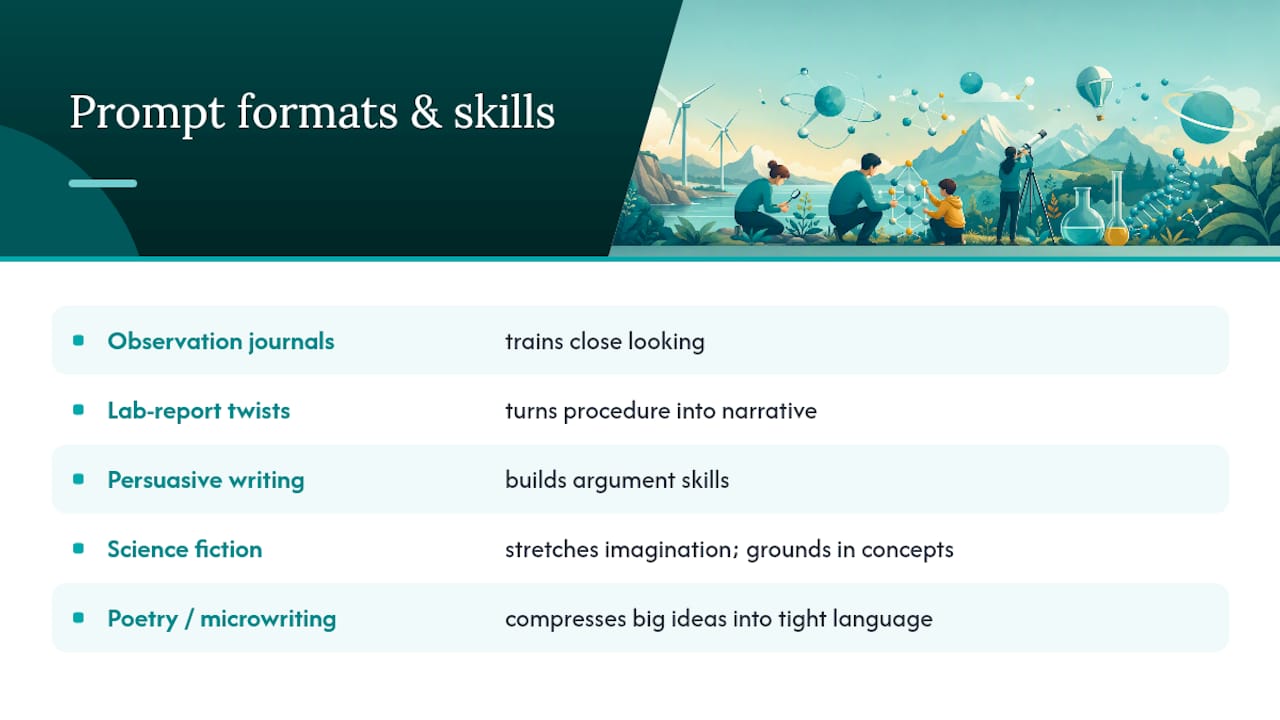
Observation and nature journal prompts train close looking. The BEETLES Project’s “I Notice, I Wonder, It Reminds Me Of” template moves students from simple identification toward genuine curiosity, and Oregon State Extension’s weekly journaling prompts offer ready sensory scaffolds. Try: “Notice one thing about a rock. Wonder one question about it.”
Lab-report twist prompts turn dry procedure into narrative. Try: “Retell your last experiment as if you were the main character in an adventure story.”
Persuasive science writing builds argument skills. Try: “Convince your principal to add a school garden using scientific reasoning.”
Science fiction and “what if” prompts stretch imagination while grounding it in real concepts. Try: “What if gravity stopped working for one hour? Write the news report.”
Poetry and microwriting compress big ideas into tight language. Try: “Write a six-word poem about the water cycle.”
Mixing creative and evidence-based formats supports both engagement and genuine science-literacy skills.
Pro Tip: Rotate prompt types weekly so students practice observation, argument, and imagination in a steady cycle rather than defaulting to whichever type feels easiest.
40 Ready-to-Use Science Writing Prompts You Can Copy Today
These prompts are grouped by format so you can grab exactly what fits your lesson plan, whether that’s a two-minute bell ringer or a week-long journal project. Teachers frequently search for exactly this kind of printable, plug-and-play prompt bank, and this collection mirrors the breadth of the best classroom resources while staying quick to scan.
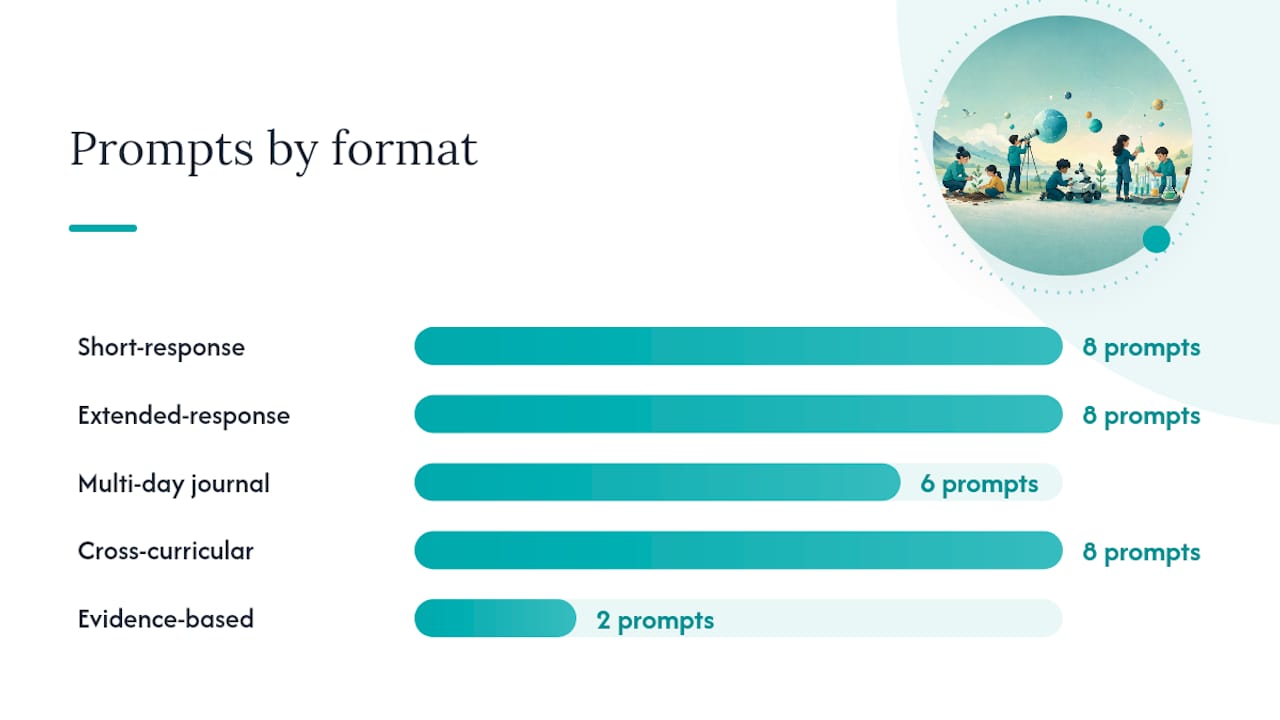
Short-response prompts (5-10 minutes):
- What is the strangest animal adaptation you know, and why does it work?
- If you shrank to the size of an ant, what would scare you most?
- Name one machine you use daily and explain how it works.
- What would Earth look like without the moon?
- Describe static electricity without using the word “electricity.”
- Why does ice float instead of sink?
- What’s one experiment you’d run if you had unlimited supplies?
- Explain why the sky is blue to someone who has never seen it.
Extended-response prompts (one to two paragraphs): 9. Argue whether humans should colonize Mars, using at least two pieces of evidence. 10. Explain the water cycle as if narrating a nature documentary. 11. Describe a volcano eruption from the point of view of a nearby tree. 12. Should schools ban single-use plastics? Defend your position. 13. Write a persuasive letter asking a company to reduce packaging waste. 14. Compare a beehive to a human city. What similarities surprise you? 15. Explain why vaccines work using an analogy a third grader would understand. 16. Describe what your body does differently when you exercise versus when you rest.
Multi-day journal prompts: 17. Track the moon’s shape for one week and write one observation each night. 18. Plant a seed and write three journal entries describing its changes. 19. Observe a cloud each day this week and describe its shape and movement. 20. Keep a “sound journal” noting one new sound you notice daily and a guess about its source. 21. Track your family’s water usage for three days and reflect on patterns. 22. Record the weather each morning and predict the next day’s forecast.
Cross-curricular and creative options: 23. Write a comic strip explaining how a rainbow forms. 24. Invent a new animal adapted for living on the moon and describe it. 25. Write a diary entry as a dinosaur on its last ordinary day. 26. Design a “science superhero” whose powers come from a real scientific principle. 27. Write a recipe that explains a chemical reaction using cooking steps. 28. Compose a rap or chant that teaches the parts of a plant cell. 29. Write a letter from a raindrop describing its journey through the water cycle. 30. Imagine a conversation between a shark and a dolphin about ocean pollution.
Evidence-based and CER-style prompts: 31. State a claim about why plants need light, then support it with evidence and reasoning. 32. Explain your hypothesis for an experiment before running it, then revise based on results. 33. Analyze a simple graph of temperature data and explain what it shows. 34. Defend a claim about which material insulates heat best, using test results. 35. Write a claim, evidence, and reasoning paragraph about why objects float or sink.
Quick fun prompts for reluctant writers: 36. If you could ask a scientist one question, what would it be and why? 37. What’s the coolest fact about space you’ve ever heard? 38. Invent a gadget that solves a problem using science you already know. 39. What job in science sounds most exciting to you, and why? 40. Describe your dream science lab in five sentences.
How to Use Science Writing Prompts for Maximum Impact
Timing shapes results more than the prompt itself. A five-minute bell ringer works best with short-response prompts; a 15 to 30 minute writing block suits extended-response or persuasive tasks; weekly nature journals need a standing ten-minute slot on the same day each week.
Scaffolds keep struggling writers moving instead of stuck. Useful tools include:
- Sentence starters (“I notice… I wonder… This reminds me of…”) borrowed directly from the BEETLES observation template
- Word banks with grade-appropriate vocabulary pulled from the day’s topic
- Graphic organizers for claim, evidence, and reasoning
- Cross-disciplinary prompt sheets that connect science writing to math and social studies
Assessment doesn’t need to be heavy. A three-point rubric (detail, clarity, evidence) works for most grades, and peer feedback pairs well with exit tickets. For students who struggle with handwriting or spelling, offer multimodal alternatives: drawing, comic panels, or a recorded voice memo instead of a written paragraph.
Pro Tip: Let a student narrate their answer aloud while you or a partner jots it down. The thinking still counts as writing practice, even when the pencil isn’t moving.
The E³ Method Behind Every Prompt Choice
Every prompt in this collection is chosen to move a child through three stages: Engage, Encourage, Empower. A student first engages with a hands-on question, then gets encouraged through low-stakes scaffolds like sentence starters, and finally feels empowered once their writing becomes something they’re proud to share.
Three classroom routines put this into practice:
- Pair a short-response prompt with a lab coat and “junior scientist” badge for instant buy-in before writing begins.
- Turn a multi-day journal into a certificate ceremony once the observation week ends.
- Use role-play props during persuasive prompts, letting a student argue “as” a scientist presenting findings.
Some kits pair real experiments with writing tasks so children experience science, then explain it in their own words.
Why Writing About Science Sticks With Kids
Writing about an experiment forces a child to slow down and explain what happened in their own words, and that act of explaining is what cements understanding far longer than watching or listening ever does. It also does something quieter: it lets a struggling reader or a nervous speaker discover they have something worth saying about the natural world. Try one prompt this week, adapt it freely, and watch what your student notices when given the room to wonder on paper.
— Tita
Pair These Prompts With Hands-On Kits That Do the Talking
Reading a prompt is one thing. Handing a child a real experiment to write about afterward is what makes the words come easily instead of feeling forced. Screen-free kits can give students hands-on moments these prompts ask them to describe, from solar-powered gadgets to lab role-play, so the writing flows from something they actually built and touched.

A kit like the Solar Energy Kit with Mirror Disk turns an abstract “explain how solar power works” prompt into a lived experience a child can describe firsthand. Pair any experiment with:
- Lab coats and badges that make the “young scientist” persuasive-writing prompts feel real
- Printable lesson plans already mapped to hands-on activities
- Certificates that turn a finished journal entry into a proud, shareable milestone
If you want prompts and materials working together instead of separately, browse the full lesson plans collection and pick a kit that matches this week’s writing goal.
Trusted Resources for Building Your Own Prompt Library
- BEETLES Project: the observation template behind this article’s nature-journal prompts.
- Oregon State Extension: weekly journaling templates for sensory description.
- JournalBuddies: large, classroom-ready prompt collections.
- DressUpYourWriting: activity ideas mixing genres to build writing skills.
Sources
- BEETLES Project — Nature exploration with young students
- Nature journaling and observations — Oregon State Extension
- 42 Fun Science Writing Prompts for Students — JournalBuddies
- Experiment with Words: How Science Boosts Writing Skills — DressUpYourWriting
FAQ
What are some interesting topics for science writing?
Strong topics connect a real phenomenon to a personal question, like explaining why ice floats, arguing for school gardens, or imagining life without gravity for a day.
What are some cool science topics for student writing?
Space, animal adaptations, weather patterns, and simple machines consistently engage students because each one invites a “why” or “what if” question they can answer from experience or observation.
What are some cool writing prompts for science journals?
The BEETLES “I Notice, I Wonder, It Reminds Me Of” format works well for any nature journal entry, turning a simple observation into a chain of genuine curiosity.
What is an example of science writing?
A student explaining the water cycle as a documentary narration, or writing a claim-evidence-reasoning paragraph about why objects float, both count as science writing that blends explanation with a clear structure.
How long should a science writing prompt take to complete?
Short-response prompts fit a five-minute bell ringer, while persuasive essays or extended lab-report rewrites need a 15 to 30 minute block to develop fully.


Leave a comment
This site is protected by hCaptcha and the hCaptcha Privacy Policy and Terms of Service apply.