What Is Identity-Driven STEAM? A Guide for Educators
Identity-driven STEAM is defined as an educational approach that places learners’ cultural, social, and personal identities at the center of science, technology, engineering, arts, and mathematics instruction. Rather than treating identity as a background detail, this model treats it as the engine of engagement, belonging, and self-efficacy. Closely related terms include STEM identity, culturally sustaining pedagogy, and justice-centered STEM education, which frames learning as a tool for addressing real social and emotional challenges faced by minoritized groups. For educators, parents, and advocates, understanding this concept is the first step toward building learning environments where every child sees themselves as a capable scientist, creator, and problem-solver.
What is identity-driven STEAM and why does it matter?
Identity-driven STEAM, also referred to in research literature as identity-centered or culturally sustaining STEAM, is not a single curriculum. It is a pedagogical orientation that asks one foundational question before any lesson begins: does this child see themselves in this subject? When the answer is yes, the research shows measurable gains in motivation, persistence, and academic outcomes.
The concept draws from three overlapping frameworks. First, STEM identity theory examines how students’ sense of belonging and recognition within STEM shapes their academic choices. Second, culturally relevant pedagogy, developed by scholar Gloria Ladson-Billings, connects academic content to students’ lived experiences and community knowledge. Third, justice-centered STEM frameworks use asset-based approaches that leverage learners’ transnational experiences and meaning-making resources to motivate inquiry and making.

For parents, the practical meaning is straightforward. A child who sees their cultural background, family story, or personal interests reflected in a science experiment is far more likely to stay curious, ask questions, and return to the activity. For educators, it means designing tasks that connect STEAM content to the real world students already inhabit, not an abstract world they are expected to enter someday.
What does research say about identity-driven STEAM and its impact?
The evidence supporting identity-driven learning in STEAM is growing and specific. Key findings include:
- Students with strong learning identity completed more lessons and achieved better mathematics outcomes over an academic year in adaptive learning systems. This means identity is not just a feel-good concept. It is a measurable predictor of academic persistence.
- Culturally relevant hands-on STEM experiences increased both engagement and STEM identity measures for underserved students, particularly when students were exposed to the engineering design process more than once. Repeated exposure matters as much as cultural relevance.
- The Trapezium Model, an emerging pedagogical framework, teaches that learner identity should be acknowledged before any new skill is introduced. This “Identity-first” approach treats personalized identity statements as foundational to instruction, not as optional warm-up activities.
“Identity-driven instruction is most effective when identity is interwoven with curricular content, situating problems and knowledge within students’ cultural contexts rather than isolated within identity statements.” — Frontiers in Education
The research also points to equity as a core outcome. Justice-centered STEAM frameworks specifically target multilingual learners and minoritized groups, using their community knowledge as an academic asset rather than a gap to be filled. This reframing changes not just what children learn, but how they feel about learning it.
How identity-driven STEAM differs from traditional STEAM education
Traditional STEAM education has made real progress in integrating arts with science and technology. However, it often focuses on content integration without an explicit identity focus. The distinction matters, and the table below captures the core differences clearly.
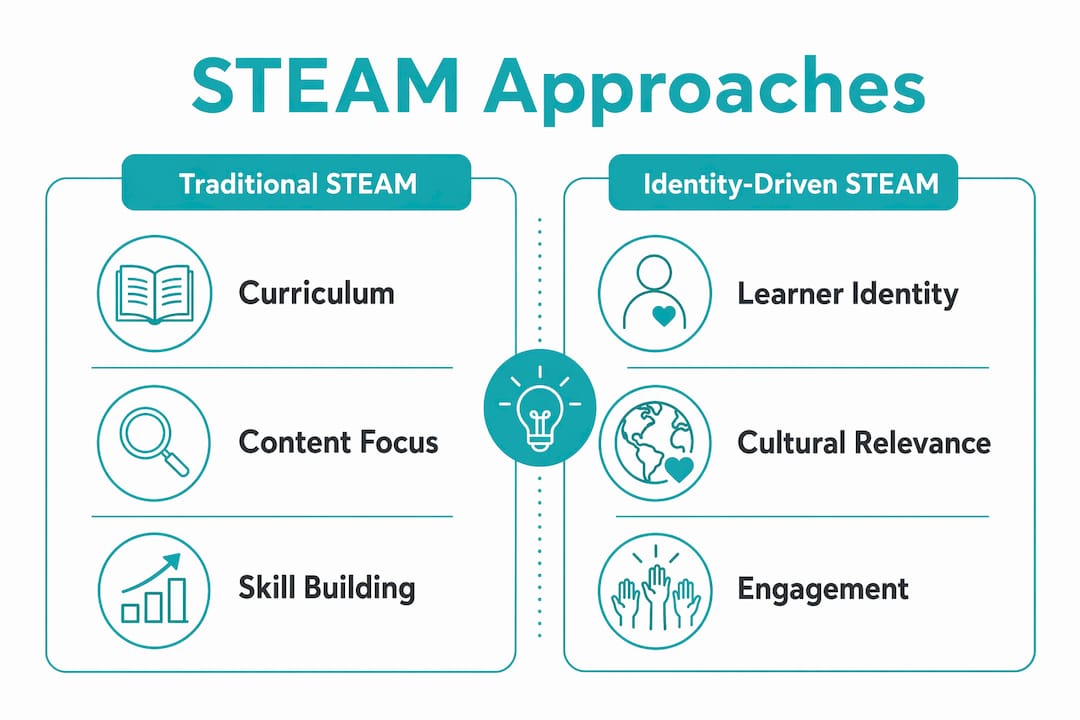
| Dimension | Traditional STEAM | Identity-Driven STEAM |
|---|---|---|
| Starting point | Curriculum content and skills | Learner identity and lived experience |
| Cultural relevance | Optional or supplemental | Foundational and embedded |
| Equity focus | Peripheral or absent | Central to task design |
| Motivation strategy | Grades, achievement, and competition | Belonging, recognition, and self-efficacy |
| Assessment lens | Skill mastery | Skill mastery plus identity growth |
Traditional STEAM may teach a child how to build a circuit. Identity-driven STEAM asks that child to build a circuit that solves a problem in their own neighborhood, using knowledge from their own family’s experience. The science is the same. The engagement is entirely different.
Culturally sustaining pedagogy, a term coined by Django Paris, extends this further by arguing that schools should not just be relevant to students’ cultures. They should actively sustain and celebrate those cultures as living, dynamic resources. When this principle enters a STEAM classroom, the result is hands-on learning for neurodivergent learners and diverse populations that feels personally meaningful rather than generically educational.
Common challenges and misconceptions about identity-driven STEAM
Misunderstanding this approach is easy, and the misconceptions can undermine even well-intentioned efforts. Here are the most common pitfalls educators and parents encounter:
- Treating identity as a one-time activity. Hanging a poster of diverse scientists or doing a single “who are you?” exercise is not identity-driven STEAM. Authentic implementation means embedding identity into every task, question, and reflection throughout the learning experience.
- Confusing STEAM education with the gaming platform Steam. The term “identity-driven Steam” is often confused with gaming communities and web3 identity dynamics, which are entirely unrelated to STEAM education. When searching for resources, always pair the term with “education” or “learning” to find relevant material.
- Assuming affirmation alone is enough. Research on the Calling-Cost Paradox in identity-based motivation shows that high identity-driven motivation without structural support increases the risk of burnout. Telling a child they are a scientist is powerful. Pairing that affirmation with manageable workloads, mentorship, and psychologically safe spaces is what makes it sustainable.
- Skipping the structural supports. Identity motivation can backfire when children are pushed to perform without the scaffolding to succeed. Mentorship, clear boundaries around effort and rest, and safe spaces to make mistakes are not extras. They are requirements.
Pro Tip: When designing an identity-driven STEAM activity, ask yourself: “Does this task connect to something this specific child already knows, values, or cares about?” If the answer is no, redesign the context before you redesign the content.
How to create identity-driven STEAM learning environments
Building an identity-driven STEAM environment is a practice, not a product. It requires intentional design at every level, from how you introduce a topic to how you celebrate a child’s discovery. Here are the strategies that research and practice support most strongly:
- Start with identity, not content. The Identity-first Trapezium Model is clear: acknowledge who the learner is before teaching what you want them to know. This might mean asking a child what problems they notice in their community, what their family builds or fixes, or what they are curious about in their daily life. These answers become the entry points for STEAM exploration.
- Design culturally affirming, hands-on activities. Culturally relevant informal STEM learning connects STEAM to students’ lived experiences and uses repeated exposure to the engineering design process to build both skill and identity. A single experiment is a moment. A series of connected experiments tied to a child’s world is a story they tell about themselves.
- Use storytelling as a pedagogical tool. Small group storytelling is one of the most effective ways to integrate cultural identity into learning. When children narrate their discoveries, they are not just reporting results. They are building a self-concept as someone who investigates, creates, and solves.
- Build structural supports into the learning design. Pair identity affirmation with mentoring relationships, clear expectations about effort, and explicit permission to rest and try again. The Calling-Cost Paradox research confirms that psychological safety is not a soft add-on. It is a prerequisite for sustained identity-driven motivation.
- Use formative assessment to track identity growth. Adaptive learning systems can correlate identity constructs with learning trajectories, giving educators concrete data on whether identity-driven approaches are working. Even without digital tools, simple reflection prompts like “What did you discover about yourself today?” give parents and educators meaningful feedback.
Pro Tip: Integrate STEAM literacy activities like journaling, drawing, and storytelling alongside experiments. When children write or draw about what they built, they reinforce both their STEAM knowledge and their identity as a learner.
The goal is not to make every child love science. The goal is to make every child believe that science has room for them, and that their perspective makes it better.
Key takeaways
Identity-driven STEAM is most effective when learner identity is embedded in every task, supported by cultural relevance, structural safety, and repeated hands-on discovery rather than treated as a one-time affirmation.
| Point | Details |
|---|---|
| Identity comes first | Acknowledge who the learner is before introducing new STEAM skills or content. |
| Cultural relevance drives engagement | Connecting STEAM tasks to students’ lived experiences measurably increases identity and motivation. |
| Affirmation needs structural support | Identity-driven motivation without workload limits and mentorship increases burnout risk. |
| Storytelling reinforces identity | Narrative activities help children build a self-concept as scientists, creators, and problem-solvers. |
| Assessment should track identity growth | Reflection prompts and adaptive tools reveal whether identity-driven approaches are working. |
Why identity-driven STEAM is the most important shift in education right now
I have watched children light up the moment a science activity connects to something they already know and love. I have also watched that same light dim when the activity feels like it belongs to someone else’s world. That gap is not about intelligence or ability. It is about belonging.
What strikes me most about the research on identity-driven learning is how often educators underestimate the cost of skipping the identity step. We rush to the content because content feels measurable and safe. But a child who does not see themselves as a scientist will not persist through difficulty, no matter how well-designed the experiment is. The identity piece is not the warm-up. It is the foundation.
The misconception I encounter most often is that identity-driven STEAM requires a complete curriculum overhaul. It does not. It requires a shift in the first question you ask. Not “what will they learn today?” but “who are they, and how does what they already know connect to what we are about to discover?” That single reframe changes everything that follows.
My honest belief is that the future of STEAM education belongs to approaches that treat every child’s background as an asset, not a variable to control for. The children who will solve tomorrow’s problems are sitting in classrooms and living rooms right now, waiting to see themselves in the work. Educators and parents who embrace identity-driven STEAM are not just improving test scores. They are building the next generation of innovators who know, from the very beginning, that they belong in the room.
— Tita
Bring identity-driven STEAM to life with Teamgeniussquad
Teamgeniussquad builds hands-on, screen-free STEAM discovery kits designed to do exactly what identity-driven learning research calls for: connect science to a child’s world, build confidence through successful discovery, and help every young learner see themselves as an innovator.
Powered by the proprietary E³ Method (Engage, Encourage, Empower), each kit gives children ages 5 to 13 the tools to conduct real experiments, step into scientist role play, and reflect on what they built and who they are becoming. The STEM-STEAM Electricity Lab Bundle is a strong starting point for families and classrooms ready to put identity-driven STEAM into practice with a structured, confidence-building experience. You can also explore the full range of experiment kits to find the right fit for your learner.
FAQ
What is identity-driven STEAM in simple terms?
Identity-driven STEAM is an educational approach that connects science, technology, engineering, arts, and mathematics learning to a child’s cultural background, personal experiences, and sense of self. The goal is to increase belonging, motivation, and confidence in STEAM subjects.
How is identity-driven STEAM different from standard STEAM education?
Standard STEAM focuses primarily on content and skill integration, while identity-driven STEAM places the learner’s identity at the center of every task and activity. The key difference is that identity-driven STEAM treats cultural relevance and equity as foundational, not optional.
How can parents support identity-driven STEAM at home?
Parents can start by connecting STEAM activities to their child’s interests, family stories, and community experiences. Pairing hands-on experiments with reflection questions like “What does this remind you of in your life?” reinforces both STEAM skills and a child’s identity as a learner and creator.
What does the research say about identity-driven learning outcomes?
Research shows that students with strong learning identity complete more lessons and achieve better academic outcomes, particularly in mathematics. Culturally relevant hands-on STEAM experiences also measurably increase STEM identity and self-efficacy for underserved students.
Is identity-driven STEAM only for minoritized or underserved students?
No. While identity-driven STEAM has the strongest documented impact for minoritized and multilingual learners, the approach benefits all children by making learning personally meaningful and building the kind of intrinsic motivation that sustains long-term curiosity and confidence in STEAM fields.


Leave a comment
This site is protected by hCaptcha and the hCaptcha Privacy Policy and Terms of Service apply.