
Non-Newtonian Solid: Properties, Models, and Applications
A non-Newtonian solid is a material that behaves as a rigid body below a critical yield stress and flows like a fluid once that threshold is exceeded. This definition separates it from both classical solids and Newtonian fluids, which maintain constant viscosity regardless of applied force. Cornstarch mixed with water, commonly called oobleck, is the most recognized example. Toothpaste, ketchup, and certain protective gels also qualify. Rheologists describe these materials using constitutive models like the Bingham plastic and the Herschel–Bulkley model, which capture the transition from solid-like resistance to fluid-like flow. Understanding these materials opens doors to applications in biomedical engineering, protective equipment, and hands-on science education.
What are the key properties of a non-Newtonian solid?
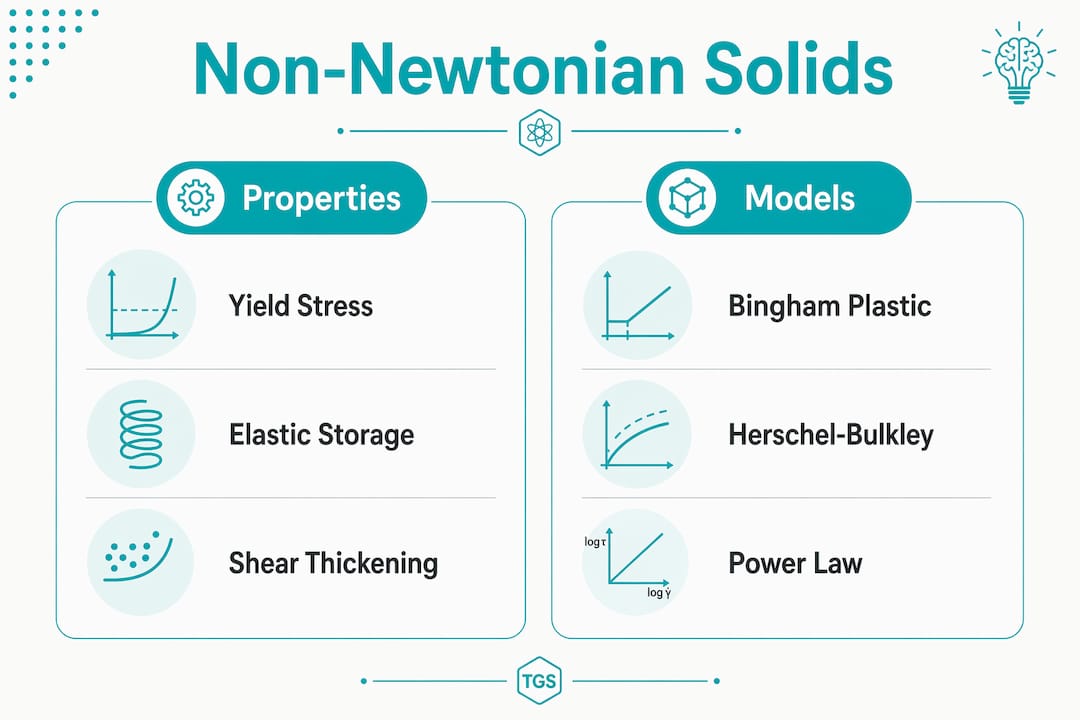
A non-Newtonian solid is defined by its yield stress threshold, the point below which the material stores energy elastically and above which it deforms and flows. This single property is what separates yield-stress materials from ordinary fluids. Water flows under any applied force, no matter how small. Toothpaste, by contrast, behaves as a soft solid until you squeeze the tube hard enough to exceed its yield stress, at which point it flows cleanly onto your brush and stops the moment you release pressure.
Beyond yield stress, these materials also show rate-dependent viscosity. Shear-thickening fluids increase in viscosity as shear rate rises, while shear-thinning fluids do the opposite. Paint is a classic shear-thinning example: it flows easily under the brush but thickens back up on the wall to prevent dripping. Cornstarch suspensions are the textbook shear-thickening case, stiffening dramatically under rapid impact.
The mechanical response of a non-Newtonian solid also depends on deformation history and strain rate. A material that has been recently stressed may yield at a different threshold than one that has been resting. This history dependence is called thixotropy, and it explains why stirring a jar of natural peanut butter makes it easier to spread. Viscoelastic materials, a closely related category, show both elastic and viscous responses simultaneously, with elastic behavior dominating at short timescales and viscous flow dominating at long ones.
- Yield stress: The minimum force required to initiate flow; below it, the material acts like a solid.
- Shear-thickening behavior: Viscosity increases with shear rate, producing temporary rigidity on impact.
- Shear-thinning behavior: Viscosity decreases with shear rate, enabling smooth application and controlled flow.
- Thixotropy: Time-dependent viscosity recovery after stress is removed.
- Viscoelastic response: Combined elastic and viscous behavior that shifts depending on loading speed.
Pro Tip: When observing non-Newtonian behavior in a classroom demo, vary the speed of your applied force deliberately. Slow pressure and fast impact on the same material will produce dramatically different results, which is the clearest way to illustrate rate dependence to students.
How do rheological models describe non-Newtonian solid behavior?
Rheological models give scientists and engineers a mathematical language for predicting how these materials respond under stress. Three models dominate the field: the Power-law model, the Bingham plastic model, and the Herschel–Bulkley model. Each captures a different slice of non-Newtonian behavior, and each carries specific limitations that make model selection a genuine scientific decision rather than a formality.
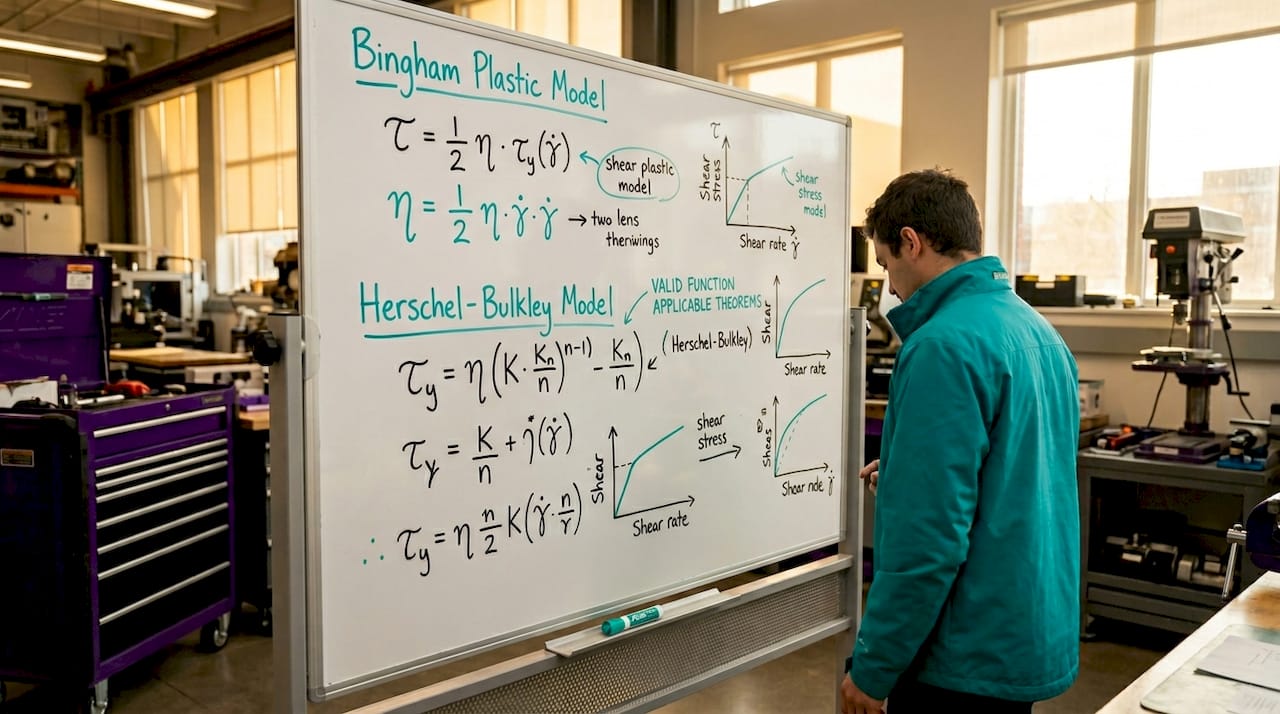
The Bingham plastic model is the simplest yield-stress model. It assumes the material behaves as a rigid solid below the yield stress and flows with constant viscosity above it. This works well for materials like toothpaste and certain muds, but it cannot capture shear-thinning or shear-thickening behavior above the yield point. The Power-law model handles rate-dependent viscosity elegantly but contains no yield stress term at all, making it unsuitable for materials that refuse to flow under small forces.
The Herschel–Bulkley model combines both features: a yield stress threshold and a power-law viscosity above it. This makes it the most flexible of the three, and it describes materials like ketchup, drilling muds, and many food gels with greater accuracy. The trade-off is added complexity in fitting experimental data, since it requires three parameters instead of two.
| Model | Yield stress | Rate-dependent viscosity | Best for |
|---|---|---|---|
| Power-law | No | Yes | Polymer melts, paints |
| Bingham plastic | Yes | No (constant above yield) | Toothpaste, cement slurry |
| Herschel–Bulkley | Yes | Yes | Ketchup, drilling fluids, gels |
One important nuance: distinguishing a true yield stress from an apparent yield point requires careful measurement. Phenomena like wall slip and thixotropy can distort readings, making a material appear to have a higher or lower yield stress than it actually does. Advanced rheology research emphasizes that thixotropy and wall slip can compromise model suitability if not accounted for in experimental design.
Pro Tip: If you are introducing these models in a classroom, start with the Bingham plastic because its two-part behavior (rigid then flowing) maps directly onto student intuition about solids and liquids. Introduce Herschel–Bulkley only after students can articulate why the Bingham model falls short for materials like ketchup.
Why do shear-thickening materials feel solid on impact?
Shear-thickening fluids feel solid on impact because rapid deformation forces suspended particles into frictional contact, forming a temporary load-bearing network throughout the material. This process is called jamming. Under slow, gentle force, the particles have time to rearrange and the material flows. Under fast impact, they cannot move out of the way quickly enough, and the particle contact networks lock together into a rigid structure that resists deformation.
In cornstarch suspensions, discontinuous shear thickening begins near a shear stress of approximately 2 Pa in cornstarch and silicone-oil systems. That number matters because it shows how little force is needed to trigger the transition, which is why a child running across a pool of oobleck stays on the surface while standing still causes them to sink. The transition is not gradual; it is abrupt and dramatic, which is what makes oobleck so visually compelling as a teaching tool.
This mechanism has moved well beyond classroom demonstrations. A 2026 biomedical study found that STF-filled lightweight foams showed marked strain reduction in ball-drop impact tests, with approximately 50% strain reduction in TPU-skin configurations and approximately 30% in standard foam. That level of protection, achieved without adding significant weight or rigidity, represents a genuine advance in wearable protective materials for athletes and medical patients alike.
- Oobleck supports fast impacts because particle jamming creates a temporary solid network.
- Slow pressure allows particle rearrangement, so the material flows like a liquid.
- STF-based protective foams absorb impact energy without the bulk of traditional padding.
- Biomedical engineers are now designing knee pads, helmets, and body armor using these principles.
How do boundary conditions affect non-Newtonian solid flow?
The container a non-Newtonian solid flows through is not a passive bystander. Boundary compliance directly selects which flow regime the material enters, and this has significant consequences for both laboratory reproducibility and industrial processing. A compliant boundary, such as a flexible tube or soft container wall, allows the material to push back against its surroundings, which tends to produce persistent heterogeneous flow patterns. A rigid boundary, by contrast, generates transient jamming clusters that form and dissolve repeatedly.
This distinction matters practically. Two laboratories running the same shear-thickening suspension through different apparatus geometries may record different viscosity profiles and conclude the material behaves differently. Neither lab is wrong. The material genuinely behaves differently because the boundary conditions are different. This is one reason why flow instability and heterogeneity in shear-thickening suspensions remain active research areas in fluid mechanics.
| Boundary type | Flow behavior | Jamming character | Practical implication |
|---|---|---|---|
| Compliant (flexible) | Persistent heterogeneity | Sustained jamming zones | Inconsistent flow in soft tubing |
| Rigid (hard walls) | Transient heterogeneity | Intermittent jamming clusters | Reproducible but pressure-sensitive |
| Intermediate | Mixed regime | Variable | Requires careful calibration |
For educators, this insight reframes a common classroom frustration. When students get inconsistent results from oobleck experiments, the container material and shape are often the cause, not measurement error. Recognizing that the geometry of the experiment is part of the experiment teaches a deeper lesson about scientific reproducibility.
How can students and educators explore non-Newtonian solids hands-on?
Hands-on experimentation is the most effective way to build genuine intuition for non-Newtonian behavior, because the properties of these materials resist description through words alone. The oobleck demonstration using cornstarch and water remains the gold standard for classroom exploration, requiring no specialized equipment and producing immediate, memorable results. Students who punch oobleck and feel it resist, then slowly press a finger in and watch it sink, have experienced yield stress and rate dependence in a single minute.
Here is a structured sequence for educators introducing non-Newtonian solids through experimentation:
- Mix oobleck using a 2:1 ratio of cornstarch to water in a wide, shallow container. A rigid bowl works better than a flexible one for consistent results.
- Test slow versus fast force by pressing a finger slowly into the surface, then striking it quickly. Record observations about resistance and flow.
- Vary the container by transferring the same mixture to a flexible bag and repeating the tests. Discuss why the results may differ.
- Introduce toothpaste as a second example. Squeeze a small amount onto a plate and observe how it holds its shape until disturbed, then flows under pressure.
- Connect to applications by discussing how the same jamming behavior that makes oobleck resist a punch is used in protective sports equipment and biomedical devices.
- Reflect and record by asking students to write or draw what they observed, connecting the physical experience to the vocabulary of yield stress, shear thickening, and viscoelastic materials.
Teamgeniussquad’s Slime, Gel, and Goop kit extends this exploration with guided experiments that connect tactile discovery to scientific vocabulary, making it especially effective for learners who build understanding through physical experience rather than reading alone. The E³ Method (Engage, Encourage, Empower) built into each kit ensures students move from curiosity to confidence through structured discovery.
Key takeaways
A non-Newtonian solid is defined by its yield stress threshold, and every property, model, and application discussed in this article flows from that single defining characteristic.
| Point | Details |
|---|---|
| Yield stress defines the category | Materials act as solids below yield stress and flow as fluids above it, per Bingham plastic modeling. |
| Model choice shapes prediction accuracy | Herschel–Bulkley captures both yield stress and rate-dependent viscosity, making it the most flexible model. |
| Jamming explains impact resistance | Particle contact networks form instantly under rapid shear, producing temporary solid-like rigidity. |
| Boundary conditions change behavior | Compliant versus rigid confinement produces different flow regimes in the same material. |
| Hands-on demos build real intuition | Oobleck experiments teach yield stress and shear thickening faster than any written description. |
Why teaching non-Newtonian solids changed how I think about science education
The first time I watched a student punch a bowl of oobleck and then slowly sink their hand into the same material, I realized something that no textbook had made clear to me: the most powerful concepts in science are the ones that contradict what your body expects. Non-Newtonian solids do exactly that. They feel wrong. They behave in ways that seem to break the rules, and that wrongness is precisely what makes them unforgettable.
What I have found consistently is that students struggle most with the idea that the same material can be both solid and fluid. The instinct is to pick one category and stick with it. The deeper lesson, that solid or fluid behavior depends on timescale and loading rate rather than on the material alone, takes time to settle. I now introduce this idea early and return to it often, because it is the conceptual key that unlocks everything else in rheology.
The 2026 research on STF-filled protective foams is worth bringing into classrooms directly. When students see that the same physics behind oobleck is being used to design lighter, more effective protective gear for athletes and medical patients, the subject stops being abstract. It becomes something they can imagine contributing to. That shift in identity, from student to potential innovator, is exactly what science education should produce. Teamgeniussquad was built on this belief, and every kit they design carries that same intention.
— Tita
Discover non-Newtonian solids through hands-on STEAM exploration

Teamgeniussquad’s Slime, Gel, and Goop Experiment Kit puts the science of non-Newtonian materials directly into young learners’ hands. Students mix, test, and observe real yield-stress and shear-thickening behaviors through guided experiments designed around the E³ Method. The kit requires no screens and no prior science knowledge, only curiosity and a willingness to get a little messy. For educators building a broader unit on states of matter or rheology, the full experiment kit collection offers complementary activities that extend the learning from oobleck to polymers, gels, and beyond.
FAQ
What is a non-Newtonian solid?
A non-Newtonian solid is a material that behaves as a rigid body below a critical yield stress and flows like a fluid once that stress is exceeded. Cornstarch suspensions, toothpaste, and certain gels are common examples.
What is the difference between Newtonian and non-Newtonian materials?
Newtonian fluids like water maintain constant viscosity regardless of applied force, while non-Newtonian materials change their viscosity or exhibit yield stress in response to stress and shear rate. This rate-dependent behavior is the defining distinction.
Why does oobleck feel solid when you hit it?
Oobleck feels solid on impact because rapid shear forces cornstarch particles into frictional contact, forming a temporary load-bearing network throughout the suspension. This jamming effect dissolves as soon as the force is removed.
Which rheological model best describes non-Newtonian solids?
The Herschel–Bulkley model is the most flexible, combining a yield stress threshold with power-law rate-dependent viscosity. It outperforms both the Bingham plastic and Power-law models for materials that exhibit yield stress and shear-thinning or shear-thickening behavior simultaneously.
How are shear-thickening fluids used in real-world applications?
Shear-thickening fluids are embedded in protective foams and padding for biomedical and athletic applications, where they absorb impact energy by jamming under rapid stress. A 2026 study confirmed significant strain reduction in STF-filled foam configurations during impact testing.



Leave a comment
This site is protected by hCaptcha and the hCaptcha Privacy Policy and Terms of Service apply.