

Role of Play in Cognitive Development: A Guide for Parents
Play builds the core thinking skills children need for school and life. It strengthens executive function, language, problem-solving, and creativity all at once, more efficiently than worksheets or drills. Start this week with three moves: give your child a brief daily period of screen-free, child-led play; step back and let them direct the storyline or building project; and ask open questions (“What happens if…?”) instead of giving answers.
- Protect 15 minutes of uninterrupted, child-led play every day.
- Remove screens during that window so attention stays with the child, not the device.
- Swap instructions for open-ended prompts that invite the child to explain their thinking.
The American Academy of Pediatrics considers play essential enough to healthy development that pediatricians sometimes recommend it explicitly, the same way they’d recommend sleep or nutrition.
Key Takeaways
Play builds executive function, language, and problem-solving more reliably than didactic drills, and adults get the best results by scaffolding rather than directing.
| Point | Details |
|---|---|
| Play strengthens executive function | Working memory, inhibition, and cognitive flexibility all develop through active, child-led play. |
| Fifteen minutes measurably lowers anxiety | Preschoolers who played briefly were about twice as likely to feel less anxious than peers who only heard a story. |
| Guided play beats free play and drills | Adult-prepared, child-led play produces stronger vocabulary and spatial-reasoning gains in controlled studies. |
| Screens should support, not replace | Interactive co-play apps can help; passive viewing removes the social, iterative core of play. |
| Teamgeniussquad extends free play | Screen-free STEAM kits and role-play props give kids new open-ended materials without replacing everyday play. |
Table of Contents
- What Counts as Play, and Why Does It Matter for Learning?
- What Do Piaget and Vygotsky Say About Play?
- Which Types of Play Build Which Cognitive Skills?
- How Does Play Build Specific Cognitive Skills?
- What Does the Research Say About Play and the Brain?
- How Should Adults Scaffold Play Without Taking Over?
- Do Screens Help or Hurt Cognitive Play?
- What Does Cognitive Development Through Play Look Like by Age?
- What Are Some Ready-to-Use Play Activities by Age?
- What Do Practitioners Notice That Research Sometimes Misses?
- Where Hands-On STEAM Kits Fit Into Playful Learning
- Frequently Asked Questions
- Sources
What Counts as Play, and Why Does It Matter for Learning?
Not every activity labeled “play” delivers cognitive benefits. Researchers at Brookings define effective playful learning by five traits: it’s joyful, meaningful, active, socially interactive, and iterative, meaning kids try, fail, adjust, and try again. A worksheet dressed up with cartoon characters isn’t play. A child building a block tower, watching it fall, and rebuilding it taller is.
Play shows up in a few recognizable forms:
- Free play: the child chooses the activity, materials, and rules entirely on their own.
- Guided play: an adult sets up an inviting environment and asks questions, but the child still leads.
- Structured games: adults set the rules (board games, tag), but children still exercise choice within them.
Direct instruction still has its place, phonics rules or math facts often need explicit teaching. But for skills like flexible thinking, collaboration, and creative problem-solving, playful learning consistently outperforms drills alone.
What Do Piaget and Vygotsky Say About Play?
Jean Piaget viewed play as the mechanism through which children construct knowledge, not just express it. His classic example: a baby playing peek-a-boo isn’t just giggling, she’s actively testing and confirming that objects continue to exist even when hidden, a milestone called object permanence.
Lev Vygotsky added the social piece. He argued children reach further cognitively when a more skilled partner, a parent, teacher, or older sibling, scaffolds the experience within what he called the zone of proximal development. Adult-guided pretend play (running a “restaurant,” taking turns as doctor and patient) pushes children past what they’d manage alone.
Modern research bridges both ideas. Studies summarized by NAEYC show that guided play, adults preparing materials and asking probing questions while children retain control, produces stronger vocabulary and spatial-reasoning gains than either pure free play or straight direct instruction.
- Piaget: play as active construction of understanding.
- Vygotsky: play as a social scaffold that stretches ability.
- Guided play research: the strongest gains come from blending both.
Which Types of Play Build Which Cognitive Skills?
Different play styles exercise different mental muscles. Matching activity to skill helps you target growth areas without turning play into a lesson plan.
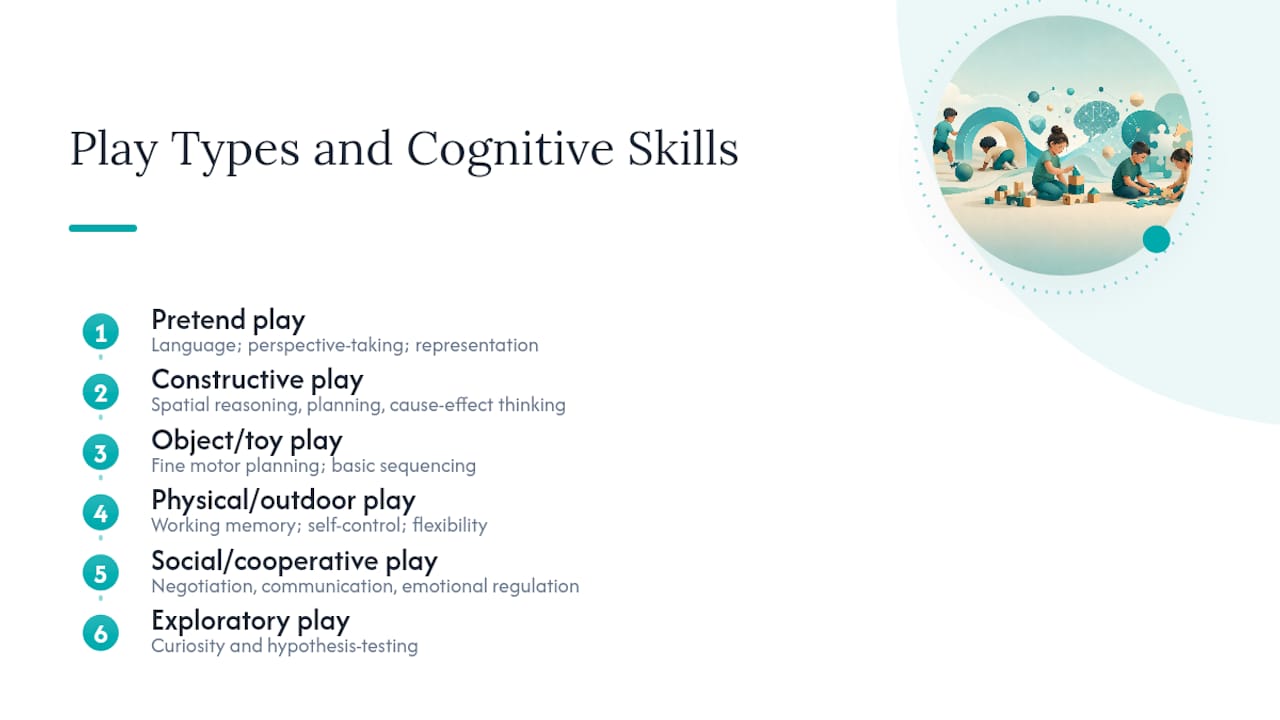
Pretend and symbolic play looks like tea parties, superhero rescues, or running a pretend veterinary clinic. It builds language, perspective-taking, and early abstract thought. A review of pretend play research links high-quality sociodramatic play to stronger representational thinking, the foundation for reading comprehension and math reasoning later on. Try assigning roles in a pretend “mission control” scenario, then swap roles halfway through.
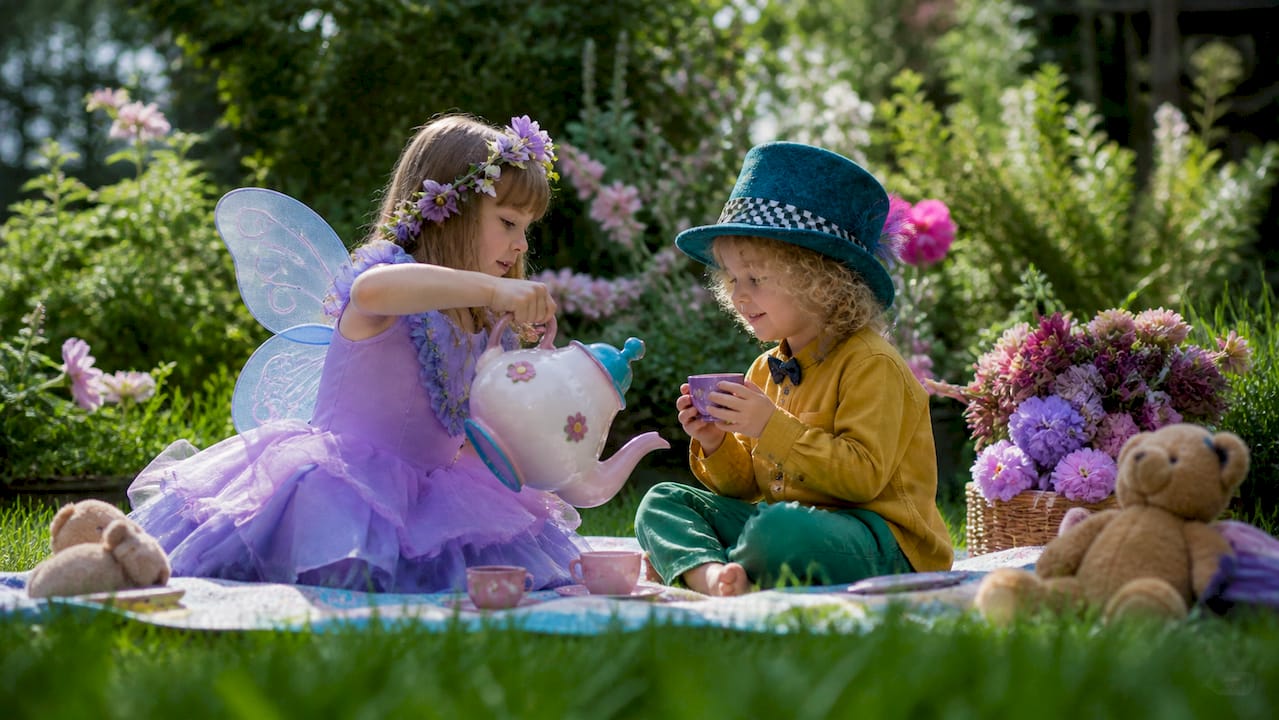
Constructive play covers blocks, LEGO sets, sandcastles, and cardboard forts. It sharpens spatial reasoning, planning, and cause-and-effect thinking. Give a child a specific challenge, “build a bridge that holds a toy car”, rather than an open instruction, to boost problem-solving specifically.
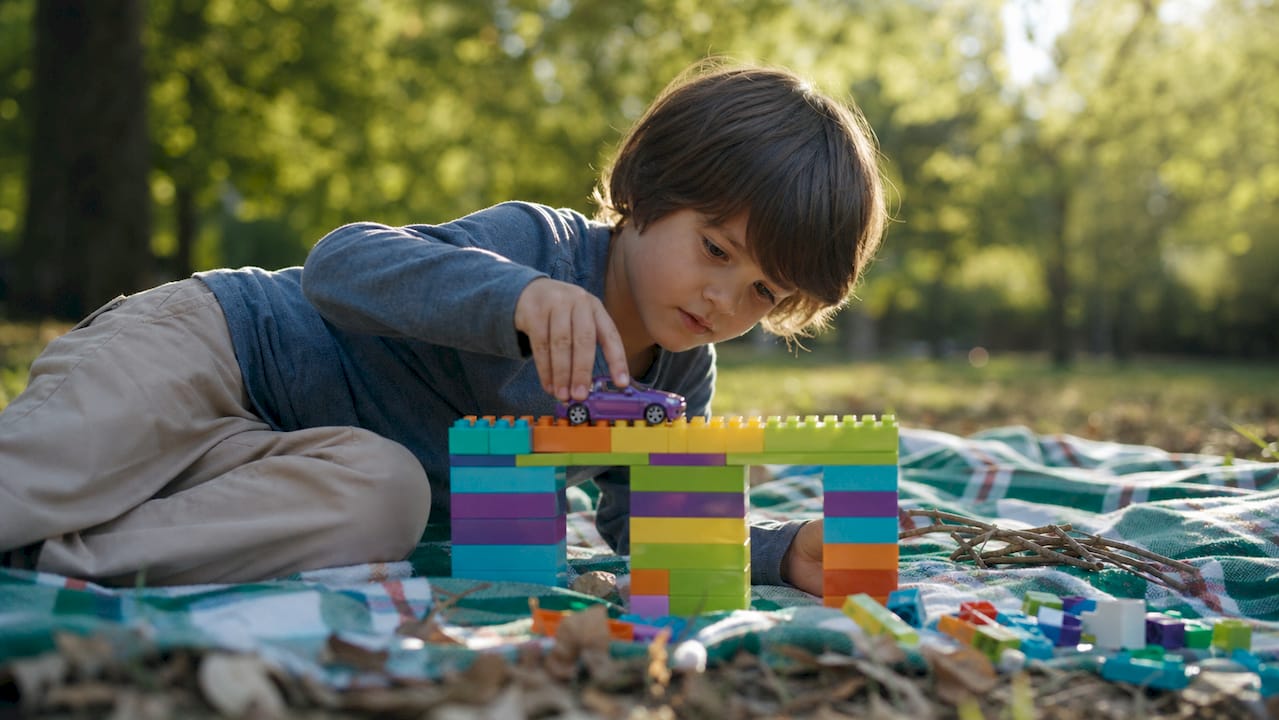
Object and toy play involves manipulating puzzles, shape sorters, or simple mechanical toys. It supports fine motor planning and early logical sequencing. Rotate toys every few weeks; novelty reactivates curiosity and sustained attention.
Physical and outdoor play includes running games, climbing, and obstacle courses. It builds working memory (remembering game rules mid-motion) and self-regulation. Add a simple rule change mid-game, “now hop instead of run”, to test cognitive flexibility.
Social and cooperative play covers group games, shared building projects, and team pretend scenarios. It develops negotiation, communication, and emotional regulation. Board games with turn-taking rules are a low-cost way to build patience and strategic thinking simultaneously.
Exploratory play means investigating new materials, water tables, nature walks, sensory bins. It fuels curiosity and hypothesis-testing, the earliest form of scientific thinking.
Pro Tip: Don’t announce the “lesson” hidden in the play. If a child senses you’re testing them, the joy drains out, and joy is one of the five traits that makes play cognitively effective in the first place.
How Does Play Build Specific Cognitive Skills?
Executive function is really three separate skills working together: working memory (holding information in mind), inhibitory control (resisting impulses), and cognitive flexibility (switching strategies when the first one fails). A game of Simon Says exercises all three at once, kids remember the rule, resist the urge to move on a false command, and adjust when the rule changes.
Play maps onto specific skills in observable ways:
- Language: Pretend play scenarios force kids to narrate, negotiate roles, and explain plans out loud, expanding vocabulary faster than passive listening.
- Memory and attention: Games with rules (hide-and-seek, card matching) demand sustained focus and recall.
- Problem-solving: Building challenges (a marble run that keeps derailing) push kids through trial-and-error cycles.
- Spatial reasoning: Puzzles, block towers, and map-drawing games train mental rotation and part-whole relationships.
- Creativity: Open-ended materials (loose parts, art supplies without a template) generate more original ideas than kits with one “correct” outcome.
Research on pretend play’s cognitive links points specifically to perspective-taking and representational competence as durable gains, skills that show up later in reading comprehension and social problem-solving.
Watch for these signs during play that a skill is developing:
- Does the child pause before acting when a rule changes? (inhibitory control)
- Can they hold a multi-step plan in mind while building? (working memory)
- Do they try a new approach after the first one fails? (cognitive flexibility)
- Can they describe what a pretend character is thinking or feeling? (perspective-taking)
What Does the Research Say About Play and the Brain?
The evidence base here is stronger than most parents realize. A PMC review on play and child development finds that play is central to building executive function, and that replacing it with heavy didactic drilling can actually delay the planning, working-memory, and flexibility skills schools depend on.
One of the more striking findings: in a study cited by the AAP, 3 and 4-year-olds who played for just 15 minutes were about twice as likely to report feeling less anxious about starting preschool compared to peers who only listened to a story. That’s a meaningful signal that play does something distinct from passive engagement, even in short doses.
The mechanisms behind this are becoming clearer:
- Play appears to help regulate stress physiology, buffering the effects of what pediatric researchers call toxic stress.
- Some neuroscience evidence tied to AAP’s clinical report links play to BDNF (brain-derived neurotrophic factor) activity and structural changes in prefrontal regions tied to executive function, though much of this comes from animal models and should be read as a plausible mechanism, not settled human proof.
- Animal studies on play deprivation show measurable changes in brain development and later problem-solving, a caution against squeezing play out of a child’s day for more seat time.
Major authorities converge on the same message. The AAP’s clinical report, NAEYC’s guidance on playful learning, and Head Start’s early childhood framework all treat play not as a break from learning, but as the mechanism learning runs on during the early years.
How Should Adults Scaffold Play Without Taking Over?
The goal is presence without control. Scaffolding means supporting a child just enough to stretch their thinking, then stepping back. Serve-and-return describes the simplest version: a baby babbles, you respond; a toddler points at a bug, you name it and ask a question. Harvard’s Center on the Developing Child treats these small back-and-forth exchanges as more powerful for cognitive growth than solitary or highly structured activities.
Try this sequence: notice what the child is doing, name it out loud (“You’re stacking the blue ones on top”), then ask one open question (“What do you think happens if you add a red one?”). Then go quiet and let them answer through action, not words.
A quick do and don’t list:
- Do follow the child’s lead, even when their plan seems inefficient.
- Do ask genuine questions you don’t already know the answer to.
- Don’t convert play into a quiz with right and wrong answers.
- Don’t rescue a child from frustration too quickly; a little struggle builds cognitive flexibility.
- Do return to silent observation once you’ve offered a prompt.
Pro Tip: If a child ignores your question and keeps playing, that’s fine. The prompt still planted an idea; you don’t need a verbal answer to know it landed.
Do Screens Help or Hurt Cognitive Play?
Technology isn’t automatically the enemy of play, but it changes the equation. Interactive, open-ended apps that involve co-play (an adult and child solving something together) can support language and problem-solving. Passive video content, the kind a child watches alone with no response required, tends to reduce the social and iterative qualities that make play cognitively powerful in the first place.
Practical rules by age:
- Infants and toddlers: skip screens during key play windows; prioritize hands-on, screen-free exploration and face-to-face serve-and-return instead.
- Preschoolers: co-view or co-play any digital content; avoid solo screen time replacing block-building or pretend play.
- School-age children: favor apps requiring creation (building, coding, storytelling) over passive consumption.
Quick screening checklist for any app or digital toy: Does it require a response, or just watching? Does it end when the child stops interacting, or auto-play the next thing? Does it invite a second player?
What Does Cognitive Development Through Play Look Like by Age?
Play behaviors shift dramatically across early childhood, and so do the skills they build.
- Infants (0 to 12 months): Peek-a-boo and reaching for objects build object permanence and cause-and-effect understanding. Head Start’s guidance highlights simple back-and-forth games as foundational for language and attachment.
- Toddlers (1 to 3 years): Stacking cups, simple pretend (feeding a doll), and exploring textures build early problem-solving and vocabulary. Watch for growing persistence when a tower falls.
- Preschoolers (3 to 5 years): Sociodramatic play (running a pretend store) and building challenges develop perspective-taking and planning. Watch for children narrating their own actions out loud.
- Early school-age (5 to 8 years): Rule-based games, collaborative building, and role-play with props sharpen strategic thinking and cooperation.
Every child’s timeline varies, and neurodivergent learners in particular may need more repetition, sensory input, or extended time in a single play stage before moving on. That variation is normal, not a warning sign.
What Are Some Ready-to-Use Play Activities by Age?
You don’t need a curriculum to build cognitive skills through play, just a few household items and a willingness to follow the child’s lead.
- Sock puppets (infants/toddlers): Materials are just old socks and markers. Extend by asking the puppet to “ask” a question the child must answer.
- Cardboard box vehicle (toddlers/preschoolers): Materials are a box and crayons. Extend by adding a destination and a “problem” en route.
- Kitchen measuring cup water play (preschoolers): Materials are cups and a basin. Extend by asking which cup holds more before testing.
- Scavenger hunt with clues (early school-age): Materials are index cards. Extend by having the child write the next clue.
- Pretend science lab role-play: Materials are a lab coat and household containers, similar to the format explored in imaginative scientist play for ages 5 to 13.
Pro Tip: Turn folding laundry into a sorting game by color or size, ordinary routines are some of the richest untapped play material in the house.
What Do Practitioners Notice That Research Sometimes Misses?
The research on play is solid, but implementation is where most families and classrooms stumble. The most common error isn’t too little play, it’s play that’s secretly disguised instruction. A “pretend grocery store” where an adult keeps steering toward counting practice stops being play the moment the child senses the agenda. Kids are remarkably good at detecting when joy has been replaced by an assessment.
The trade-off practitioners wrestle with constantly is time. A caregiver juggling a packed schedule often assumes structured enrichment is the more efficient use of minutes. In practice, 15 unstructured minutes of child-led building or pretend scenario frequently produces more durable problem-solving gains than the same 15 minutes spent on a flashcard app.
That tension between guided support and adult control shows up constantly in role-play learning approaches for educators as well, the framework Teamgeniussquad’s E³ Method (Engage, Encourage, Empower) was built around: set up the environment, then get out of the way.
Where Hands-On STEAM Kits Fit Into Playful Learning
Hands-on kits don’t replace everyday free play, they extend it. If your child has exhausted the cardboard-box phase and is asking for something with a bit more structure and mystery, a screen-free STEAM kit gives them new materials to apply the same cognitive skills, planning, spatial reasoning, hypothesis testing, without a screen in sight.

Look for three things when choosing any kit: an age fit that matches your child’s current skill level, materials open-ended enough to allow more than one “correct” outcome, and instructions light enough that a child does most of the thinking. Teamgeniussquad builds every kit around those same criteria, using role-play elements like lab coats and certificates so kids experience themselves as real scientists, not just kids following steps. The Science Solar Energy Kit with Mirror Disk turns spatial reasoning and mechanical curiosity into a hands-on build, while the Genius Buddy Plushies support the identity-driven side of pretend play for younger kids still building their “scientist” self-concept. Browse the full experiment kits collection to find one that fits your child’s next stretch of curiosity.
Frequently Asked Questions
What is the role of play in cognitive development? Play builds executive function, language, memory, problem-solving, and creativity by giving children a low-stakes space to test ideas, take on perspectives, and practice regulating their own behavior. The AAP treats it as central enough to development that it belongs in routine pediatric guidance, not just free time.
At what age does play matter most for cognitive growth? Play matters across every stage of early childhood, but the specific skills it builds shift with age. Infants use play for cause-and-effect and attachment; preschoolers use it for perspective-taking and planning; school-age kids use it for strategy and cooperation.
Can too much structured activity replace the benefits of play? Structured learning has value, but it works best alongside play, not instead of it.
Does screen time count as play? Sometimes. Interactive apps involving co-play or creation can support cognitive skills, but passive video content lacks the social and iterative qualities that make traditional play effective.
How can I tell if my child’s play is building cognitive skills? Watch for signs like pausing before acting on a rule change, holding a multi-step plan in mind, or trying a new approach after something fails. Those behaviors reflect working memory, inhibition, and cognitive flexibility in action.
Sources
- The Power of Play: A Pediatric Role in Enhancing Development in Young Children | Pediatrics | AAP
- Play and child development — PMC article
- The role of pretend play in children’s cognitive development — ECRP
- Headstart
Treat these as a starting point, not a diagnosis. If you have specific concerns about a child’s developmental progress, a pediatrician or early childhood specialist can assess it directly rather than relying on general reading alone.


Leave a comment
This site is protected by hCaptcha and the hCaptcha Privacy Policy and Terms of Service apply.