Role-Play Learning Advantages for K–12 Educators
Role-play learning delivers measurable gains across cognitive, affective, and behavioral domains for K–12 students, making it one of the most versatile tools in a teacher’s planning kit. Research confirms that structured role-play consistently strengthens deeper understanding, builds empathy, and rehearses real-world skills in ways that passive instruction rarely achieves.
The top advantages educators cite most often:
- Deeper retention through multi-sensory, embodied experience
- Perspective-taking and empathy developed by inhabiting another viewpoint
- Transferable skill rehearsal in a low-stakes, error-safe environment
- Collaboration and communication practiced in authentic, dynamic exchanges
- Motivation and engagement lifted by novelty and personal investment
- Reduced anxiety around new or difficult content through rehearsed roles
The evidence base is strong. Harvard’s ABLConnect synthesizes decades of research and identifies structured design, clear objectives, and debriefing as the features that separate high-impact role-play from classroom theater.
Key Takeaways
Role-play learning produces its strongest results when clear objectives, structured roles, repeated practice, and guided debriefing work together as a single system.
| Point | Details |
|---|---|
| Three proven domains | Role-play strengthens cognitive retention, affective empathy, and behavioral skill transfer when designed with intent. |
| Repetition multiplies gains | Scores rose notably across three repeated role-play encounters in a controlled study. |
| Debrief is non-negotiable | Structured reflection after the scenario is what converts experience into durable, transferable knowledge. |
| Inclusion requires design | Visual role cards, advance scenario previews, and opt-out signals make role-play accessible for neurodivergent learners. |
| Start small this term | A 15–20 minute scenario with a four-criterion rubric and a 10-minute debrief is a complete, research-aligned session. |
Table of Contents
- 1. The advantages of role-play learning span three proven domains
- 2. How to design a role-play session that actually works
- 3. Ready-to-use role-play examples across grade bands
- 4. How to assess role-play learning fairly and clearly
- 5. Common challenges in role-play and how to handle them
- 6. What the research actually shows about role-play effectiveness
- 7. Why you should try one role-play activity this term
- Bring role-play to life with hands-on STEAM kits
- Sources
1. The advantages of role-play learning span three proven domains
Understanding why role-play works helps you design sessions that actually hit your learning objectives rather than just filling time with activity.
Cognitive advantages. When students step into a role, they engage multiple sensory systems simultaneously: they speak, listen, react, and problem-solve in real time. This multi-sensory encoding produces deeper processing than reading or watching a video alone. The mechanism is sometimes called embodied cognition: the body’s involvement in a task strengthens the memory trace for the concept. NIU’s Center for Innovative Teaching and Learning notes that role-play connects abstract content to real-world scenarios, which is precisely the condition under which students move from surface recall to genuine understanding.
Classroom implication: Pair role-play with a brief pre-activity reading so students arrive with enough background knowledge to make the scenario meaningful, then use the activity itself to deepen and apply that knowledge rather than introduce it cold.
Affective advantages. Inhabiting another person’s perspective, even briefly, shifts attitudes. A 2024 Frontiers in Psychology study found that role-play interventions increased prosocial attitudes and reduced anxiety, and follow-up interviews showed the experience left a lasting impression on participants long after the session ended. A 2026 review of role-play interventions reported consistent improvements in emotional regulation and interpersonal functioning across multiple formats, though the reviewers noted methodological heterogeneity across studies.
Classroom implication: Use role-play deliberately for social-emotional learning goals, not just content delivery. A single well-designed scenario on conflict resolution or civic responsibility can shift a student’s attitude in ways a lecture cannot replicate.
Behavioral advantages. Skill rehearsal is where role-play arguably outperforms every other instructional method. A 2025 BMC Medical Education study found role-play significantly outperformed video-based learning for interprofessional communication and teamwork, precisely because it allows immediate experiential feedback and real-time error correction. Students do not just watch a skill; they practice it, receive feedback, and adjust. That cycle is what produces transfer to real-world performance.
Classroom implication: Build in at least two rounds of the same scenario when behavioral skill transfer is the goal. A single run-through rarely produces durable change; repetition with feedback does.
Statistic to cite: A controlled scenario-based study tracked communication checklist scores across three repeated encounters: scores rose notably across three repeated encounters, alongside significant gains in self-efficacy.
2. How to design a role-play session that actually works
Well-structured role-plays tied to measurable learning objectives consistently outperform unstructured, spontaneous ones. The checklist below fits a single planning session.
- Write the learning objective first. Decide whether you are targeting a cognitive outcome (understanding a concept), an affective outcome (empathy, attitude shift), or a behavioral outcome (a specific skill). The objective determines everything else.
- Choose scenario fidelity. High-fidelity scenarios (detailed scripts, realistic props) work well for older students and behavioral goals. Lower-fidelity, open-ended scenarios suit younger learners and exploratory affective goals.
- Define roles and rules. Give each student a clear role card: name, perspective, goal, and one or two constraints. Ambiguity in roles is the most common reason role-play loses focus.
- Prepare materials. Keep materials minimal and low-cost: printed role cards, a simple scenario sheet, and any props that add authenticity without overwhelming logistics.
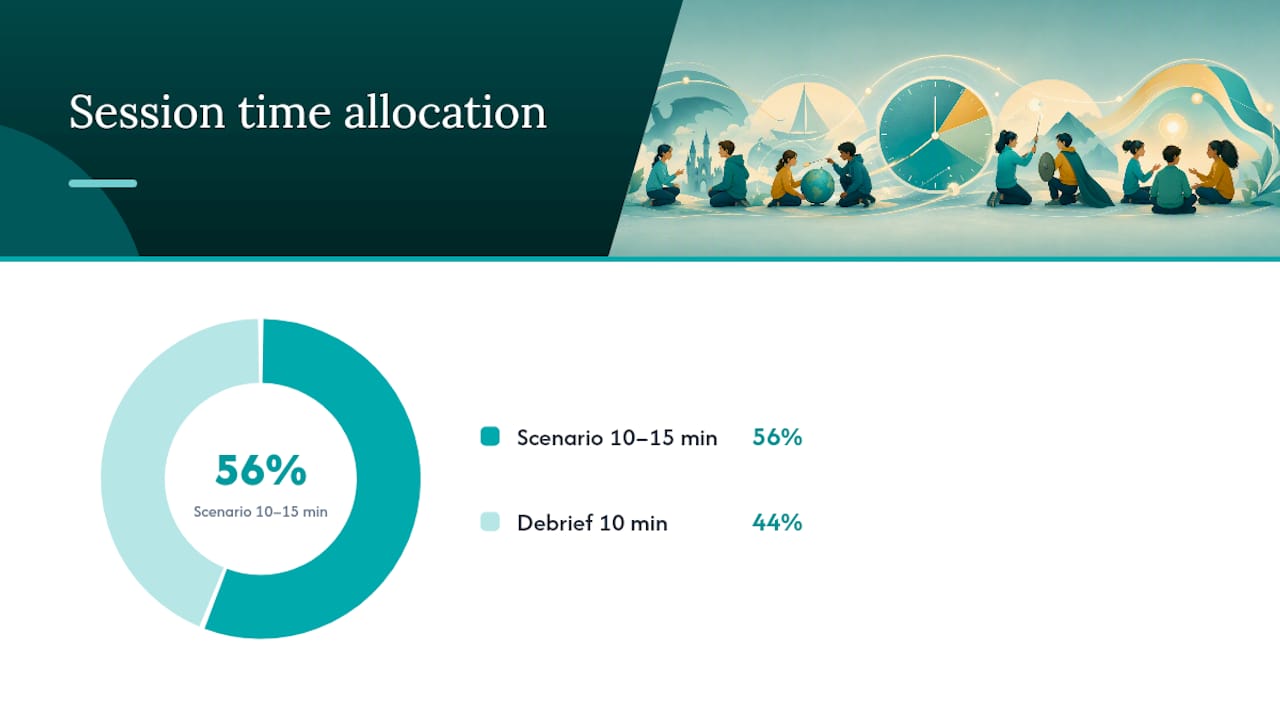
- Set timing. A 10–15 minute scenario with a 10-minute debrief is a realistic starting point. Time-box each phase visibly so students know when the activity ends.
- Run the activity. Circulate, observe, and take brief notes for assessment. Resist the urge to intervene unless the scenario derails or a student shows genuine distress.
- Debrief with structured reflection. This step is not optional. Use these prompts: What happened in your role? What surprised you? What would you do differently? What does this connect to in real life? Allow 8–10 minutes minimum.
Pro Tip: For younger learners (K–3), use picture-based role cards and model the scenario yourself before students begin. Seeing an adult “play a role” removes the social risk and signals that the activity is safe.
Pro Tip: If a scenario touches on sensitive topics (poverty, discrimination, illness), brief students beforehand on the “step out” signal: a simple hand gesture or the word “pause” that lets any student exit the role without explanation.
Debrief protocol template (copy into your lesson plan):
- In role: “What was your character trying to achieve?”
- Out of role: “What did you notice or feel during the scenario?”
- Connect: “Where does this situation show up in real life?”
- Transfer: “What is one thing you would do differently next time?”
For accessibility, offer alternative participation modes: a student who cannot speak in front of peers can write their character’s responses, use a communication device, or serve as an observer with a structured observation checklist.
3. Ready-to-use role-play examples across grade bands
These templates are designed to be adapted in under 30 minutes. Each is low-cost and classroom-tested in structure.
Elementary (Grades K–2): Community Helpers at Work
- Learning objective: Students identify the roles and responsibilities of community helpers and practice asking for and offering help.
- Roles: Firefighter, librarian, doctor, student visitor (2–5 students).
- Time: 15 minutes of role-play, 10-minute debrief.
- Materials: Printed role cards with pictures, simple props (toy phone, book, bandage).
- Neurodivergent note: The predictable, script-supported structure works especially well for students who benefit from clear expectations. Visual role cards reduce ambiguity and lower anxiety before the activity begins. Imaginative scientist play follows the same identity-first principle: children perform a role before they fully understand it, and confidence grows from there.
Middle School (Grades 6–8): Historical Town Hall
- Learning objective: Students analyze multiple perspectives on a historical decision (e.g., the debate over westward expansion) and practice evidence-based argument.
- Roles: Settler, Indigenous community member, government official, journalist.
- Time: 20-minute debate, 10-minute debrief.
- Materials: One-page background reading per role, a simple agenda card.
- Neurodivergent note: Providing the background reading 24 hours in advance gives students processing time and reduces in-the-moment cognitive load.
High School (Grades 9–12): Mock Environmental Science Hearing
- Learning objective: Students evaluate competing evidence on a local environmental issue and practice formal argumentation and active listening.
- Roles: Industry representative, environmental scientist, community resident, city council member, journalist.
- Time: 25–30 minutes for the hearing, 15-minute debrief.
- Materials: One-page briefing per role, a shared “evidence packet” with 3–4 data points.
- Note: This format maps directly to ELA speaking and listening standards and NGSS science practices. Group swim programs and similar group-based skill activities show the same pattern: structured group roles accelerate social skill development faster than individual practice alone.
You can find adaptable lesson-plan templates that pair well with these scenarios, including timing guides and reflection prompts.
4. How to assess role-play learning fairly and clearly
Assessment is where many role-play sessions fall short. A clear rubric set before the activity removes ambiguity for students and makes grading defensible.
Sample role-play rubric (4-point scale):
| Criterion | 4 — Exceeds | 3 — Meets | 2 — Approaching | 1 — Beginning |
|---|---|---|---|---|
| Role fidelity | Consistently maintains character perspective with detail | Maintains character perspective most of the time | Occasionally steps out of role | Rarely maintains character perspective |
| Communication | Clear, confident, audience-aware | Mostly clear with minor lapses | Partially clear; some confusion | Unclear or minimal contribution |
| Content accuracy | All claims accurate and well-supported | Most claims accurate | Some inaccuracies present | Frequent inaccuracies |
| Reflection quality | Insightful, specific connections to learning objectives | Solid connections with some specificity | General connections, limited depth | Minimal or no reflection |
Formative checks during the activity:
- Circulate with a brief observation checklist: note which students are engaged, which are passive, and whether the scenario is producing the intended learning behaviors.
- Use a one-sentence exit ticket immediately after the debrief: “Write one thing your character believed and one thing you personally think about the same issue.” This separates role performance from personal understanding.
- Peer feedback works well in middle and high school: a simple “one strength, one question” format keeps it focused and safe.
Role-play outcomes map cleanly to Common Core ELA speaking and listening standards (SL.1, SL.4), NCSS social studies standards for civic participation, and CASEL’s SEL competencies for social awareness and responsible decision-making. When assessment is paired with structured debriefing, the research suggests transfer of learning increases, because reflection is the mechanism that converts experience into durable knowledge.
5. Common challenges in role-play and how to handle them
Every experienced teacher has had a role-play session go sideways. The good news is that most problems are predictable and preventable.
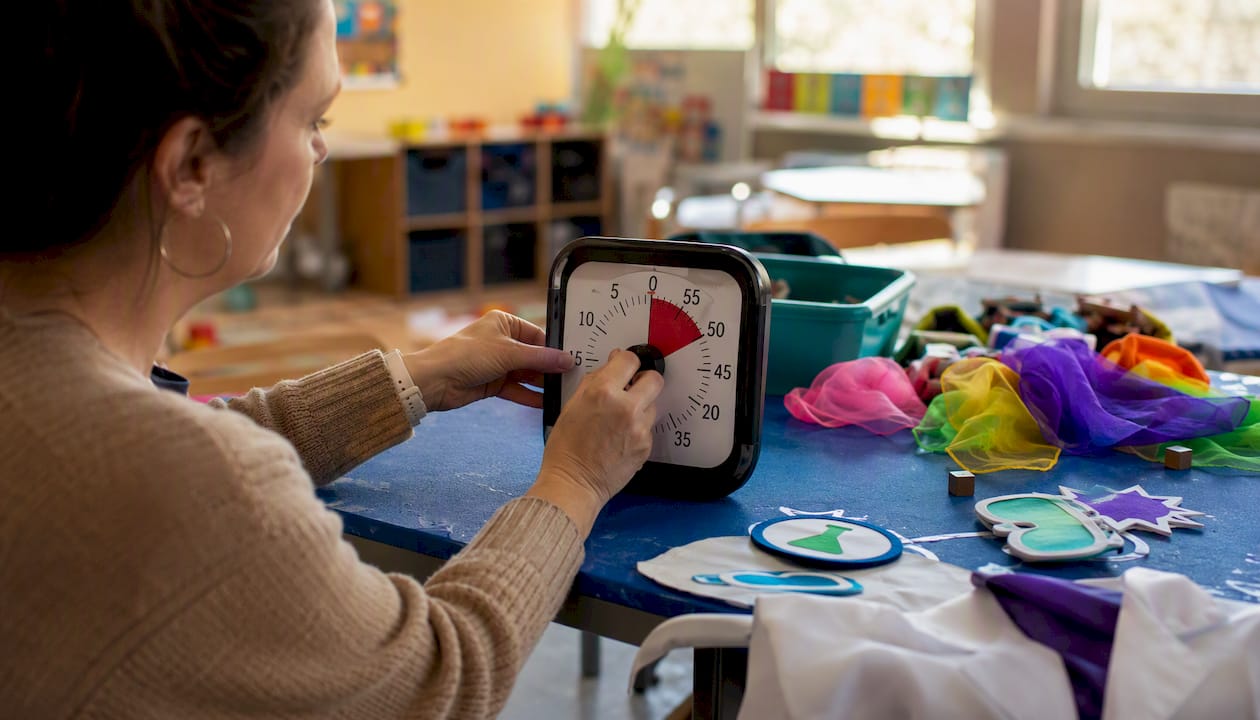
Time constraints. Role-play expands to fill whatever time you give it. Time-box every phase: 5 minutes for setup, 15 for the scenario, 10 for debrief. A visible timer on the board keeps everyone on track.
Student embarrassment or resistance. This is the most common barrier, especially in middle school. Lower the social stakes by starting with pairs rather than whole-class performance, using written or drawn responses as an alternative, and framing the activity as “practicing a skill” rather than “performing.” ABLConnect’s research overview notes that role-play functions as a psychological container: errors belong to the character, not the student, which is precisely what makes it safe to try new behaviors.
Uneven participation. Assign roles deliberately rather than letting students self-select. Rotate roles across multiple sessions so no student is always the observer or always the lead.
Emotionally triggering content. Some scenarios touch real experiences students carry into the room. Establish ground rules before the first session: respect for all participants, no use of real names in fictional scenarios, and a clear opt-out signal. For topics like poverty, illness, or discrimination, consider co-facilitation with a school counselor. Research on role-play and anxiety confirms that emotional responses are a normal part of the process and, when guided well, contribute to lasting learning rather than harm.
Assessment ambiguity. Share the rubric before the activity, not after. Students perform better when they know what “good” looks like, and it removes the perception that grading is subjective.
Accessibility checklist for neurodivergent learners:
- Provide role cards with visuals and bullet-point scripts rather than dense paragraphs.
- Share the scenario overview the day before so students can process it at their own pace.
- Offer a written or drawn response option as an equivalent alternative to verbal performance.
- Use a visual schedule on the board showing each phase of the session and its duration.
- Allow a “director” role for students who need to participate without performing: they guide the scenario, take notes, and contribute during debrief.
Quick reorientation strategy: If a session derails, call “pause,” step out of the scenario together, and ask one grounding question: “What is the one thing your character is trying to accomplish right now?” This refocuses students on the task without shutting the activity down.
6. What the research actually shows about role-play effectiveness
The evidence for learning through role-play is consistent across disciplines, though the strongest studies come from health education and social-emotional learning contexts. Here is what the research pool supports, stated with appropriate confidence:
- Frontiers in Psychology (2025) synthesizes evidence across educational contexts and finds role-play enhances outcomes across cognitive, affective, and behavioral domains, with the strongest effects when design includes clear objectives and structured debrief.
- A 2025 BMC Medical Education mixed-methods study found role-play outperformed video-based learning for interprofessional communication and teamwork, attributing the advantage to immediate experiential feedback.
- A controlled scenario-based study (PMC, 2024) tracked communication scores across three repeated encounters and found consistent, statistically significant gains alongside improvements in self-efficacy, suggesting repeated exposure matters.
- A 2026 review of psychodramatic and experiential role-play formats reported consistent improvements in emotional regulation and interpersonal functioning, while noting that methodological heterogeneity across studies warrants caution in generalizing effect sizes.
- Expert facilitation and intentional scenario design appear to be essential moderators: unexpected strong emotional responses are normal and should be treated as part of the learning process requiring guided reflection, not as evidence the activity failed.
Classroom case applying these findings:
A middle-school social studies teacher runs a three-session historical role-play unit on the Civil Rights Movement. In session one, students receive role cards and a background reading 24 hours in advance. In session two, they run the scenario twice with different role assignments. In session three, they complete a structured written debrief and peer feedback exchange. This design mirrors the repeated-encounter, structured-feedback conditions that produced the strongest gains in the controlled research. The teacher uses the four-criterion rubric from Section 4 and maps outcomes to NCSS civic participation standards.
The limitation worth naming: most high-quality studies come from higher education and health training contexts. Direct K–12 experimental evidence is thinner, though the pedagogical mechanisms (embodied learning, immediate feedback, perspective-taking) are well-supported across age groups.
7. Why you should try one role-play activity this term
The research on role-play learning is clear enough that waiting for a perfect unit to try it is a missed opportunity. You do not need elaborate props or a full week of class time. A 15–20 minute paired scenario with a simple four-criterion rubric and a 10-minute debrief is enough to see whether your students respond, and the evidence strongly suggests they will.
What tends to surprise teachers the most is not the engagement boost, though that is real. It is the quality of the reflection. Students who struggled to articulate their thinking in a written response often find their voice in a debrief conversation after inhabiting a character. That is the “merger effect” in practice: the degree of psychological immersion in a persona predicts whether the experience becomes lasting knowledge.
Start small. Pick one scenario from Section 3, use the debrief protocol from Section 2, and assess with the rubric from Section 4. That is a complete, research-aligned session you can run this week.
Bring role-play to life with hands-on STEAM kits

Teamgeniussquad’s screen-free STEAM kits are built around the same identity-first principle that makes role-play so powerful: children step into the role of scientist, inventor, or innovator before they have mastered the content, and confidence grows from the doing. Each kit includes role-play elements like lab coats, badges, and certificates that help children own their identity as young creators.
The Mini Fab Science Lab is a classroom-ready option for small-group role-play labs, pairing hands-on experiments with the kind of structured, identity-driven discovery that the research consistently links to deeper learning. Teachers can also explore ready-to-use lesson plans designed to complement role-play scenarios with clear objectives, timing guides, and reflection prompts.
Sources
- Frontiers in Psychology (2025) — role-play enhances cognitive, affective, and behavioral outcomes
- BMC Medical Education (2025) — role-play vs video-based learning in health education
- PMC Article (2024) — scenario-based role-play improves communication skills and self-efficacy in medical students
- ABLConnect — Role Play research overview (Harvard)



Leave a comment
This site is protected by hCaptcha and the hCaptcha Privacy Policy and Terms of Service apply.