What Is Experiential Learning: A Guide for Educators
Experiential learning is the process of building knowledge and skill through direct experience combined with structured reflection, a definition grounded in David A. Kolb’s foundational theory and affirmed by the Association for Experiential Education (AEE). For educators, the bottom line is this: students retain more and think more deeply when they do something real, then pause to make sense of it.
TL;DR:
- Core mechanic: experience plus structured reflection produces transfer, not just activity completion.
- Primary classroom benefit: deeper retention, critical thinking, and skill development that students can apply in new situations.
This article walks through Kolb’s four-stage cycle, the design principles that separate true experiential learning from simple hands-on tasks, ready-to-use reflection prompts, assessment strategies, and a compact STEAM case study you can adapt for your next lesson.
Table of Contents
- What is experiential learning, and why does it matter?
- How Kolb’s four-stage cycle works in practice
- What makes an experience truly experiential, not just hands-on
- What research shows about the benefits of experiential learning
- How to design an experiential learning activity step by step
- Concrete experiential learning activities across K–12, higher ed, and the workplace
- Who benefits most from experiential learning, and when to use it
- Key Takeaways
- The reflection question that changes everything
- Ready-made STEAM kits that bring experiential learning to life
- Useful sources and further reading
What is experiential learning, and why does it matter?
Kolb’s experiential learning theory defines learning as “the process whereby knowledge is created through the transformation of experience.” That single sentence carries a big implication: experience alone does not produce learning. Transformation does. The transformation happens through reflection, analysis, and deliberate application.
The Ithaca College Experiential Learning Alliance describes the process as immersive experience plus reflection leading to skill development and changes in attitude. Notice the three-part structure: academic learning, authentic experience, and reflective practice working together. Strip out any one of those, and you have something less than experiential learning.
John Dewey laid the philosophical groundwork decades before Kolb formalized the cycle. Dewey argued that not all experiences are equally educative, and that poorly designed experiences can actually miseducate. That warning still matters today, because many classrooms label any activity-based lesson as “experiential” when the reflection and transfer components are missing entirely.
How Kolb’s four-stage cycle works in practice
Kolb’s cycle moves through four stages, and each one builds on the last. Understanding them lets you design lessons that complete the full loop rather than stopping at the fun part.
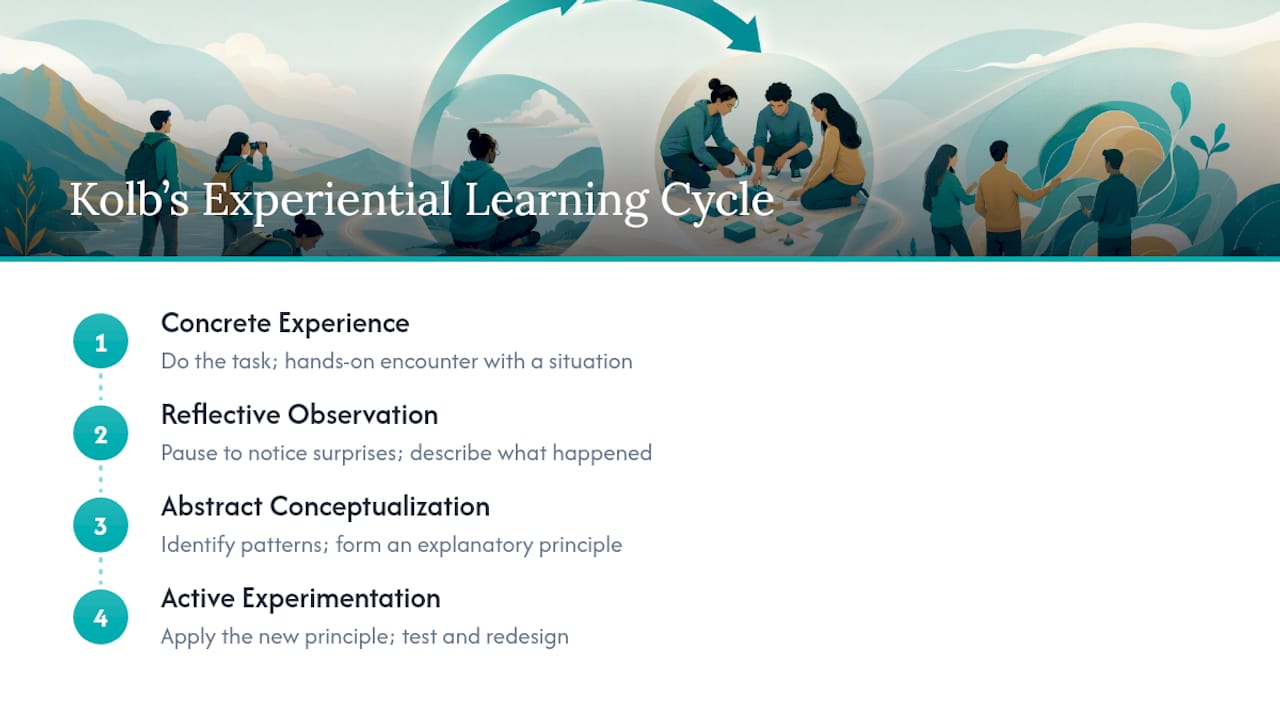
Concrete Experience is the doing stage: the student encounters a real situation, completes a task, or engages with a problem directly. This is where most “hands-on” lessons begin and, unfortunately, end.
Reflective Observation follows immediately. The learner pauses to observe what happened, notice what surprised them, and describe the experience without yet explaining it. This stage is the most commonly skipped in classroom settings, and skipping it breaks the cycle.
Abstract Conceptualization is where the learner builds or refines a mental model. They connect what they observed to existing knowledge, identify patterns, and form a principle or theory that explains the experience. This is the cognitive heavy lifting.
Active Experimentation closes the loop. The learner applies the new principle to a different situation, tests a hypothesis, or modifies their approach. That application then becomes a new Concrete Experience, and the cycle begins again.
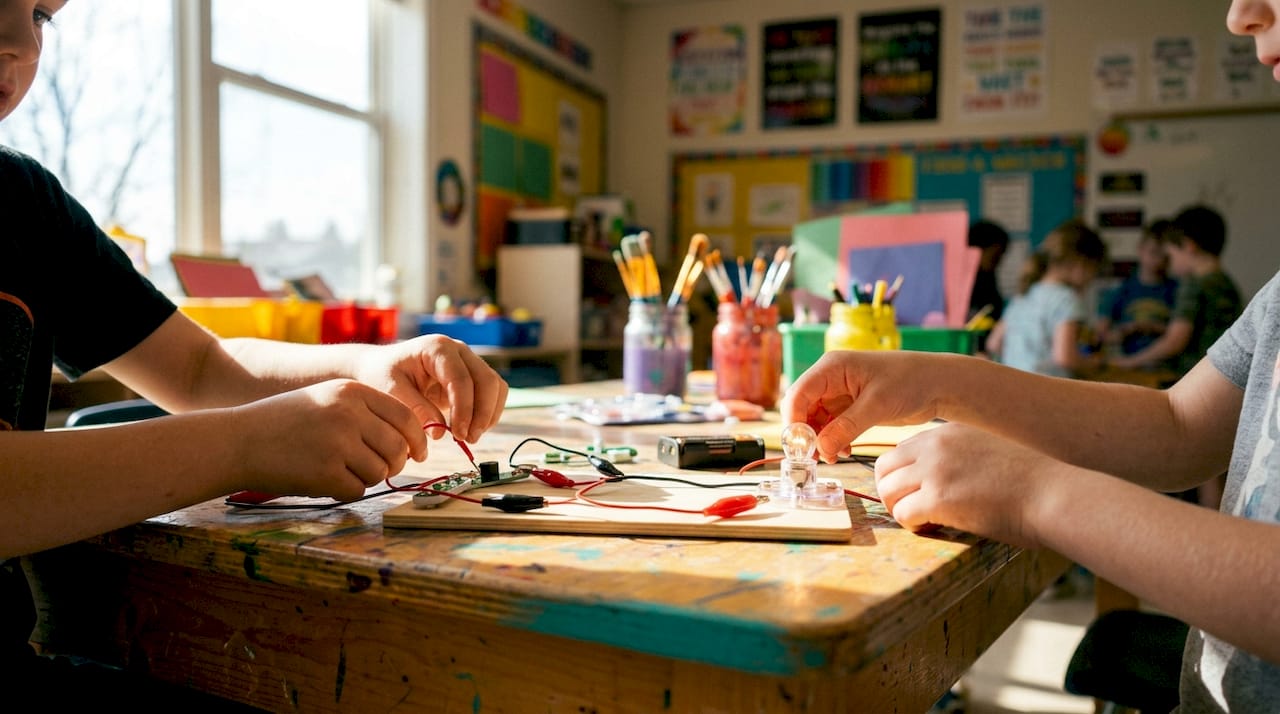
A quick micro-example: a student builds a simple circuit (Concrete Experience), notices the bulb only lights when the loop is closed (Reflective Observation), concludes that electricity needs a complete path (Abstract Conceptualization), then redesigns the circuit to add a second bulb (Active Experimentation). Four stages, one small activity, genuine learning.
Pro Tip: Add a visual flow diagram to your lesson plan showing the four stages as a circle with arrows. Sharing it with students before an activity helps them understand why the reflection questions are not optional, they are the mechanism.
What makes an experience truly experiential, not just hands-on
The AEE’s definition of experiential education requires intentionally designed experiences followed by focused reflection. CSU Pueblo’s institutional framework adds initiative, accountability, and active engagement to that list. Together, they give educators a practical checklist.
- Assessment of transfer: — The lesson plan includes a way to check whether the student can apply the learning in a new situation.
Pro Tip: Frame failure explicitly at the start of an activity: “Part of today’s goal is to find out what doesn’t work.” This single sentence shifts the psychological contract and makes the Reflective Observation stage far richer, because students stop hiding mistakes and start analyzing them.
What research shows about the benefits of experiential learning
Experiential learning consistently improves higher-order thinking and transfer across educational levels, and the evidence base is broad. A systematic literature review drawing on Scopus, ERIC, Web of Science, and Google Scholar found positive impacts on academic achievement, critical thinking, motivation, collaboration, and problem-solving. Those outcomes span K–12 through higher education.
A peer-reviewed synthesis published on PMC confirms that experiential approaches support active learning, deeper application of knowledge, and measurable gains in metacognitive skill. Students who learn experientially do not just know more; they become more aware of how they learn, which compounds over time.
The University of Tennessee’s Experience Learning program documents additional outcomes: increased persistence, stronger content knowledge, and higher-order thinking linked directly to experiential engagement. Persistence is worth highlighting separately because it predicts long-term academic success more reliably than test scores alone.
Key outcome categories supported by the research:
- Critical thinking and analytical reasoning
- Motivation and sustained engagement
- Practical problem-solving and collaboration
- Metacognitive awareness (knowing how you learn)
- Content retention and transfer to new contexts
- Persistence and academic confidence
For neurodivergent learners specifically, multi-sensory, identity-driven, and scaffolded experiential activities offer particular advantages. The University of Toronto’s Experiential Learning Hub notes that these learners gain from the concrete, tactile, and role-based elements that well-designed experiential activities naturally include.
How to design an experiential learning activity step by step
A well-designed experiential activity follows a clear sequence. Skipping steps, especially reflection planning, is the most common reason activities fall short.
- Define learning outcomes first. Write one or two specific statements describing what students will be able to do or explain after the activity, not just what they will experience.
- Choose an authentic experience. Select a task that connects to real-world problems, student identity, or genuine inquiry. Authenticity drives motivation.
- Plan scaffolding. Decide how much structure students need at the start and where you will pull back to allow independent decision-making.
- Embed reflection at three points. Before: “What do you already know? What do you predict?” During: “What are you noticing right now? What is not working?” After: “What did you learn? Where else could this apply?”
- Identify transfer tasks. Design a follow-up challenge where students apply the principle in a new context. This is the Active Experimentation stage.
- Set assessment criteria. Decide in advance what evidence of learning looks like: a reflection journal entry, a revised design, a verbal explanation, or a performance task.
- Plan facilitation cues. Write two or three open-ended questions you will use if students get stuck, and decide when you will intervene versus let productive struggle continue.
Sample reflection prompts you can copy directly:
- Before: “What do you think will happen, and why?”
- During: “What is one thing that surprised you so far?”
- After: “What principle did this experience reveal? Where in your life could you use that principle?”
Assessment options by class size: for small groups, reflective journals and one-on-one performance tasks work well. For larger classes, structured peer feedback rubrics and exit tickets tied to transfer questions scale without sacrificing depth. Portfolios work across both contexts and give students ownership of their learning evidence.
Concrete experiential learning activities across K–12, higher ed, and the workplace
Activity 1: The bridge challenge (grades 3–8, 45 minutes)
Learning goal: Apply principles of structural engineering and iterative design.
Students use index cards, tape, and paper clips to build a bridge that holds the most weight. The experience itself takes 20 minutes. The remaining 25 minutes are structured reflection: groups document what failed, identify the structural principle behind each failure, and redesign one element. The transfer task is a written prompt: “Where do engineers face this same trade-off in real buildings?”
Activity 2: Community problem mapping (grades 6–12, two class periods)
Learning goal: Practice systems thinking and civic reasoning.
Students identify one real problem in their school or neighborhood, map its causes and effects on a large sheet, then propose and justify one intervention. Reflection prompts focus on perspective-taking: “Whose experience did you not include in your map?” Assessment is a short presentation with a rubric scoring evidence use, reasoning, and acknowledgment of uncertainty.
Activity 3: Role-play scientist experiment (ages 5–13, 30–60 minutes)
Learning goal: Build scientific identity alongside content knowledge.
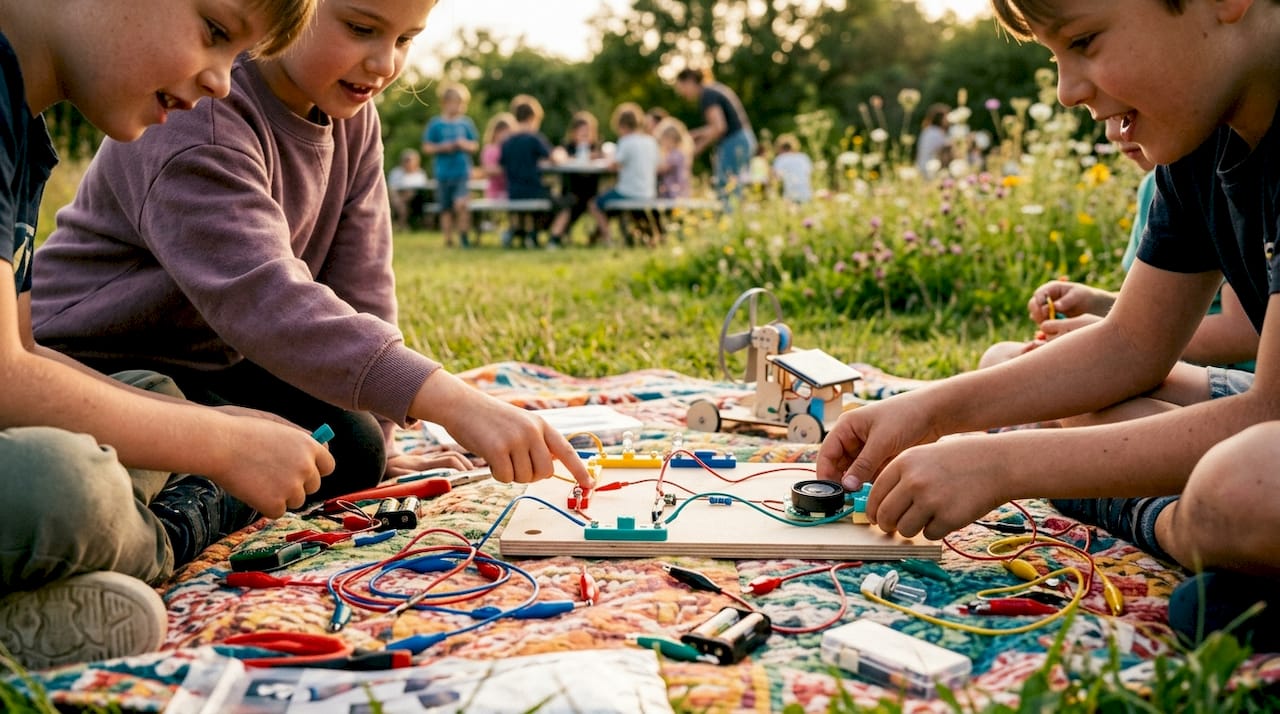
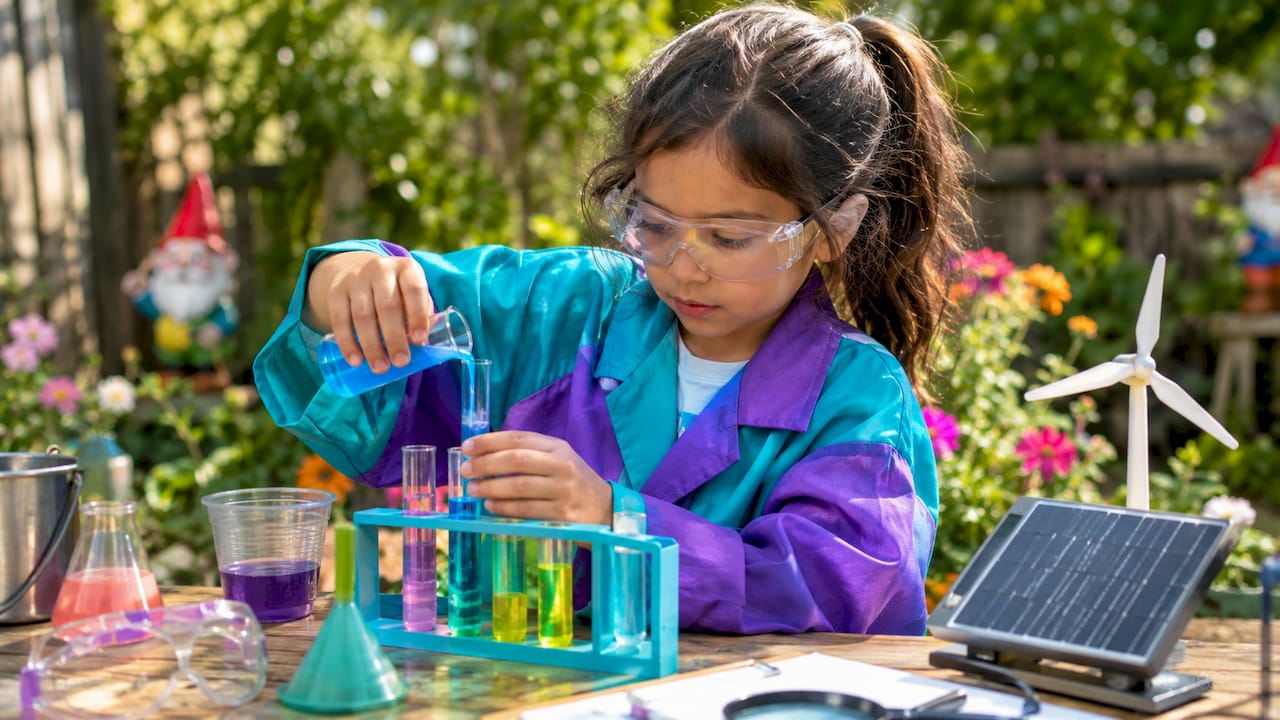
This is where identity-driven STEAM design, like the approach Teamgeniussquad uses in its screen-free discovery kits, shows its full value. Students put on lab coats, receive a “mission brief,” and conduct a real experiment (solar energy, chemical reactions, or simple machines). The role-play frame is not decorative; it shifts how children relate to the challenge. Reflection prompts: “What did you discover as a scientist today? What would you test next?” The screen-free, tactile format is especially effective for neurodivergent learners who benefit from concrete, multi-sensory engagement.
Activity 4: Workplace simulation (higher ed or professional training)
Learning goal: Apply decision-making frameworks under realistic constraints.
Teams receive a scenario with incomplete information and competing priorities, make a documented decision, then debrief against what actually happened in a real case. Experiential approaches in capability development consistently show that this simulation-plus-debrief structure accelerates skill transfer more than lecture-based case studies alone.
Who benefits most from experiential learning, and when to use it
Experiential learning is not the right tool for every moment, but it is the right tool for more moments than most curricula currently use it.
Learner groups that gain the most:
- Neurodivergent learners (including those with dyslexia, dysgraphia, ADHD, and sensory processing differences): multi-sensory, tactile, and role-based activities reduce the barriers that text-heavy instruction creates. For practical strategies, supporting neurodivergent learners through STEAM offers a strong starting framework.
When NOT to prioritize full experiential design: during high-stakes standardized testing preparation windows, when rapid content coverage is the primary goal, or when students lack the prerequisite knowledge to make meaningful choices in an open experience. In those cases, a hybrid approach works well: deliver content directly, then use a short experiential activity to consolidate and apply it. The relationship between STEAM and traditional education is not either/or; the most effective classrooms use both.
Key Takeaways
Experiential learning works because structured reflection transforms direct experience into transferable knowledge, and without that reflection, even the most engaging activity produces surface-level learning at best.
| Point | Details |
|---|---|
| Definition | Learning through direct experience plus structured reflection, grounded in Kolb’s four-stage cycle. |
| Kolb’s cycle | Concrete Experience → Reflective Observation → Abstract Conceptualization → Active Experimentation; all four stages must complete. |
| Design checklist | Intentional outcomes, authentic experience, learner agency, planned reflection (before/during/after), and a transfer task. |
| Assessment tip | Use analytic rubrics, portfolios, or exit tickets focused on transfer, not just task completion. |
| Teamgeniussquad kits | Screen-free STEAM kits with the E³ Method (Engage, Encourage, Empower) map directly to Kolb’s cycle and support neurodivergent learners through tactile, identity-driven design. |
The reflection question that changes everything
Most educators know reflection matters. Fewer realize that the quality of the reflection question matters more than the amount of reflection time. A generic “What did you learn today?” produces generic answers. A targeted question like “What would you do differently, and why?” forces students to move from Reflective Observation into Abstract Conceptualization, which is exactly where durable learning forms.
The habit that consistently improves experiential sessions is writing your three reflection prompts before you plan the activity itself. When you start with the reflection, you design the experience to generate the observations those prompts need. The activity becomes a vehicle for the thinking, not the other way around. That inversion is small in practice and enormous in outcome.
Ready-made STEAM kits that bring experiential learning to life
Designing experiential lessons from scratch takes time most educators do not have. Teamgeniussquad’s screen-free STEAM discovery kits are built around the E³ Method (Engage, Encourage, Empower), which maps directly to Kolb’s cycle: children engage with a real experiment, reflect through guided prompts, and apply their discovery through role-play and identity-building tools like lab coats, badges, and mission certificates.
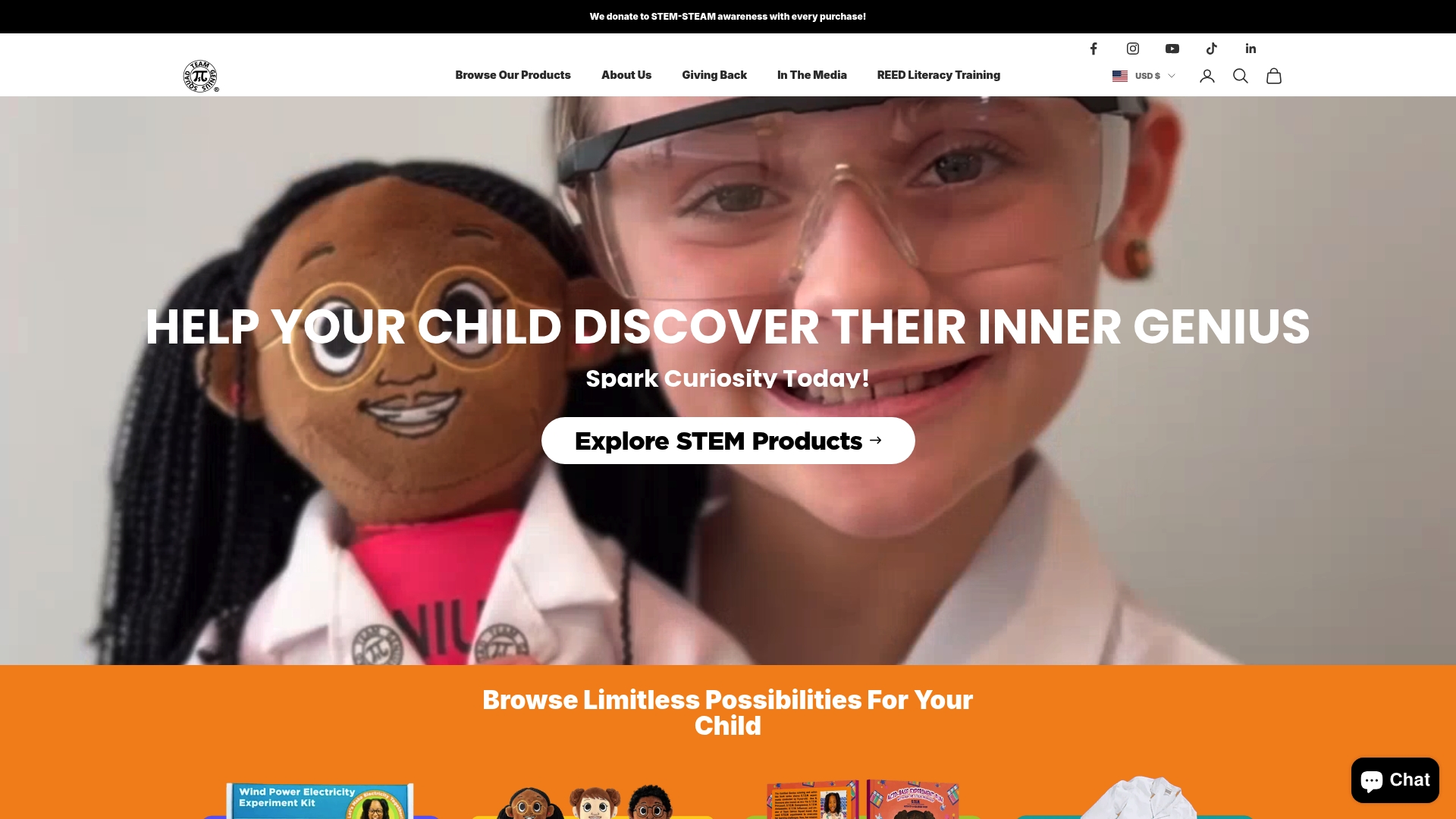
Each kit includes structured reflection prompts and educator-aligned lesson plans so you spend your prep time on facilitation, not material design. The Solar Energy Kit is a strong starting point for any classroom exploring physical science through genuine experiential methods. Browse the full kit range and download ready-to-use lesson plans at shop.teamgeniussquad.com.
Useful sources and further reading
These primary references are worth bookmarking whether you are designing your first experiential lesson or deepening your theoretical grounding.
- Experiential Learning 101 - Experiential Learning Hub
- What is Experiential Education? - Association for Experiential Education
- Experiential learning (instructional guide) - NIU CITL
- Systematic review on the effectiveness of experiential learning - JPPIPA
- Experiential learning review (PMC8569223)
- Definition of Experiential Education | Experiential Education | CSU Pueblo
- Benefits of Experience Learning | Experience Learning
- What is Experiential Learning? - Ithaca College

Leave a comment
This site is protected by hCaptcha and the hCaptcha Privacy Policy and Terms of Service apply.