

Learning Tips for Dyslexia: Strategies That Build Confidence
Start with audio, break work into short chunks, and put accommodation requests in writing today. These three moves matter more than any single app or gadget, and they work together: audio reduces decoding strain, short sessions like the Pomodoro Technique fight reading fatigue before it sets in, and a documented IEP or 504 plan makes every other strategy easier to use at school. Pair that with structured literacy instruction and multisensory tools that combine visuals, sound, and hands-on practice, and you have a real foundation. At Teamgeniussquad, we build that hands-on piece into every kit we design.
- Try text-to-speech or an audiobook before assigned reading, not after you’re already stuck.
- Work in 25 minute chunks with 5 minute breaks so fatigue never builds up unchecked.
- Request an IEP or 504 evaluation in writing this week if one isn’t already in place.
- Add a tactile or visual layer (diagrams, models, letter tiles) to anything text-heavy.
Pro Tip: Don’t marathon a subject just because momentum feels good. Schedule a real recovery break every 25 to 30 minutes. Pushing through fatigue burns tomorrow’s energy today.
Key Takeaways
The most effective learning tips for dyslexia combine audio-first reading, short focused study sessions, documented school accommodations, and hands-on multisensory practice.
| Point | Details |
|---|---|
| Lead with audio | Use text-to-speech or audiobooks before assigned reading to reduce decoding strain from the start. |
| Chunk study time | Work in 25 minute Pomodoro sessions with 5 minute breaks to prevent reading fatigue. |
| Document accommodations | Request an IEP or 504 evaluation in writing and name specific tools like extended time and text-to-speech. |
| Layer the senses | Combine visual, auditory, and tactile input, since multisensory practice builds stronger memory traces than reading alone. |
| Reinforce with hands-on play | Teamgeniussquad’s screen-free STEAM kits give learners a tactile confidence win that pairs with structured literacy instruction. |
Table of Contents
- How does time management change learning tips for dyslexia?
- Reading strategies that lower the decoding load
- Writing and note-taking without the handwriting bottleneck
- Assistive technology worth trying this week
- Getting real school support through an IEP or 504 plan
- Building strengths and self-advocacy skills
- Why these strategies actually work
- Managing stress and anxiety during study and tests
- Tracking progress and adjusting the plan over time
- Working with a tutor or dyslexia specialist
- Hands-on STEAM kits that reinforce these strategies
- Frequently Asked Questions
- Sources
How does time management change learning tips for dyslexia?
Long assignments feel impossible when the page itself is exhausting. The fix isn’t willpower, it’s structure: break every project into pieces small enough to finish in one sitting, then spread those pieces across several days instead of cramming.
- List every step a project requires, from research to final formatting, before you touch the actual work.
- Assign each step its own day or session, using calendar blocks rather than a vague “do it this week” plan.
- Rank tasks by due date first, effort second, so the hardest chunks get tackled when energy is highest, usually mornings.
- Time each session with a simple timer, following the Pomodoro Technique of 25 minutes on, 5 minutes off, which was designed to manage exactly this kind of fatigue.
A sample Tuesday might look like: 25 minutes reading a science chapter aloud with text-to-speech, a 5 minute stretch break, then 25 minutes outlining a paragraph by dictation. Two sessions, one homework block, no burnout.
Pro Tip: Use your break to move your body, not scroll a phone. A short walk resets attention far better than more screen time.
Reading strategies that lower the decoding load
Reading gets easier when you have a job to do before you start decoding a single word. Preview first: scan headings, bold terms, and any figures or captions to build a mental map of what’s coming.
From there, the 6 Ps framework, a research-based comprehension approach built specifically for struggling readers, gives you a repeatable sequence:
- Prior knowledge: What do I already know about this topic?
- Purpose: Why am I reading this section?
- Predict: What do I think it will say?
- Preview: What do headings and images tell me first?
- Picture: Can I form a mental image of this idea?
- Pause: Am I still following, or did I lose the thread?
Combine that with read-along audio. Playing a text-to-speech track while your eyes follow the printed page, or listening to an audiobook version alongside the paper copy, lets your ears carry the language-processing load your eyes struggle with. Slow the playback speed if the pace outruns comprehension.
Clinical guidance consistently identifies structured, systematic literacy instruction as the gold standard for dyslexia intervention, meaning these strategies work best layered on top of explicit, sequential reading instruction rather than replacing it.
After every five to seven lines, pause and say out loud: “So this section is telling me that…” That one habit forces active processing instead of passive scanning, and it catches confusion while it’s still small.
Writing and note-taking without the handwriting bottleneck
For many dyslexic learners, ideas move faster than a pencil can. Dictation closes that gap. Speaking a paragraph into Google Docs voice typing or a dedicated tool like Dragon lets you capture full sentences at talking speed, then edit afterward by listening back with text-to-speech rather than rereading silently.
Note-taking works the same way once you drop the assumption that notes must be handwritten and linear.
- Type notes instead of writing them, so speed doesn’t cost legibility.
- Build mind maps or color-coded index cards for anything with multiple related parts.
- Record lectures and mark timestamps at moments of confusion for quick review later.
- Try a workflow of record, transcribe, chunk into sections, then summarize each chunk aloud.
A synced audio pen like the Livescribe SmartPen links handwritten notes to the exact audio moment they were taken, so you can tap a scribbled word and hear what the teacher said right then.
Pro Tip: Speed up playback to 1.5x for a first pass, then search the transcript by keyword instead of scrubbing through a full recording to find one detail.
Assistive technology worth trying this week
The right tool removes friction the moment you open it, not after weeks of setup. Start with these, roughly in order of impact:
- Read&Write: a browser toolbar that reads webpages, PDFs, and documents aloud while highlighting each word.
- Speechify or NaturalReader: quick text-to-speech apps for converting any document into audio on the fly.
- Bookshare: a library of accessible titles for students with documented print disabilities, typically accessed through a school.
- Learning Ally: human-narrated audiobooks paired with the printed text, popular in school and library settings.
- Audible: consumer audiobooks that work well for read-along practice outside school hours.
- Dragon (Dragon NaturallySpeaking): voice recognition software for dictating essays and long-form writing.
To convert a stubborn PDF into audio, most text-to-speech tools let you upload the file directly and choose a natural-sounding voice. Microsoft’s Immersive Reader, built into many school platforms, does the same for web text with one click. For test prep, record yourself reading key facts aloud and turn that recording into an audio flashcard set you can replay during a commute.
Bookshare and Learning Ally usually require school or library enrollment, while Audible and browser extensions are available to anyone directly. Harvard Health notes that dyslexia is a language-processing difference unrelated to intelligence, and that assistive technology can meaningfully close the gap between ability and output at any age, not just in childhood.
Getting real school support through an IEP or 504 plan
Accommodations aren’t a favor, they’re a documented process, and U.S. public schools are generally required to consider and provide supports once a need is identified.
- Request a formal evaluation in writing, addressed to the school’s special education coordinator, so there’s a paper trail with a response deadline.
- Document specific struggles with examples: homework that takes three times longer, tears during reading, avoidance of writing tasks.
- Ask directly for assistive technology and extended time, naming tools like text-to-speech or a laptop for writing rather than leaving it vague.
- Propose specific homework and test adjustments, such as reduced reading load or oral testing options, instead of waiting for the school to suggest them.
Common accommodations worth requesting include extended time, text-to-speech access, oral testing, a reduced reading load, and digital access to class notes.
Pro Tip: Practice using accommodations during regular study sessions, not just on test day. A learner who’s never used extended time before an exam won’t know how to pace themselves with it.
Building strengths and self-advocacy skills
Dyslexia comes with a processing difference in reading, not a ceiling on ability, and many learners show real strength in spatial reasoning, hands-on problem-solving, and creative thinking. Naming those strengths out loud changes how a learner approaches a hard subject.
- Run a quick strengths audit: what tasks feel easy, fast, or even fun?
- Match those strengths to study methods, like using diagrams for a history timeline instead of paragraphs.
- Practice a short script: “I understand this material, but reading it takes me longer. Can I use text-to-speech for this assignment?”
- Build small, visible wins through hands-on projects that prove competence fast.
This connects to what’s known as the 5 S’s framework: skills, strategies, school support, student buy-in, and stakeholder involvement. The Open University’s research on dyslexia study tips points to something specific: even well-designed strategies fail without real buy-in from the student.
Pro Tip: Let the learner help choose which strategy to try first. A plan they picked gets used; a plan handed down rarely does.
Why these strategies actually work
Structured literacy, systematic and explicit reading instruction, remains the evidence-backed standard for dyslexia intervention, and every tactic in this article builds on top of it rather than replacing it.
Combining audio, visual, and tactile input at the same time doesn’t just accommodate a language-processing difference, it routes around the specific bottleneck causing it. Hands-on tactile learning, using models, letter tiles, or real experiments, anchors abstract ideas and creates a memory trace that decoding alone can’t build.
That’s the clinical logic behind pairing audiobooks with printed text, or building a science concept with a physical model before reading about it: two or three senses working together encode information more reliably than reading in isolation ever could.
Managing stress and anxiety during study and tests
Reading fatigue and anxiety feed each other. A learner who’s already exhausted from decoding text has less mental bandwidth left to manage nerves, and nerves in turn make decoding even harder. Breaking that loop starts with recognizing it out loud: “This is hard because of how my brain processes text, not because I’m not trying.”
Build in physical resets. A short walk, stretching, or even a few slow breaths between Pomodoro sessions lowers the stress hormones that make reading comprehension worse under pressure. Avoid scheduling the hardest subject right before bed or right after a long day. Timing matters as much as technique.

Before a test, rehearse the actual conditions you’ll face. If extended time is part of an accommodation plan, practice pacing with that extra time during a mock quiz, not for the first time during finals. Familiarity with the format reduces the unknowns that anxiety feeds on.
Normalize asking for a break during a test itself, if that accommodation exists. A five-minute reset during a two-hour exam isn’t wasted time, it protects the accuracy of everything that follows. Caregivers can help by talking through what a test will look like beforehand, rather than only debriefing after a bad result. Preparation, not reassurance alone, is what actually lowers anxiety long term.
Tracking progress and adjusting the plan over time
No strategy stays perfectly matched to a learner forever. What works in third grade often needs a rebuild by seventh, as reading demands shift from decoding simple sentences to parsing dense textbook paragraphs.
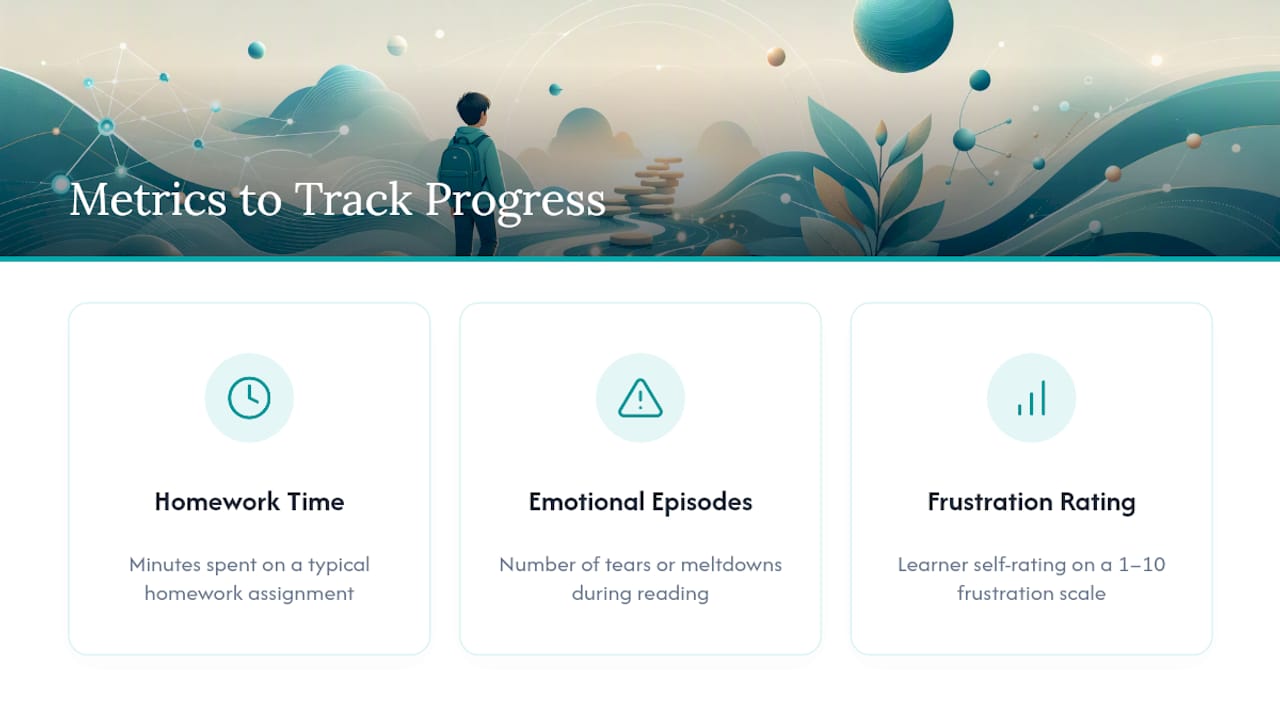
Track something concrete every few weeks: minutes spent on a typical homework assignment, number of tears or meltdowns during reading time, or a simple 1 to 10 frustration rating the learner gives themselves. These numbers matter more than a gut feeling because they catch slow decline before it becomes a crisis.
Revisit accommodations at least once a year, ideally at the same time as an IEP or 504 review, and ask a direct question: is this tool still helping, or has the learner outgrown it? A text-to-speech app that felt essential in fourth grade might become unnecessary once decoding speed improves, while a new challenge, like note-taking in a faster-paced class, might call for a tool that wasn’t needed before.
Involve the learner directly in this review. Ask what feels harder now than it used to, and what feels easier. Self-reported friction points are often more accurate than a caregiver’s outside impression, since the learner is the one experiencing the cognitive load firsthand. Adjust one variable at a time, whether that’s session length, tool choice, or accommodation type, so you can tell what actually caused the improvement.
Working with a tutor or dyslexia specialist
A generalist tutor and a dyslexia specialist are not interchangeable. Look specifically for someone trained in structured literacy methods, since that systematic, multisensory approach is what clinical guidance consistently points to as effective for dyslexia specifically, not just reading help in general.
Ask direct questions before hiring: What reading program or method do you use? Are you trained in an Orton-Gillingham based approach or something comparable? How do you track progress session to session? A specialist should be able to answer specifically, not vaguely.
Coordinate the tutor’s work with school accommodations rather than running them as separate tracks. If a 504 plan grants extended time and text-to-speech, a good tutor builds practice around those exact tools so the learner isn’t relearning a new system outside school.
Session frequency matters less than consistency. Two focused 30 minute sessions a week, held reliably, typically outperform one long session that gets rescheduled constantly. Ask for a written progress update every few weeks, even informally, so the plan stays adjustable rather than static.
A caregiver’s perspective on what actually changed
Switching to read-along audiobooks paired with short study blocks cut one learner’s homework time nearly in half and noticeably reduced the nightly tears. Small changes, applied consistently, outperformed any single big fix.
Hands-on STEAM kits that reinforce these strategies
Audio and text-based strategies carry most of the weight in daily schoolwork, but confidence gets built somewhere else too: in moments where a learner sees an idea work with their own hands. That’s the gap Teamgeniussquad’s screen-free STEAM kits fill. Each kit uses our E³ Method, Engage, Encourage, Empower, to turn a science concept into a tactile experiment, complete with lab coats and role-play elements that let a child feel like a real scientist rather than a struggling reader.

These kits are an adjunct to strong learning tips for dyslexia, not a substitute for structured literacy instruction or documented school accommodations. Pair them with the reading and audio strategies above, not as a replacement. If you’re building a home routine around hands-on learning, the collection of lesson plans pairs STEAM activities directly with literacy support, and it’s a practical next step: browse the current lesson plans and pick one experiment to try this week alongside your learner’s regular reading practice.
Frequently Asked Questions
What are the best learning tips for dyslexia to start with today? Begin with audio: text-to-speech or an audiobook version of any assigned reading. Add short 25 minute study sessions with breaks, and put an accommodation request in writing if one isn’t already active.
How can caregivers help a dyslexic child with homework? Support them with read-along audio, chunk assignments into small daily pieces, and build in short physical breaks between sessions to manage reading fatigue before it builds up.
Do audiobooks actually help with dyslexia, or are they a shortcut? Audiobooks paired with printed text let a learner absorb language content while easing the decoding burden, which several university resources describe as a legitimate, evidence-informed study strategy rather than a workaround.
What’s the difference between an IEP and a 504 plan? An IEP typically involves specialized instruction under federal special education law, while a 504 plan focuses on accommodations like extended time or assistive technology within general education, and U.S. public schools generally must consider both when a need is documented.
Can hands-on activities really support reading and writing skills? Yes. Tactile, hands-on learning anchors abstract concepts in physical experience, which reduces reliance on language processing alone and helps ideas stick through an additional sensory channel.
Sources
- Pomodoro Technique - Academic Resource Center, Duke University
- Dyslexia: Tools and supports for this learning disability - Harvard Health



Leave a comment
This site is protected by hCaptcha and the hCaptcha Privacy Policy and Terms of Service apply.