PBL STEM Activities for Ages 5–13 That Solve Real Problems
The best PBL STEM activities give children a problem they care about, a short list of constraints, and permission to fail, revise and try again. Below you will find a planning framework, age-banded project ideas that run in one to three hours with everyday materials, and ways to make each one a real-world challenge instead of a craft project with a science label.
TL;DR
- Start with a problem children genuinely feel is important, then add constraints (materials, time, budget) so the design work is real.
- Every project should follow the engineering loop: define, brainstorm, prototype, test, revise. The revision step is where the learning happens.
- Add talking, drawing and writing to the build. Reflection turns “we made a thing” into “we understand why it worked.”
- Plenty of strong projects take one to three hours and cost very little, so you do not need a big budget or a lab.
- Design for different minds: offer more than one way to plan, build and show learning.
Table of Contents
- What PBL STEM actually means for kids
- Why real-world problems beat contrived ones
- A five-step framework you can reuse
- Project ideas by age band
- Real-world challenge starters
- Add literacy and reflection to every project
- Our perspective: confidence is part of the lesson
- Make PBL work for different minds
- How to assess what children learned
- Set realistic expectations
- Bring a STEM role model into your project
- Frequently asked questions
- Sources
What PBL STEM actually means for kids
Project-based learning (PBL) in STEM asks children to work toward a meaningful product or solution over a stretch of time, using science, technology, engineering, art and math along the way. A worksheet asks for the right answer. A project asks, “How might we keep a package safe when it falls?” and lets children discover what they need to know in order to answer.
The National Academies of Sciences, Engineering, and Medicine make a point that every educator and parent can use: effective investigation and design work moves beyond “doing” projects toward sensemaking, where students use science practices to build new knowledge. The goal is not one correct product. The most valuable moment is often when a child studies a prototype that failed and revises the design based on evidence.
That shift changes how you run an activity. You stop asking “Did it work?” and start asking “What did the test tell us, and what will we change?”
Why real-world problems beat contrived ones
A common pitfall in STEM PBL is picking a problem that is too contrived. Children can tell when a challenge exists only so an adult can hand out materials. The same National Academies chapter points to tasks grounded in problems kids truly consider important, such as improving accessibility or tackling a local environmental challenge.

There is also evidence from long-running programs that connecting classwork to real engineering context pays off. In teacher surveys gathered over a decade of use of SAE International’s A World In Motion, 98% of teachers saw increased student excitement, 91% reported improved academic performance in STEM-related areas, and 85% saw higher interest in STEM careers. These are teacher-reported results, not controlled experiments, so read them as encouraging rather than conclusive.
Here is a quick test for any idea you are considering:
- Is there a real person or place that benefits? A younger sibling, a school garden, a neighbor who uses a wheelchair, a creek near your school.
- Are there honest constraints? Limited materials, a time limit, a weight or height requirement.
- Can the result be tested? Something you can measure, count, time or observe.
- Can the child’s choices change the outcome? If every group ends up with the same product, it is a recipe, not a project.
A five-step framework you can reuse
You do not need a new plan for every project. Use the same loop every time, and children begin to own it. The core engineering design steps in strong elementary and middle school activities are consistent: define the problem, brainstorm, prototype, test and iterate.
1. Define the problem
State the need in one sentence and name who it is for. Ask children to restate it in their own words. Younger children can draw the problem; older children can write a short problem statement with two constraints.
2. Brainstorm
Give everyone a few quiet minutes to sketch or jot ideas before group talk begins. This protects children who need more time to think and prevents the loudest voice from setting the plan.
3. Prototype
Build a first version fast. Set a timer. A rough prototype that can be tested in twenty minutes teaches more than a polished one that takes the whole session.
4. Test
Decide on the measurement before testing: distance, time, weight held, number of drops survived. Record results on a simple chart.
5. Revise and reflect
Change one thing, test again, and compare. Then ask children to explain in speech, drawing or writing what they changed and why. This is the sensemaking step, and it deserves real time, not the last two minutes.
Project ideas by age band
The projects below are built around free, well-documented activities from TeachEngineering where possible, and adapted with real-world framing. Adjust difficulty by changing constraints, not by changing the problem.
Ages 5–7: Small problems, big hands-on moments
Bee-Bot rescue route. Children program a floor robot to carry “supplies” across a mat map to a pretend village. A 2025 study of 82 preschoolers aged 5–7 found significant improvements in abstract thinking and problem decomposition after a summer camp built around tangible programming tools. If you do not have a robot, an unplugged version works: one child gives arrow-card instructions and another acts as the robot.
Mint-mobile test track. Children build small race cars from candy rings, straws, craft sticks, index cards and tape, then change one variable at a time. The Mint-Mobiles activity uses these simple materials to explore independent, dependent and control variables. Real-world frame: “Which design would carry a delivery farthest down the hallway?”

Project work in the first grade. If you worry that small children cannot manage a project, a study of project work in a first-grade classroom found that children had ample opportunities to learn and develop, including chances to articulate their thinking in different ways. Keep it short, visual and talkative.
Ages 8–10: Testing, measuring, improving
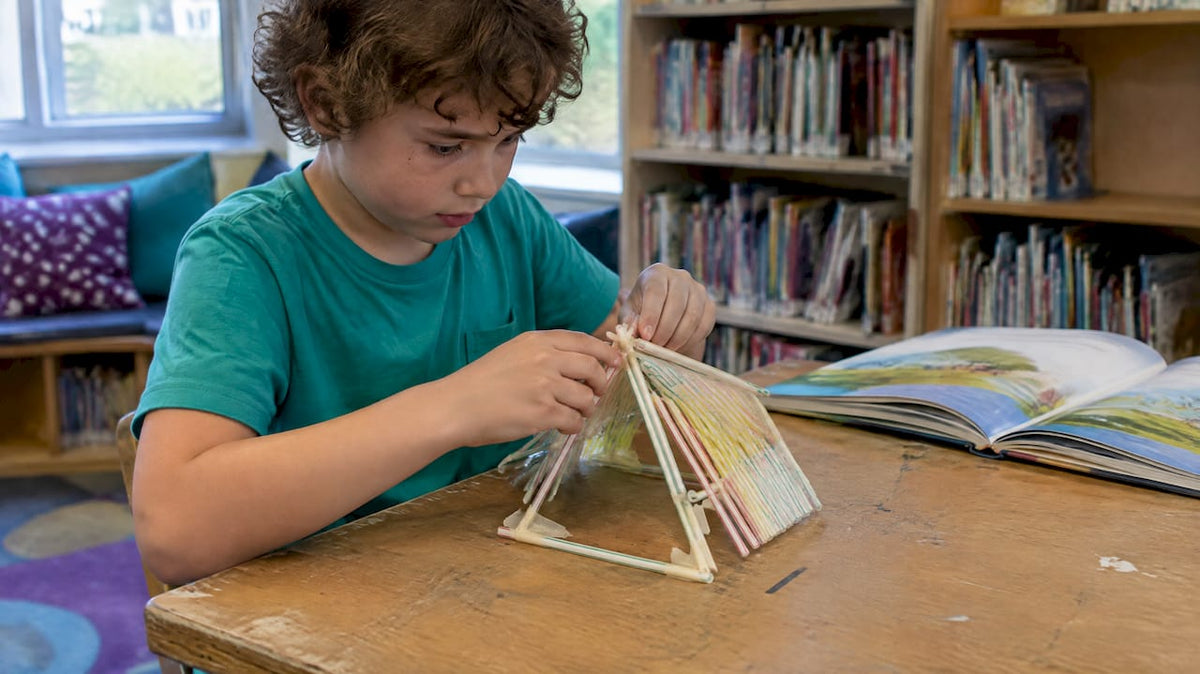
Strongest stronghold. Teams build towers from straws under design constraints and compete to see whose holds the most. According to TeachEngineering’s Strongholds activity, common project durations run from one to three hours, and materials often cost under $5 per group using household or school supplies. Real-world frame: a shelter that must survive a wind test from a fan.
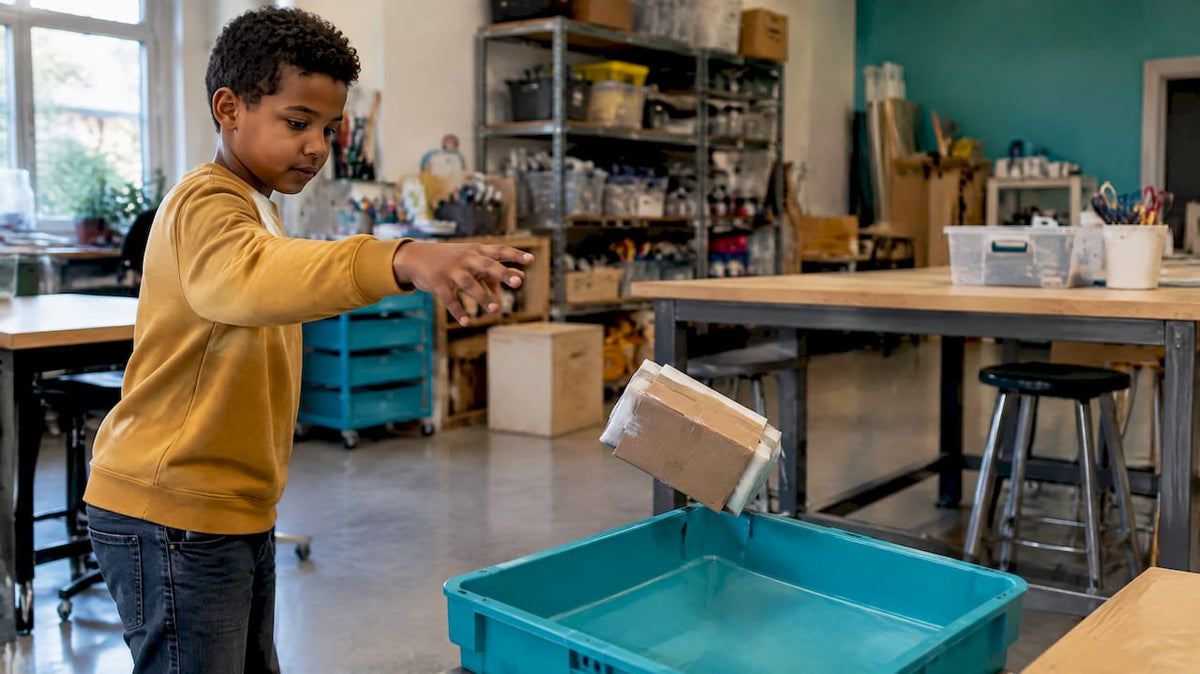
Egg-drop care package. Students design devices to protect and accurately deliver dropped eggs, and the eggs represent care packages for people in a disaster area with no road access. The story gives the drop purpose. Have teams record each drop height and what failed.
Solar car. Children learn that solar panels gather energy from the sun and can power items, then design a solar-powered car. Link it to a local question: what would it take to power a school bus stop light?
Ages 11–13: Constraints, data and community
Super Slinger launcher. Students design, build and test small launchers that must aim and launch Ping-Pong balls, following the engineering design process in the Super Slinger challenge. Push for data: ten trials, a mean distance, a spread, and a written case for the final design.
Student-generated problems. Invite older students to find a problem in their school or neighborhood, such as a crowded bike rack, a leaky gutter or a noisy cafeteria. Ask them to define realistic constraints and list the resources available, such as a custodian’s expertise or a parent who works in construction.
Accessibility audit. Teams measure door widths, ramp slopes or sign heights around school and propose a low-cost improvement with a scale model. It is real-world, measurable, and meaningful.
For more ready-to-run ideas with measurable tests, see our 10 STEM design challenges, our guide to age-tagged engineering projects and our unplugged engineering challenges for iteration practice with no devices.
Real-world challenge starters
If you are searching for real-world STEM challenges, start with a need you can see from your own door. These starters work in a classroom, a counseling group, a library program or a living room.
| Real-world need | Build challenge | What to measure |
|---|---|---|
| Packages break in delivery | Egg-drop protector | Drop height survived |
| Storm shelter for a pretend village | Straw tower | Weight or wind load held |
| Litter near the school | Trash-collecting tool from reused items | Items picked up in 60 seconds |
| Hard-to-open containers | Easier-grip handle | Time to open, ease rating |
| Plastic waste | Reuse product from recycled materials | Number of reuses, durability |
For the recycling row, our classroom-ready recycled STEM projects cover ages 5–13, and our Earth Day STEM activities add an inclusive environmental angle.
Add literacy and reflection to every project
STEM PBL works better when children talk, draw and write about what they are doing. A study of project work in a first-grade classroom found that projects can cover more mandated objectives and encourage children to express deeper, more accurate ideas through writing and discussion than traditional teacher-directed lessons. That makes literacy a natural partner for science, not an add-on.
Three simple routines:
- Predict and sketch. Before testing, children draw what they expect and write one sentence of why.
- Lab log. After each test, one line: “We changed ___, and the result was ___.”
- Explain it out loud. A two-minute team report to another group, using the words “variable,” “prototype” and “constraint.”
Creative formats can work too. One exploratory project had elementary students and a professional musician write and record lyrics about science, and the paper describes lyric writing as a way to express learning. For children who find writing paragraphs exhausting, a song, comic strip or recorded explanation can show the same understanding. Our art-integrated STEM projects show more ways to blend creativity with engineering.
Our perspective: confidence is part of the lesson
At Team Genius Squad, we build every kit around a simple belief: a child who sees herself as a scientist will act like one. Our E³ Method, Engage, Encourage, Empower, came out of a real family journey with dyslexia and dysgraphia, and it shapes how we think about project work.
Here is what that means in practice for PBL:
- Engage with a story and a role. A lab coat, a badge and a mission change how a child approaches a task. “You are the engineer for this village” is more motivating than “complete page four.”
- Encourage the revision. We want children to hear that a failed test is data, not a verdict. When a tower falls, celebrate what it taught the team.
- Empower through choice. Let children choose how they plan (sketch, talk, build first) and how they show learning (write, draw, present). Children who struggle in traditional settings often shine when the path is flexible.
Many children who find reading and writing hard are strong spatial thinkers and problem solvers. A well-designed project lets those strengths lead, while reflection routines build the literacy skills alongside. That is why our kits combine real experiments with reading, writing and reflection, and keep the experience hands-on and screen-free.
— Tita
Make PBL work for different minds
Inclusive design is not extra work if you plan it from the start. Try these moves:
- Offer multiple ways to start. Some children think by sketching, others by handling materials, others by talking. Allow all three.
- Chunk the task. Write or draw the steps on a visual checklist so no child needs to hold the whole plan in memory. Our practical STEM checklist can serve as a starting point.
- Make roles flexible. Builder, recorder, tester and reporter can rotate. A child who dislikes handwriting can be the tester and speak results into a voice recorder.
- Keep sessions short. Thirty to sixty minutes is plenty. See our 30–60 minute STEAM activities with UDL tips for low-prep formats.
- Use familiar materials. Building bricks lower the barrier for many children. Our LEGO STEM challenges by age are organized for parents and teachers.
Counselors can use the same framework in small groups. A team project gives children a shared goal, a chance to practice patience and a safe place to recover from a setback.
How to assess what children learned
Skip the single grade on the finished product. Look at the process instead:
- Problem understanding. Can the child explain who the design is for and what the constraints are?
- Evidence use. Did the child record test results and point to them when explaining a change?
- Revision. Did the second version differ from the first for a stated reason?
- Communication. Can the child describe the work in words, drawings or a recording?
- Persistence. Did the child return to the problem after a failure?
A simple three-level rubric (beginning, developing, confident) for each row is enough. Share it with children before the project, so they know what good work looks like.
Set realistic expectations
Project work builds engagement and interest, but do not expect one unit to move test scores for good. A quasi-experimental study of the Gear Up 4 STEM camp for grades 3–5 found significant improvements in science test scores during the year of participation, but the effects were not sustained in the following year. The takeaway is consistency: regular, repeated exposure beats a single exciting week.
A realistic plan might be one short project every two or three weeks, reusing the same five-step loop, so children get faster and more confident each time.
Bring a STEM role model into your project
If you want to spark a project with a role model, our founder Ava N. Simmons, the young STEM entrepreneur who inspired Team Genius Squad, offers live experiences. You can book a 30-minute Zoom 1-on-1 interactive STEM experiment for kids 5–13 at 50 USD, or explore the virtual group entrepreneurship experience at 550 USD and the in-person group STEM experience at 1100 USD on our shop page. For hands-on project starters you can use at home or in class, browse our experiment kits.
Frequently asked questions
How long should a PBL STEM activity take?
For ages 5–13, one to three hours is a good range for a single challenge, and many can be split into two shorter sessions. TeachEngineering’s tower-building activity lists durations in that range. Always leave time for testing and revision, not just building.
Do I need special materials?
No. Straws, tape, craft sticks, index cards, paper cups and recycled containers carry most of the projects above. TeachEngineering’s materials lists often come in under $5 per group. Spend your money on a few extra rolls of tape and a timer instead.
How do I make a challenge feel real to kids?
Tie it to a person or place they know, such as a classmate, a pet, the playground or a nearby stream. Then add honest constraints and a test that measures success. Letting older students identify the problem themselves is often the biggest motivator.
Can PBL work for children who struggle with reading or writing?
Yes, when children have options for how they plan and show learning. Sketches, spoken explanations, recordings and role-based tasks let them demonstrate understanding while literacy skills grow through low-pressure reflection routines. Pair the project with short, repeated writing prompts rather than long reports.
Sources
- TeachEngineering: The Strongest Strongholds
- TeachEngineering: Mint-Mobiles
- TeachEngineering: Bombs Away! Egg Drop
- TeachEngineering: Ready, Set, Solar!
- TeachEngineering: Super Slinger Engineering Challenge
- ERIC: Tangible Programming Tools in Early Childhood (EJ1468121)
- EDC: A World In Motion
- National Academies: Starting Strong with Investigation and Design
- ERIC: The Effects of Project Work in a First-Grade Classroom
- ERIC: Singing In Science
- ERIC: Gear Up 4 STEM

Leave a comment
This site is protected by hCaptcha and the hCaptcha Privacy Policy and Terms of Service apply.