Inclusive STEM Classroom Ideas That Work for Every Learner
An inclusive STEM classroom is one where every child has a real way in, a real job to do and a real way to show what they understand. That takes planning, not extra worksheets. The ideas below start with lesson design, then move to roles, language, hands-on challenges, storytelling and the small routines that help children who struggle with reading or writing see themselves as scientists.
TL;DR
- Design the lesson with options built in from the start (Universal Design for Learning), instead of patching it with accommodations afterward.
- Give every group member a rotating role so participation is not decided by the loudest voice.
- Let children show understanding by sketching, speaking, building or writing, and keep reading and writing demands separate from the science itself.
- Use low-prep engineering challenges with clear tests, and treat early failures as the experiment working.
- Wrap science in story and role-play so children build an identity as innovators, not just a score.
Table of Contents
- Start with the design, not the accommodation
- Build group work that actually includes everyone
- Change the words you use
- Hands-on challenges with a low floor and a high ceiling
- Make the challenge relevant to the child
- Use story and role-play to open the door for struggling readers
- What the evidence says about hands-on, inclusive challenges
- Our perspective: confidence comes first
- Bring it together: a sample 45-minute lesson
- Bring hands-on discovery into your classroom
- FAQ
- Sources
Start with the design, not the accommodation
Most inclusion trouble begins before the lesson starts. A single path through the activity gets built, and then a few students need it changed. The UDL Guidelines from CAST take the opposite approach. They organize planning around multiple means of engagement, representation and action, with the goal of learners who are purposeful, reflective, resourceful, authentic and strategic.
In plain classroom terms, that means asking three questions while you plan:
- How will children get interested? Offer a choice of context, such as building a bridge for a toy, a pet or a town.
- How will they take in the information? Pair written directions with a demo, a picture sequence or an audio read-aloud, and put real materials in their hands.
- How will they show what they learned? Accept a labeled sketch, a spoken explanation, a photo log or a short written reflection.
The UDL text notes that proactive design reduces the need for time-consuming individual adjustments later. It also keeps the challenge meaningful for everyone, instead of impossible for some. Understood’s guide to planning inclusive STEM lessons makes the same point and adds a useful distinction: a one-time STEM activity is engaging, but a planned lesson builds more lasting depth.
A quick planning check
Before you teach, read your lesson and underline every place a child must read, write, listen or speak to continue. For each underline, ask whether it is the science skill you are teaching or just the delivery. If it is the delivery, add a second route.

Build group work that actually includes everyone
Group work is where good intentions go quietly wrong. Without structure, one or two students handle the materials and the rest watch. Get into STEM’s eight principles for inclusive STEM education recommend assigning specific roles, such as materials manager, recorder and presenter, and being intentional about who takes leadership and technical jobs so existing stereotypes are not repeated.
A simple routine that works in grades K-8:
- Materials manager: collects and returns supplies, and is the only one who reaches for the tray.
- Builder: assembles the design, with hands-on time rotated every few minutes.
- Recorder: sketches or notes results, in words, symbols or photos.
- Presenter: explains the design to another team or to the class.
Rotate roles every session and post the rotation chart. Children who find writing hard still take their turn as recorder, as long as “recording” can mean a labeled drawing or a voice memo. Children who are quiet still present, perhaps to a single partner first.
Change the words you use
Language is a barrier that teachers can remove in one afternoon. The same Get into STEM guidance encourages moving away from gendered terms, for instance saying “everyone” instead of “guys.” It also suggests reframing “messing around” as the authentic scientific practice of experimenting and exploring, which gives students room to take risks without fear of judgment.
Try these shifts:
- “Who’s good at science?” becomes “What did your test show?”
- “Wrong answer” becomes “Interesting result. What would you change?”
- “Be careful, you’ll break it” becomes “Let’s see what happens, then redesign.”
The Smithsonian Science Education Center’s whitepaper on diversity, equity, accessibility and inclusion frames the aim as serving all STEM learners along the continuum of human ability. Your classroom language is where that aim becomes visible to children.
Hands-on challenges with a low floor and a high ceiling
Good inclusive challenges are easy to start and hard to finish perfectly. Every child can begin with paper, tape and cups, and every child can keep improving.
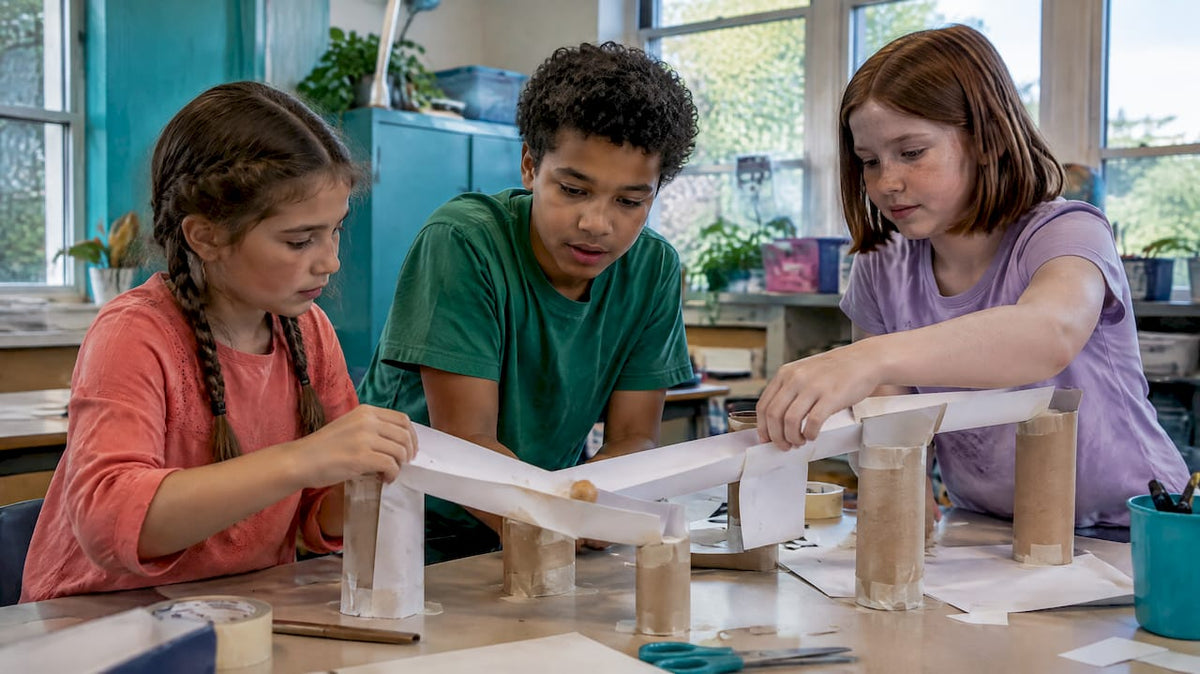
Paper Ball Run
Science Buddies describes this as a challenge where teams of one to four students design, build, test and iterate paper ball runs. The teacher message that matters is that engineering means building, testing and changing the design to solve problems. It suits mixed-ability groups because a child who struggles with written directions can still read the ramp.
Ping Pong Pickup
In this engineering challenge, students sketch ideas for a device that picks up and releases a ball, including features that help it reach greater distance. The sketch step is the inclusion lever: it lets children plan visually before anyone writes a sentence.
Why these work
Science Buddies’ free resources include NGSS-aligned challenges for grades 3-5 and worksheets that help students document their design process again and again. Documenting iterations tells a child, in black and white, that the first version was supposed to change.
For more low-cost builds with measurable tests, see our guide to 10 STEM design challenges, and for screen-free options, our unplugged engineering challenges for iteration and inclusion.
Make the challenge relevant to the child
Children persist when a problem feels like theirs. A 2023 article in Frontiers in Education argues that inclusive STEM requires educators to reflect on dominant perspectives embedded in traditional curricula, and it ties students seeing their own cultures and backgrounds in the problems to a stronger sense of belonging.
Practical ways to do that:
- Let students choose who the design is for: a grandparent, a neighbor, a pet, a school garden.
- Share scientists and inventors who look and learn differently from the textbook default.
- Bring in stories from many cultures. Folklore is a natural doorway, and teacher-curated Anansi story books can anchor a discussion about trickster characters who solve problems with cleverness.
- Ask families for local examples of building, cooking, farming or repair.
Our own identity-driven STEM ideas go deeper on this for ages 5-13.
Use story and role-play to open the door for struggling readers
Engagement is often the first barrier to staying with STEM, especially for children who find reading hard. An IES-funded success story about Filament Games notes that many students disengage from science in middle school, particularly those who struggle with reading and with traditional teaching, and that the games were informed by UDL. The lesson for an elementary teacher is to reach children earlier, and through more than text.
Three low-cost moves:
- Give the lesson a mission. “Today, our lab has to move a message across the room without touching the floor.”
- Give children a role. Lab coats, badges and certificates are inexpensive, and they change how a child describes themselves: not “I did a worksheet” but “I’m the lead engineer.”
- End with a reflection that is not only writing. Tell it, draw it, or act it out for a partner.
Our guide to STEM storytelling examples has ready-to-use story prompts, and our SEL STEM activities pair science with confidence-building skills.
What the evidence says about hands-on, inclusive challenges
A 2025 CAST white paper on the Take Flight program reports a pilot of more than 1,100 students in 33 schools across 11 states, using drone-based lessons with UDL supports. It found statistically significant gains (p < .001) in STEM career interest, technical skills and collaboration, and teachers reported a 1.6-point increase in their own confidence leading such activities. This was a drone program with rural learners, so it does not prove that any specific classroom activity will deliver the same results. It does suggest that structured, supported, hands-on missions can move both students and teachers.
A 2026 systematic review of UDL in STEM is also worth a look if you need research to bring to your principal or curriculum team.
Our perspective: confidence comes first
We started Team Genius Squad from a real family journey with dyslexia and dysgraphia. We watched how quickly a bright child can decide, “I’m just not a science person,” because the first thing asked of them was to read a dense page or write a tidy paragraph.

That is why our approach, the E³ Method (Engage, Encourage, Empower), moves in a particular order. First, a child is drawn in by something they can touch and do. Then they are encouraged through a success that is real, because the experiment actually works. Only then are they empowered to say, “I am an innovator.” Literacy is still part of it, since our kits combine experiments with reading, writing and reflection, but reading and writing serve the discovery instead of blocking the door to it.
If we could give every classroom teacher one idea, it would be this: inclusion is not a lower bar. It is more than one way to reach the same bar, and a child who has been told they are a scientist behaves like one. Different minds really can build the future, and your classroom is where many of them first believe it.
— Tita
Bring it together: a sample 45-minute lesson
Here is how the ideas fit into one session for grades 2-5. Adjust the timing to your group.
| Minutes | What happens | Inclusion lever |
|---|---|---|
| 0-5 | Mission story: “Our lab must build a ramp that moves a ball into a cup.” | Story and role-play engage reluctant starters |
| 5-10 | Demo plus picture directions; roles assigned from the rotation chart | Multiple means of representation, structured roles |
| 10-20 | Sketch and plan in pairs or small groups | Visual planning before writing |
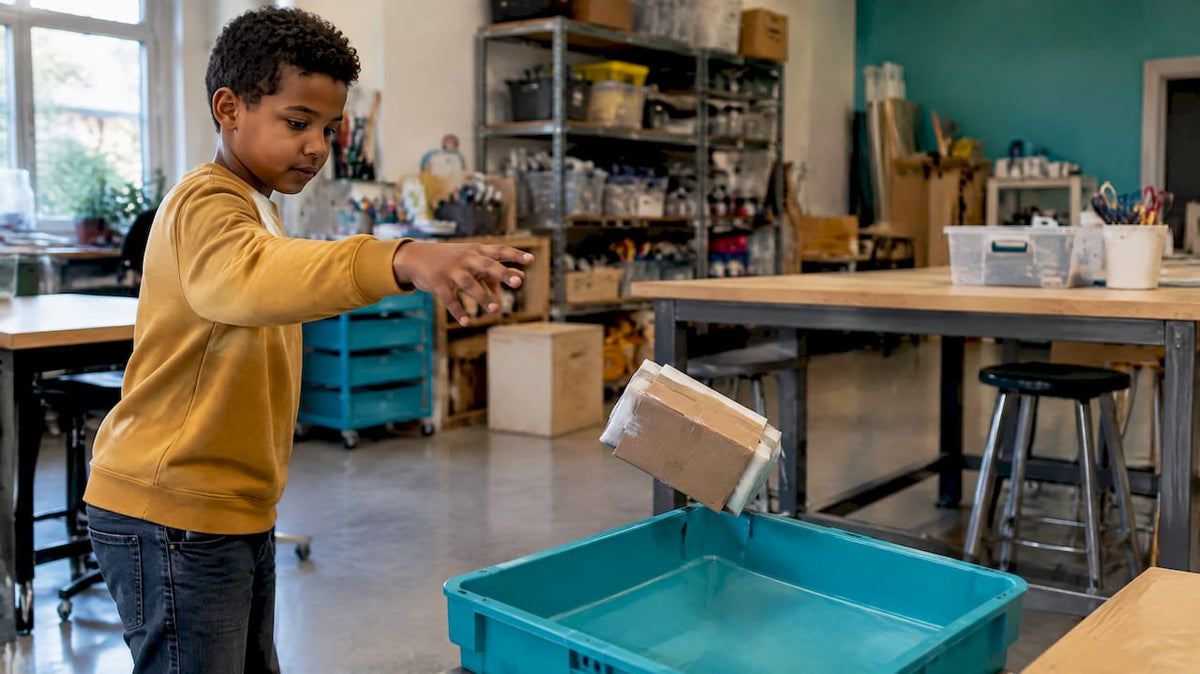
| 20-35 | Build, test, change, test again | Hands-on action, iteration as the goal |
| 35-45 | Share-out: sketch, say or write what changed and why | Multiple ways to show understanding |
For more activities with UDL tips and low-prep materials, see our K-8 STEAM activities for the classroom and our guide to STEAM activities for special needs. If you want help matching hands-on activities to reading and writing goals, our article on literacy-first, neurodivergent-friendly STEM is a good next step.
Bring hands-on discovery into your classroom
If you would like ready-made materials, our experiment kits are hands-on and screen-free, for children ages 5-13, and built around identity-driven play. You can also browse our STEM-STEAM books and puzzles and lab coats for role-play. For a live experience, Meet Ava, our young STEM ambassador, offers a 30-minute Zoom one-on-one interactive experiment for $50, a virtual group entrepreneurship experience for $550 and an in-person group STEM experience for $1,100.
FAQ
How can teachers make a classroom more inclusive?
Start by designing lessons with options for engagement, representation and action, rather than adding accommodations later. Assign rotating group roles, use inclusive language such as “everyone,” and let students show understanding in more than one way. Small, consistent routines matter more than one big overhaul.
What are some good topics for STEM projects?
Choose projects with a simple start and room to improve, such as ball ramps, ping pong pickup devices, bridges or simple circuits. Let students pick who the design is for, so the problem feels personal. Free challenges from Science Buddies are a good starting point for grades 3-5.
Where can I find free science lesson plans?
Science Buddies publishes free NGSS-aligned engineering challenges and teacher guides, including worksheets for documenting the design process. CAST’s UDL Guidelines are also free and help you adapt any plan so more students can take part. Our own blog has low-prep activity ideas for grades K-8.
Do inclusive STEM ideas only help students with identified disabilities?
No. UDL is designed to lower barriers for everyone, including students who struggle with traditional teaching methods, English learners and children who are simply shy. Multiple ways to engage and respond tend to make the lesson clearer for the whole class.
Sources
- CAST Universal Design for Learning Guidelines
- UDL Guidelines 2.2 full text
- How to plan an inclusive STEM lesson, Understood
- 8 principles for inclusive learning environments, Get into STEM
- Teaching Everyone: DEIA in the STEM Classroom, Smithsonian Science Education Center
- Paper Ball Run Fluor Challenge, Science Buddies
- Ping Pong Pickup Engineering Challenge, Science Buddies
- Four Ways to Teach the Scientific Method, Science Buddies
- Frontiers in Education, 2023
- Filament Games success story, IES
- CAST Take Flight white paper
- UDL in STEM systematic review

Leave a comment
This site is protected by hCaptcha and the hCaptcha Privacy Policy and Terms of Service apply.