15 Inclusive Low Prep STEM Bin Ideas for Teachers and Parents
A STEM bin is a small, reusable container filled with open-ended materials that invite a child to build, test, or solve something on their own terms. This guide hands you a ready-to-use idea set, from marble runs to circuit boxes, plus the setup and rotation systems that keep bins low-prep instead of one more thing on your plate. You’ll also find budget swaps and inclusion tips so every learner has an entry point.
TL;DR:
- STEM bins should include a variety of open-ended materials and a starter challenge card to support creative problem-solving and engagement for all learners.
- Core supplies such as pattern blocks, linking cubes, and craft sticks are cost-effective, adaptable, and recommended for safe use with different age groups.
- Implementing a scheduled, low-prep rotation system with visual labels and check-out logs helps manage availability and maintain organization.
- Using interest-based themes and visual step-by-step prompts encourages participation from reluctant or overwhelmed students.
- Budget-friendly options like recycled materials, dollar stores, and community donations often outperform expensive kits by fostering more creative exploration.
Table of Contents
- Stem Bins Ideas For Building, Motion, And Logic
- What To Put In A Stem Bin: Supplies And Safe Swaps
- How To Fit Stem Bins Into Your Daily Routine
- Making Stem Bins Work For Every Learner
- Keeping Stem Bins Affordable, Organized, And Safe
- Why Identity-Driven Design Changes What Bins Can Do
- Ready-Made Kits That Pair With Your Bin Rotation
- Where To Go Next For Bin Ideas And Management Tips
- Sources
Stem Bins Ideas For Building, Motion, And Logic
The best stem bin ideas share one trait: they invite a child to make a decision, test it, and try again. That loop, more than any single material, is what shifts learning from chasing a correct answer to open-ended design thinking, and it’s why the same handful of bins can serve kindergartners and fifth graders with a small tweak to the challenge card.
Here are fifteen themed bins worth building or rotating through your shelves:
- Pattern block puzzles. Fill with foam or plastic pattern blocks and a stack of outline cards. Challenge: recreate the shape, then design an original one. K–2 variation: trace the block first; grades 3–5: build symmetrical designs.
- Magnetic tile city. Magnetic tiles plus small figures. Challenge: build a structure that holds a specific number of “residents.” Works well as a morning tub.
- Straw connector towers. Straws and connector pieces (or tape and toothpicks as a swap). Challenge: build the tallest freestanding tower in 10 minutes.
- Cup tower stacking. Plastic or paper cups. Challenge: stack a tower that survives a light tap. Great early finisher task, almost zero setup.
- Marble run engineering. Cardboard tubes, tape, and marbles. Challenge: get a marble from top to bottom in under five seconds.
- Gear and pulley bin. Simple plastic gear sets. Challenge: build a gear train that turns two directions at once.
- Simple circuits box. Batteries, wires, and small bulbs or buzzers. Challenge: light a bulb using only three parts. Best for grades 3–5 with adult supervision on first use.
- Puzzle logic bin. Tangrams or logic-grid puzzles. Challenge: solve one puzzle, then create a new clue for a classmate.
- Sensory measurement bin. Rice or dried beans, scoops, and measuring cups. Challenge: measure and compare volume between three containers.
- Recyclable builder bin. Bottle caps, cardboard scraps, egg cartons. Challenge: build something that moves without batteries.
- LEGO engineering bin. Assorted bricks and a task card. Challenge: build a bridge that spans a 6 inch gap.
- Bridge challenge bin. Craft sticks and tape. Challenge: build a bridge that holds a toy car for 10 seconds.
- Coding unplugged bin. Arrow cards or a grid mat. Challenge: write step-by-step directions to move a token to a target square.
- Shadow and light bin. Flashlights and small opaque objects. Challenge: create a shadow puppet show scene.
- Balance and weight bin. A simple balance scale and assorted small objects. Challenge: find three items that balance one heavier item.
Pro Tip: Keep one “starter challenge” card in every bin, even for your most advanced builders. A single scaffolded prompt gives hesitant learners a safety net while still leaving room for creative choice once they’ve completed it.
What To Put In A Stem Bin: Supplies And Safe Swaps
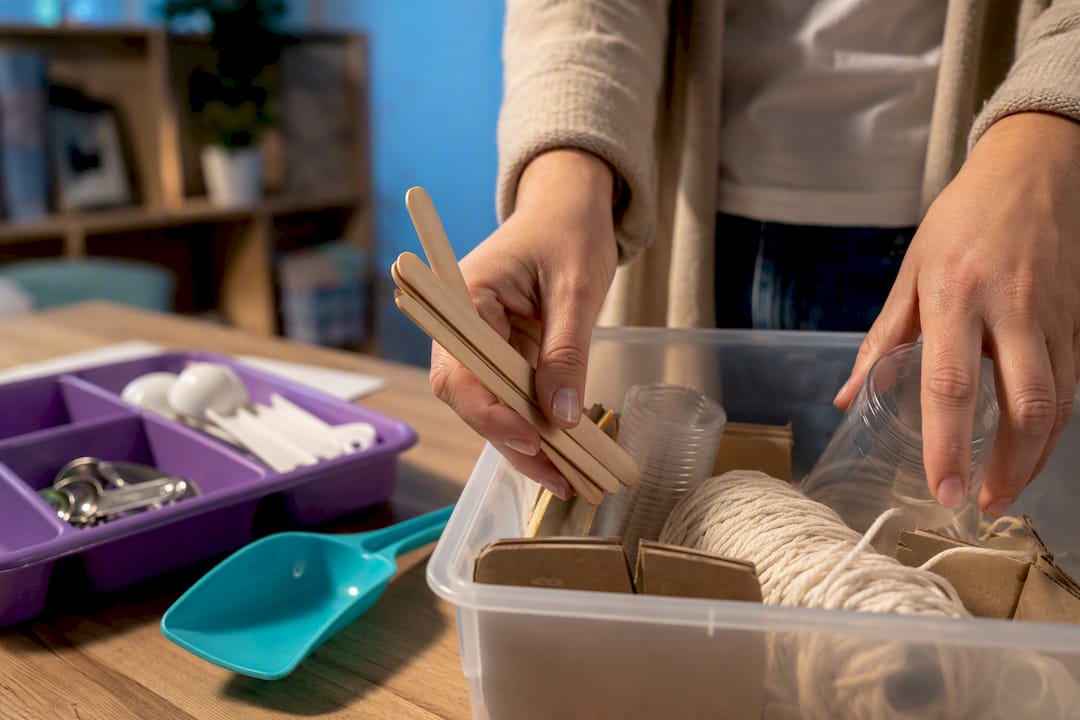
Every functional bin traces back to a short list of reusable core supplies: pattern blocks, linking cubes, craft sticks, paper cups, straws, pipe cleaners, tape, and a small parts container to keep loose pieces from scattering. Add a blank notebook or a stack of blueprint cards, since pairing a build with a short written reflection turns a play session into a literacy moment without extra planning.
Age adjustments matter more than most people assume. Swap marbles for large foam balls with children under six, and keep any tool requiring supervision (scissors, hot glue) in a separate teacher-managed bin rather than mixed into open shelves.
- Core kit: pattern blocks, linking cubes, craft sticks, cups, straws, pipe cleaners, tape
- Documentation tools: blank notebook or blueprint card, pencil
- Sample prompt: “Draw your build, then write one sentence about what you’d change.”
- Choking-risk swap: foam balls or large beads for children under six
- Budget swap: bottle caps and cardboard instead of purchased connectors
Budget-friendly bins built from recycled and dollar-store materials often outperform expensive kits, largely because plain materials force more creative problem-solving than pre-molded pieces do.
How To Fit Stem Bins Into Your Daily Routine
STEM bins earn their keep when they slot into moments you already have. Teachers commonly use them as morning “soft start” tubs, early finisher tasks, rotating centers, or WIN time and indoor recess options.
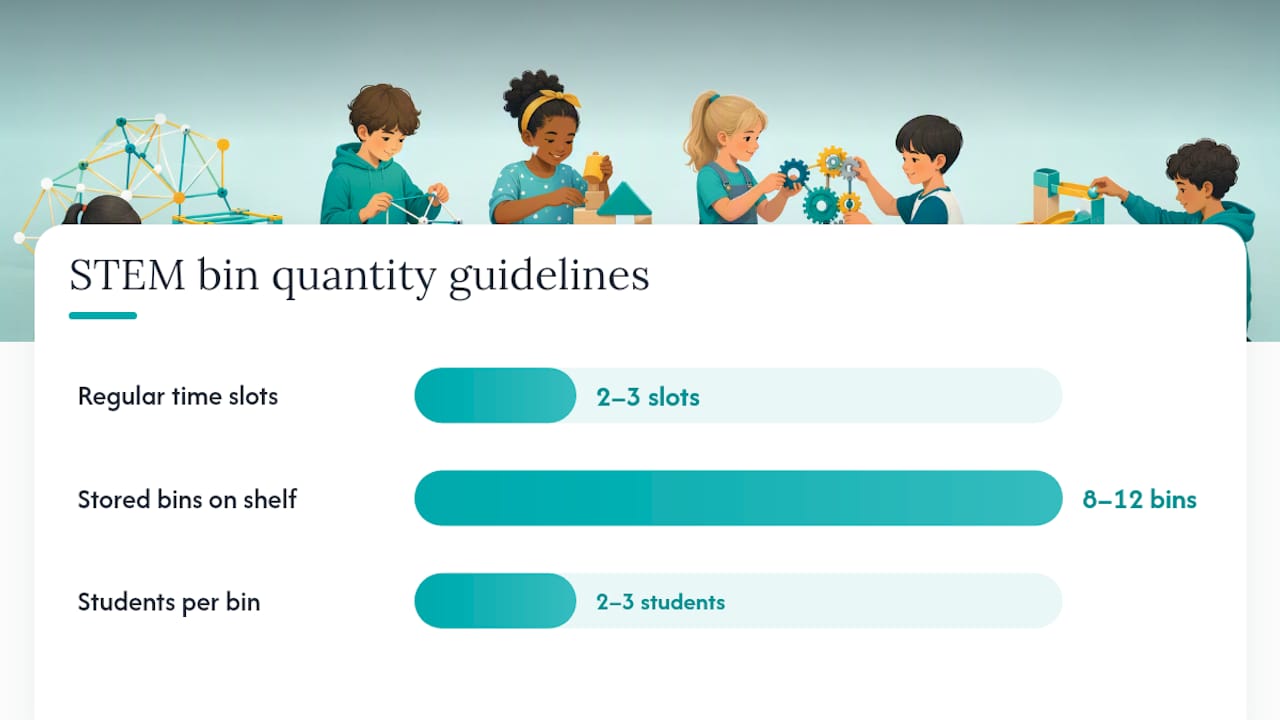
- Pick your slots. Choose two or three regular windows, morning arrival and early finisher time cover most classrooms without adding new schedule blocks.
- Set up a shelf system. Store 8 to 12 labeled bins at a time; more than that overwhelms the shelf and the students.
- Assign access with clothespins. A clothespin rotation system lets students clip their name to a bin, capping how many kids use one at a time and keeping choice fair.
- Log check-outs. A simple sign-out sheet on a clipboard tracks who used what and flags missing pieces before they become a bigger problem.
- Build in quick documentation. A photo on a class tablet or two reflection questions (“What worked? What would you change?”) gives you assessment evidence without a formal rubric.
Framing bins as design tasks rather than worksheets tends to cut down on “I’m finished” interruptions, since students stay engaged testing variations instead of waiting for the next assignment.
Pro Tip: Cap group size at two or three students per bin. Any larger and the quietest kid in the group ends up watching instead of building.
Making Stem Bins Work For Every Learner
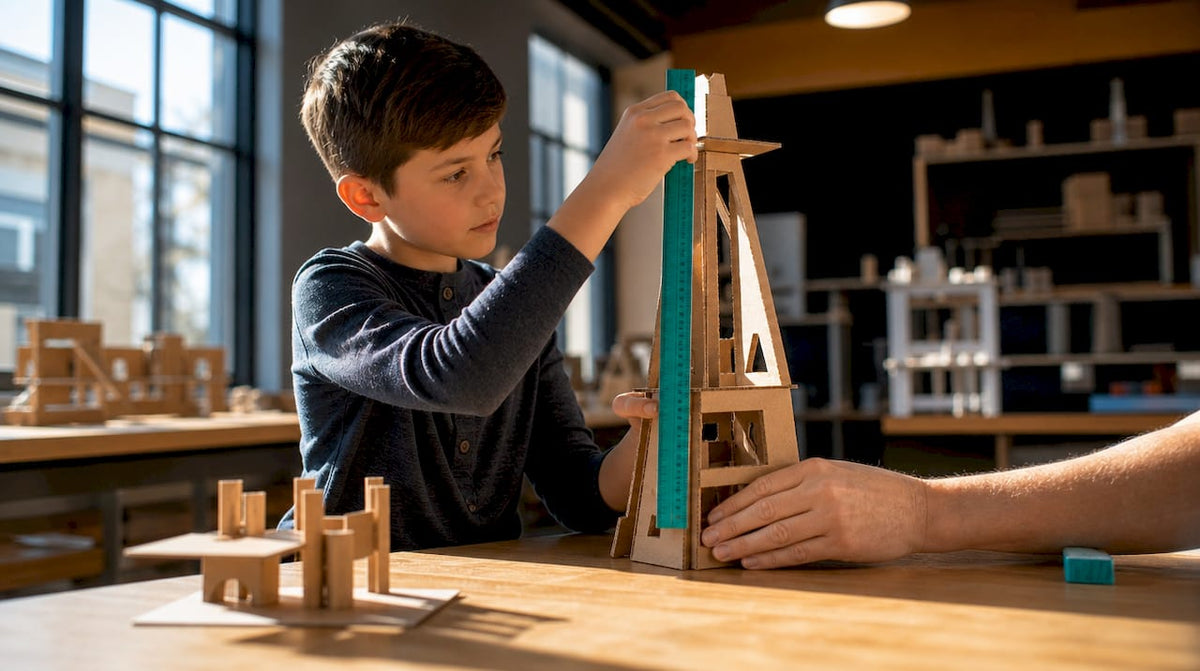
Interest-based themes do more for engagement than any material upgrade. A dinosaur-themed bridge challenge or a space-themed circuit box pulls in a reluctant builder faster than a generic prompt ever will. Pair that with visual step cards, so instructions are pictures and short phrases, and a starter prompt for every open task, since a single starter challenge reduces the anxiety of a blank slate.
A child who struggles to know where to begin doesn’t need fewer choices. He needs one small, clear first step and permission to change course after that.
The E³ Method, Engage, Encourage, Empower, is built around the idea that kids move from a low-pressure starting point toward genuine ownership of their work. Role-play elements like a lab coat or a “scientist badge” moment can give a child permission to see themself as the builder, not just the one following directions.
- Use interest-based themes tied to books, shows, or hobbies the student already loves
- Add a visual step card for any multi-part challenge
- Keep a blank “field notebook” in every bin for sketches and reflections
- For an overwhelmed student, try a 3-step scaffold: show one example, offer one material limit, ask one question (“What’s your first step?”)
Explore more inclusive approaches in how to support neurodivergent learners in STEAM.
Keeping Stem Bins Affordable, Organized, And Safe
Dollar stores, recycling bins, and community donations cover most of a bin’s supply list before you spend real money. Grant platforms like DonorsChoose and local education foundations are worth a look for bigger purchases like magnetic tiles or circuit kits. Skip anything with small detachable parts for bins used by children under five, and keep loose hardware in zipper pouches rather than loose in the bin.
- Clear plastic bins with lids for visibility and stacking
- Zipper pouches inside each bin for small parts (gears, connectors, batteries)
- Labeled shelves matching bin labels, so cleanup is self-directed
- A monthly five-minute inventory check to spot missing or broken pieces
- Storage layout tips from organizing a home for a smooth back-to-school transition translate directly to classroom shelving
Why Identity-Driven Design Changes What Bins Can Do
Team Genius Squad grew out of a family’s experience with dyslexia and dysgraphia, which shaped a simple belief: kids build confidence faster when they see themselves as the innovator, not just the student following a card. That’s the thread running through every bin idea above.
— Tita
Ready-Made Kits That Pair With Your Bin Rotation
Building fifteen bins from scratch takes real weekend hours, cutting cards, sourcing parts, writing prompts. If your shelf needs a head start, a Science Solar Energy Kit with Mirror Disk or the Shocking Electric Science experiment kit drops straight into your circuits or motion bin with the task cards, materials, and role-play pieces already built in.

Each kit follows the E³ Method, so the challenge card, the hands-on build, and a short reflection prompt arrive together instead of you assembling them separately. That matters most for teachers juggling multiple subjects and parents managing more than one child’s learning at home. Browse the full experiment kits collection to find a bin filler that matches whatever theme your class is already excited about, and add it to your rotation this week.
Where To Go Next For Bin Ideas And Management Tips
- Bored Teachers’ STEAM bin roundup, a solid activity bank for classroom timing and use-cases
- Having Fun First’s bin-building guide, strong on literacy integration and starter prompts
- We Are Teachers’ STEM bin ideas, useful for the design-thinking framing
- Kristen Sullins Teaching’s first grade bin system, the clearest clothespin management walkthrough
- StemSparkLab’s budget bin guide, practical for dollar-store sourcing
Sources
- 10 STEAM Bin Ideas & How to Use Them in the Classroom — Bored Teachers
- Creating a STEM Bin — Having Fun First
- STEM bins ideas — We Are Teachers
- STEM Bin Activities for First Grade — Kristen Sullins Teaching


Leave a comment
This site is protected by hCaptcha and the hCaptcha Privacy Policy and Terms of Service apply.