
Why Inclusive STEAM Matters for Every Child
Inclusive STEAM education is the intentional design of learning environments where every child, regardless of ability, background, language, or identity, can fully participate and succeed in science, technology, engineering, arts, and math. The term “inclusive STEAM” builds on UNESCO’s framework for inclusive education, which defines inclusion not as placing diverse learners in the same room, but as transforming entire education systems to remove barriers in curricula, pedagogy, and teaching. For children aged 5 to 13, this distinction is not academic. It determines whether a child grows up seeing themselves as a scientist, creator, and problem-solver, or decides early that STEAM is not for them.
Why inclusive STEAM matters for children aged 5 to 13
The window between ages 5 and 13 is when STEM identity forms. Research confirms that early STEM belonging depends more on repeated, supported experiences that build competence than on simple exposure volume. A child who touches a circuit, names a hypothesis, or earns a badge as a “young engineer” at age seven carries that identity forward. A child who is excluded, overlooked, or taught in a language they do not fully understand loses that window, often permanently.
The scale of exclusion in current education systems makes why diversity in STEM matters impossible to ignore. Nearly 240 million children globally have some form of disability, and 40% of countries lack teacher training on inclusion. Over 250 million learners receive instruction in a language they do not understand best. These are not edge cases. They represent the majority of children in many communities, and they are precisely the children that inclusive STEAM education is designed to reach.

The benefits of inclusive STEAM extend beyond equity. When classrooms are designed for the full range of learners, every child benefits from richer instruction, more flexible teaching methods, and a culture of belonging that lifts engagement across the board.
What does the evidence say about inclusive STEAM benefits?
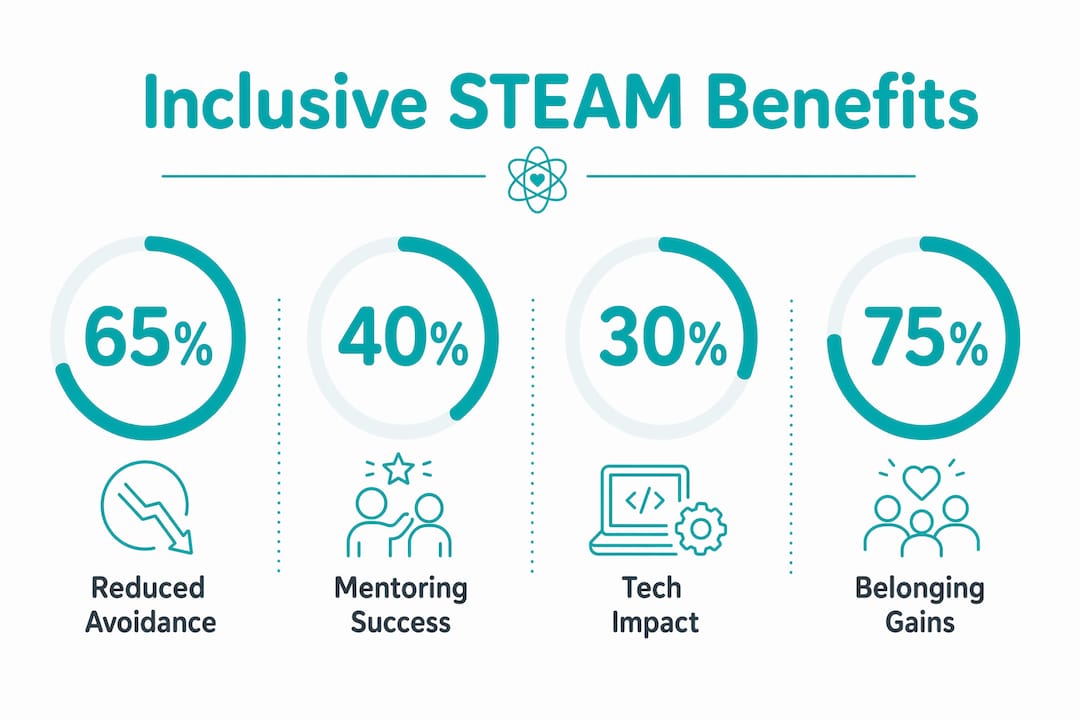
The research on inclusive STEAM is specific and growing. A mega-analysis of 6,111 children found that belonging gaps in K-12 STEM appear early and reduce engagement without deliberate intervention, with gender gaps particularly significant among Hispanic and Latine middle school students in computer science and engineering. That finding means that by the time a child reaches sixth grade, the damage to their STEM identity may already be done if no one acted in the early years.
Mentoring programs show measurable results when designed well. A landmark study found that combined online mentoring by female STEM experts paired with teacher-led STEM clubs produces sustained engagement gains for girls aged 5 to 13. This was the first study to demonstrate the added impact of combining out-of-school mentoring with in-school club participation. The implication is clear: no single intervention is enough. Inclusive STEAM requires layered, coordinated support.
Technology plays a measurable role as well. In inclusive elementary settings, AI-based assistive technologies combined with UDL predict academic success for students with disabilities at an R² of 0.830, a remarkably strong correlation. That number tells educators and parents that coordinated supports, not simple accommodations, are what actually move outcomes.
Here is a summary of the key evidence:
| Intervention | Documented Impact |
|---|---|
| Early belonging-building in STEM | Reduces identity avoidance; increases motivation in marginalized groups |
| Combined mentoring plus STEM clubs | Sustained STEM engagement gains for girls aged 5 to 13 |
| UDL plus AI assistive technology | R²=0.830 prediction of academic success for students with disabilities |
| Inclusive education policy adoption | Countries with inclusive laws rose from 1% to 24% since 2000 |
Pro Tip: When evaluating any STEAM program for your child or classroom, ask whether it measures conceptual mastery alongside motivation. Programs that only track enthusiasm are missing half the picture.
How does inclusive STEAM differ from traditional STEAM?
Traditional STEAM education adds arts to STEM and often delivers hands-on projects, but it does not automatically remove barriers for diverse learners. The difference lies in intentional design. UNESCO’s systemic inclusion framework distinguishes between placing a child with a disability in a STEAM classroom and actually redesigning the curriculum so that child can participate fully. The first is integration. The second is inclusion.
Universal Design for Learning, known as UDL, is the most widely recognized framework for making that distinction concrete. UDL aligns naturally with STEAM by offering multiple ways to engage, represent information, and express understanding. A child who struggles with writing can demonstrate scientific reasoning through drawing, building, or verbal explanation. A child who is learning English can access concepts through tactile materials and visual supports. UDL does not lower expectations. It removes the structural obstacles that prevent children from showing what they know.
The comparison below shows where traditional and inclusive STEAM diverge in practice:
| Dimension | Traditional STEAM | Inclusive STEAM |
|---|---|---|
| Design intent | Engaging for average learners | Designed for the full range of learners |
| Barrier removal | Accommodations added after the fact | Barriers removed in the original design |
| Language access | Instruction in dominant language | Multiple language supports built in |
| Assessment | Primarily written or verbal | Multiple expression formats accepted |
| Identity building | Incidental | Intentional and explicit |
A common pitfall in schools is treating inclusion as a bolt-on. A teacher adds a visual aid here, a modified worksheet there, but the core lesson design remains unchanged. Coordinated inclusion strategies consistently outperform these piecemeal approaches, and the research on assistive technology confirms that the combination of UDL principles with targeted tools is what drives real academic gains.
Pro Tip: If you are an educator reviewing a STEAM curriculum for inclusivity, check whether diverse learners are considered in the original lesson design or only in the “modifications” section. That placement tells you everything about the program’s actual philosophy.
What challenges does inclusive STEAM address, and how can we overcome them?
The barriers children face in STEAM learning are specific and interconnected. Understanding them is the first step toward removing them. Here are the most significant challenges and the strategies that address each one.
1. Lack of teacher training on inclusion. 40% of countries lack teacher training on inclusive practices, which means many educators are doing their best without the tools they need. Schools and districts can address this by investing in UDL professional development and pairing new teachers with inclusion-trained mentors.
2. Hostile peer environments. Even open, well-resourced STEAM activities can become exclusionary without planned social norms. Research on gaming communities found that over 3.6 billion participants face harassment and exclusion in spaces that appear open to all. The same dynamic appears in STEAM classrooms and clubs. Educators must establish explicit norms, cooperative roles, and regular check-ins to build genuinely safe spaces.
3. Language and cultural barriers. Over 250 million learners worldwide receive instruction in a language they do not understand best. Inclusive STEAM addresses this through visual supports, hands-on materials, and culturally responsive examples that connect science concepts to children’s lived experiences.
4. Stereotype threat and identity avoidance. When children from marginalized groups see no one who looks like them in STEAM, they begin to disengage. Representation through role models, cooperative learning structures, and identity-affirming tools like lab coats, badges, and scientist role play directly counters this pattern. Teamgeniussquad’s approach to identity-driven STEAM learning is built on exactly this insight.
5. Procedural opacity. Children, especially those with disabilities or anxiety, disengage when they do not understand why activities are structured the way they are or what choices they have. Building transparency into lesson design, explaining the purpose of each step, and offering genuine participation choices strengthens belonging and engagement for every learner.
6. Insufficient assistive technology integration. Many schools provide assistive tools but do not coordinate them with curriculum design. The research is clear that simple accommodations underperform compared to coordinated UDL plus assistive technology approaches. Parents and advocates can push for this coordination explicitly in IEP and 504 meetings.
How to promote inclusive STEAM: practical steps for educators and parents
Knowing the evidence is one thing. Putting it into practice with a room full of seven-year-olds is another. These strategies are grounded in research and designed for real classrooms and homes.
-
Design for multiple entry points. Every STEAM activity should have at least two ways to engage: one tactile, one visual or verbal. Children who struggle with reading can still conduct experiments and record observations through drawing or dictation. This is the core of UDL-aligned STEAM practices.
-
Use diverse success exemplars. Show children scientists, engineers, and artists from a wide range of backgrounds, abilities, and identities. When a child aged 8 sees a scientist who shares their background, the message “this is for me” becomes credible.
-
Build mentoring into the program structure. The evidence on combined mentoring and club participation shows that sustained impact requires both in-school and out-of-school touchpoints. Parents can seek community mentors; schools can partner with local STEM professionals for regular visits or virtual sessions.
-
Establish clear community norms. Before any STEAM activity begins, co-create norms with children. “We try things even when they feel hard.” “We celebrate mistakes because they teach us.” These norms, revisited regularly, build the psychological safety that makes risk-taking and learning possible.
-
Integrate identity-building tools. Lab coats, scientist badges, and completion certificates are not just fun. They help children step into a role and build a self-concept as a creator and problem-solver. For children who struggle in traditional learning environments, this identity work is especially powerful.
-
Advocate for coordinated support in schools. Parents of children with disabilities should ask specifically whether assistive technologies are coordinated with UDL-designed instruction, not just provided as standalone tools. The research on neurodivergent learners in STEAM supports this coordinated approach consistently.
Key takeaways
Inclusive STEAM education works because it removes barriers by design, builds belonging early, and coordinates multiple supports to produce measurable gains in participation and academic success for every child.
| Point | Details |
|---|---|
| Inclusion is systemic, not incidental | Redesign curricula and teaching methods; do not add accommodations after the fact. |
| Belonging shapes STEM identity early | Intervene between ages 5 and 13 to prevent lasting disengagement from STEAM fields. |
| Coordinated supports outperform single tools | Combine UDL principles with assistive technology for the strongest academic outcomes. |
| Mentoring plus clubs sustains engagement | Pair in-school STEM clubs with out-of-school mentoring for girls and underrepresented groups. |
| Safe peer environments require active design | Establish explicit norms and cooperative roles; open access alone does not prevent exclusion. |
Why I believe inclusive STEAM is the most urgent work in education right now
I have spent years watching children light up the moment they realize a science experiment is something they can actually do. I have also watched that light go out when a child decides, at age nine, that STEAM is not for them, usually because no one designed the experience with them in mind. That moment of quiet withdrawal is the thing I cannot stop thinking about.
The research confirms what many educators and parents already sense: the gap between children who thrive in STEAM and those who disengage is not about intelligence or potential. It is about belonging, identity, and whether the learning environment was designed to include them or merely tolerate their presence. The policy momentum is real, with inclusive education laws expanding from 1% to 24% of countries since 2000, but policy does not automatically reach the classroom. That gap between law and lived experience is where educators, parents, and counselors do the most important work.
What I find most hopeful is that the strategies that work for the most marginalized learners, multiple engagement pathways, identity-affirming tools, cooperative norms, and coordinated supports, make STEAM better for every child. Inclusion is not a concession to equity. It is the design principle that produces the best learning outcomes across the board. Every child deserves to walk into a STEAM experience and see themselves reflected in it.
— Tita
How Teamgeniussquad supports inclusive STEAM learning
Teamgeniussquad builds hands-on, screen-free STEAM discovery kits designed from the ground up for children aged 5 to 13 who learn differently, dream boldly, and deserve to see themselves as scientists. Inspired by a real family journey with dyslexia and dysgraphia, every kit applies the E³ Method (Engage, Encourage, Empower) to guide children from curiosity to confidence through real experiments, scientist role play, and identity-building tools. The STEM-STEAM Electricity Lab Bundle is a strong starting point for educators and families ready to bring inclusive, hands-on STEAM learning home or into the classroom. Because different minds do not just belong in STEAM. They build the future of it.
FAQ
What is inclusive STEAM education?
Inclusive STEAM education is the intentional design of learning environments that remove barriers so every child, regardless of ability, language, or background, can fully participate and succeed in science, technology, engineering, arts, and math.
Why does diversity in STEM matter for young children?
Belonging gaps in K-12 STEM appear as early as elementary school and reduce long-term engagement without deliberate intervention, making early inclusive design critical for children aged 5 to 13.
What is Universal Design for Learning and how does it support STEAM?
Universal Design for Learning (UDL) is a framework that offers multiple ways to engage, represent information, and express understanding. Combined with AI-based assistive technology, UDL predicts academic success for students with disabilities at a remarkably high rate in inclusive STEAM settings.
How can parents promote inclusive STEAM at home?
Parents can use hands-on, identity-affirming STEAM kits, seek out diverse role models in science and engineering, and ask schools whether assistive technologies are coordinated with UDL-designed instruction rather than provided as standalone tools.
What makes inclusive STEAM different from regular STEAM programs?
Regular STEAM programs may add accommodations after the fact, while inclusive STEAM removes barriers in the original design through UDL principles, cultural responsiveness, multiple expression formats, and explicit identity-building tools.


Leave a comment
This site is protected by hCaptcha and the hCaptcha Privacy Policy and Terms of Service apply.