What Is the STEAM Learner Identity? A Parent's Guide
Most people assume a child either “has a STEM brain” or doesn’t. That assumption is both wrong and quietly damaging. What is the STEAM learner identity really about? It’s not a fixed trait a child is born with. It’s a developing sense of self, built through experience, recognition, and belonging, that shapes whether a child sees themselves as someone who can create, investigate, and solve problems. Understanding this concept changes how you support children in STEAM fields, not by pushing harder, but by building smarter.
Table of Contents
- Key takeaways
- What is the STEAM learner identity and why it matters
- Why the “A” in STEAM changes everything
- How recognition and belonging shape STEAM identity
- Practical strategies for nurturing STEAM identity at home and school
- My take on what we’re getting wrong about STEAM identity
- Give your child the tools to own their STEAM identity
- FAQ
Key takeaways
| Point | Details |
|---|---|
| Identity has five core dimensions | STEAM learner identity includes self-perception, competence, interest, belonging, and recognition from peers and adults. |
| Arts belong in the framework | Including the “A” in STEAM builds design thinking and creative confidence, not just technical skill. |
| Recognition shapes persistence | Consistent positive feedback from adults directly influences how long children stay engaged in STEAM activities. |
| Low-floor tasks build ownership | Open-ended, accessible activities give children agency and strengthen their STEAM identity over time. |
| Identity is dynamic, not fixed | A child’s STEAM identity can grow at any age with the right social environment and encouragement. |
What is the STEAM learner identity and why it matters
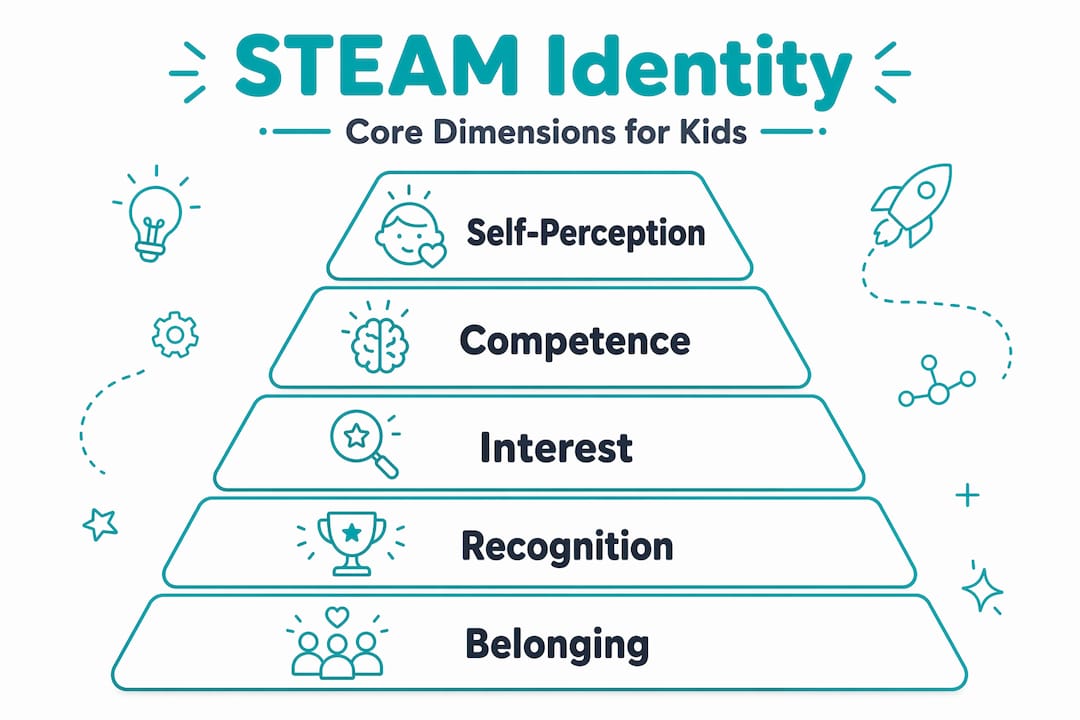
Defining STEAM learner identity comes down to one core question: does a child see themselves as someone who belongs in STEAM? According to recent research, STEAM learner identity is built from five interconnected dimensions. These are self-perception as a STEAM person, perceived competence, inherent interest, a sense of belonging, and recognition from peers and adults. Each one feeds the others, and none of them works in isolation.
Think of a seven-year-old who loves taking apart toys to see how they work. She has interest and some sense of competence. But if no adult ever names what she’s doing as “engineering” or “investigation,” she may not connect her curiosity to a broader identity. That naming moment matters more than most parents realize.
The importance of STEAM identity goes far beyond liking science class. Research tracking over 1,100 students found these five identity dimensions to be strong predictors of persistence and engagement in STEAM fields. Children who develop a strong STEAM identity don’t just perform better. They continue showing up, even when challenges get hard.
STEAM education identity is also distinct from academic achievement. A child can earn top marks on a worksheet while privately believing “science is not really for me.” The grade tells you about knowledge retention. The identity tells you about long-term trajectory.
The five dimensions explained
Each dimension plays a specific role in how a child constructs their STEAM self-image:
- Self-perception: Does the child describe themselves as a “science person” or a “builder”? This narrative self-label is a foundational building block.
- Perceived competence: Does the child believe they can actually succeed at STEAM tasks? This is not the same as actual ability.
- Interest: Does the child find genuine pleasure in exploring STEAM topics, even outside of school?
- Belonging: Does the child feel like STEAM spaces are places where someone like them fits in?
- Recognition: Do the important adults and peers in a child’s life reinforce their identity as a STEAM learner?
| Dimension | What it looks like at ages 5-8 | What it looks like at ages 9-13 |
|---|---|---|
| Self-perception | “I’m a builder!” | “I think like an engineer.” |
| Competence | “I can figure this out.” | “I’ve solved problems like this before.” |
| Interest | Asks endless “why” questions | Pursues science topics voluntarily |
| Belonging | Wants to join science activities | Identifies with a STEAM peer group |
| Recognition | Gets praised for “investigating” | Receives specific acknowledgment of skills |
Why the “A” in STEAM changes everything
STEM and STEAM are not interchangeable, and understanding that difference is central to defining STEAM learner identity fully. The addition of Arts is not decorative. Educational leaders emphasize that arts integration develops design thinking, storytelling, and imagination, which are skills that technical logic alone cannot produce.
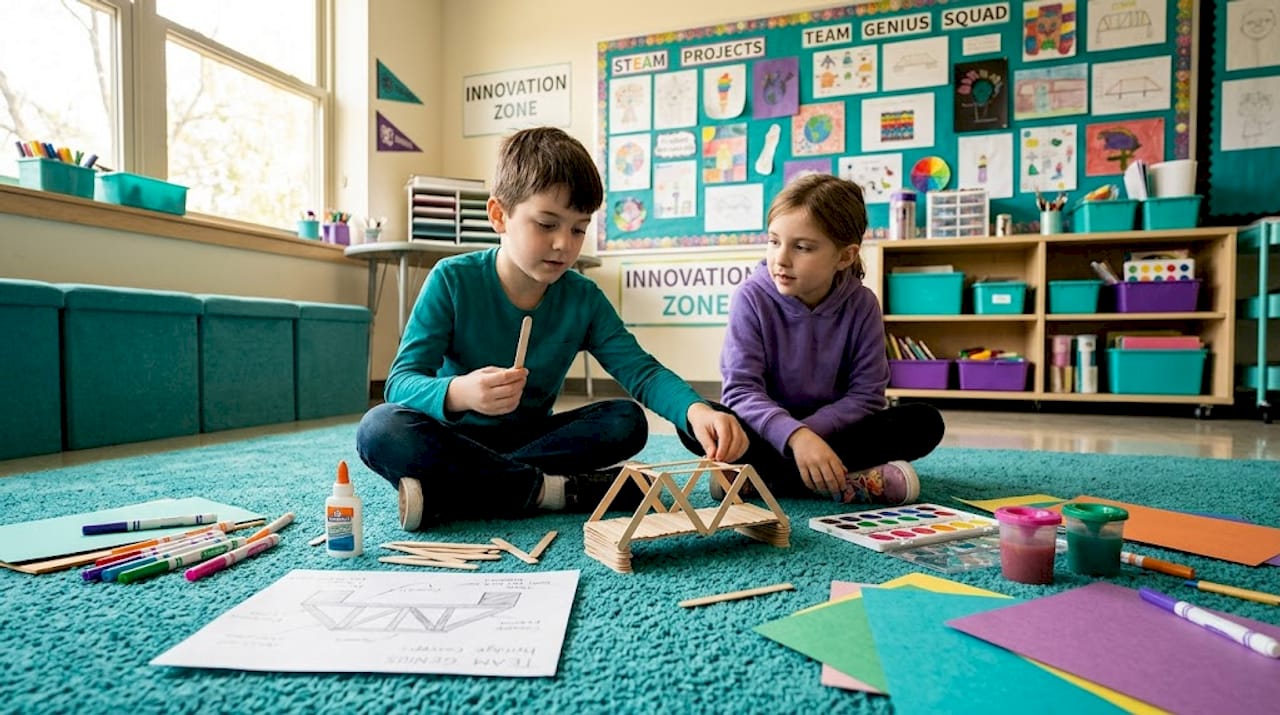
Consider two children building a bridge from craft sticks. In a pure STEM frame, success means the bridge holds weight. In a STEAM frame, the child is also asked: How will the bridge look to the people crossing it? What story does this structure tell? That second layer activates a different part of the brain and, critically, a different sense of self.
Children who see themselves as both creative and analytical develop broader STEAM identities that are more resilient. When a technical challenge stumps them, their artistic thinking gives them another entry point. When a creative project needs structure, their STEAM skills provide it.
Here is what arts integration looks like in practice for children aged 5-13:
- Using sketching and diagrams before building a physical model
- Writing a short story about a problem a scientist character must solve
- Designing the packaging for an invented product using geometry and color theory
- Building a musical instrument and measuring how different lengths affect pitch
Pro Tip: When a child draws their invention before building it, don’t skip over that step. That sketch is design thinking in action. Name it out loud: “You’re doing what engineers call prototyping.” That language plants the seed of STEAM identity.
Incorporating arts in STEAM is not just aesthetic. It fundamentally supports the integration of technical and creative thinking that defines how real innovators work. From architects to biomedical engineers, the professionals in these fields consistently describe their work as both a science and an art.
How recognition and belonging shape STEAM identity
Here is something research makes unmistakably clear: identity can fluctuate, and consistent positive recognition is one of the most powerful forces that stabilizes it. A child can leave school on Monday feeling like a scientist and arrive Tuesday feeling like an outsider, depending entirely on one interaction with a peer or adult.
This is not fragility. It’s how identity works during childhood. The good news is that parents, educators, and caregivers have real influence here.
NAEYC research shows that children need to see themselves and their cultures reflected in learning materials. When classroom environments include diverse representations of who does STEAM work, belonging increases. When a child of any background sees someone who looks like them solving problems on the cover of a book or on the wall of a classroom, their sense of “this is for me” grows measurably.
Here are specific strategies educators and parents can implement to strengthen recognition and belonging:
- Name what children are doing in STEAM terms. Instead of saying “Nice job building that tower,” say “You just tested a structural design. That’s what civil engineers do.” The language of recognition directly shapes internal self-belief.
- Display their work as serious investigation. Treat a child’s experiment journal the same way a teacher treats a math test. Frame it, display it, refer back to it.
- Connect STEAM to their lived world. A child who loves cooking can explore chemistry. A child who loves sports can explore physics. The connection between their existing identity and STEAM is already there. Your job is to point to it.
- Create peer recognition rituals. In a classroom, a weekly “Genius Spotlight” where children share one thing they figured out builds communal belonging and models the characteristics of STEAM learners for the whole group.
Pro Tip: When children in your care say “I’m not good at math,” respond by asking what problems they’ve solved lately, not by reassuring them that math is easy. Connecting effort to evidence is more powerful than empty encouragement.
Practical strategies for nurturing STEAM identity at home and school
Theory lands differently when paired with practice. Hands-on, personalized projects increase ownership, interest, and engagement, which are all conditions that build STEAM identity from the ground up. The goal is not to replicate a science lab. It’s to create conditions where children can experience what it feels like to investigate and create.
The most effective strategies share one quality: they give children agency. Low-floor, high-ceiling tasks allow children to enter at their own level and expand based on their curiosity. A prompt like “Build something that moves” can engage a five-year-old with blocks and a twelve-year-old with motors. The task is the same. The depth is self-directed.
| Less effective approach | More effective approach |
|---|---|
| Following a step-by-step recipe project | Open prompt with materials and a challenge question |
| Praising the result (“Great job!”) | Naming the process (“You iterated on that design three times.”) |
| Isolated individual tasks | Collaborative builds with roles assigned |
| Abstract problems with no context | Challenges connected to the child’s real environment |
| Single-discipline activity | Project that blends science, math, art, and storytelling |
A few additional strategies that consistently strengthen STEAM identity:
- Keep a “discovery journal” where children document what they tried, what failed, and what they learned. This positions failure as data, not defeat.
- Bring STEAM vs. traditional approaches into conversations at home so children understand why hands-on learning is a strength, not a shortcut.
- Use screen-free STEAM strategies that require tactile engagement. Physical manipulation of materials builds a different and deeper kind of competence than digital simulations do.
- Celebrate process milestones, not just outcomes. Finishing is not the point. Thinking is.
Transformation schools have promoted this kind of identity-rich STEAM education since 2012 by weaving lived experiences and the creative process into every subject. Families don’t need to wait for the perfect school environment to start. The principles are replicable at a kitchen table.
My take on what we’re getting wrong about STEAM identity
I’ve spent a great deal of time thinking about how children develop confidence in their own thinking, and I keep coming back to the same uncomfortable observation: we spend too much time measuring performance and too little time building belief.
When I look at children who disengage from STEAM in middle school, the pattern is rarely about ability. It’s about accumulated experiences where they did not feel recognized, did not see themselves in the material, or were told, in subtle and not-so-subtle ways, that there was a “right kind” of STEAM learner. They concluded, logically, that they were not it.
What works is treating STEAM identity as a living, growing thing. Structure matters, yes. But creative freedom is what makes a child feel like the identity belongs to them and not just to the curriculum. The children who persist long-term are not necessarily the ones who got the best scores. They are the ones who experienced enough small wins, enough specific praise, and enough belonging to decide: “This is who I am.”
Early positive reinforcement does not just feel good. It physically rewires how a child approaches challenge. When a five-year-old is told that what they just did was real investigation, they carry that belief into the next challenge. And the one after that. That is how STEAM learner identity forms: one recognized moment at a time.
— Tita
Give your child the tools to own their STEAM identity
At Teamgeniussquad, everything is built around one belief: children don’t just learn STEAM, they become STEAM learners. The Electricity Lab Bundle gives children ages 5 to 13 a hands-on, screen-free way to conduct real experiments, step into a scientist’s role, and experience the specific kind of discovery that builds genuine confidence.

Powered by the proprietary E³ Method (Engage, Encourage, Empower), each Teamgeniussquad kit is designed to move children from curiosity to competence to identity. Lab coats, badges, and certificates are not extras. They are identity tools. Parents and educators can also explore STEAM books and puzzles to complement the hands-on experience with reflection and storytelling. Because STEAM identity grows strongest when children can see themselves in the story.
FAQ
What is the STEAM learner identity in simple terms?
STEAM learner identity is a child’s sense of themselves as someone who belongs in and can succeed at science, technology, engineering, arts, and math. It includes how competent they feel, how interested they are, and whether they feel recognized and welcomed in STEAM spaces.
At what age does STEAM identity start forming?
STEAM identity begins forming as early as age five, when consistent positive feedback from adults can already influence persistence and engagement. The earlier children receive specific, process-focused recognition, the stronger their foundation becomes.
How is STEAM identity different from STEM identity?
STEAM identity includes the creative and artistic dimension that STEM identity does not. This means children also see themselves as designers and storytellers, not just analysts, which produces broader creative confidence alongside technical skills.
Can a child’s STEAM identity grow after a bad experience?
Yes. Because identity is dynamic rather than fixed, targeted recognition, belonging-focused environments, and hands-on success experiences can rebuild and strengthen STEAM identity at any point during childhood.
What is the biggest mistake parents make with STEAM identity?
The most common mistake is praising outcomes rather than naming processes. Saying “You’re so smart” does less for STEAM identity than saying “You just designed and tested a solution.” Specific process praise is what shapes a child’s internal self-belief as a STEAM learner.



Leave a comment
This site is protected by hCaptcha and the hCaptcha Privacy Policy and Terms of Service apply.