
Supercooled Water: Science, Experiments, and Discovery
Water freezes at 32°F (0°C). Everyone knows that. Except water doesn’t always follow that rule, and the exceptions reveal some of the most surprising physics happening at the molecular level. Supercooled water is liquid water that has been cooled below its normal freezing point without turning into ice, and it exists in a delicate, unstable state that can shatter into crystals the moment you disturb it. Scientists have spent decades trying to understand why, and the answers they’re uncovering are reshaping how we think about one of Earth’s most common substances.
Table of Contents
- Key Takeaways
- What supercooled water actually is
- What recent experiments have revealed
- How simulations fill the gaps
- How to observe supercooled water yourself
- My perspective on what this moment in water science means
- Bring the science of water to life with Teamgeniussquad
- FAQ
Key Takeaways
| Point | Details |
|---|---|
| Metastability drives supercooling | Water stays liquid below freezing when it lacks nucleation sites where ice crystals can begin forming. |
| Two liquid states exist | Supercooled water can exist as both high-density and low-density liquid phases separated by a measurable energy barrier. |
| Ultrafast tools cracked the mystery | Researchers used x-ray lasers to observe supercooled water in a previously unreachable temperature zone called “no-man’s-land.” |
| Experiments are accessible | You can safely create supercooled water at home or in a classroom using distilled water and a controlled freezer. |
| Supercooling shapes real weather | Supercooled droplets in clouds delay freezing and play a direct role in rain formation and atmospheric behavior. |
What supercooled water actually is
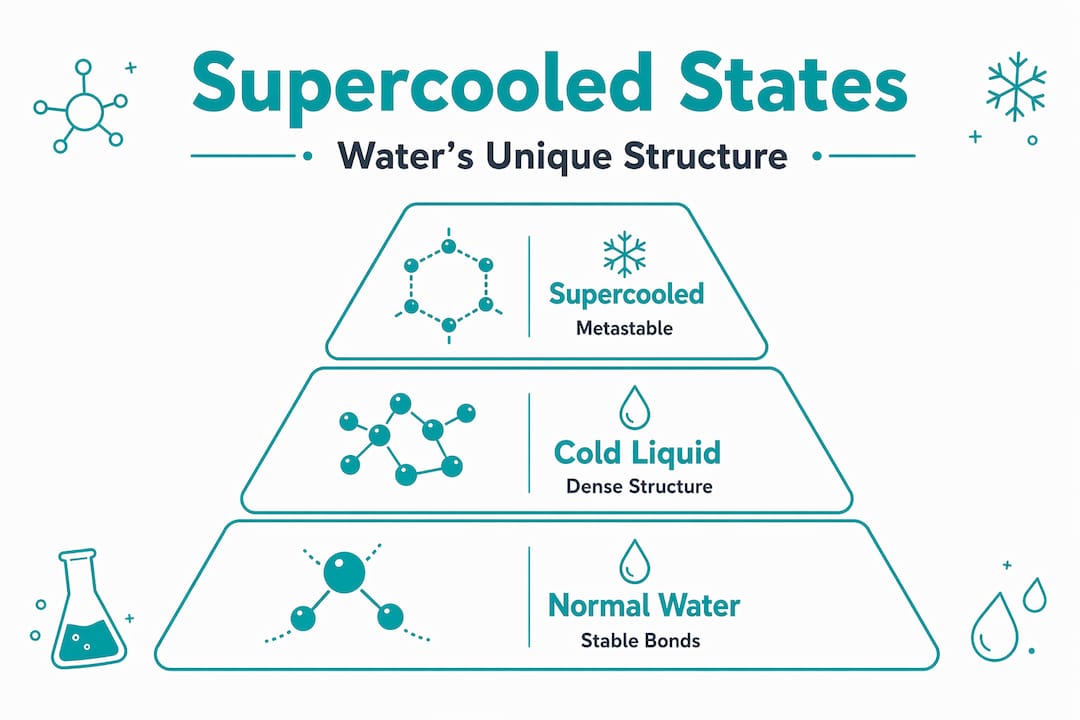
Most people picture a clean boundary between liquid and solid water. Above 0°C, it flows. Below 0°C, it freezes. The reality is messier and far more interesting. Supercooled liquid water is metastable, meaning it exists in a temporary state that is thermodynamically unstable but hasn’t yet collapsed into the lower-energy solid form. It’s liquid, but it’s holding on by a thread.
The key to understanding this lies in nucleation. Ice doesn’t form just because the temperature drops below freezing. It needs a starting point, a nucleation site, which is typically a tiny impurity, a bubble, or a surface irregularity where water molecules can begin arranging themselves into a crystal lattice. Without that trigger, water molecules keep moving past each other in their liquid state even as the temperature falls further and further below zero.
Water’s behavior at low temperatures is already unusual for other reasons. It reaches its maximum density at 4°C and actually expands as it cools below that threshold. This is the opposite of how most liquids behave. These anomalous expansion properties arise from fluctuations between two distinct molecular configurations that become especially pronounced in the supercooled range. Understanding supercooled water, then, isn’t just about freezing. It’s about understanding why water behaves the way it does at every temperature.
Pro Tip: When explaining the properties of supercooled water to students, start with the nucleation concept first, before introducing phase diagrams or molecular structures. Once a student grasps why ice needs a “starting point,” the rest follows naturally.
The molecular structure in supercooled states differs meaningfully from ordinary cold water. As temperature drops, water molecules form increasingly ordered hydrogen-bond networks, shifting between configurations that physicists describe as high-density and low-density liquid structures. That dynamic is at the heart of decades of scientific debate.
What recent experiments have revealed
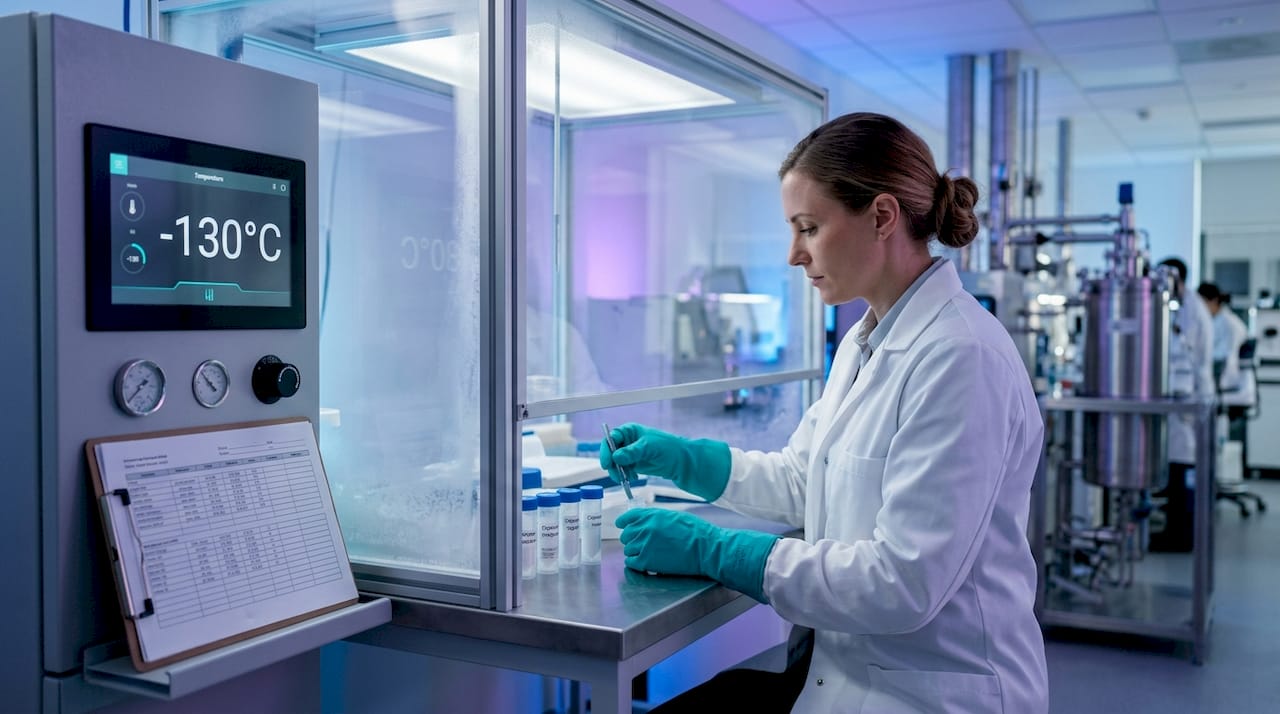
Studying supercooled water has never been easy. Between roughly -38°C and -123°C lies what researchers call the “no-man’s-land” on water’s phase diagram. In this range, liquid water freezes too rapidly for conventional instruments to measure it before ice formation takes over. For decades, this temperature zone was essentially off-limits to direct observation.
That changed with a technique as elegant as it is bold. Researchers began preparing amorphous ice below 136 K (about -137°C), then heating it rapidly with ultrafast x-ray lasers, giving scientists a window of microseconds to measure the supercooled liquid’s properties before crystallization occurs. This approach, pioneered at institutions including Stockholm University, allowed the first credible measurements inside no-man’s-land.
| Technique | Temperature Range | Key Finding |
|---|---|---|
| Ultrafast x-ray laser on amorphous ice | ~210 K and 1000 bar | Density fluctuations consistent with a liquid-liquid critical point |
| Isochoric heating with x-ray scattering | No-man’s-land region | Critical fluctuations observed confirming LLCP proximity |
| Thermodynamic measurements | 229 K (H2O) and 233 K (D2O) | Compressibility maxima indicating a Widom line near a critical point |
| Dynamic transition observation | Around 233 K (-40°C) | Fragile-to-strong crossover in relaxation behavior confirmed |
One of the most significant recent breakthroughs involves what physicists call the liquid-liquid critical point (LLCP). The hypothesis, debated for more than 30 years, proposes that water has a second critical point deep in the supercooled region where two distinct liquid phases meet. A 2025 observation confirmed a fragile-to-strong dynamic crossover around -40°C for the first time, marking a shift in how water molecules relax and move, a signature consistent with that critical point’s existence.
Pro Tip: For classroom discussions, the Widom line is a useful teaching concept. It’s the extension of the liquid-liquid critical point into the single-phase region, and it helps explain why water’s properties change so dramatically as temperature falls, even before any visible phase change occurs.
These measurements matter well beyond academic curiosity. The anomalous properties of water, from its unusually high heat capacity to its expansion on freezing, all appear to originate from those fluctuations between liquid phases near this critical point.
How simulations fill the gaps
Experiments can only probe so far. Computational models have played an equally important role in building understanding of supercooled water, particularly for the molecular-scale dynamics that lab instruments can’t directly observe.
The TIP4P/2005 model is one of the most widely used tools for simulating water behavior. It represents each water molecule with a specific geometry and charge distribution, allowing researchers to model how millions of molecules interact over time. What these simulations have shown is striking. Two distinct liquid phases separated by a free-energy barrier exist in the supercooled range, with the barrier vanishing near -85°C, which corresponds precisely to what theory predicts for a critical point.
But this work is genuinely hard. Simulating supercooled water accurately requires large system sizes, extended simulation times, and precise modeling of quantum mechanical interactions between molecules. The 2026 UC Davis simulations used 8,000 water molecules to observe the phase separation behavior reliably. Earlier, smaller simulations produced conflicting results, which is why the scientific community debated the LLCP for so long.
Here’s a clear breakdown of how the two approaches compare:
- Experiments provide real physical measurements but are limited by rapid crystallization in the no-man’s-land temperature range, requiring extraordinary techniques like ultrafast x-ray lasers to gather even microseconds of data.
- Simulations allow full control of temperature and pressure and can probe molecular behavior directly, but depend heavily on how accurately the water model captures real intermolecular forces.
- Experiments confirm bulk properties like compressibility and correlation length, giving researchers thermodynamic evidence for a critical point.
- Simulations reveal the molecular-scale mechanism, specifically the shift between high-density and low-density hydrogen-bond networks, explaining why those bulk properties change.
- Both approaches together make the case far stronger than either could alone, and the 2025 to 2026 period has seen them converge on the same conclusion for the first time.
The remaining controversy centers on where exactly the critical point lies and whether current water models are accurate enough to resolve it precisely. That debate is healthy and productive, the kind of scientific tension that drives better methods.
How to observe supercooled water yourself
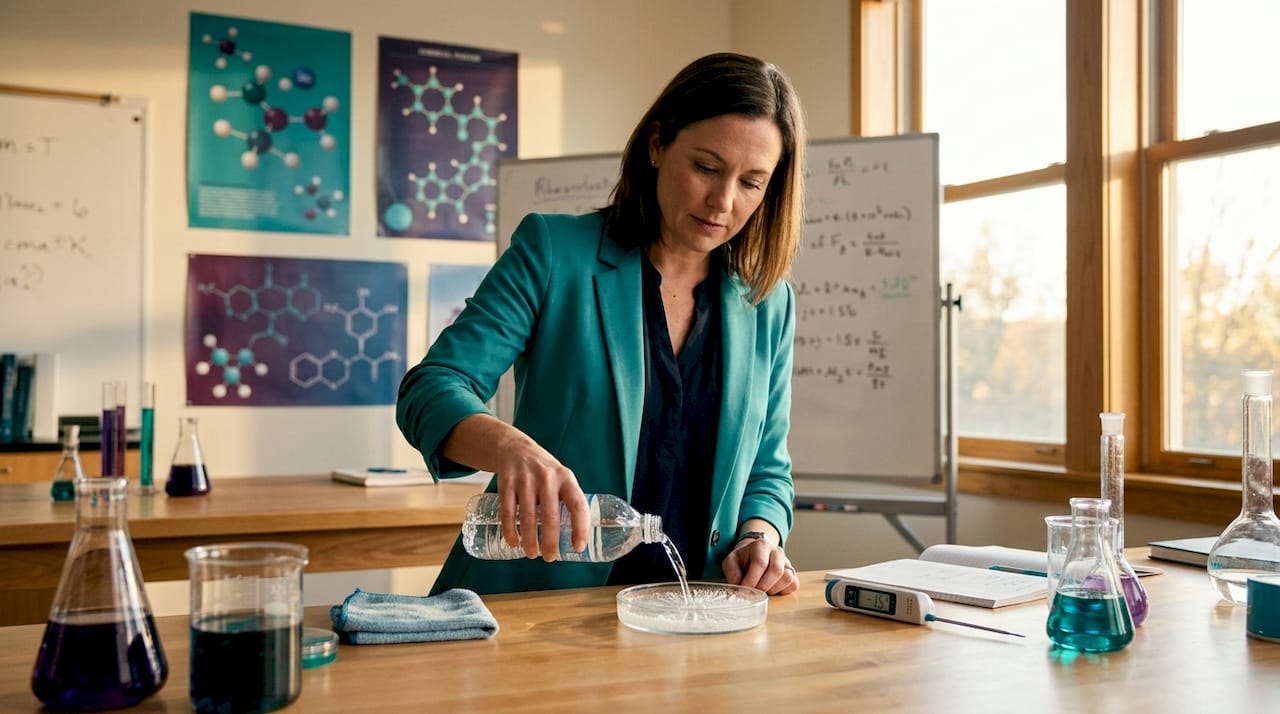
Here’s where the supercooled water phenomenon stops being abstract and becomes something you can actually witness. Creating supercooled water at home or in a classroom is one of the most visually dramatic science demonstrations available, and the setup is simple.
The moment you tap a bottle of properly supercooled water, it freezes before your eyes. The effect is called snap freezing, and it happens because your tap creates a vibration that acts as a nucleation trigger. The metastable liquid was already primed to freeze. It just needed that one tiny push. That same process happens in clouds, where supercooled water droplets persist well below freezing until a dust particle or ice crystal provides a nucleation site, triggering rain or snow.
Follow these steps for a reliable classroom demonstration:
- Purchase or prepare distilled water. Tap water contains dissolved minerals and gases that act as nucleation sites and will prevent successful supercooling.
- Place sealed, unopened bottles of distilled water in a freezer set to about -24°C (-11°F). The bottles should remain completely still throughout the process.
- After approximately 2.5 to 3 hours, carefully check one bottle without disturbing it. The water should still appear liquid.
- Remove one bottle very slowly from the freezer and set it gently on a flat surface.
- Tap the bottle firmly on the surface or open the cap to introduce a nucleation point. Watch the water freeze in seconds.
- For a more dramatic effect, pour the supercooled liquid slowly over a single ice cube in a bowl. A column of ice will build up in real time.
Pro Tip: The most common reason this experiment fails is vibration during freezing. If your freezer has an ice maker or automatic defrost cycle, the motor vibration can trigger crystallization before the demonstration. Try a small dorm-style freezer or place the bottles in a foam-insulated box inside the main freezer to reduce vibration.
The purity of your water sample is the single most controllable variable in this experiment. Even a speck of dust or a tiny air bubble gives ice a place to start forming, ending the supercooled state before you’re ready. This is exactly why professional researchers go to extraordinary lengths to control contamination in their laboratory samples.
For educators looking to connect the hands-on demonstration to broader concepts, this experiment opens conversations about phase transitions, thermodynamics, atmospheric science, and molecular structure. All from a bottle of distilled water in a freezer.
My perspective on what this moment in water science means
I’ve watched students and curious adults encounter supercooled water for the first time, and the reaction is almost always the same. Disbelief, then delight, then questions that go much deeper than the demonstration itself. That sequence is exactly what good science education should produce.
What strikes me most about the recent LLCP discoveries is how they reframe a substance everyone assumes they already understand. Water has been studied longer than almost any other material in chemistry, and yet researchers only confirmed one of its most fundamental behaviors in the last few years. That should be exciting rather than humbling. It means our tools finally caught up to the questions.
I think the bigger challenge is getting updated science into classrooms quickly enough. Most textbook descriptions of water’s properties are accurate but incomplete, and they don’t reflect what experiments from 2025 and 2026 are showing us about two liquid phases and dynamic crossovers. Educators deserve better access to these discoveries in accessible language, not years later after the findings have filtered through curriculum revision cycles.
The exploration of liquid energy behavior in tangible, hands-on formats is what actually moves students from passive observers to active thinkers. I’ve seen children who struggled in traditional science classes light up when they hold a bottle of supercooled water and feel it freeze in their hands. That experience doesn’t just teach a concept. It builds a belief that science is something they can do.
Don’t wait for perfect conditions to explore these ideas. The science is there, the tools are accessible, and the questions are genuinely open. Start with a bottle of distilled water and see where the curiosity takes you.
— Tita
Bring the science of water to life with Teamgeniussquad
If the supercooled water demonstration sparked something in you as an educator or parent, Teamgeniussquad has built hands-on kits designed to take that spark further. The Liquid Energy Experiment Kit explores the properties and behaviors of water and other liquids in ways that children ages 5 to 13 can engage with directly, building scientific thinking through doing rather than watching. For those ready to go deeper into water chemistry and crystallization concepts, the Just Add Sugar S.T.E.M. Experiment Kit connects solution properties to real crystal formation, an excellent companion to any supercooling lesson.

Powered by the E³ Method (Engage, Encourage, Empower), every Teamgeniussquad kit is designed to help children see themselves as scientists, not just students. The STEM-STEAM Electricity Lab Bundle extends that discovery into energy science for learners ready for the next challenge. Explore the full collection and find the kit that turns curiosity into confidence.
FAQ
What is supercooled water?
Supercooled water is liquid water cooled below 0°C (32°F) without freezing because it lacks the nucleation sites needed for ice crystal formation. It remains in a metastable liquid state until disturbed.
Why does supercooled water freeze instantly when shaken?
Shaking creates vibrations that act as nucleation triggers, providing a site where ice crystals can begin forming rapidly. Since the liquid is already metastable, freezing happens almost instantaneously once that trigger occurs.
What are the main applications of supercooled water?
Supercooled water appears in meteorology, where supercooled cloud droplets affect rain and snow formation, and in scientific research exploring water’s molecular structure and phase behavior.
How cold can supercooled water get?
Under laboratory conditions with highly purified water and careful vibration control, supercooled water can reach approximately -40°C before homogeneous nucleation causes spontaneous freezing. The fragile-to-strong crossover observed at this temperature marks a fundamental change in the water’s dynamic behavior.
What is the liquid-liquid critical point of water?
The liquid-liquid critical point (LLCP) is a proposed second critical point deep in water’s supercooled region where two forms of liquid water, high-density and low-density, become indistinguishable. Recent experiments and UC Davis simulations provide strong evidence that this point exists near -85°C.

.%20Everyone%20knows%20that.%20Except%20water%20doesn%E2%80%99t%20always%20follow%20that%20rule,%20and%20the%20exceptions%20reveal%20some%20of%20the%20most%20surprising%20physics%20happening%20at%20the%20molecular%20level.%20Sup...)
Leave a comment
This site is protected by hCaptcha and the hCaptcha Privacy Policy and Terms of Service apply.