

Who Discovered Beryllium? History and Fun Learning Ideas
Most people assume one brilliant scientist sat down one day and simply “discovered” beryllium, adding it neatly to the periodic table. The real story is far more fascinating, and honestly, it’s the kind of layered tale that makes science feel alive. Beryllium’s journey from hidden gem to recognized element spans 30 years, two continents, and several brilliant minds working both together and apart. For parents and educators raising curious, neurodiverse learners, this story offers something even more valuable than chemistry facts: it shows children that discovery is a process, not a single perfect moment.
Table of Contents
- Setting the stage: What is beryllium?
- A two-part discovery: Who, when, and how?
- More than just a name: What does it mean to ‘discover’ an element?
- Explore science like Vauquelin: Fun activities and teaching ideas
- Why the discovery of beryllium teaches more than just chemistry
- Next steps: Make discovery fun with Genius Squad STEM tools
- Frequently asked questions
Key Takeaways
| Point | Details |
|---|---|
| Discovery is a process | Beryllium’s story shows that discovering an element often happens in stages by different scientists. |
| Teamwork matters | Multiple experts contributed, proving science discovery can be a group accomplishment. |
| Learning can be hands-on | Hands-on experiments make history and science more memorable, especially for neurodiverse children. |
| Clear explanations help | Breaking stories into simple steps makes complex ideas accessible for all learners. |
Setting the stage: What is beryllium?
Before we explore who found it, let’s get to know beryllium itself. It is a rare, lightweight silver-white metal, and it holds the distinction of being one of the lightest metals on the entire periodic table. What makes it especially exciting for young learners is where it hides in nature: beryllium is found inside beautiful gemstones like emeralds and aquamarines. That alone tends to spark a child’s imagination immediately.
Beryllium sits at position number 4 on the periodic table, making it the fourth element. Its chemical symbol is Be. You can point this out to your child on an elements puzzle for kids, turning an abstract symbol into a tangible, tactile discovery moment. Physically touching and placing the element in its spot can help neurodiverse learners build a mental map of where beryllium lives among its neighbors.
Here are some real-world places beryllium appears in modern life, which you can share with your young scientist:
- Aerospace and spacecraft components: Beryllium is used in satellites and rocket parts because it is incredibly lightweight yet strong.
- Electronics: It appears in computer chips, gyroscopes, and audio speakers because of its unique ability to conduct heat efficiently.
- X-ray windows: Medical X-ray machines use thin beryllium windows because the metal allows radiation to pass through with minimal interference.
- Sports equipment: Some high-performance golf clubs and bicycle components have historically included beryllium alloys.
As Britannica notes, beryllium was discovered as an oxide in 1798 by French chemist Nicolas-Louis Vauquelin, but even that statement contains layers we need to unpack. Knowing what it is first helps children understand why finding it was such a big deal.
A two-part discovery: Who, when, and how?
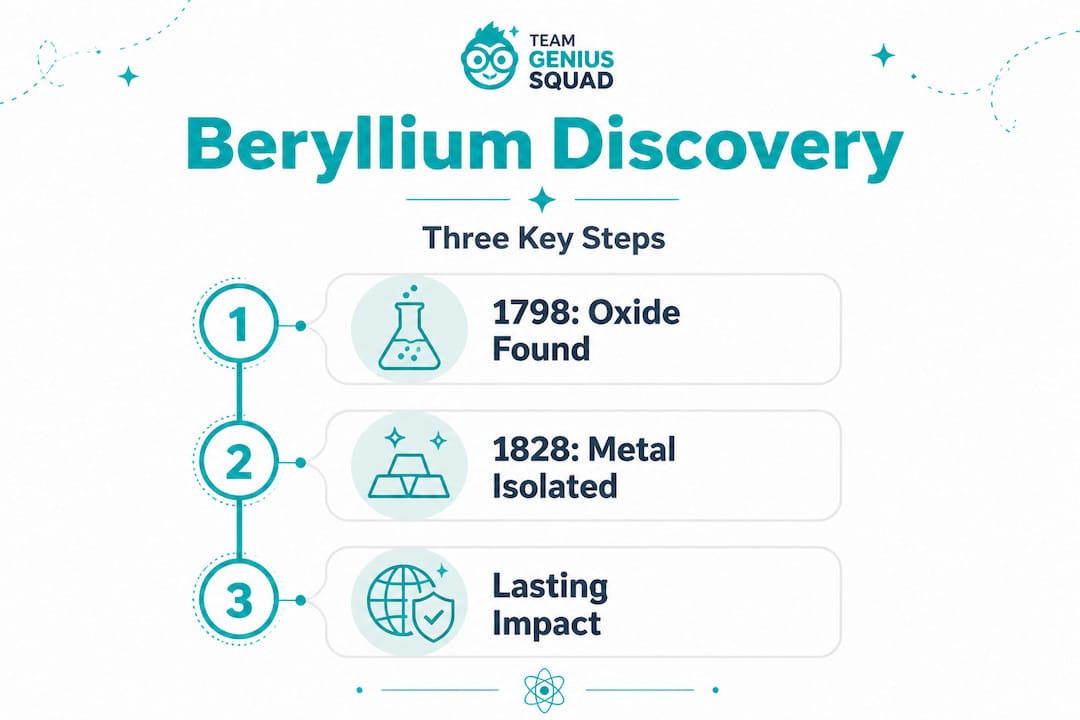
Now that beryllium is introduced, let’s go straight into the discovery story and find out who deserves credit, and for what specific achievement. The answer, as we promised, is not simple. It involves two distinct historical breakthroughs separated by three decades.
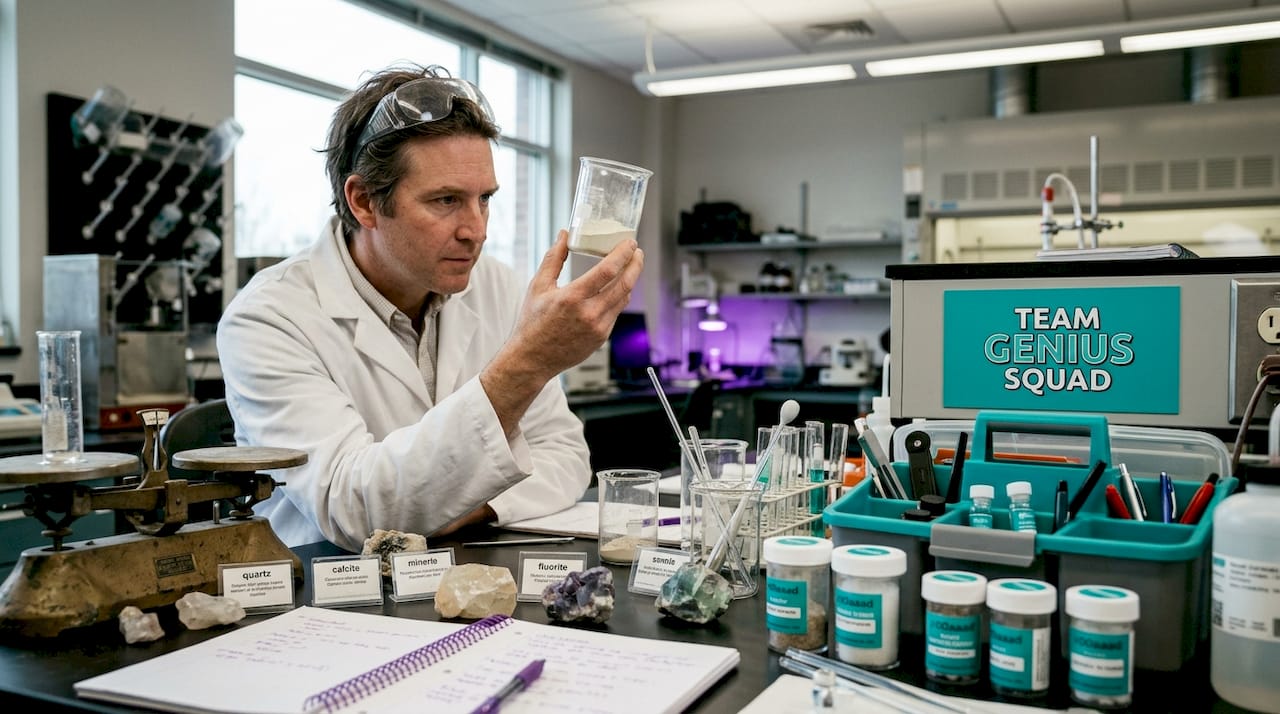
The first breakthrough came in 1798. French chemist Nicolas-Louis Vauquelin was carefully analyzing samples of the mineral beryl and the gemstone emerald when he noticed something unexpected: a substance that did not match any known element. He successfully identified this new substance as an oxide, meaning it was beryllium chemically bonded to oxygen, not yet in its pure metallic form. This was a landmark moment in chemistry. Vauquelin’s oxide discovery in 1798 gave the scientific world its first real evidence that beryllium existed.
But identifying an oxide is not the same as holding pure metal in your hand. That took another 30 years.
In 1828, two chemists working independently on opposite sides of Europe each succeeded in isolating pure beryllium metal: Friedrich Wöhler in Germany and Antoine A. B. Bussy in France. Neither man knew the other was working on the same problem at the same time, which makes their simultaneous achievement all the more remarkable.
Here is a simple comparison to help illustrate both discoveries clearly:
| Discovery type | Scientist | Country | Year | Method |
|---|---|---|---|---|
| Beryllium oxide identified | Nicolas-Louis Vauquelin | France | 1798 | Chemical analysis of beryl and emerald |
| Pure beryllium metal isolated | Friedrich Wöhler | Germany | 1828 | Chemical reduction process |
| Pure beryllium metal isolated | Antoine A. B. Bussy | France | 1828 | Chemical reduction process |
For children learning science history, this table tells a powerful story: real breakthroughs build on each other. To walk through supporting core chemistry learning with your child, you can frame the timeline as three stepping stones toward the same goal.
Here is a numbered sequence you can read aloud with your child to bring the story to life:
- Vauquelin studies beautiful green emeralds and notices something unusual in their chemical makeup.
- He isolates a new oxide and announces his finding to the scientific community in 1798.
- Scientists begin searching for a way to reduce that oxide into its pure metallic form.
- Wöhler and Bussy each figure out the reduction process in 1828, independently of each other.
- The scientific world now has pure beryllium metal, completing a 30-year discovery journey.
This kind of storytelling format is especially powerful for history of element discoveries because it gives children a narrative arc they can follow and remember, rather than isolated facts to memorize.
More than just a name: What does it mean to ‘discover’ an element?
Understanding who gets credited for a discovery helps us see science as a team effort. So what does “discover” really mean when it comes to chemistry? This is actually one of the most interesting philosophical questions in science, and it is one that children as young as seven can begin to explore with guidance.
In everyday life, we use “discover” to mean finding something new, like discovering a hidden trail in the woods. In science, the word carries three distinct meanings that can apply at different stages:
- Identifying: Finding evidence that something new exists, even if you cannot yet hold it in your hands.
- Isolating: Creating a pure sample of the element for the first time.
- Understanding: Learning how it behaves, what its properties are, and how it fits into the larger structure of matter.
As Britannica explains, when people ask who discovered beryllium, the answer genuinely depends on what you mean by “discovered.” Vauquelin gets credit for identifying it as an oxide in 1798, while Wöhler and Bussy are credited for isolating the pure metal in 1828. All three men contributed something essential and irreplaceable to the full story.
“Science is not one person’s trophy. It is a relay race where each runner passes the baton a little further down the track.”
This is a wonderful concept to share with neurodiverse children who may feel pressure to have all the answers at once. The story of beryllium proves that partial progress is still real progress, and that building on someone else’s work is not cheating. It is science.
Pro Tip: Ask your child to draw a “discovery ladder” with three rungs: Identifying, Isolating, and Understanding. Then have them place Vauquelin, Wöhler, and Bussy on the correct rungs. This simple visual activity works beautifully for visual-spatial learners and can be paired with an energy ball activity to build excitement about how electricity and science connect across history.
For children with dyslexia, dysgraphia, or attention differences, moving away from reading-only content toward visual models and storytelling structures can make abstract science concepts far more accessible and genuinely enjoyable.
Explore science like Vauquelin: Fun activities and teaching ideas
You are now ready to turn curiosity into action! Here are some ideas to make science discovery hands-on for children at home or in the classroom, using the story of beryllium as your jumping-off point.
These activities do not require expensive materials or a formal lab setting. They require curiosity, a few household supplies, and a willingness to let children lead their own exploration.
-
The “unknown substance” sorting game: Gather a handful of mystery solids, such as salt, sugar, baking soda, cornstarch, and sand. Challenge your child to group them using only observation: color, texture, smell, and whether they dissolve in water. This mimics what early chemists actually did when they encountered new minerals like beryl. It teaches systematic thinking without any reading required.
-
The gemstone treasure hunt: Show your child images of emeralds and aquamarines and explain that beryllium is hiding inside them. Then create a simple treasure box with different colored rocks or glass gems. Ask your child to imagine being Vauquelin: Which one might hold a hidden secret? This role-play approach builds narrative thinking and science identity at the same time.
-
The timeline drawing project: Give your child a long strip of paper and ask them to illustrate the three stages of beryllium’s discovery. Drawings, stickers, and colors all work. The goal is to externalize the sequence, which research consistently shows improves retention for hands-on and visual learners.
-
The “two scientists, one discovery” conversation: Ask your child: “If two people figure out the same thing at the same time, who wins?” There is no wrong answer. This kind of open question builds critical thinking and models the collaborative spirit that real science demands.
The remarkable fact that Wöhler and Bussy isolated beryllium independently in the same year, 1828, is genuinely mind-blowing to children when presented this way. It shows that great ideas often emerge from the same cultural and scientific moment, not from one magical individual.
Pro Tip: For neurodiverse learners who thrive with sensory engagement, pair the sorting game above with a full interactive science experiment for discovery kit. You can also explore how substances change and react using slime and goop chemistry experiments, which build the same observational skills Vauquelin used in his own lab more than 200 years ago.
Why the discovery of beryllium teaches more than just chemistry
Here is where we want to offer a perspective that most science curriculum guides simply skip over. The standard approach to teaching element history goes something like this: name the element, name the discoverer, give the date, move on. But that approach misses the most important lesson entirely.
When children learn that Vauquelin identified beryllium in 1798 but that it took 30 more years and two additional scientists to complete the picture, something shifts. They begin to see themselves in the story. Because many children, especially those with dyslexia, dysgraphia, ADHD, or other learning differences, already know what it feels like to understand part of something but not all of it. They know what partial progress feels like. And they often carry shame about it.
The story of beryllium reframes that experience entirely. Partial progress is not failure. It is the first step of a relay race that others will eventually complete or that you yourself will complete later. That message, delivered through a real historical event rather than a motivational poster, lands differently. It lands in the body. It becomes part of how a child understands what science actually is.
Understanding teamwork in science also builds empathy and collaboration skills that extend far beyond the lab. When children see Wöhler and Bussy working separately but arriving at the same answer, they begin to appreciate that different approaches can lead to the same truth. That is a profound lesson in intellectual humility and mutual respect.
The periodic table puzzle is one tool we love for making this tangible. When a child physically places beryllium at position number 4 and sees its neighbors, they are not just memorizing a chart. They are building a spatial understanding of how elements relate to each other, which is exactly the kind of pattern recognition that many neurodiverse learners excel at once given the right medium.
Making science history hands-on is not a workaround for “struggling” learners. It is actually the richest, most meaningful way for all children to engage with complex ideas. Different minds genuinely do build the future, and the history of beryllium proves it.
Next steps: Make discovery fun with Genius Squad STEM tools
Ready to bring more hands-on discoveries to your home or classroom? These next steps will keep the learning going and turn the story of beryllium into a springboard for broader STEAM exploration.
At Team Genius Squad, every kit is built around the E³ Method: Engage, Encourage, and Empower. When children experience science through doing rather than reading alone, confidence follows naturally. Try an energy ball experiment with your child and watch curiosity light up their face the moment they complete the circuit.

Each of our screen-free kits is designed with neurodiverse learners in mind, offering tactile materials, role-play tools, and guided prompts that make every child feel like a real scientist. Whether your child is drawn to chemistry, physics, or the history of amazing scientific minds, there is a discovery waiting for them. Because every young genius deserves the chance to say, “I found something new.”
Frequently asked questions
Why is beryllium’s discovery considered a team effort?
Because different scientists made important steps at different times, Vauquelin identified the oxide in 1798, while Wöhler and Bussy isolated pure beryllium metal independently in 1828, meaning the full discovery unfolded across 30 years and multiple contributors.
How can I explain beryllium’s discovery to a child with diverse learning needs?
Break the story into three clear steps and use a visual timeline or drawings, comparing the process to solving a puzzle where different people fit in new pieces at different times.
Where is beryllium found in daily life?
Beryllium is used in aerospace components, electronics, and medical X-ray windows, though the oxide form discovered by Vauquelin in 1798 was the first clue scientists had about its existence.
What’s the difference between discovering an element and isolating it?
Discovering an element typically means finding chemical evidence that it exists; isolating it means producing a pure sample of the element, which is what Wöhler and Bussy achieved in 1828, three decades after Vauquelin’s initial finding.



Leave a comment
This site is protected by hCaptcha and the hCaptcha Privacy Policy and Terms of Service apply.