
What Role Does Encouragement Play in Learning?
Encouragement reliably raises engagement, self-efficacy, and academic performance when it’s specific and focused on effort or potential rather than fixed ability. The evidence on this is strong, consistent, and, frankly, more actionable than most teaching advice you’ll come across.
Three things are worth knowing before you go any further:
- A meta-analysis spanning 344 samples and 223,209 participants found that perceived social support from teachers and parents correlates strongly with academic achievement, largely through its effect on engagement.
- The mechanism is straightforward: encouragement raises a learner’s sense of competence, which shifts them toward mastery goals instead of just trying to look capable in front of peers.
- The payoff shows up in real numbers. In one classroom study, children given verbal encouragement before a task jumped from 30% to 77% accuracy on the same problem set.
At Teamgeniussquad, we see this play out constantly in how kids respond to hands-on STEAM challenges, which is a big part of why we built our kits around encouragement instead of just information delivery. But the research on this predates any product. It’s been building for decades, and it points in one direction.
Key Takeaways
Encouragement improves learning outcomes most reliably when it’s specific, process-focused, and paired with clear, hands-on tasks rather than delivered as vague praise alone.
| Point | Details |
|---|---|
| Ditch trait praise | Replace “You’re so smart” with language that names the specific strategy a learner used. |
| Watch for persistence | Increased strategy talk and willingness to try again after failure signal encouragement is working. |
| Equity impact is real | Students with lower parental education or middling prior grades see the largest gains from targeted encouragement. |
| Pair with structure | Support alone rarely moves performance directly. It works through motivation and engagement, so pair it with clear tasks. |
| Teamgeniussquad kits operationalize this | Process-focused prompts, role-play identity, and built-in reflection turn encouragement into a repeatable, hands-on habit. |
Table of Contents
- Why Encouragement Matters for Learning
- How Does Encouragement Actually Change a Learner’s Behavior?
- What Are the Best Ways to Encourage Students?
- What Mistakes Undermine the Power of Encouragement?
- How Can You Tell If Encouragement Is Working?
- What Does the Research Actually Show?
- How Do You Build a Culture of Encouragement?
- What We’ve Learned From Watching Kids Respond to Encouragement
- How Hands-On STEAM Kits Put Encouragement Into Practice
- Sources
Why Encouragement Matters for Learning
Encouragement shapes three things that determine whether a student keeps trying: motivation, engagement, and belief in their own ability to improve. When any of those three erodes, grades drop even if intelligence hasn’t changed at all.
The mechanism works like this: a student who feels supported interprets a hard problem as solvable rather than threatening. That interpretation changes behavior. Instead of giving up after one failed attempt, an encouraged student tries a second approach, then a third. Persistence, not raw aptitude, is often the variable that separates who improves and who plateaus.
Statistic Callout: Across a synthesis of 344 samples and more than 223,000 participants, intrinsic motivation and perceived social support emerged as two of the strongest predictors of student achievement, outperforming many demographic and structural variables researchers typically expect to dominate.
Who benefits most? Research using propensity-score matching found that teacher encouragement produced the largest gains in students from lower-parental-education backgrounds and those sitting right on the edge of academic milestones. These are the students most likely to be overlooked, and encouragement turns out to be one of the cheapest, highest-leverage interventions available to help them.
- Students with middling prior grades gain the most from targeted encouragement toward the next academic step.
- Lower-SES students see outsized benefits compared to peers from more resourced households.
- The effect compounds. Encouraged students take harder classes, which then opens more doors later.
How Does Encouragement Actually Change a Learner’s Behavior?
Encouragement works through three well-documented psychological channels: it builds perceived competence and autonomy (Self-Determination Theory), it raises a learner’s expectation of success and their sense that the task matters (expectancy-value theory), and it nudges students toward mastery goals instead of performance goals (goal-orientation theory).
Self-Determination Theory, developed by Deci and Ryan, argues that motivation flourishes when three needs are met: competence, autonomy, and relatedness. Encouragement that says “you figured out a new way to solve that” hits competence directly. Encouragement that asks “what do you want to try next?” hits autonomy. A parent or teacher who shows genuine interest in a child’s process, not just their score, satisfies relatedness.
Researchers describe teacher and parental encouragement as acting like a chain: it raises perceived competence first, and that shift in self-perception is what then changes goal orientation and pulls students into harder, more complex tasks they’d otherwise avoid.
Expectancy-value theory adds a second layer. Students invest effort in tasks they believe they can succeed at (expectancy) and that they find personally meaningful (value). Encouragement that connects a task to a student’s interests, “this experiment works a lot like the one you loved last week,” boosts value. Encouragement that highlights past wins boosts expectancy.
Mediation research backs this up directly. One study found that teacher support affects achievement indirectly, routed through academic self-efficacy and academic emotions rather than acting on grades in some magic, direct way. Support alone doesn’t teach a child anything. It changes how they feel about attempting the material, and that feeling is what moves the needle.
Here’s what this looks like in three real statements:
- Process-focused praise: “You tried three different angles before it worked. That’s exactly how real scientists solve problems.” This targets competence and normalizes struggle.
- Potential-focused encouragement: “You’re getting closer to figuring this out. I can see it.” This targets expectancy without promising a guaranteed outcome.
- Autonomy-supportive prompt: “What do you think will happen if you change the angle of the mirror?” This hands the decision back to the learner instead of dictating the next step.
What Are the Best Ways to Encourage Students?
The single highest-impact change most adults can make is swapping vague trait praise (“You’re so smart”) for specific, process-focused language (“You kept adjusting your hypothesis until the data made sense”). This one shift changes how a child interprets failure for years afterward.
Beyond that core principle, encouragement works across several channels, and mixing them matters more than mastering any single one.
Verbal strategies:
- Narrate the specific strategy a learner used, not just the result.
- Ask reflective questions instead of handing over answers.
- Name effort and adaptability out loud, especially after a setback.
Nonverbal cues:
- A raised eyebrow of genuine curiosity signals interest without judgment.
- Sitting at eye level during a tough problem communicates patience.
- A simple thumbs-up after a hard try, not just a correct answer, reinforces persistence.
Routines and tangible supports:
- Weekly “strategy share” circles where kids explain how they solved something, not just what they got.
- Role-play props, like lab coats or badges, that let kids step into an identity of competence.
- Reward stickers tied to effort milestones rather than test scores, such as STEM-STEAM encouragement sticker sheets that celebrate a strategy attempt.
Age-specific scripts:
For early childhood (ages 3 to 5), keep language short and sensory: “Look how you stacked those! You found the balance point.” For elementary-age kids (6 to 11), connect effort to strategy: “You changed your plan when the first one didn’t work. That’s smart problem-solving.” For middle and high schoolers (12 to 18), respect their growing need for autonomy: “You clearly thought this through. What’s your reasoning behind this part?”
Ten micro-scripts worth keeping on hand:
- “Tell me how you figured that out.”
- “What’s one thing you’d try differently next time?”
- “That took real persistence.”
- “I noticed you didn’t give up when it got hard.”
- “You’re thinking like a real problem-solver.”
- “What part are you most proud of?”
- “Let’s look at what worked, even if the final answer wasn’t right.”
- “You’ve made progress since last week. I can see it.”
- “What do you want to explore next?”
- “That’s a smart way to test your idea.”
At home, this can be as simple as a “role-play evening,” where a family activity like a family STEM project becomes the backdrop for process-focused conversation instead of grade talk.
What Mistakes Undermine the Power of Encouragement?
Vague, trait-based praise and overpraising both erode the long-term motivation they’re meant to build, mainly because they reduce a student’s sense of genuine competence once the praise stops matching reality. Encouragement that feels inflated or generic teaches kids to distrust adult feedback altogether.
| Don’t say | Do say instead |
|---|---|
| “You’re so smart.” | “I noticed you tried three different approaches. That persistence will help you.” |
| “Great job!” (after everything) | “That transition in your explanation was clear. What made you choose that order?” |
| “Don’t worry, it’s easy.” | “This part is genuinely tricky. Let’s figure out where it’s getting stuck.” |
| “You always get this right.” | “You worked through that carefully. What was your first move?” |
Pro Tip: If your classroom or home has become praise-heavy without much substance behind it, shift the culture toward strategy-sharing instead of compliment-giving. Ask kids to explain their process to a peer once a week. The praise becomes specific automatically, because they have to describe what they actually did.
Neurodiverse learners and children with learning difficulties need extra care here. Encouragement that predicts success or highlights effort reduces performance anxiety for students with dyslexia and dysgraphia by creating a lower-threat environment where experimentation feels safe. Avoid comparing a child’s pace to peers. Emphasize incremental, self-referenced progress instead. A resource like dyslexia-friendly education strategies offers more specific guidance for this population.
How Can You Tell If Encouragement Is Working?
Three observable signs tell you encouragement is landing: increased persistence after failure, more frequent strategy talk (“I tried it this way, then that way”), and visibly positive emotional responses to challenging tasks rather than avoidance.
A quick observation checklist for a lesson or homework session:
- Does the student attempt a second strategy after the first one fails?
- Do they narrate their thinking out loud without being prompted?
- Is their body language open (leaning in) rather than closed off (arms crossed, avoiding eye contact)?
- Do they ask a follow-up question instead of stopping at “I don’t know”?
- Do they show curiosity about why something worked, not just relief that it did?
- Are they willing to try a harder version of the same task?
- Do they reference a past success when facing a new challenge?
A simple, age-adapted three-question self-report works well weekly or biweekly:
- “How did you feel when something was hard today?”
- “What’s one thing you tried that you’re proud of?”
- “What do you want help with next time?”
For classrooms, track patterns at the group level rather than singling out individuals in shared documents, and always get consent before using any personal reflection data beyond informal conversation. Simple, low-tech tracking, a notebook or shared spreadsheet, is enough for most settings. Research on online learning environments backs the importance of this mediating step: one study of 822 students found that support alone showed no direct effect on performance unless it first boosted intrinsic motivation and engagement. Encouragement without engagement is just noise.
What Does the Research Actually Show?
The strongest evidence available shows that verbal, process-focused encouragement produces immediate task-performance gains, and when sustained over time, it supports measurable long-term academic progress, especially for students sitting near an achievement threshold.
Statistic Callout: The jump from 30% to 77% accuracy after a single encouraging statement is one of the clearest experimental demonstrations that encouragement has a measurable, immediate effect on task performance, not just a vague emotional lift.
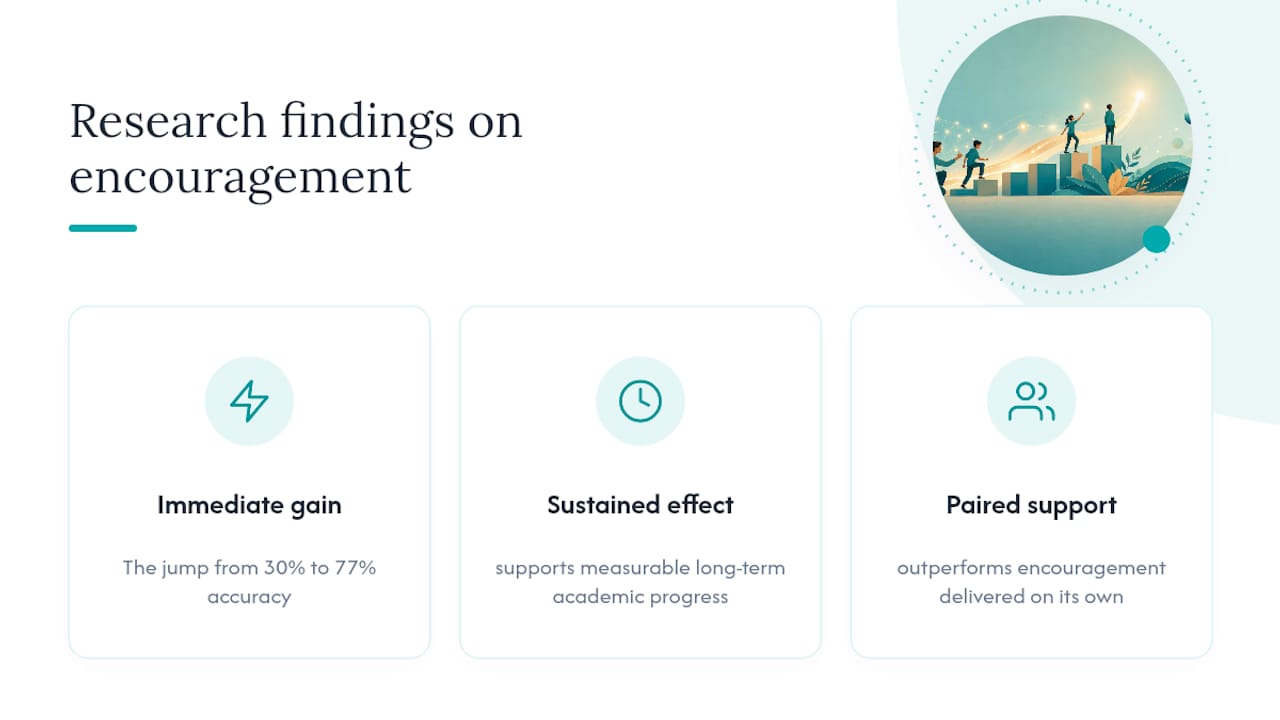
None of this proves encouragement works in isolation. It works best paired with clear tasks and real instructional support, which is exactly why pairing it with structured, hands-on activities tends to outperform encouragement delivered on its own.
How Do You Build a Culture of Encouragement?
A culture of encouragement looks like a classroom or home where effort, strategy, and reflection get talked about out loud as often as results do, until noticing progress becomes a habit rather than an event.
Here’s a rough eight-week roadmap:
- Weeks 1 to 2: Introduce one process-focused phrase per day. Track how often you catch yourself falling back into trait praise (“smart,” “talented”) and swap it consciously.
- Weeks 3 to 4: Add a weekly strategy-share circle, five minutes where kids explain how they solved something, not just what they got right.
- Weeks 5 to 6: Layer in a tangible ritual, like role-play badges or a “scientist of the week” reflection, tied to effort rather than accuracy.
- Weeks 7 to 8: Introduce a family or classroom reflection activity, such as acting out a real experiment and discussing what surprised them, drawing on identity-driven STEAM concepts where kids see themselves as the ones doing the discovering.
A simple mini-activity to try at home or in class: hand a child a basic experiment kit, ask them to predict the outcome before starting, and afterward, ask them to explain what they’d change next time. The prediction step builds autonomy. The reflection step builds self-efficacy.
Checkpoints matter:
- After week 2: Are process-focused phrases starting to feel natural, or still forced?
- After week 4: Are kids initiating strategy talk unprompted?
- After week 8: Has persistence after failure visibly increased compared to week one?
For a deeper look at how agency and encouragement interact in group settings, student agency in STEAM classrooms offers a useful framework for educators building this out at scale.
What We’ve Learned From Watching Kids Respond to Encouragement
One pattern shows up again and again when process-focused encouragement replaces vague praise: kids who used to freeze at the first wrong answer start treating mistakes as information instead of failure. That shift usually takes a few weeks, not months, once the language around effort changes consistently.
Before that shift, a common scene plays out in classrooms and living rooms alike. A child hits a wall on a problem, hears “you’re so smart, you’ll get it,” and interprets the compliment as pressure rather than support. Smart kids aren’t supposed to need three tries. So they stop trying after one. Swap that same moment for “I like how you’re testing different ideas, what’s your next guess?” and the response changes almost immediately. The child keeps going, because the language gave them permission to be in process rather than judged on a fixed trait.
The most useful adjustment isn’t a script or a poster on a wall. It’s catching the moment right after a mistake and choosing curiosity over reassurance. That single habit, repeated consistently, does more for a child’s confidence than any single well-crafted compliment ever will.

How Hands-On STEAM Kits Put Encouragement Into Practice
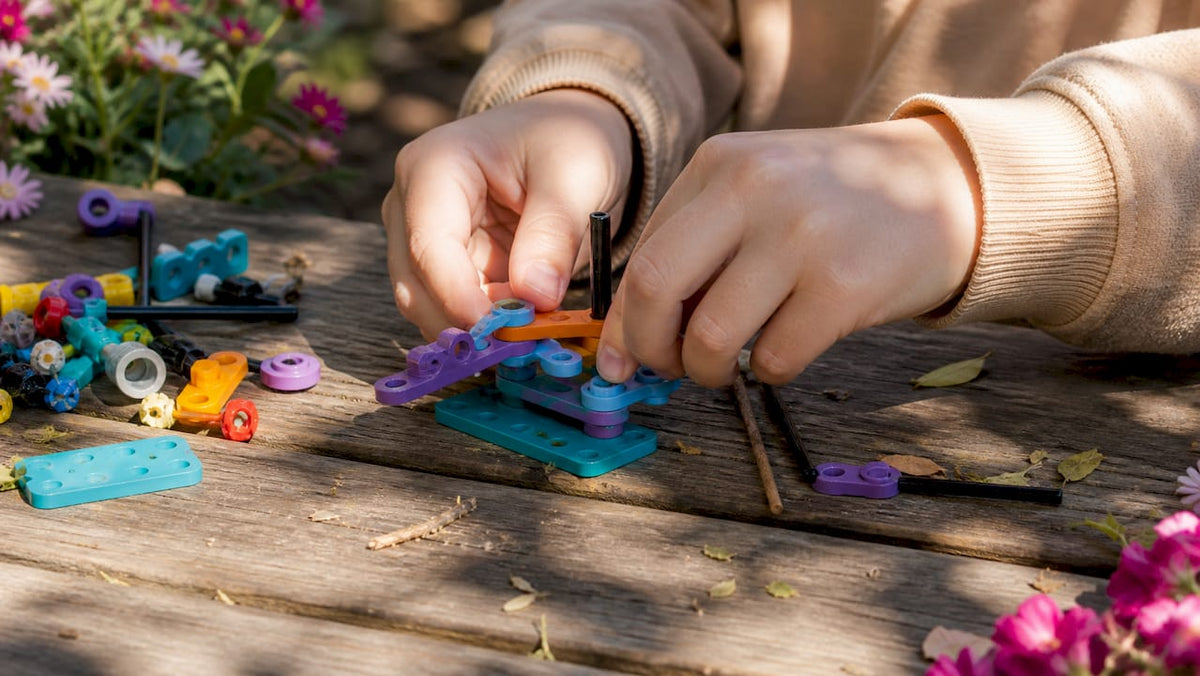
Hands-on STEAM kits translate the research on process-focused encouragement into something a child can hold, test, and reflect on, rather than a phrase adults have to remember to say at the right moment. That’s the gap Teamgeniussquad was built to close.

Picture a classroom where a teacher hands out a solar energy kit and, instead of grading the final result, asks each student to predict what will happen before they start. That prediction step, paired with a reflection question afterward, is the exact expectancy-value mechanism described earlier, made physical. At home, a parent running the same kit with their child can ask, “What surprised you?” instead of “Did you get it right?” and watch the conversation shift from performance to curiosity.
Three features of Teamgeniussquad kits map directly onto the strategies covered in this piece:
- Process-focused prompts built into each experiment guide kids to explain their reasoning, not just their results.
- Identity-driven role-play, including lab coats and certificates, lets children see themselves as scientists rather than students being tested.
- Built-in reflection prompts after each activity turn the strategy-share habit into something automatic rather than something a teacher has to remember to add.
This approach grew out of a real family’s experience navigating dyslexia and dysgraphia, which is part of why the E³ Method, Engage, Encourage, Empower, was built around low-threat, high-curiosity experimentation from the start.
If you’re an educator looking to build this into your lesson planning, the lesson plans resource offers a direct starting point for embedding process-focused encouragement into your weekly routine. If you’re weighing options for family engagement around books and reading, family engagement through books is a helpful partner resource worth pairing alongside hands-on activities.
Sources
- Does Teacher Encouragement Influence Students’ Educational Progress? A Propensity-Score Matching Analysis
- Meta-analytic evidence on intrinsic motivation and social support (journal source provided in prompt)
- “I am sure you’ll succeed”: When a teacher’s verbal encouragement of success increases children’s academic performance
- Mediating role of academic self-efficacy and academic emotions in the relationship between teacher support and academic achievement | Scientific Reports



Leave a comment
This site is protected by hCaptcha and the hCaptcha Privacy Policy and Terms of Service apply.