
Literacy First, Neurodivergent Friendly Hands On STEM for Kids 5–13
Start with a short shortlist of low-prep, hands-on STEM activities organized by age and subject. In 20 to 45 minutes, kids ages 5 to 13 run a real engineering design cycle, practice observation and data recording, and connect their experiment to a story or writing prompt. Screen-free, literacy-tied setups work especially well for neurodivergent learners, and a ready-made kit can fill in when time or materials run short.
TL;DR:
- Most activities can be scaled in complexity and time, with younger kids focusing on quick observations and older children handling multi-step builds and data analysis.
- Incorporating reflection and journaling is key to deeper learning, making repeated experiments with small variations more effective than multiple one-off projects.
- Preparation involves gathering common household items or scouting specialty materials in advance, with ready-made kits streamlining setup and promoting consistent, literacy-rich experiences.
- Guided virtual sessions or curated experiment kits offer efficient, literacy-integrated ways to introduce science, engineering, and technology concepts to various age groups.
- Free resources from NASA JPL, Exploratorium, and other organizations provide extensive ideas and instructions for engaging STEM activities at home or in the classroom.
Table of Contents
- What Are the Best Hands-On STEM Activities to Try First?
- Which Activities Fit Each Age Group and Subject?
- What Do You Need to Gather Before You Start?
- How Do You Turn Play Into Measurable Learning?
- How Team Genius Squad Approaches Hands-On STEM
- Why the “Just Do the Experiment” Approach Falls Short
- A Simpler Way to Run STEM Activities at Home or in Class
- Where to Find More Free STEM Activities
- Sources
- FAQ
What Are the Best Hands-On STEM Activities to Try First?
These experiments need little setup and a lot of curiosity. Each one maps to a subject area, so you can rotate through science, engineering, technology, and math without repeating a format.
- Elephant toothpaste (chemistry). Mix hydrogen peroxide, dish soap, and yeast to trigger a foaming reaction that erupts from a bottle. Materials: hydrogen peroxide, yeast, dish soap, warm water. Time: 15 minutes. Best for ages 8 to 13, with adult supervision for the peroxide.
- Cardboard rover (engineering). Kids build a small rover from cardboard, straws, and rubber bands, then test how far it travels per wind of the axle, echoing NASA JPL’s cardboard rover lesson. Materials: cardboard, pencils, rubber bands, straws. Time: about half an hour to three quarters of an hour. Ages 8 to 13.
- Solar oven s’mores (energy). A pizza box lined with foil and plastic wrap captures sunlight to melt chocolate and marshmallow. Materials: pizza box, foil, plastic wrap, tape. Time: about half an hour outdoors. Ages 5 to 10.
- Sink-or-float boat challenge (buoyancy). Kids build a boat from foil or clay that holds the most pennies before sinking. Materials: foil or clay, pennies, a basin of water. Time: around 20 minutes. Ages 5 to 8.
- Paper roller coaster (forces). Tape and paper tubes become a marble track that tests speed and momentum. Materials: cardstock, tape, marbles. Time: about half an hour to two thirds of an hour. Ages 8 to 13.
- Lemon circuit (basic circuits). A lemon, zinc and copper electrodes, and a small LED demonstrate a simple electrochemical circuit. Materials: lemons, galvanized nails, copper wire, LED. Time: approximately 20 minutes. Ages 10 to 13.
- Simple coding maze (technology). Kids write step-by-step directional commands on index cards to move a toy through a floor maze, an unplugged intro to sequencing logic. Materials: tape, index cards, a small figure. Time: roughly 20 minutes. Ages 5 to 10.
- DIY slime (polymers). Combining glue, borax solution, and water shows kids how polymers change texture. Materials: white glue, borax, water. Time: about 15 minutes. Ages 5 to 10.
Extend any activity by timing it, changing one variable, or adding a numeric goal, like “make the rover travel 3 feet in fewer than 10 winds.” Pair the lemon circuit or coding maze with a two-sentence writing prompt: “What surprised you? What would you change next time?”
Which Activities Fit Each Age Group and Subject?
Matching an activity to a child’s stage keeps frustration low and curiosity high. Younger kids need shorter cycles and bigger materials; older kids can handle multi-step builds and open-ended variables.
Ages 5 to 7:
- Science: Float-or-sink sorting with household objects teaches prediction and grouping.
- Engineering: Building the tallest tower from cups and craft sticks introduces balance.
- Math: Sorting buttons by size and color builds pattern recognition.
- Inclusive variant: use dimmed lighting and fewer objects at once for children sensitive to visual clutter.
Ages 8 to 10:
- Science: Growing crystals from borax solution shows saturation and time-based change.
- Engineering: The cardboard rover challenge above, scaled down to a smaller test track.
- Tech: The unplugged coding maze, extended with an “if/then” rule card.
- Inclusive variant: swap timed challenges for open-ended ones to reduce pressure for kids who need extra processing time.
Ages 11 to 13:
- Science: Testing pH with cabbage juice indicator connects chemistry to kitchen materials.
- Engineering: Building a working catapult introduces torque and force estimation.
- Math: Graphing rover distance against number of axle winds turns data into a real chart.
- Inclusive variant: allow written or drawn responses instead of verbal presentations for reflection steps.
Scaffold up by adding constraints (budget limits, size caps) or scaffold down by pre-cutting materials and demonstrating one step before kids try it solo.
What Do You Need to Gather Before You Start?
Most of these activities pull from what’s already in a kitchen drawer or recycling bin. A few need specialty items worth ordering ahead.
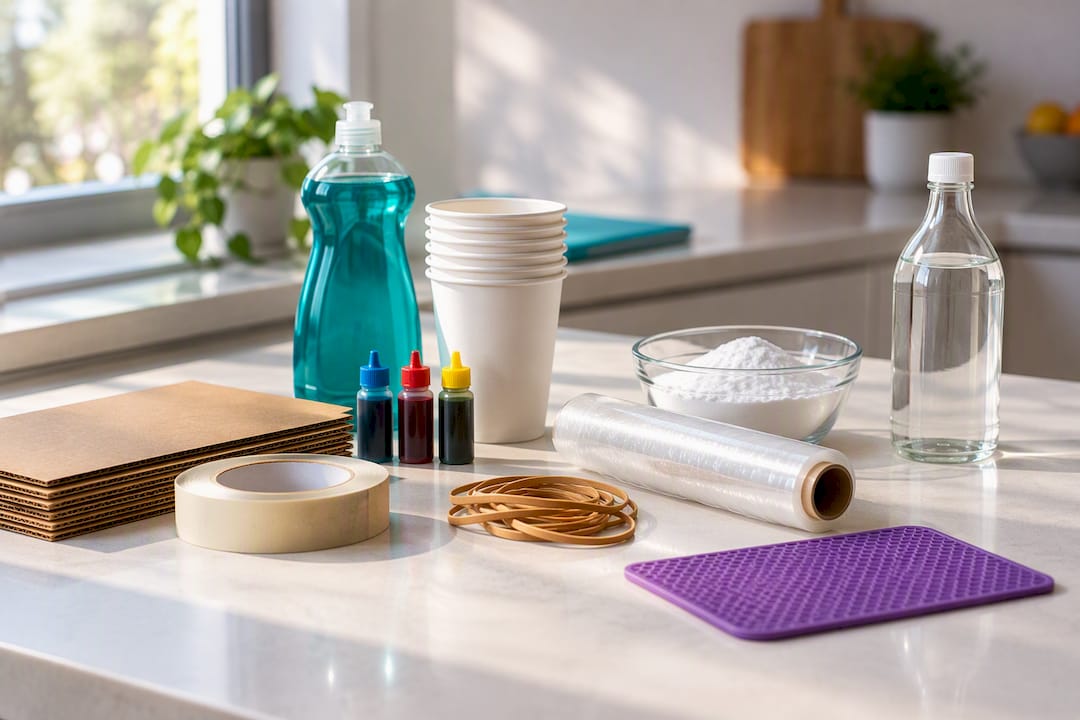
Common household items: cardboard, tape, dish soap, food coloring, paper cups, rubber bands, plastic wrap, baking soda, vinegar.
Kit-only or special items: hydrogen peroxide at higher concentrations, galvanized nails, borax, small LEDs, or copper wire.
Prep checklist:
- Measure and pre-portion liquids the night before.
- Set up a wipeable workspace with paper towels within reach.
- Have safety goggles and gloves out for any chemical mixing.
- Read through the activity once solo before running it with kids.
National PTA separates its resources into “Learn at Home” activities using items you already own and “STEM at Home Kits” for anything requiring advance ordering. That split is worth borrowing for your own planning. A kit earns its price when you’re running multiple experiments back to back, need consistent materials across a group, or want literacy tie-ins and role-play elements built in rather than assembled from scratch.
Pro Tip: Keep a labeled shoebox of “always ready” supplies, tape, rubber bands, cups, food coloring, so you can start a new experiment on a whim without a supply run.
For recycled-material builds on a tight budget, classroom-ready recycled STEM projects stretch a single collection of cardboard and bottle caps across several activities.
How Do You Turn Play Into Measurable Learning?
Running the activity is only half the work. What kids notice, question, and write down afterward is where the learning actually sticks.
- Notice. Ask what the child observes before touching anything, “What do you see? What do you think will happen?”
- Wonder. Turn observation into a question: “What happens if we use less water?”
- Plan. Sketch or describe the approach before building. This single step mirrors the engineering design process NASA JPL builds into its rover lesson.
- Test. Run the experiment and record what happens, distance, time, number of tries.
- Reflect. Ask two questions: “What worked? What would you change?”
Elementary STEM activities work best when they emphasize the actual process of science, meaning controls, variables, and recorded data, rather than a scripted outcome. A simple engineering journal, even a folded piece of paper with three boxes labeled “Plan,” “Test,” and “Change,” gives kids a place to sketch and write. ISTE recommends this kind of documentation as a literacy practice, not just a science one, since it forces kids to translate what they did into words and pictures.
To layer in reading, pair an experiment with a short book on a related theme, then ask two questions afterward: “How is what the character did like what you did?” and “What would you try differently?” That pairing gives kids a story-driven reason to test their ideas, not just a task to finish.

How Team Genius Squad Approaches Hands-On STEM
Every activity in this guide works better with a framework behind it, which is where Team Genius Squad’s proprietary E³ Method, Engage, Encourage, Empower, comes in. It’s built specifically for kids who don’t always thrive in traditional classroom pacing.
- Screen-free, role-play elements (lab coats, badges) turn “doing an experiment” into “being a scientist.”
- Kits are designed with neurodivergent learners in mind, drawing on a real family’s experience with dyslexia and dysgraphia.
- Literacy integration isn’t an add-on. Reading and reflection prompts are built into the experience alongside the science.
At home, a kit removes the guesswork of measuring and sourcing materials. In a classroom, it gives every student the same consistent setup, which matters when you’re managing 20 kids and one supply closet. For more on how prepackaged materials support learning outcomes, see the role of hands-on kits in STEAM learning.
Why the “Just Do the Experiment” Approach Falls Short
Most advice on hands-on STEM stops at the materials list. Mix this, build that, watch it react.
Literacy-integrated, neurodivergent-friendly hands-on STEM works because it treats reflection as part of the science, not an optional extra bolted onto the end. A child who struggles to sit through a worksheet often lights up when asked to sketch what happened or tell you a two-sentence story about it. That’s not a workaround. That’s a legitimate way to demonstrate understanding.
The conventional wisdom, more experiments, more materials, more variety, misses that repetition with reflection beats novelty without it. Run the same rover test three times with one small change each round, and a child learns more about engineering than they would from three different one-off activities. Prioritize the “wonder and reflect” steps before you worry about buying more supplies.
— Tita
A Simpler Way to Run STEM Activities at Home or in Class
Gathering materials, writing prompts, and building in role-play takes real time, time most parents and teachers don’t have on a Tuesday night. Some experiment kits do that preparation for you, pairing age-matched science with literacy prompts and screen-free role-play so kids step into the identity of a scientist rather than just following steps.
If you want a guided, one-on-one option instead of a self-run kit, Meet Ava, the STEM Ambassador, offers a 30-minute virtual experiment session built for kids ages 5 to 13, priced at $50 one-off. For a small group wanting a deeper entrepreneurship angle, the virtual group experience runs $550, and the in-person group version runs $1,100. For families who’d rather build the experience themselves, browse the experiment kits collection for age-matched options that come with materials, instructions, and literacy tie-ins already built in. Pick the kit route for solo or family use, and the Meet Ava sessions when you want a guided, live experience for a group.
Where to Find More Free STEM Activities
- NASA JPL’s cardboard rover lesson offers full build steps, troubleshooting tips, and measurement extensions.
- National PTA’s STEM at Home splits activities by household items versus kit-based projects.
- Exploratorium’s activity bank has hundreds of low-cost, teacher-tested experiments.
- Boise State’s STEM presentation guidance covers structuring the scientific process for young learners.
- ISTE’s literacy-into-STEM guidance explains how to embed journaling and writing into project work.
Sources
- Make a Cardboard Rover – Engineering Lesson | NASA JPL Education
- STEM at Home Activities - STEM + Families - Programs | National PTA
- Elements of an engaging K–12 STEM presentation
- Exploratorium activities
- Embed literacy into STEM projects | ISTE
FAQ
What are some hands-on STEM activities for science?
Elephant toothpaste, crystal growing, sink-or-float boat challenges, and pH testing with cabbage juice all count as hands-on science activities. Each teaches observation and prediction using items you likely already have at home.
What is an example of a STEM activity?
A cardboard rover build is a strong single example: kids design, build, test, and improve a small vehicle using cardboard, straws, and rubber bands, following the engineering design cycle NASA JPL outlines. It covers engineering, math (measuring distance), and reflection in one session.
What are some fun activities for STEM clubs?
Group-friendly picks include paper roller coasters, lemon circuits, and rover-building competitions where teams compare designs. Adding a shared engineering journal lets club members document and compare results across the group.
What are some STEM activities for adults?
Adults can run the same lemon circuit, solar oven, or crystal-growing experiments with older teens or as facilitators for younger kids, since the core science scales up with more precise measurement and data analysis. Adults typically shift from doing the activity to guiding the notice-wonder-plan-test-reflect cycle described above.
How much adult involvement do these activities need?
Most activities need light supervision for setup and safety, then kids can run the testing and reflection steps mostly on their own. Chemical-based experiments like elephant toothpaste need closer adult supervision throughout.


Leave a comment
This site is protected by hCaptcha and the hCaptcha Privacy Policy and Terms of Service apply.