Why Foundation in STEAM Matters for Kids 5–13
A strong foundation in STEAM education is defined as the integrated development of Science, Technology, Engineering, Arts, and Mathematics skills during the critical window of ages 5–13. Why foundation in STEAM matters becomes clear when you look at what children gain: not just technical knowledge, but the creative thinking, resilience, and problem-solving identity that carry them through every stage of learning and life. Studies from 2026 show that interdisciplinary STEAM integration supports cognitive, social, and emotional growth in children during these exact years. Teamgeniussquad was built on this understanding, and every kit it creates reflects the belief that the right foundation changes everything.
Why foundation in STEAM matters more than any single subject
STEAM education is not simply STEM with an art class added on. It is a fully integrated approach where each discipline reinforces the others, creating a learning experience that is richer and more durable than any single subject can provide. Foundational STEAM integration develops creative thinking and complex problem-solving abilities that standard STEM curricula cannot reach on their own. That distinction matters enormously for children ages 5–13, whose brains are actively building the neural pathways that will shape how they think for decades.
The ages 5–13 window is not arbitrary. Research identifies this period as a critical formation stage, and purely disconnected learning experiences cause children to lose the curiosity needed for sustained STEAM engagement later in life. Curiosity lost at age 8 is rarely recovered at age 18. Educators and parents who understand this invest in experiences that connect subjects meaningfully, not in isolation.
STEAM also prepares children for a workforce that increasingly demands both technical and human skills. Understanding why STEAM benefits children goes beyond career readiness. It is about raising adaptable, confident thinkers who can face problems that do not yet have names.
How does arts integration strengthen STEM learning?
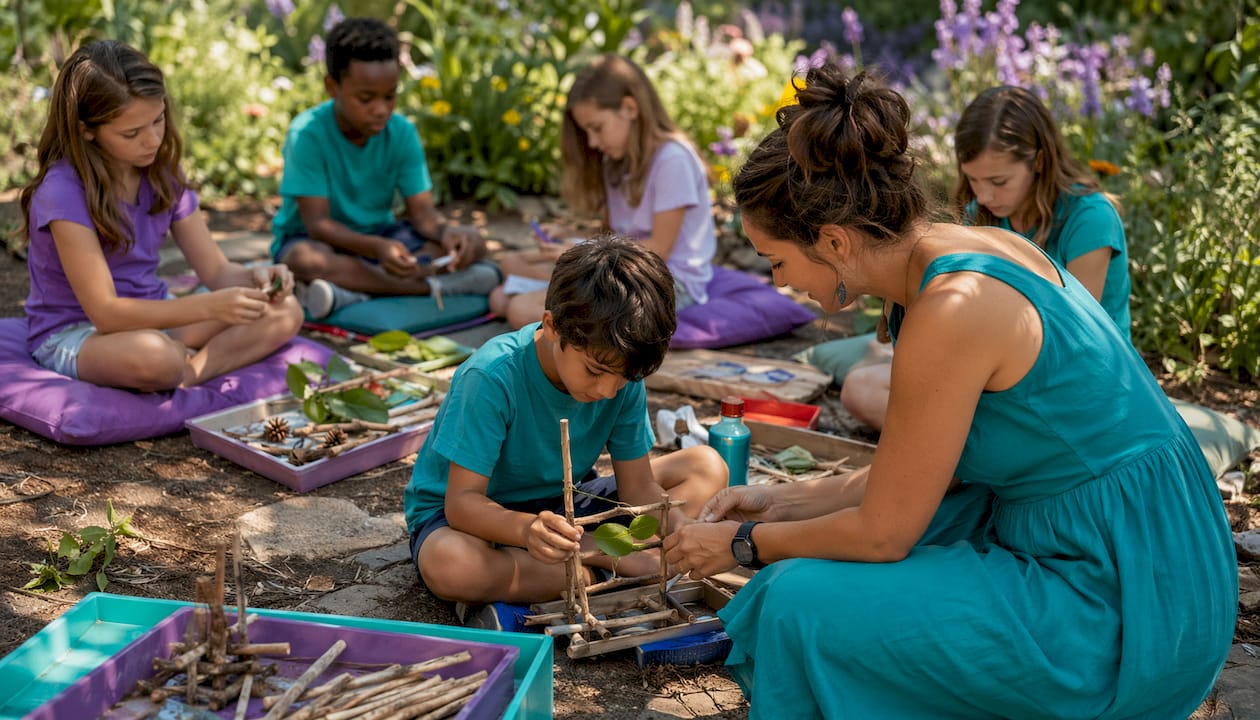
Arts are the cognitive bridge in STEAM, not a decorative addition. Arts improve retention and application of technical concepts through storytelling, design thinking, and reflection. A child who builds a bridge from popsicle sticks and then sketches its design, writes about what failed, and presents it to peers has engaged four disciplines at once. That child retains the engineering concept far longer than one who only reads about load distribution.
Design thinking, which comes directly from arts education, is the same iterative process engineers use to prototype and refine solutions. Arts skills like design thinking and multimodal communication are in high demand for innovation-focused STEM roles. The job market is not waiting for schools to catch up. Employers already know that the most effective problem-solvers are the ones who can think visually, communicate across disciplines, and iterate without fear of failure.
The evidence for arts integration is not anecdotal. A review of 62 arts education studies confirms that students with sustained arts education show higher engagement, critical thinking, and persistence, outcomes that enhance STEM learning equally. Persistence is especially significant. A child who learns to revise a drawing, a song, or a sculpture learns that failure is a step, not a verdict.
Arts also build empathy, which is the foundation of human-centered design. Music education, for example, boosts social-emotional growth in early childhood, developing the same relational skills that make great scientists and engineers effective collaborators.
- Design thinking: Children learn to prototype, test, and revise, mirroring real engineering processes.
- Multimodal communication: Kids express ideas through drawing, writing, and building, not just verbal answers.
- Empathy and human-centered focus: Arts teach children to consider the people their solutions will serve.
- Iterative resilience: Revision in arts normalizes the trial-and-error cycle central to scientific inquiry.
- Retention through storytelling: Narrative structures help children remember and apply complex STEM concepts.
Pro Tip: Ask children to explain their STEAM project as if they are telling a story. Narrative framing activates the same brain regions as creative arts, deepening retention of the technical concepts involved.
Why do real-world problems build a stronger STEAM foundation?
Children learn best when the problem in front of them feels real. Educational frameworks from 2026 emphasize arts woven into inquiry around authentic issues like sustainability, community health, and environmental design. A child designing a water filtration system for a local river is not just learning chemistry. That child is becoming a problem-solver with a sense of agency and purpose.
This shift from passive learner to active creator is the most powerful outcome of a strong STEAM foundation. Children ages 5–13 can engage meaningfully with complex, real-world problems when given proper structure, and doing so builds resilience and an innovator identity early. That identity, the belief that “I am someone who solves problems,” is what sustains a child through difficult coursework years later.
Real-world STEAM projects also develop collaboration naturally. When a group of third graders designs a community garden layout, they negotiate, compromise, and build on each other’s ideas. Those are the same skills that drive effective teams in every professional field.
Here are four types of real-world STEAM projects that build foundational skills in children ages 5–13:
- Environmental design challenges: Children design solutions to local issues like reducing plastic waste or improving a school garden, integrating science, math, and visual arts.
- Community health projects: Kids research a neighborhood health topic and create informational posters or models, combining research skills, data literacy, and artistic communication.
- Engineering and architecture builds: Children construct model buildings or bridges using everyday materials, applying physics concepts and iterative design thinking.
- Technology and storytelling: Kids create illustrated books or simple animations that explain a scientific concept, merging literacy, technology, and scientific understanding.
Each of these project types gives children a reason to care about what they are learning. Motivation follows meaning, and meaning comes from connection to the real world.
What are the key foundational concepts in STEAM for ages 5–13?
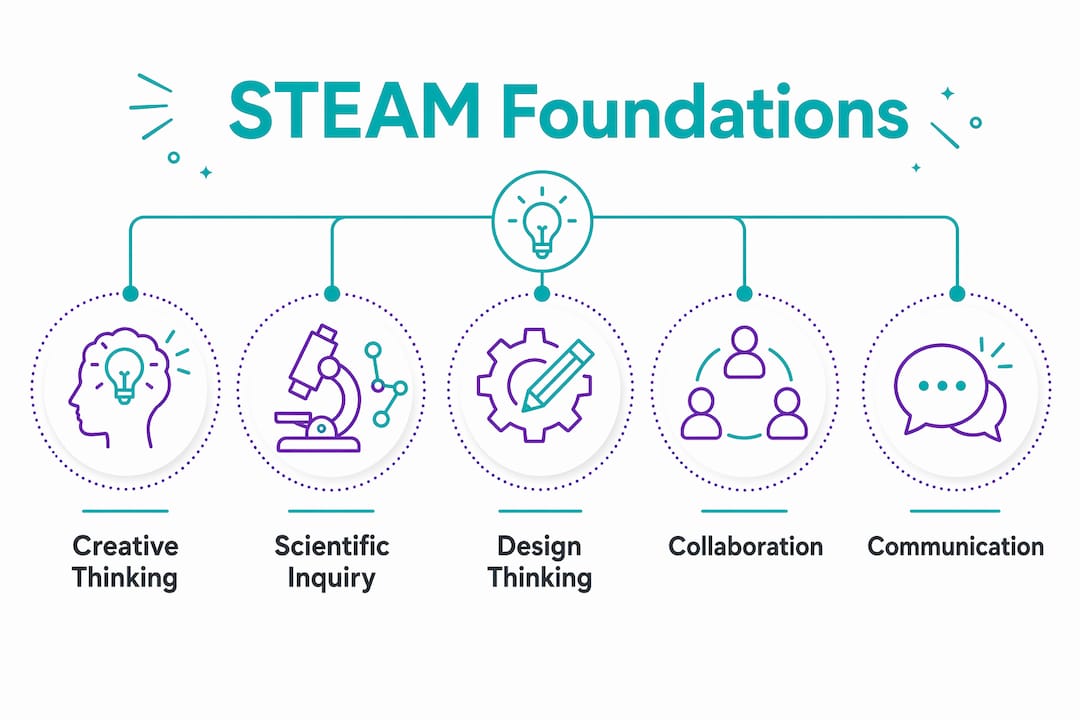
The foundational concepts in STEAM are not a checklist of facts. They are a set of thinking habits and skills that children build through repeated, varied experience. Balancing theoretical knowledge and practical experimentation nurtures collaboration and critical thinking as high-demand future workforce skills. The table below maps the core skills to what they look like in practice for children in this age range.
| STEAM Skill | What It Looks Like in Practice |
|---|---|
| Creative problem solving | A child redesigns a failed experiment rather than giving up |
| Scientific inquiry | Asking “what if” questions and testing predictions with simple materials |
| Collaboration | Working in small groups to build, debate, and refine a shared solution |
| Technological dexterity | Using basic tools, measuring instruments, or simple coding to complete a task |
| Critical thinking | Evaluating why one design worked better than another and explaining the reasoning |
| Communication and reflection | Writing or drawing about what was learned and what would be done differently |
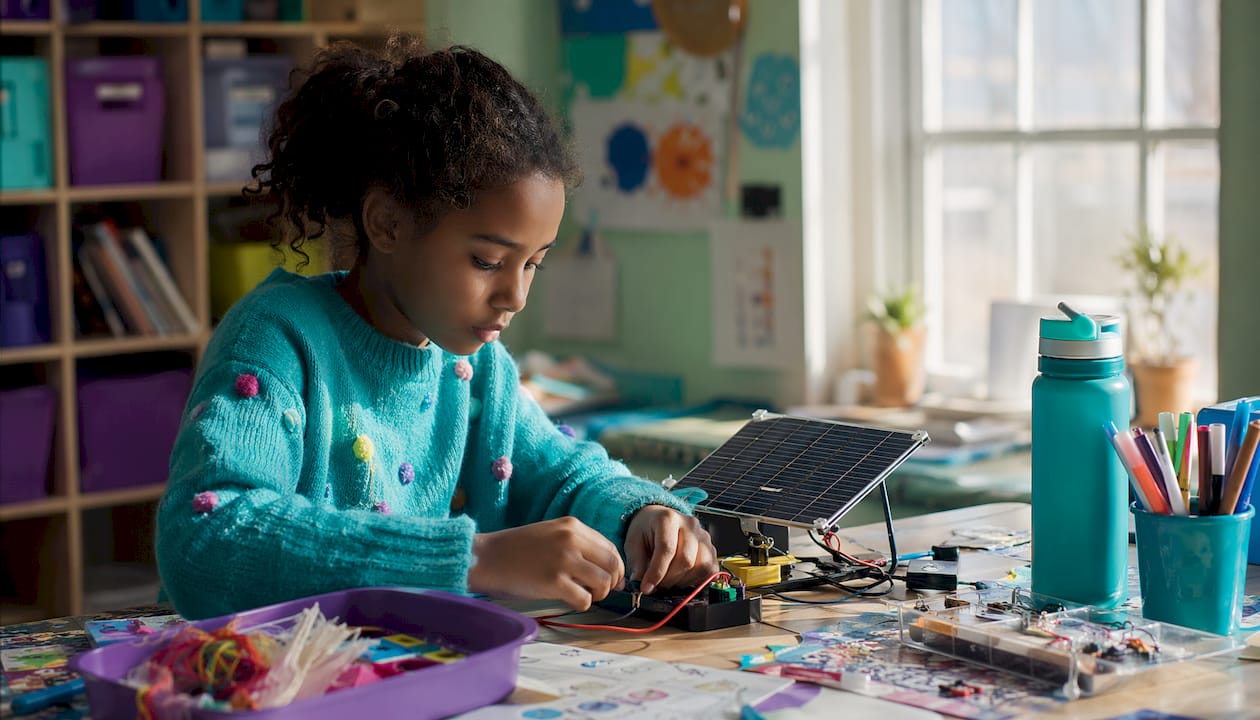
These skills do not develop in isolation. A child who conducts a solar energy experiment is practicing scientific inquiry, technological dexterity, and critical thinking simultaneously. That overlap is exactly what makes STEAM so effective as a foundational approach.
Soft skills like adaptability and communication are equally part of the STEAM foundation. Music enhances language and literacy skills in children, which directly supports the communication and reflection skills that STEAM projects require. The arts and sciences are not opposites. They are partners in building a complete thinker.
Pro Tip: Rotate the role of “team leader” during group STEAM projects. Every child gets practice directing, listening, and adapting, which builds the communication and adaptability skills that no worksheet can teach.
What are the most common pitfalls in building a STEAM foundation?
The most common mistake in STEAM education is treating arts as decoration. Surface-level arts integration, such as coloring a diagram of a cell or gluing googly eyes onto a robot, does not constitute STEAM. True STEAM requires arts as an active tool in problem solving and innovation. When arts are cosmetic, children miss the cognitive benefits entirely.
A second pitfall is emotional neglect. True STEAM education requires emotional and psychological support for children to confidently integrate creative imagination with analytical skills. A child who fears being wrong will not take the creative risks that STEAM demands. Building psychological safety in the classroom or at home is not a soft extra. It is a structural requirement.
Educators also face real logistical barriers. Curriculum resources and professional development are crucial to overcoming these challenges and ensuring deep arts integration in STEAM. Organizations like STEM.org provide frameworks that treat arts integration as a quality marker, not an optional enrichment. Parents and caregivers can support this at home by choosing materials that reflect the same standard.
- Avoid cosmetic arts: Choose projects where art serves a function, such as designing a prototype or communicating data visually.
- Build emotional safety: Celebrate attempts, not just correct answers. Let children see adults wrestle with problems too.
- Choose depth over breadth: One well-designed interdisciplinary project teaches more than five disconnected activities.
- Support educator development: Advocate for professional development that trains teachers in genuine STEAM integration, not just STEM with an art day.
- Use identity-building tools: Help children see themselves as scientists and creators through role play, titles, and reflection journals.
Understanding the difference between STEAM and STEM is the first step toward avoiding these pitfalls. Once you see the distinction clearly, the right choices become much easier to make.
Key Takeaways
A strong STEAM foundation built during ages 5–13 is the single most effective investment educators and parents can make in a child’s long-term learning, creativity, and confidence.
| Point | Details |
|---|---|
| Arts are not optional in STEAM | Arts drive design thinking, retention, and resilience, making them central to real STEAM learning. |
| Ages 5–13 are critical | This window shapes curiosity and learning identity; disconnected experiences cause lasting disengagement. |
| Real-world problems motivate | Authentic challenges turn children from passive learners into active, confident problem-solvers. |
| Avoid surface-level integration | Cosmetic arts projects undermine STEAM; arts must function as a tool in problem solving. |
| Emotional safety enables learning | Children need psychological support to take the creative risks that STEAM demands. |
What I have learned from watching children unlock their inner genius
I have spent years watching children light up the moment a project connects to something real. The ones who struggle most in traditional classrooms are often the ones who thrive hardest in STEAM. That pattern is not a coincidence. It is evidence that the foundation we build matters more than the content we deliver.
What surprises most educators and parents is how quickly children rise to meet a genuine challenge. Give a seven-year-old a real problem, the right materials, and permission to fail, and you will see something remarkable. They do not give up. They iterate. They argue, collaborate, and try again. That is not a personality trait. It is a skill that a strong STEAM foundation builds deliberately.
The mistake I see most often is adults underestimating children. We simplify problems until they are no longer interesting, and then we wonder why kids disengage. The research is clear: children ages 5–13 can handle complexity when they have structure and support. Our job is not to make it easier. Our job is to make it meaningful.
The arts piece is where I see the biggest gap between what schools say and what they do. Painting a volcano is not STEAM. Designing a model of a real geological event, writing about the science behind it, and presenting findings to a peer group is STEAM. The difference is whether the child is a consumer or a creator. Always aim for creator.
— Tita
Teamgeniussquad’s hands-on kits that build real STEAM foundations
Teamgeniussquad designs every kit around the belief that children learn best by doing, not watching. Each hands-on experiment kit is built on the E³ Method (Engage, Encourage, Empower), guiding children from curiosity to confidence through purposeful, screen-free discovery. The kits are not just activities. They are identity-building experiences where children step into the role of scientist, creator, and innovator.
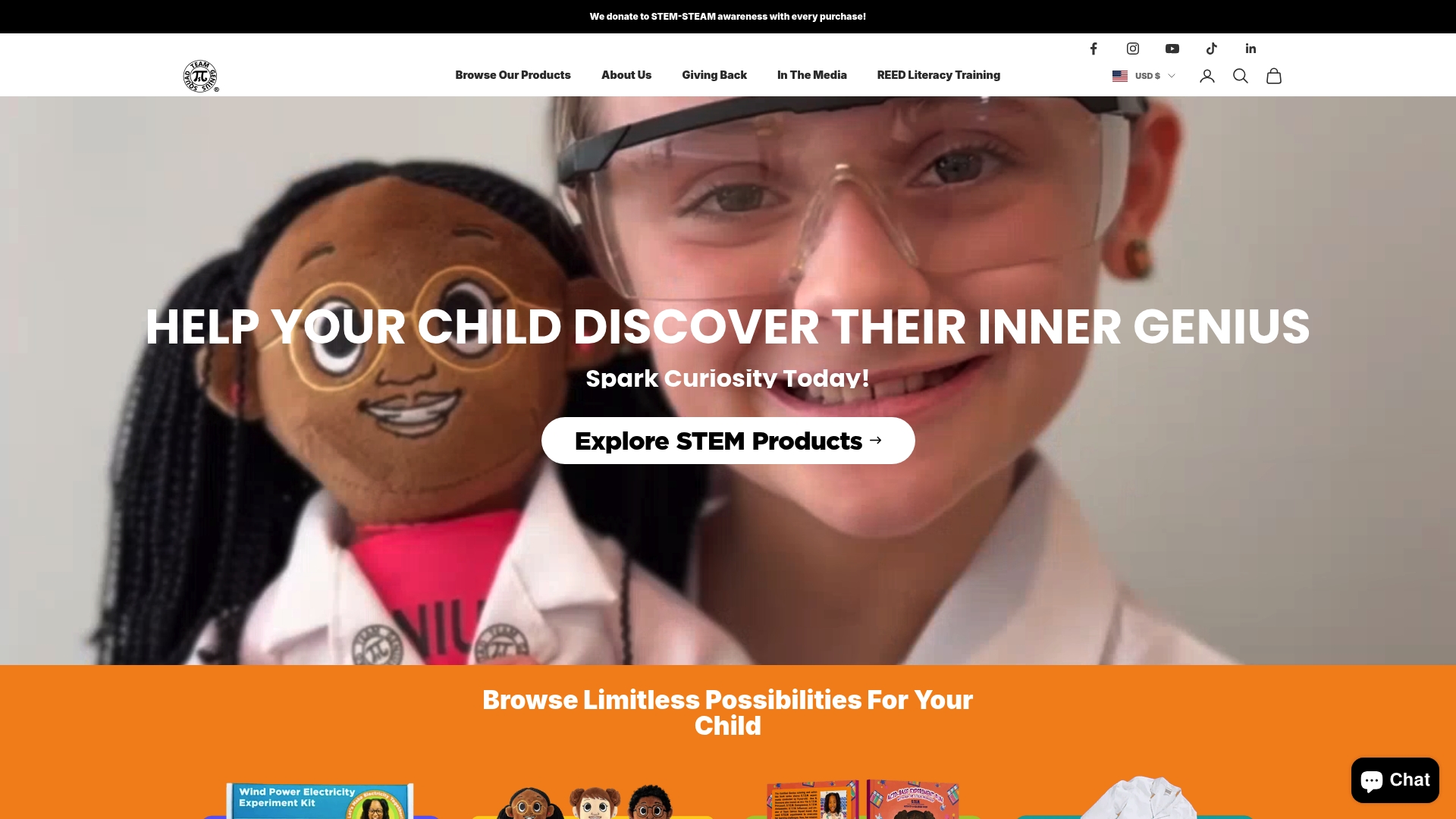
Whether you are a parent looking for a meaningful weekend project or an educator seeking curriculum-aligned materials, Teamgeniussquad offers resources that reflect the same research-grounded principles covered in this article. From STEAM books and puzzles to full experiment labs, every product is designed to make the STEAM foundation feel exciting, achievable, and real for every child ages 5–13.
FAQ
What is a STEAM foundation for children?
A STEAM foundation is the integrated development of Science, Technology, Engineering, Arts, and Mathematics skills during early childhood. It builds creative thinking, critical reasoning, and problem-solving habits that support all future learning.
Why does the arts component matter in STEAM?
Arts drive design thinking, iterative problem solving, and multimodal communication, skills that a review of 62 arts education studies confirms improve engagement and persistence in STEM learning equally.
What age is best to start building a STEAM foundation?
Ages 5–13 are the critical formation window. Research shows that disconnected or purely theoretical experiences during this period cause children to lose the curiosity needed for sustained STEAM engagement later in life.
How can parents support a STEAM foundation at home?
Parents can choose hands-on, interdisciplinary materials that connect science and creativity, celebrate effort over correct answers, and use identity-building tools like role play and reflection to help children see themselves as innovators.
What is the difference between STEAM and STEM?
STEM covers Science, Technology, Engineering, and Mathematics. STEAM adds Arts as a functional discipline, not a decorative one, making it a fuller approach that develops creativity, empathy, and communication alongside technical skills.


Leave a comment
This site is protected by hCaptcha and the hCaptcha Privacy Policy and Terms of Service apply.