

Life Cycle of a Low Mass Star: Student Guide
The life cycle of a low mass star is defined by extraordinarily slow hydrogen fusion, a lifespan that can stretch into the trillions of years, and a quiet final stage as a white dwarf. Low mass stars, generally those with less than 0.6 solar masses, follow a path through the main sequence, red giant, planetary nebula, and white dwarf stages. Stellar evolution, the formal term astronomers use for this process, is modeled rather than observed for low mass stars because the universe is only 13.8 billion years old and no low mass star has yet completed its full cycle. Understanding these stages builds the foundation for all of astrophysics, from how galaxies age to why most stars in the universe are still burning today.
What defines a low mass star and how does it differ from higher mass stars?
A low mass star is any star with a mass below roughly 0.6 solar masses. The Sun, at one solar mass, sits in the intermediate range and follows a related but distinct evolutionary path. Red dwarf stars like Proxima Centauri are the most familiar examples of true low mass stars, and they make up the majority of all stars in the Milky Way.
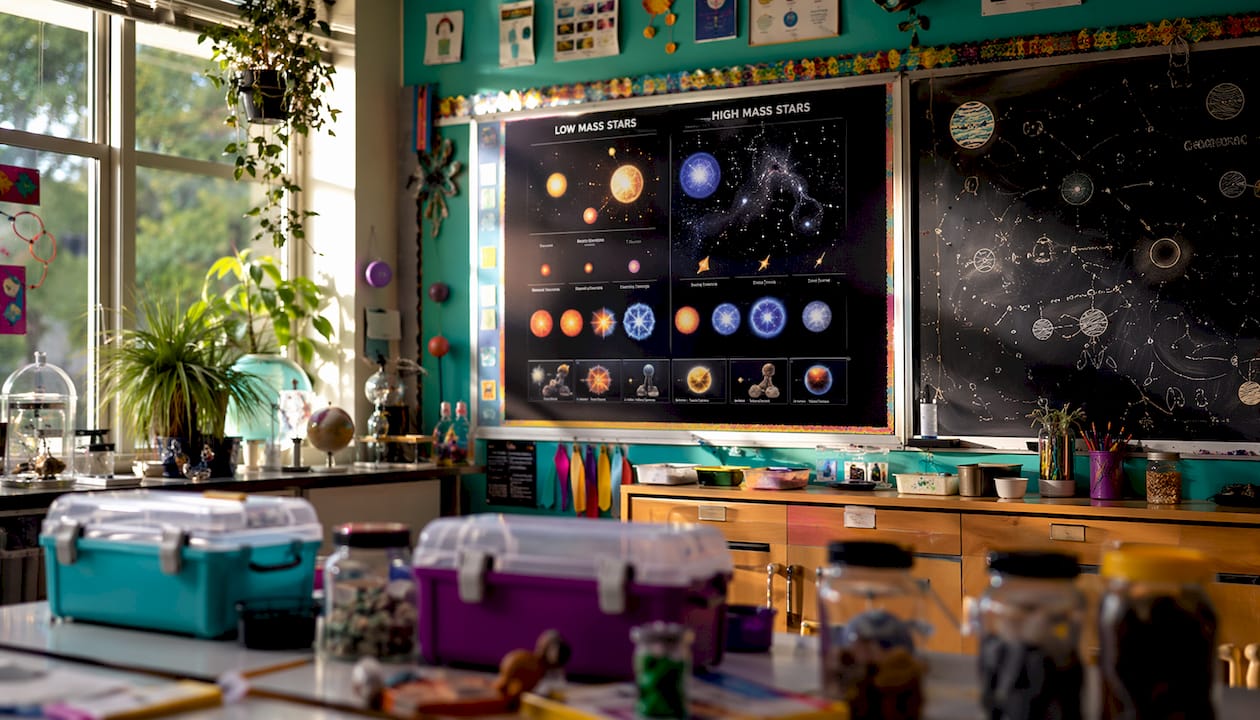
The internal structure of a low mass star differs sharply from that of a massive star. Stars below about 0.35 solar masses are fully convective, meaning their entire interior circulates like a boiling pot. This constant mixing prevents helium from accumulating in the core, which has a major consequence: these stars never build up the helium core needed to trigger a red giant phase. Intermediate and high mass stars, by contrast, develop a layered structure with a distinct helium core, which eventually drives red giant expansion and, in the most massive cases, a supernova.
The key differences between low mass and high mass stars come down to a few physical realities:
- Mass threshold: Stars below 0.6 solar masses are classified as low mass; those above roughly 8 solar masses are high mass stars that end in supernovae.
- Core fusion: Low mass stars fuse hydrogen at a slow, steady rate. High mass stars burn through their fuel rapidly and violently.
- Convection: Stars below 0.35 solar masses are fully convective, mixing fuel throughout. Higher mass stars develop radiative cores with convective outer zones.
- Lifespan: Low mass stars live far longer than massive stars, which may burn out in just a few million years.
- Remnant: Low mass stars leave behind white dwarfs. High mass stars leave neutron stars or black holes.
The Chandrasekhar limit of approximately 1.4 solar masses defines the maximum mass a white dwarf can sustain before gravitational collapse takes over. Low mass stars always produce white dwarfs well below this threshold, which is why they end their lives quietly rather than in catastrophic explosions.
What are the main stages in the life cycle of a low mass star?
The low mass star lifecycle follows a clear sequence, each stage driven by the balance between gravity and the outward pressure of nuclear fusion or, eventually, quantum mechanical forces.
-
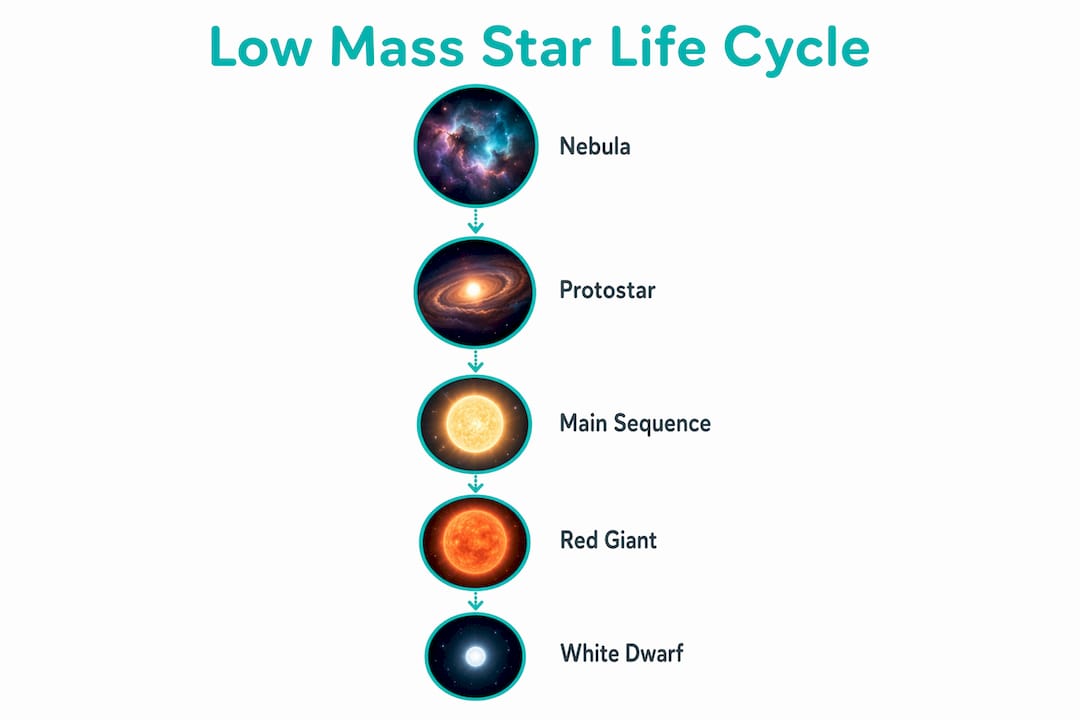
Nebula and protostar: Stars form from nebulae collapsing under gravity. As a cloud of gas and dust contracts, it heats up and forms a protostar. The protostar continues to gather mass until core temperatures reach the threshold for hydrogen fusion.
-
Main sequence: Once hydrogen fusion ignites at the core, the star enters the main sequence. This is the longest and most stable phase of low mass star evolution. The star fuses hydrogen into helium at a slow, steady rate, and the outward pressure of fusion balances the inward pull of gravity. A star near 0.6 solar masses spends over 100 billion years in this phase alone.
-
Red giant (for stars above ~0.35 solar masses): When hydrogen in the core runs low, the core contracts and heats up while outer layers expand and cool. The star swells into a red giant, becoming far larger and redder than before. Helium fusion begins in the core during this phase, releasing additional energy.
-
Planetary nebula: The red giant eventually sheds its outer layers in a glowing shell of gas called a planetary nebula. The name is misleading since it has nothing to do with planets. It is simply the expelled outer atmosphere of the dying star, illuminated by the hot core left behind.
-
White dwarf: The exposed core becomes a white dwarf. This dense remnant is supported not by fusion but by electron degeneracy pressure, a quantum mechanical effect that resists further collapse regardless of temperature.
-
Blue dwarf (theoretical): For the smallest low mass stars, models predict a blue dwarf phase before the white dwarf stage. As hydrogen runs low, the star heats up and shrinks slightly, glowing blue before fading. No blue dwarf has ever been observed because the universe is not old enough for any star to have reached this point.
-
Black dwarf (theoretical): White dwarfs cool over billions to trillions of years. Eventually, they should fade into cold, dark black dwarfs. No black dwarf exists yet because the cooling timescale exceeds the current age of the universe.
Pro Tip: When teaching these stages, pair each phase with a physical process. Main sequence equals hydrogen fusion. Red giant equals core contraction plus helium fusion. White dwarf equals electron degeneracy pressure. Connecting physics to each stage makes the sequence stick.
How long do low mass stars live and why is their lifespan so extraordinary?
Low mass stars live longer than any other type of star, and the reason is straightforward physics. Lower mass means lower gravitational compression on the core. Lower compression means lower core temperature and pressure. Lower pressure means a slower fusion rate.
Low mass stars burn hydrogen at a much slower rate due to lower gravitational pressure. That reduced fusion rate is the direct cause of their extraordinary longevity, allowing lifespans that dwarf even the current age of the universe.
A star near 0.6 solar masses spends over 100 billion years on the main sequence. The universe itself is only 13.8 billion years old. That means every low mass star that has ever formed is still on the main sequence today, still fusing hydrogen, still shining. Not one has yet reached the red giant or white dwarf stage.
Fully convective stars below 0.35 solar masses extend their lifespans even further. Because their interiors constantly mix, fresh hydrogen from the outer layers continuously feeds the core. This prevents the helium buildup that would otherwise end the main sequence phase. The result is a star that uses nearly all of its hydrogen fuel before exhausting its supply, pushing lifespans toward the trillions of years.
Contrast this with the life cycle of a high mass star. A star with 20 solar masses burns through its fuel in just a few million years. It lives fast, dies violently in a supernova, and leaves behind a neutron star or black hole. The life cycle of a massive star is dramatic and brief. The low mass star lifecycle is quiet and almost incomprehensibly long.
What misconceptions often arise about low mass star evolution?
Several common misunderstandings appear regularly in astronomy classrooms, and clearing them up sharpens understanding of the full picture.
- All stars explode when they die. This is false for low mass stars. Low mass stars shed outer layers as planetary nebulae and leave white dwarfs. Only high mass stars produce supernovae.
- All stars become red giants. Stars below about 0.35 solar masses are fully convective and skip the red giant phase entirely. They never build the helium core that triggers expansion.
- Planetary nebulae are related to planets. The term is historical and misleading. A planetary nebula is the expelled outer atmosphere of a dying star, not a planet-forming disk.
- White dwarfs are still fusing fuel. White dwarfs produce no fusion energy. They are supported entirely by electron degeneracy pressure, a quantum effect that does not require heat or nuclear reactions.
- Black dwarfs exist somewhere in the universe. No black dwarf has ever been observed. The cooling timescale for a white dwarf to become a black dwarf exceeds the current age of the universe.
Pro Tip: Use the contrast between low and high mass star deaths as a teaching anchor. Ask students: “Which star goes out with a bang, and which fades quietly?” That single question organizes the entire comparison between the life cycle of a massive star and the fate of a low mass one.
Exploring star phases through hands-on activities helps students move past these misconceptions by connecting abstract models to tangible experiences.
Key Takeaways
The life cycle of a low mass star is the longest stellar process in the universe, driven by slow hydrogen fusion, full convection in the smallest stars, and a final quiet stage as a white dwarf supported by electron degeneracy pressure.
| Point | Details |
|---|---|
| Extraordinary lifespan | Stars near 0.6 solar masses spend over 100 billion years on the main sequence alone. |
| Fully convective stars skip red giants | Stars below 0.35 solar masses mix hydrogen continuously and never develop a red giant phase. |
| White dwarfs are quantum objects | Electron degeneracy pressure, not fusion, holds white dwarfs together against gravity. |
| Black dwarfs remain theoretical | No white dwarf has cooled long enough to become a black dwarf; the universe is too young. |
| Low mass vs. high mass deaths | Low mass stars fade as white dwarfs; high mass stars explode as supernovae and leave neutron stars or black holes. |
Why teaching stellar evolution changed how I think about time
Teaching the life cycle of a low mass star forces you to confront something most science topics never ask of students: the idea that some processes are simply too slow for any human, or any civilization, to witness directly. Every stage beyond the main sequence for a low mass star is a prediction, not an observation. That is not a weakness in the science. It is one of the most powerful demonstrations of what physics can do.
What I have found works best in the classroom is leaning into that strangeness. When students realize that every red dwarf they see in the night sky is still in its infancy, cosmically speaking, it reframes the entire conversation about stellar evolution. The contrast with the life cycle of a high mass star is equally powerful. A massive star lives millions of years and dies in a supernova we can actually see. A low mass star lives trillions of years and fades so slowly that no instrument will ever record its final breath.
The misconception I correct most often is the assumption that “death” in stellar terms means something dramatic. For low mass stars, it means a gradual dimming over timescales that make the age of the universe look brief. That reframe alone tends to produce the most genuine curiosity I see from students. Pair that with a hands-on star life cycle guide and the concepts move from abstract to real in a way that lectures alone rarely achieve.
— Tita
Bring stellar evolution to life with Teamgeniussquad
Astronomy concepts like stellar evolution become genuinely exciting when students can connect them to real experiments and discovery tools. Teamgeniussquad builds hands-on, screen-free STEAM kits designed to help children ages 5–13 step into the role of young scientists, using the trademarked E³ Method (Engage, Encourage, Empower) to guide every learning moment.

Whether you are teaching in a classroom or at home, Teamgeniussquad’s STEM books and puzzles give students a tangible way to explore science concepts that feel abstract on paper. Find the full collection of discovery kits and learning tools at the Teamgeniussquad shop and give young learners the experience of thinking like real scientists.
FAQ
What is the life cycle of a low mass star?
The life cycle of a low mass star moves from nebula to protostar, then through a long main sequence phase, followed by red giant, planetary nebula, and white dwarf stages. Stars below 0.35 solar masses skip the red giant phase entirely due to full convection.
How long does a low mass star live?
A low mass star near 0.6 solar masses spends over 100 billion years on the main sequence. Fully convective stars below 0.35 solar masses may live even longer, potentially into the trillions of years.
Why don’t low mass stars explode like massive stars?
Low mass stars lack the core mass needed to trigger a supernova. They shed outer layers as planetary nebulae and leave behind white dwarfs, while high mass stars collapse violently and explode.
What is a white dwarf and how is it supported?
A white dwarf is the dense remnant left after a low mass star sheds its outer layers. It is supported against gravitational collapse by electron degeneracy pressure, a quantum mechanical effect that requires no ongoing fusion.
Have any low mass stars completed their full life cycle?
No. The universe is 13.8 billion years old, and low mass stars live far longer than that. Every low mass star ever formed is still on the main sequence, making later stages like blue dwarfs and black dwarfs entirely theoretical at this point in cosmic history.



Leave a comment
This site is protected by hCaptcha and the hCaptcha Privacy Policy and Terms of Service apply.