
Bending Light Explained: Science Guide for Families
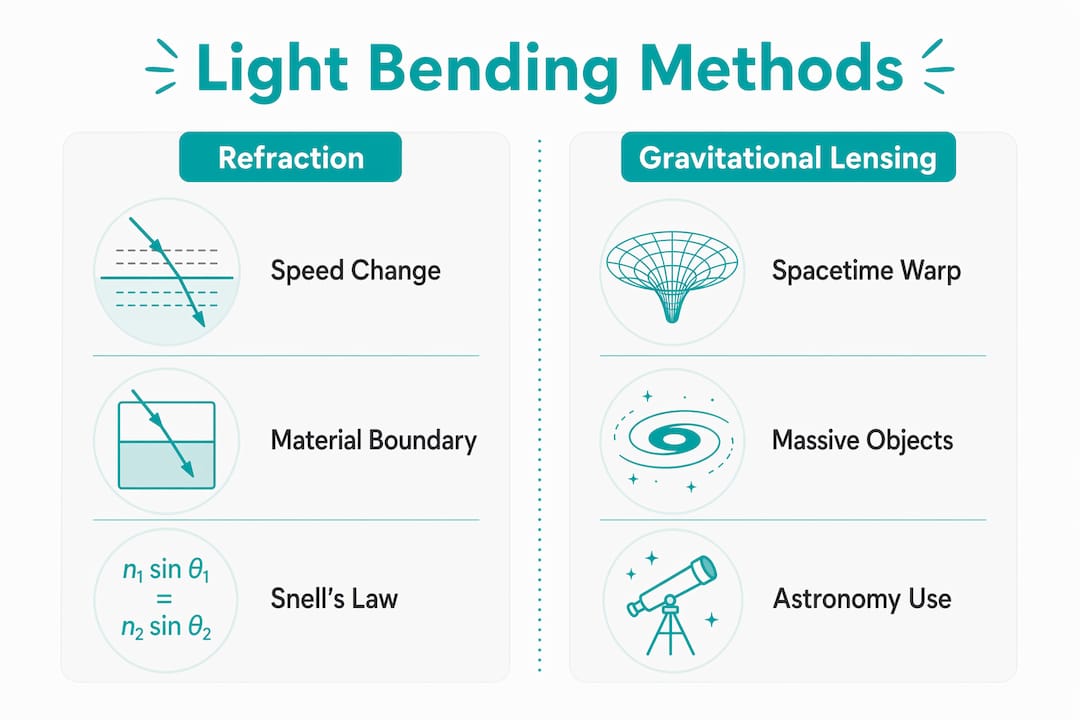
Bending light is defined as the change in direction of light rays when they cross from one medium into another with different optical properties, a process scientists call refraction. This phenomenon is governed by Snell’s Law, expressed as n1 sin θ1 = n2 sin θ2, which predicts exactly how much a light ray will bend at any boundary. The refractive index of a material measures how much it slows light down. Air has a refractive index of 1.0, while water sits at 1.33, which is why a straw in a glass of water looks broken at the surface. Beyond refraction, gravity itself bends light through a process called gravitational lensing, proving that the light bending phenomenon reaches far beyond the classroom.
How does bending light actually work?
Light bends because it changes speed when it moves from one material into another. Think of the refractive index as a speed limit posted for each material. In a vacuum, light travels at roughly 3×10^8 m/s, but inside water it slows to about 2.25×10^8 m/s. That speed drop is what forces the light ray to change direction.
The direction of the bend depends on whether light is speeding up or slowing down.
- Entering a denser medium (like air into water): light slows down and bends toward the normal line, an imaginary line drawn perpendicular to the surface.
- Entering a less dense medium (like water into air): light speeds up and bends away from the normal line.
- Hitting a surface straight on (at 0° to the normal): light passes through without bending at all.
A useful analogy is a shopping cart rolling from pavement onto grass at an angle. The wheel that hits the grass first slows down, causing the cart to turn. Light behaves the same way. The side of the wavefront that enters the new medium first slows down, and the whole wave pivots.
Snell’s Law makes this pivot mathematically predictable. Plug in the refractive indexes of both materials and the angle of the incoming ray, and the formula tells you the exact exit angle. This precision is what makes optical engineering possible, from camera lenses to corrective eyeglasses.

Pro Tip: Think of the refractive index as a “speed limit” for light inside a material. The higher the number, the slower light travels, and the sharper the bend at the boundary.
What are the best experiments to see light refraction in action?
Seeing the light bending phenomenon with your own eyes makes the science click far faster than reading about it. These experiments work at home or in a classroom with minimal supplies.
Classic pencil in water. Place a pencil in a clear glass of water and look from the side. The pencil appears to snap at the waterline. Your eyes interpret the refracted rays as if they traveled in a straight line, so the pencil looks offset. This optical illusion results from your brain assuming light always travels straight, even when it does not.
Laser pointer in milky water. Fill a clear container with water and add one drop of milk. Shine a laser pointer through the side of the container. The milk scatters the beam, making the entire path of the refracted light visible as a glowing line inside the water. This beats the pencil demo for engagement because learners can watch the bend happen in real time.
Prism and white light. A glass prism separates white light into its full spectrum of colors because each wavelength refracts at a slightly different angle. Red light bends the least; violet bends the most. Rainbows work on exactly this principle, with water droplets acting as millions of tiny prisms.
Total internal reflection demo. Shine a flashlight through the side of a full water bottle at a steep angle. At a certain point, the light stops exiting the water and bounces entirely back inside. Total internal reflection occurs when light moves from a denser medium to a less dense one beyond a critical angle. Diamonds exploit this effect to produce their signature sparkle.
Pro Tip: For the laser and milk experiment, use a green laser pointer. Green light scatters more visibly than red, making the beam path easier to see in a lit classroom.
What is gravitational lensing and how does it bend light?
Gravitational lensing is the bending of light caused by massive objects warping the fabric of spacetime, not by a change in material medium. Albert Einstein’s general theory of relativity predicted this effect, and it was confirmed during the 1919 solar eclipse, when astronomers measured starlight deflecting by about 1.75 arcseconds as it passed the edge of the Sun. That measurement matched Einstein’s prediction almost exactly and changed physics permanently.
The table below compares refraction and gravitational lensing side by side.
| Feature | Refraction | Gravitational lensing |
|---|---|---|
| Cause | Speed change between media | Spacetime curvature from mass |
| Governed by | Snell’s Law | Einstein’s general relativity |
| Scale | Everyday objects and labs | Stars, galaxies, black holes |
| Deflection amount | Varies by refractive index | Up to tens of degrees near black holes |
| Practical use | Lenses, fiber optics, optics | Mapping dark matter, finding exoplanets |
Near a black hole, deflection can reach tens of degrees, far beyond anything a glass lens produces. Astronomers use this effect as a natural telescope. Gravitational lensing allows scientists to observe dark matter and distant exoplanets by analyzing how their gravity bends the light of objects behind them. Space itself acts as a lens, and the effects are measurable even on light that left ancient galaxies billions of years ago.
The key distinction for learners is this: refraction bends light because a material slows it down. Gravitational lensing bends light because mass curves the space the light travels through. Both are real, both are measurable, and both follow precise mathematical rules.
How is bending light used in everyday life and technology?
Refraction enables technologies that most people use every single day without realizing it. Understanding how light bends is not just a classroom exercise. It is the foundation of industries worth trillions of dollars.
- Eyeglasses and contact lenses use curved glass or plastic to refract incoming light onto the correct spot on the retina. A person with nearsightedness has a lens that focuses light in front of the retina. A corrective lens bends the light outward first, shifting the focal point back to where it belongs.
- Camera lenses stack multiple curved glass elements to control how light bends before hitting the sensor. Each element corrects for a specific distortion, producing a sharp image.
- Fiber optic cables carry internet data as pulses of light. They rely on total internal reflection to keep light trapped inside a thin glass fiber across thousands of miles. Without the bending principles discovered in optics labs, high-speed internet would not exist.
- Rainbows form when sunlight enters a raindrop, refracts, reflects off the back of the drop, and refracts again on the way out. Each color exits at a slightly different angle, spreading white sunlight into a full arc of color.
- Mirages occur when hot air near the ground has a lower refractive index than cooler air above it. Light from the sky bends upward as it enters the hotter layer, and your eyes interpret it as a reflection on the ground, which looks like water.
Teaching these connections matters. Connecting light bending theory to everyday life increases student interest and helps learners see science as relevant rather than abstract. A child who understands why their glasses work is far more likely to stay curious about physics.
Key Takeaways
Refraction is the primary cause of bending light, governed by Snell’s Law and driven by speed changes between materials with different refractive indexes.
| Point | Details |
|---|---|
| Refraction drives bending | Light bends because it changes speed at the boundary between two materials. |
| Snell’s Law predicts angles | The formula n1 sin θ1 = n2 sin θ2 calculates the exact bend angle for any two media. |
| Refractive index as speed limit | Air is 1.0, water is 1.33; the higher the index, the slower light travels and the sharper the bend. |
| Gravitational lensing extends the concept | Massive objects curve spacetime, bending light without any material medium involved. |
| Real-world applications are everywhere | Eyeglasses, fiber optics, cameras, and rainbows all depend on controlled light bending. |
Why I think we teach light bending the wrong way
The biggest mistake I see in optics education is starting with the formula. Teachers write Snell’s Law on the board before a single student has watched a laser beam bend in a tank of water. The formula means nothing without the experience behind it.
The second mistake is language. Saying “light bends” implies the ray curves like a garden hose. Light does not physically curve. It changes direction at a boundary because one side of the wavefront slows down before the other. That distinction sounds small, but it shapes how a learner thinks about every optics problem that follows.
My strongest recommendation is to run the milk-and-laser experiment before any lecture. Let learners predict what will happen, watch the beam bend, and then ask why. Curiosity-driven questions are the best entry point into Snell’s Law. Once a child has seen the beam pivot in real time, the math becomes an explanation of something they already witnessed, not an abstract rule to memorize.
The gravitational lensing section of any light unit is where learners’ eyes light up. Telling a ten-year-old that the universe itself bends light, and that we used that fact to find planets around other stars, is the kind of moment that builds a lifelong interest in science. Lead with the wonder. The equations will follow.
— Tita
Hands-on light science kits from Teamgeniussquad
Teamgeniussquad builds screen-free STEAM kits that turn abstract science into something children can hold, test, and repeat. The DIY Lamp S.T.E.M. Kit gives learners a direct, tactile way to explore how light behaves, from building the source to observing how it travels and bends. Each kit follows the E³ Method: Engage, Encourage, Empower, so children move from curiosity to confidence through real discovery.

For educators and parents ready to bring optics to life, the full experiment kits collection covers physics topics including light, energy, and reflection. These kits are designed for ages 5–13 and work equally well at a kitchen table or in a classroom. Children do not just learn how light bends. They experience it, remember it, and own it.
FAQ
What causes light to bend when it enters water?
Light bends when entering water because it slows from roughly 3×10^8 m/s in air to about 2.25×10^8 m/s in water. That speed change at the boundary forces the ray to change direction, a process called refraction.
What is Snell’s Law in simple terms?
Snell’s Law is the formula that predicts exactly how much light will bend at the boundary between two materials. It uses the refractive indexes of both materials and the incoming angle to calculate the outgoing angle.
Why does a straw look broken in a glass of water?
The straw looks broken because light from the submerged part bends as it exits the water, but your eyes assume light always travels in a straight line. The brain places the straw where the bent rays appear to originate, which is offset from its real position.
What is the difference between refraction and gravitational lensing?
Refraction bends light because a material changes its speed. Gravitational lensing bends light because a massive object curves spacetime itself, with no material medium required. Both follow precise mathematical rules but operate at completely different scales.
Can kids do light bending experiments at home?
Yes. The pencil-in-water demo requires only a glass and water. Adding a drop of milk and shining a flashlight through the container makes the refracted beam visible and turns a simple kitchen setup into a real optics demonstration.


Leave a comment
This site is protected by hCaptcha and the hCaptcha Privacy Policy and Terms of Service apply.