Star phases: Hands-on STEAM activities for confident kids
Most of us picture a star’s life as a neat, straight line: it’s born, it shines, it dies. Simple enough to sketch on a napkin. But that picture leaves out one of the most fascinating truths in all of astronomy, which is that a star’s journey depends entirely on how massive it is, and the path it takes can branch in wildly different directions. Some stars quietly fade into white dwarfs, while others explode with unimaginable force and leave behind black holes. For children, especially those who learn differently, discovering that science rarely follows a single, predictable road is more than an astronomy lesson. It’s a confidence-building revelation.
Table of Contents
- What are star phases? Explaining the basics
- Why star phases branch: The role of mass
- Hands-on activities to explore star phases
- Accessible printables and digital tools for star phases
- What most star phase guides miss: Branching and confidence-building
- Next steps: Inspiring more hands-on science with Team Genius Squad
- Frequently asked questions
Key Takeaways
| Point | Details |
|---|---|
| Main sequence lasts longest | Most stars spend billions of years stabilizing by burning hydrogen during the main sequence phase. |
| Mass shapes star destiny | A star’s mass decides whether it ends as a white dwarf, neutron star, or black hole. |
| Multimodal learning helps | Using visual, tactile, and step-by-step activities builds confidence in neurodivergent kids. |
| Hands-on tools reinforce concepts | Interactive resources and printables make the branching structure of star phases clear and fun. |
| Branching models beat linear | Presenting star phases as a branching path, not a single line, helps all learners understand and remember. |
What are star phases? Explaining the basics
Now that we’ve framed how star journeys are more than a straight line, let’s clarify the essential vocabulary and the sequence most activities use.
Before any hands-on activity can take flight, children need a foundation of clear, memorable language. Star phases, also called stages in stellar evolution, describe the major changes a star goes through from the moment it begins forming inside a cloud of gas and dust all the way to its dramatic final chapter. Learning these terms gives young scientists a shared vocabulary that makes every experiment richer and more meaningful.
Here are the key stages most star life cycle activities introduce, described in plain, kid-friendly terms:
- Nebula: A giant cloud of gas and dust in space where stars are born. Think of it as a star’s nursery.
- Protostar: The early, warming stage when gravity pulls the nebula together and the core begins to heat up.
- Main sequence: The long, stable “working life” of a star. Our own Sun has been in this phase for about 4.6 billion years. NASA’s free resources introduce stage vocabulary like nebula, red giant, supernova, white dwarf, and black hole for learners of all ages.
- Red giant or red supergiant: As a star runs low on hydrogen fuel, it expands dramatically and cools at the surface, glowing red.
- White dwarf: The dense, glowing remnant left behind when a lower-mass star sheds its outer layers.
- Supernova: A colossal explosion that marks the end of a high-mass star’s life.
- Neutron star or black hole: The extreme objects that remain after a supernova, depending on the original star’s mass.
The main sequence is the longest and most stable phase in typical stellar evolution, when a star fuses hydrogen into helium in its core and maintains a careful balance between the inward pull of gravity and the outward push of fusion pressure. For children just beginning their star journey, understanding this phase as the “everyday life” of a star makes the later, more dramatic stages feel even more exciting by contrast.
“Stars are like stories. The beginning and ending are dramatic, but the long middle chapter is where the real magic of balance and stability happens.”
Framing the main sequence as a star’s “daily life” is a powerful way to help children, especially those who think in narratives and metaphors, connect emotionally to the science. When kids understand what is “normal” for a star, the deviations become thrilling surprises rather than confusing detours.
Why star phases branch: The role of mass
With basic vocabulary covered, it’s time to reveal the real twist: not all stars complete their journey the same way. It depends on their mass.
This is where astronomy gets genuinely exciting, and where most classroom resources fall short. A common teaching approach presents star phases as a single, universal sequence. In reality, phase ordering is not identical for all stars, because mass determines the branch a star takes after leaving the main sequence. That branching structure is a gift for curious young minds because it introduces the concept of variables, of cause and effect, and of decision-making in nature.
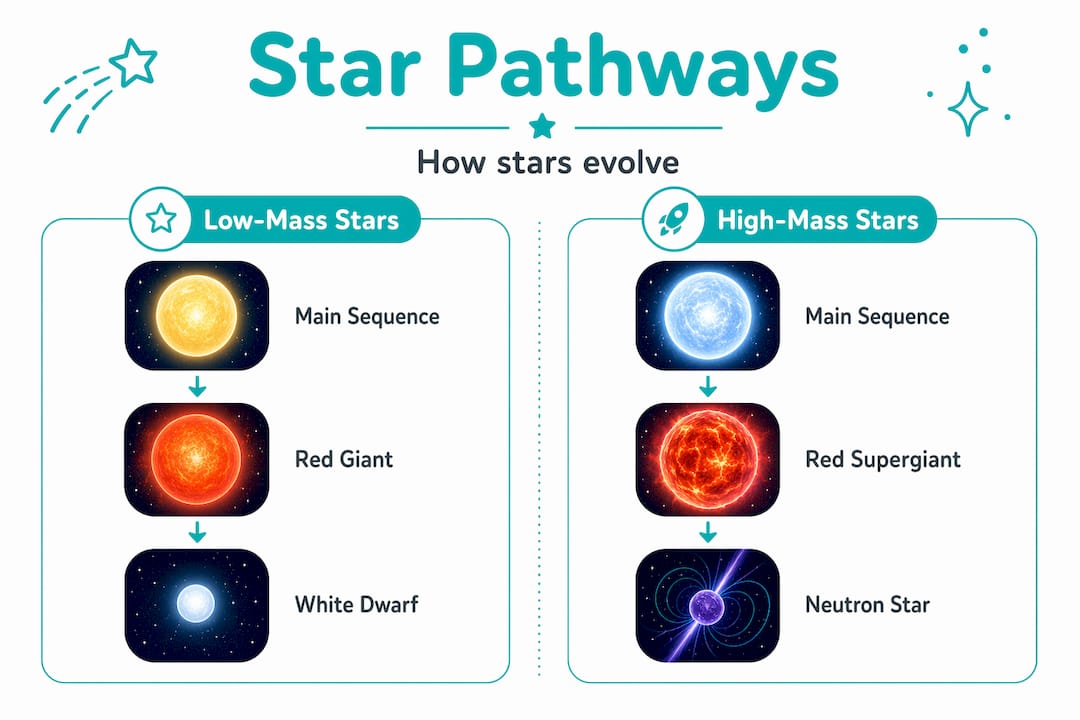
A widely used kid-facing phase ordering looks like this:
- Nebula or protostar
- Main sequence
- Red giant (low-mass) or red supergiant (high-mass)
- Branch point based on mass:
- Low-mass stars shed their outer layers, form a planetary nebula, and become a white dwarf.
- High-mass stars explode in a supernova and leave behind a neutron star or, if massive enough, a black hole.
Here is a simple comparison table to help families visualize the branching model at a glance:
| Feature | Low-mass stars (like our Sun) | High-mass stars |
|---|---|---|
| After main sequence | Red giant | Red supergiant |
| End stage | White dwarf | Neutron star or black hole |
| Final event | Planetary nebula | Supernova explosion |
| Life span | Billions of years | Millions of years |
| Energy output | Moderate and steady | Extremely intense |
Notice how the table itself becomes a teaching tool. For children who respond well to multimodal teaching strategies, seeing data organized visually alongside a hands-on model makes the branching concept stick far more reliably than reading a paragraph alone.
Pro Tip: For younger learners or children just beginning to explore the star life cycle hands-on guide, start with just two stages: the nebula and the main sequence. Once children feel confident naming and describing those two phases, introduce the branching model gently as a “choose your own adventure” story based on a star’s mass. This approach preserves the joy of discovery without overwhelming developing learners.
The decision-tree structure of stellar evolution is particularly empowering for neurodivergent children. Rather than memorizing a single fixed sequence, they get to ask a question at every branch: “How heavy is this star?” That kind of active, choice-driven thinking transforms passive learning into genuine scientific reasoning.
Hands-on activities to explore star phases
Parents now know how star paths branch; let’s turn that into real, hands-on exploration activities that kids can enjoy and understand.
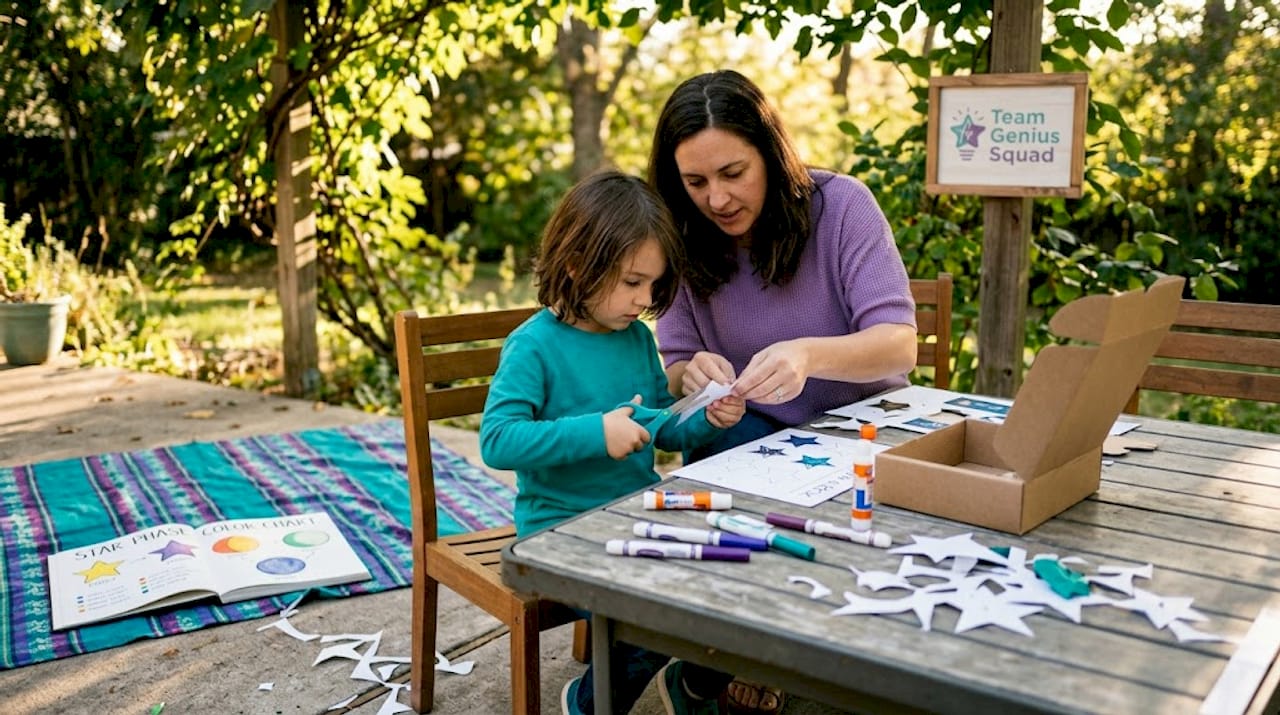
Knowing the science is only half the journey. Experiencing it through touch, movement, and creative play is where deep understanding truly takes root. Hands-on activities allow children to become the scientist, not just the student, and that shift in identity is transformative, especially for children who have struggled in traditional learning environments.
One of the most celebrated tools available is the Star in a Box interactive activity from Las Cumbres Observatory, which lets learners explore star life cycles by adjusting a star’s mass and observing how its size, brightness, temperature, and phase change over time. Children can literally drag a slider and watch a star evolve, making the abstract concept of stellar aging wonderfully concrete and visual.
For families who prefer screen-free exploration, the paper-based Star in a Box version provides printed diagrams and guided worksheets that connect life stages to the Hertzsprung-Russell diagram, a classic scientific chart that plots stars by temperature and brightness. The paper version includes scaffold recommendations, suggesting that younger or beginner learners stick to the main sequence track first before exploring the full branching model.
Here is a practical overview of activities organized by learning style and age range:
| Activity | Format | Best for | Star phases covered |
|---|---|---|---|
| Star in a Box (interactive) | Digital tool | Ages 9 to 13 | All phases, H-R diagram |
| Star Box paper-based | Printable worksheet | Ages 7 to 12 | Main sequence + branches |
| NASA coloring pages | Printable art | Ages 5 to 9 | Nebula, main sequence, supernova |
| Playdough star models | Tactile hands-on | Ages 5 to 10 | Nebula through red giant |
| Decision-tree poster | Visual art project | Ages 8 to 13 | Full branching model |
Additional hands-on tips for parents of neurodivergent learners include:
- Use color coding to represent different star phases. Assign a specific color to each stage so that children can physically sort, arrange, or color-code their diagrams.
- Break activities into short sessions. Rather than completing a full star life cycle chart in one sitting, focus on one phase per day and celebrate each small discovery.
- Incorporate role play. Let children “become” a star at a specific phase, describing how they feel, what they look like, and what comes next.
- Pair physical movement with vocabulary. Have children crouch small for a nebula, stand tall and steady for the main sequence, spread arms wide for a red giant, and collapse dramatically for a supernova.
You can find a treasure of free, accessible NASA’s coloring activities that introduce star phase vocabulary through creative, low-pressure artistic expression, which is especially valuable for children who experience anxiety around traditional academic tasks. When a child colors a nebula deep purple and a red giant glowing orange, they are encoding scientific vocabulary through sensory memory, which is one of the most durable forms of learning we know.
Pro Tip: Building learning confidence through STEM starts with letting children experience success on their own terms. If a child struggles with writing but loves building, swap a written reflection for a clay model or a drawing. The learning goal stays the same; the path to it is simply wider and more welcoming.
Accessible printables and digital tools for star phases
After trying activities, parents may want ready-to-use resources to support further learning and reinforce what their children discover.
The good news is that high-quality, free resources are more widely available today than ever before, and many of them are specifically designed with visual learners and early-stage science explorers in mind. Knowing where to find them saves families hours of searching and ensures the materials are scientifically accurate.
Free NASA printable resources include coloring pages, activity sheets, and vocabulary cards tied directly to the life cycles of stars. These materials are organized to support explicit stage vocabulary learning, covering terms like nebula, red giant, supernova, white dwarf, and black hole in a sequential and visual format that works beautifully as a supplement to any hands-on experiment.
Types of printables that reinforce star phase learning most effectively include:
- Coloring diagrams that label each phase of the star life cycle, encouraging children to color as they narrate the story of a star’s journey.
- Vocabulary card sets with each term on one side and a simple definition or illustration on the other, perfect for tactile learners who benefit from physical card-sorting activities.
- Branching flowcharts that visually separate the low-mass and high-mass paths, helping children understand why two stars can have completely different endings.
- H-R diagram worksheets that let older learners plot stars by temperature and brightness, connecting classroom vocabulary to real scientific data.
- Comparison charts where children fill in what they know about each phase in their own words, reinforcing retention through active writing and reflection.
“The best printable is not the one with the most information on it. It’s the one that leaves room for a child to add their own thinking, their own color, and their own questions.”
For families looking to build a broader science library, exploring STEM books for star phases alongside printable tools creates a rich, layered learning environment where children can read, build, color, and reflect, all within the same topic, reinforcing understanding from multiple directions at once.
What most star phase guides miss: Branching and confidence-building
Having reviewed accessible tools, let’s dig into why teaching strategy matters, and what most resources get wrong about star phases for all learners.
Here is something worth saying plainly: the majority of star phase guides, including many popular worksheets and classroom posters, present stellar evolution as a single, linear story. Nebula becomes protostar, protostar becomes main sequence star, main sequence becomes red giant, and red giant becomes white dwarf. Full stop. That narrative is not wrong for lower-mass stars like our Sun, but it is profoundly incomplete, and for children who already feel like they don’t quite fit the standard mold, a one-size-fits-all science story sends an unintended but damaging message.
Multimodal, stage-based representations using visual diagrams, tactile model-making, and short, repeatable steps consistently work well for neurodivergent learners. When children can see, touch, arrange, and narrate a concept, they are far more likely to retain it, and more importantly, to feel genuinely capable of understanding it. That feeling of capability is the foundation of scientific confidence.
At the same time, it’s worth acknowledging what even well-intentioned printables can miss. Star life cycle worksheets that simplify stellar evolution into a single linear story are more accessible at first glance, but they can underemphasize the mass-dependent branching that makes the science truly meaningful. Without the branching model, children learn a sequence. With it, they learn a system. That distinction matters enormously for building real scientific thinking.
Our perspective, shaped by working with children who learn differently, is that branching model tips and decision-tree tools are not just good astronomy pedagogy. They are confidence-building tools. When a child understands that the outcome changes depending on the input, that knowledge is a small but powerful version of how all complex systems work, including the social and academic systems children navigate every single day.
Teaching star phases as a branching system, supported by tactile models and visual diagrams, is also a way of telling children: “Science is not one single path. And neither are you.” That message, delivered through confidence building strategies woven into hands-on STEAM learning, is what transforms an astronomy lesson into a lasting act of empowerment.
Next steps: Inspiring more hands-on science with Team Genius Squad
To wrap up, parents wondering how to build on star phase learning can discover more hands-on tools that grow confidence and curiosity.
Star phases are just the beginning. Every question your child asks about a nebula or a black hole is a signal that their scientific curiosity is alive and growing, and that curiosity deserves to be fed with experiences that feel exciting, successful, and uniquely theirs.

Team Genius Squad’s experiment kit collection is designed specifically for children who learn best by doing, exploring, and discovering on their own terms. Powered by our E³ Method (Engage, Encourage, Empower), each kit creates a hands-on science experience that builds real confidence through purposeful play. And for families who want to pair exploration with inspiring stories, our STEAM books and puzzles bring the scientist’s journey to life in ways that resonate with young learners who see the world a little differently. Because different minds really do build the future.
Frequently asked questions
What is the longest phase in a star’s life cycle?
The main sequence is the longest stage, lasting billions of years as the star steadily fuses hydrogen into helium in its core while maintaining internal balance.
How can I adapt star phase activities for neurodivergent children?
Use multimodal learning through visual diagrams, tactile models, and short repeatable steps, and the LCO paper-based activity recommends starting with main sequence stages for younger and beginner learners.
Where can I find free educational materials about star phases?
NASA’s “Journey Through the Heliosphere” resource includes free coloring pages, activity sheets, and vocabulary materials covering all major star phase stages.
Are star phase orderings the same for all stars?
No, because mass determines the branch a star takes after the main sequence, with lower-mass stars ending as white dwarfs and higher-mass stars becoming neutron stars or black holes.


Leave a comment
This site is protected by hCaptcha and the hCaptcha Privacy Policy and Terms of Service apply.