
Turn Costumes Into Inquiry with Science Lab Dramatic Play for Teachers
A science lab dramatic play center gives children a lab coat, a clipboard, and a reason to ask “what if?” That single shift, from watching science to doing it, builds observation, measurement, and recording skills while planting the idea that they belong in a lab. This guide covers the materials checklist, ten ready-to-run activities, setup and rotation systems, and the research-backed teacher moves that turn a pretend lab into real inquiry.
TL;DR:
- A science lab dramatic play setup is effective with basic, durable items like lab coats, safety glasses, magnifiers, and recycled containers, prioritizing safety and engagement.
- Role rotation, simple recording tools, and clear signage help children develop observation and measurement skills while fostering a sense of identity as a scientist.
- Scientific inquiry is enhanced when adults scaffold play through verbal narration connecting actions to scientific concepts, such as predicting or recording observations.
- Supervision is crucial for small-tool safety, especially with children under five, though children who demonstrate safe handling can be monitored less frequently.
- Ready-made experiment kits with lab coats, safety gear, and guided prompts streamline setup and support authentic inquiry without extensive prep.
Table of Contents
- What Goes Into a Science Lab Dramatic Play Setup
- 10 Science Lab Dramatic Play Activities Kids Actually Want to Repeat
- How to Set Up and Manage a Lab Dramatic Play Center
- Turning Play Into Inquiry: The Research Behind Scaffolding
- Safety and Inclusion Checklist for Your Lab Center
- Why Identity-Driven Science Play Changes What Kids Believe About Themselves
- Skip the Prep With a Ready-Made Lab Coat and Experiment Kit
- Sources
- FAQ
What Goes Into a Science Lab Dramatic Play Setup
The best dramatic play science lab runs on durable basics, not expensive gear. Start with the wearable identity pieces. Lab coats, safety glasses, and a name badge do more than look cute in photos. They cue a child’s brain into a role, the same way a firefighter hat cues rescue play. From there, build out tools children can actually use with their hands: magnifiers, tweezers, small scales, measuring cups, and eyedroppers.
- Wearables: lab coats, safety glasses, ID badges or “scientist license” cards
- Tools: magnifiers, tweezers, measuring spoons/cups, a simple balance scale, plastic beakers
- Documentation gear: clipboards, blank observation journals, pencils, printable role cards
- Signage: station labels (“Mixing Lab,” “Specimen Station”), a printable periodic-table poster for flavor
Printable labels and role cards cost nothing beyond ink and cardstock, and recycled containers (yogurt cups, egg cartons, spice jars) stand in for beakers and specimen trays. NAEYC’s guidance on early tinkering and making encourages exactly this: start with a few safe, high-impact materials rather than buying an entire inventory at once. Check every item for choking-hazard size before it hits the shelf, and plan to supervise tool use until each child shows they can handle it safely.
10 Science Lab Dramatic Play Activities Kids Actually Want to Repeat
Each of these science experiment role play activities takes under 15 minutes to set up and can run for a week or a month, depending on how deep you want to go.
- Potion station. Colored water, droppers, and empty bottles let kids mix, pour, and predict color changes. Objective: measurement and prediction. Prompt: “How many drops until it turns green?” Younger kids just pour; older kids log ratios in a journal.
- Bug lab. Plastic insects, magnifiers, and a sorting tray build classification skills. Prompt: “What do these three bugs have in common?” Watch for kids grouping by legs, color, or size unprompted, which is a strong engagement signal.
- Paleontology dig. Bury small toy bones or fossils in sand or dry rice for excavation with brushes and tweezers. Objective: fine motor control and patience. Variant: older kids sketch and label their “find.”
- Sink or float station. A water bin and a basket of small objects test buoyancy predictions. Prompt: “Guess first, then test. Were you right?” This is a hypothesis-and-test loop in its simplest form.
- Magnet sorting. A pile of mixed objects and a magnet wand teach material properties. Objective: classification by attribute, not appearance.
- Weather station. Kids “forecast” using a toy thermometer and cloud pictures, then record it on a simple chart. Great for daily repeat play.
- Germ lab. Glitter as “germs” on hands, washed off with soap, makes hygiene visible and memorable.
- Volcano eruption. Baking soda and vinegar in a cardboard volcano, with a countdown and safety glasses on. Objective: cause and effect.
- Plant growth journal. A bean seed in a cup, checked and sketched daily. Objective: long-term observation and recording.
- Sound lab. Rubber bands on a box, or water glasses at different fill levels, let kids test pitch. Prompt: “What happens when you fill the glass more?”
Rotate two or three stations weekly rather than running all ten at once. That keeps materials fresh and gives you room to add 30 hands-on science activities for home practice between classroom rotations.
How to Set Up and Manage a Lab Dramatic Play Center
Zone the space into three parts: an experiment station where the mess happens, an observation and reporting desk where kids write or draw findings, and a storage shelf that stays out of the main traffic path. A 15 to 20 minute block works for most preschool and kindergarten attention spans, with a visual timer so transitions do not feel abrupt.
- Assign roles with printable job cards: Lead Scientist, Recorder, Safety Checker, Materials Manager
- Rotate roles daily so every child gets a turn at recording, not just doing
- Use a photo-journal or simple lab-report template (draw it, label it, one sentence about what happened)
- Run quick formative checks by asking one open question per child before they leave the station
Pro Tip: Buy or make five items before you buy fifty. A magnifier, a scale, a clipboard, safety glasses, and one printable role card set will tell you what your kids actually gravitate toward, before you invest in more. This mirrors what NAEYC recommends for sustainable classroom tinkering setups: identify hazards and interest first, expand second.
Turning Play Into Inquiry: The Research Behind Scaffolding
Dramatic play only becomes science learning when an adult scaffolds it. Left alone, a lab center is just a costume box. The move that changes that is narration: naming what a child is doing in scientific language while they do it. “You’re testing whether the block floats. That’s a hypothesis.” NSTA’s guidance on identifying practices during play frames this narration as the mechanism that makes learning visible for both the child and the assessing adult.
This lines up directly with recognized early-learning standards. NGSS practices like “planning and carrying out investigations” and “analyzing data” map almost exactly onto sink/float testing and journal recording. Head Start’s Early Learning Outcomes Framework and NAEYC both point to the same cross-domain payoff: science dramatic play strengthens language, literacy, math, social skills, and fine motor development simultaneously, because a child measuring water is also counting, predicting, and writing.

The deeper research on embodied cognition backs the physical, costume-and-tool version of play specifically. The National Academies’ chapter on early science and engineering finds that movement and drama help children grasp abstract ideas, like states of matter or life cycles, by making them physical and spatial instead of purely verbal. That is a meaningful finding for any child who struggles with abstract explanation delivered as pure talk.
One caution from the field: preschool classrooms often underdeliver on science unless teachers intentionally connect play to learning goals, and a static science corner without prompting or recording tools rarely produces that connection on its own. The fix researchers point to is structuring multi-week investigations with focused vocabulary and recording tools rather than swapping props every few days.
Safety and Inclusion Checklist for Your Lab Center
- Screen every tool and prop for choking-hazard size before it enters rotation, and supervise tweezers, tongs, and scale weights directly.
- Swap food-based props (dried beans, glitter, scented items) for allergy-safe or sensory-friendly alternatives when a child needs it.
- Offer a seated role, like Recorder or Data Checker, so children with mobility differences lead the station instead of sitting out.
- Post a visual schedule with pictures alongside words so nonreaders and children who benefit from visual supports can follow the routine independently.
Why Identity-Driven Science Play Changes What Kids Believe About Themselves
A child who puts on a lab coat isn’t just playing. They’re trying on a version of themselves who solves problems and asks questions without fear of getting it wrong, which matters most for the kids who feel like traditional worksheets were never built for their brain. That belief, more than any single fact learned, is what carries a struggling reader or a child with dysgraphia through a science lesson that would otherwise shut them down. A classroom that gives every child a turn as Lead Scientist, not just the fastest reader, is doing identity work as much as science work. Pair the Deluxe STEM lab coat with a recording journal, and watch which kids ask to keep going after the timer ends.
— Tita
Skip the Prep With a Ready-Made Lab Coat and Experiment Kit
Building this checklist from scratch takes an evening of printing, cutting, and sourcing beakers from the recycling bin, and Teamgeniussquad already did that legwork. Our screen-free Experiment Kits pair hands-on trials with a lab coat, safety glasses, and guided prompts that mirror the scaffolding recommended above, so you get the identity-building costume and the recording tools in one box instead of assembling them piece by piece.
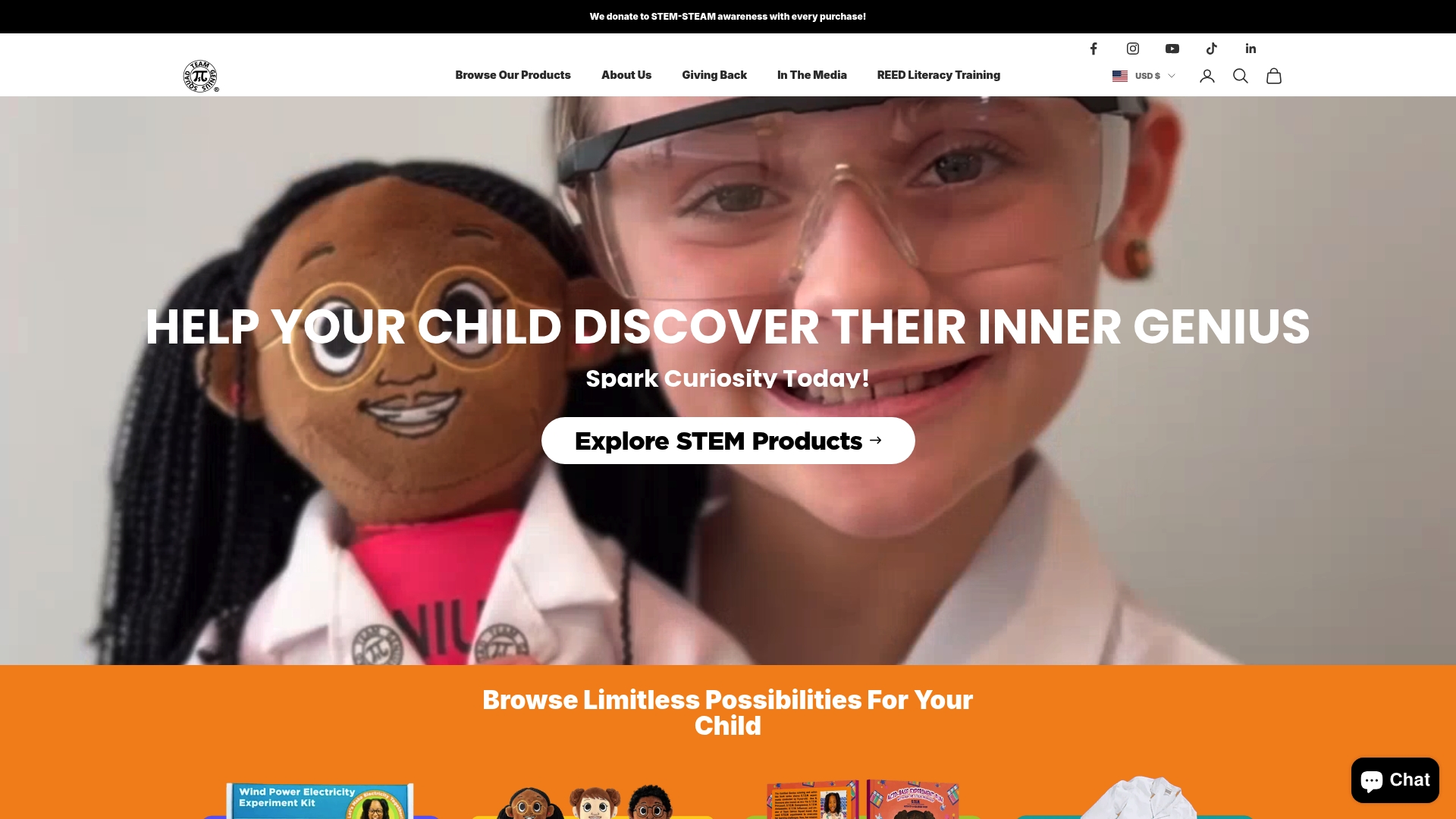
Every kit uses our E³ Method (Engage, Encourage, Empower) to walk a child from first experiment to confident explanation, which matters most for kids who need a hands-on entry point rather than a worksheet. If you want a live version of that experience, Meet Ava, the STEM Ambassador, for a 30-minute one-on-one Zoom experiment session built for kids ages 5 to 13. Browse the full shop to build your own bundle, starting with a lab coat and one kit, and add stations as your young scientist asks for more.
Sources
- Pocket of Preschool — The science center in my classroom is…
- NSTA — Reassessing recess: identifying practices during play
- National Academies — Science and Engineering in Preschool Through Elementary Grades (chapter 7)
- Science at the center: Meaningful science learning in a preschool classroom
FAQ
What Age Is Best for Science Lab Dramatic Play?
Preschool through early elementary, roughly ages 3 to 9, gets the most benefit because it matches the identity-formation window when kids readily adopt roles like “scientist.” Younger children focus on sensory exploration, while children around 6 to 9 can add recording, measurement, and simple hypothesis testing to the same stations.
How Do I Assess Whether Kids Are Actually Learning, Not Just Playing?
Watch for specific behaviors: a child predicting before testing, sorting objects by a shared trait, or narrating their own actions using words like “test” or “measure.” A completed observation journal entry or a labeled sketch is a concrete, gradable sign that role play crossed into recorded inquiry.
What Cheap Materials Work Best for a Preschool Science Lab?
Recycled containers, dried beans, food coloring, and a magnifier from a dollar store cover most stations without cost. NAEYC’s guidance on early tinkering supports starting small with a few safe, high-impact items rather than buying a full kit upfront.
How Closely Should I Supervise Tool Use in the Lab Center?
Direct supervision is necessary any time tweezers, small scale weights, or anything choking-hazard sized is in a child’s hands, especially for children under 5. Once a child demonstrates safe handling, you can shift to periodic check-ins rather than constant hovering.
Does Teamgeniussquad Sell a Complete Lab Dramatic Play Kit?
Yes. Teamgeniussquad’s Experiment Kits and lab coat bundles combine the wearable role-play pieces with guided activity prompts and recording tools described throughout this checklist. Current prices are listed on the shop page.


Leave a comment
This site is protected by hCaptcha and the hCaptcha Privacy Policy and Terms of Service apply.