
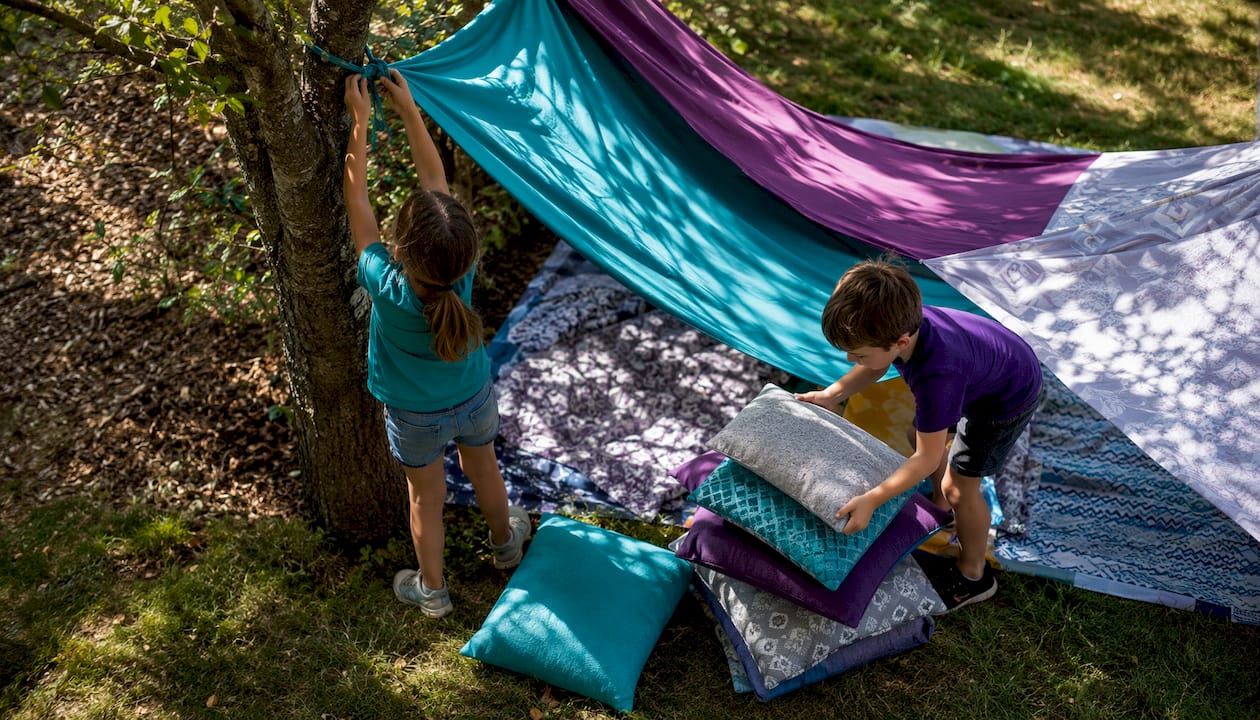
Play Fort Ideas That Turn Playtime into STEAM Learning
A play fort is one of the most powerful hands-on learning tools a child can experience, combining creative construction with real engineering thinking, spatial reasoning, and imaginative scientific role play. When a child drapes a sheet over two chairs and clips the corners tight, they are already solving a structural problem. That is STEAM learning in its most natural form.
- Play forts engage children in engineering (how do I keep this roof from sagging?), physics (what makes this stable?), and creative design all at once.
- They build problem-solving skills through trial and error, not worksheets.
- Collaborative fort building develops communication, negotiation, and teamwork.
- Fort construction is low-cost and accessible, requiring only household materials or an affordable kit.
- Paired with STEAM discovery kits and themed role play, forts become immersive scientific worlds where children step into the identity of explorers, engineers, and innovators.
Table of Contents
- How to play fort: DIY building techniques for any space
- What commercial fort-building kits offer that DIY can’t
- How fort building supports child development at every age
- The Fort card game: strategy and social play in one box
- How Teamgeniussquad’s STEAM discovery kits take fort play further
- Key Takeaways
How to play fort: DIY building techniques for any space
Building a basic blanket fort takes about 20 minutes and uses materials already in your home. The key is choosing the right anchor points and roof material from the start.
Essential materials:
- Flat sheets (for roofs — they sag far less than thick blankets)
- Chairs, tables, and couch backs as the structural frame
- Binder clips, clothespins, or chip clips to secure corners
- Couch cushions and pillows for walls and flooring
- Heavy books or cans to weigh down sheet edges
- Battery-powered string lights for atmosphere and to help hold fabric in place
Anchoring for stability: Space your anchor points wide enough that the roof can span them without a deep sag in the middle. Heavy furniture does the structural work; clips prevent sliding. The higher your anchor points, the taller and more usable the interior space.
Creating multiple rooms: Hang a second sheet perpendicular to the main roof and clip it to a chair leg or table edge. Children who draw a floor plan first, marking entrances and separate zones, often build forts that last for days rather than hours.
Adapting for outdoors: Backyard fort plans call for a few extra steps. Choose a spot with level ground and good drainage, and lay down a ground cloth or a pallet base to keep the interior dry. Tarp A-frames anchored with tent stakes and paracord go up in under an hour and hold up to wind far better than fabric alone.
Pro Tip: Add a string of battery-powered lights along the roofline. The lights do double duty: they create a magical atmosphere and their weight helps hold the fabric taut, reducing sag without extra clips.
Incremental complexity matters for development. Start younger children with a simple cushion fort or a single-sheet drape over a table. Older kids can tackle multi-room builds, second-story lookout levels using a bunk bed as a base, or outdoor structures using sticks and natural materials. Iterative fort building challenges children to solve structural failures as they go, and that process of fixing and rebuilding is where the real STEAM learning happens.
What commercial fort-building kits offer that DIY can’t
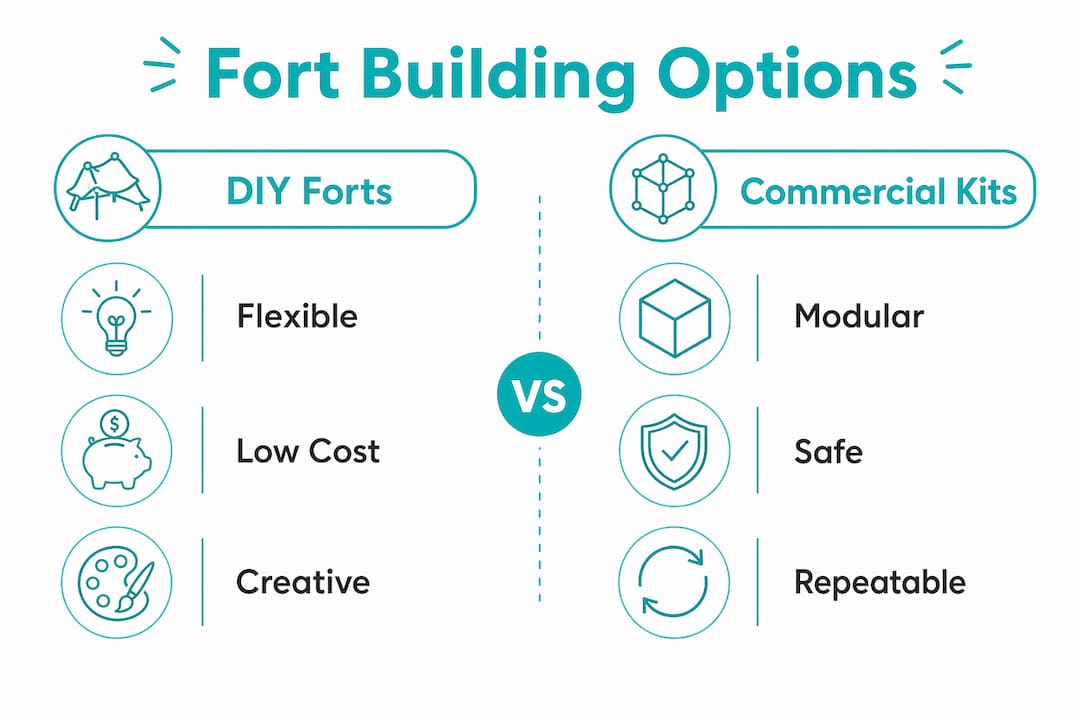
Commercial kits give children repeatable, scalable structures with consistent safety standards. Three kits stand out for different reasons.
Yourigami Kids Play Fort is a modular foam system built around 12 interlocking pieces: hinged panels, square panels, triangles, rectangles, and pop-out shapes that double as accessories or seat pads. The foam is CertiPUR-US certified, meaning it has been tested for durability and harmful substance content. Covers are soft, removable, and machine washable, which matters enormously for group play and sleepovers. One important note: the foam needs up to 48 hours to fully expand after unboxing, so plan accordingly before a big play date.
Make-A-Fort takes a structural approach using rods, connectors, and interlocking panels to build large-scale forts, mazes, and tunnels. Their Explorer Kit configurations range from a single-child First Night House requiring 6 by 4 feet of floor space to a three-kit Mansion that needs 14 by 10 feet and sleeps a group. The Minecraft-themed kits add a layer of narrative play that resonates strongly with kids ages 7 and up.
Hey! Play! Flexible Construction Fort Build Set is a 60-piece rod-and-connector kit designed specifically to educate aspiring STEM learners. The ball connectors and rods snap together cleanly, and the kit supports multiple creative fort designs from a single set of pieces. It is widely available through major US retailers, making it an accessible entry point for classrooms and after-school programs.
Across all three, the pattern is the same: modular systems that grow with the child, prioritize safety, and invite repeated creative use rather than a single build.
How fort building supports child development at every age
Fort building is not just fun. The process of solving structural failures builds resilience and creative problem-solving more than the finished structure itself, making it one of the most effective STEAM engagement methods available to parents and educators.
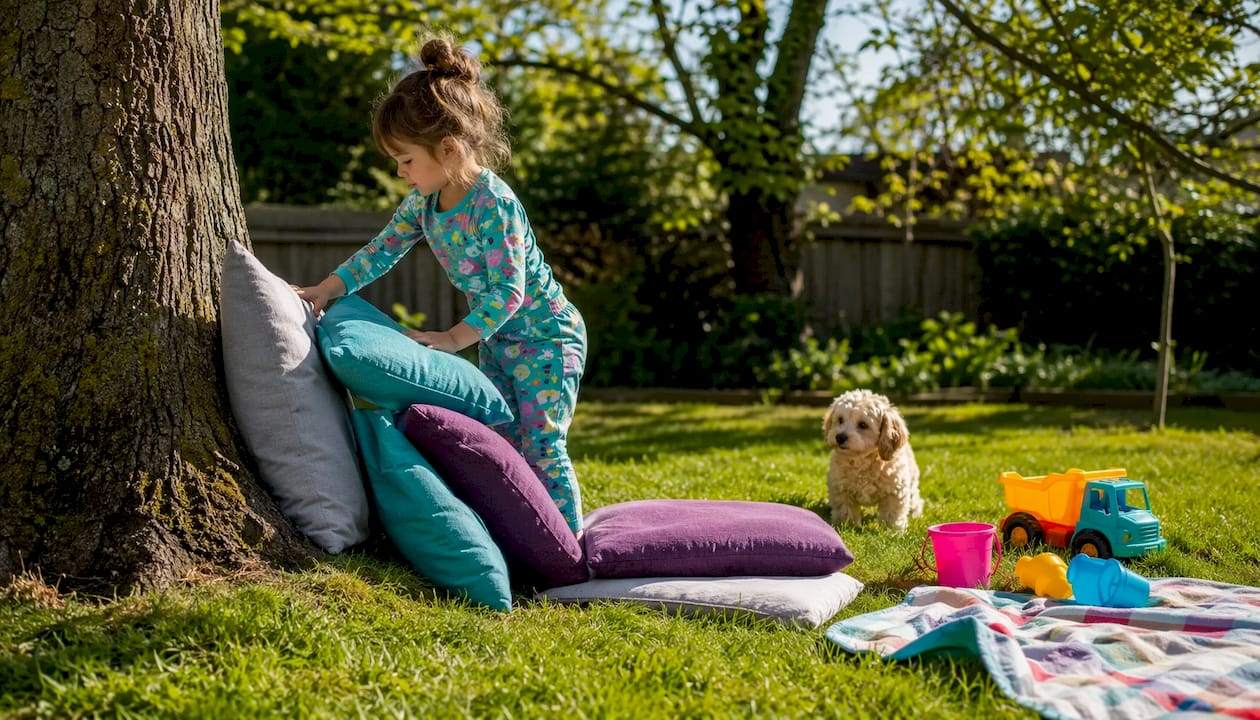
Ages 3–6: Simple forts, a cushion lean-to or a single sheet over a table, are perfect for this stage. The goal is imaginative play and sensory comfort, not engineering complexity. These early builds introduce spatial awareness and cause-and-effect thinking in a low-pressure way.
Ages 7–10: Children at this stage can plan multi-room structures, experiment with different anchoring methods, and begin incorporating thematic role play. A fort becomes a space station, a laboratory, or a field research base. This is the ideal age to introduce team-building experiments alongside construction, since cooperative building at this stage develops negotiation and communication skills alongside engineering thinking.
Ages 11–13: Older children benefit from complex modular builds that require planning, resource management, and iteration. Outdoor backyard fort plans using pallets, rope, and reclaimed materials introduce real construction concepts. Identity formation is strong at this age, and a fort that a child designed and built themselves becomes a source of genuine pride and confidence.
Across all ages, the developmental sweet spot is choosing a challenge that is just beyond the child’s current ability. Modular kits that allow incremental expansion are ideal because they grow with the child rather than becoming obsolete after a single build.
The Fort card game: strategy and social play in one box
The Fort card game, designed by Grant Rodiek and published by Leder Games, is a deck-building game for 2–4 players that takes 20–40 minutes to play. Players take on the role of kids collecting pizza and toys, recruiting friends, and upgrading a personal fort board to score victory points.
Each turn follows five phases: Cleanup, Play, Recruit, Discard, and Draw. The clever twist is that cards are not just for your own turn. Other players can follow your public action on their turn if they discard a matching suit card, which means every decision you make affects the whole group. That mechanic mirrors real-world social dynamics in a way that feels natural to children.
Grant Rodiek designed the game’s mechanics to reflect friendship and resource collection as genuine social strategies, and that intentionality shows in how the game plays. Children who engage with Fort regularly develop stronger decision-making skills, learn to read other players’ intentions, and practice the kind of collaborative and competitive thinking that transfers directly to real-world problem-solving. For educators looking for a kids fort game that doubles as a strategy and social skills tool, Fort is one of the most thoughtfully designed options available.
How Teamgeniussquad’s STEAM discovery kits take fort play further
Teamgeniussquad was founded on a belief that every child, especially those who struggle in traditional learning environments, deserves to experience the joy of discovery and the confidence that comes with it. Inspired by the journey of young STEM entrepreneur Ava N. Simmons, who navigated dyslexia and dysgraphia to become a Kidpreneur and Global S.T.E.M. ambassador, the brand was built to unlock the inner genius in children who learn differently.
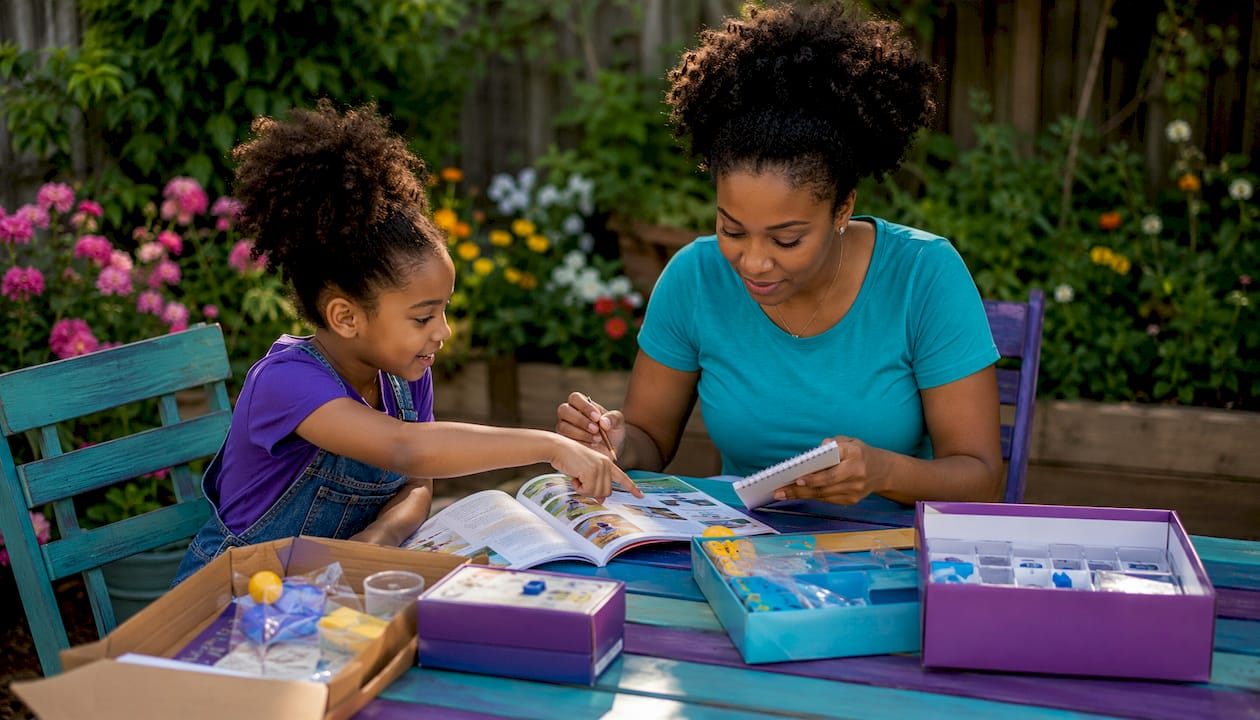
Every Teamgeniussquad kit runs on the proprietary E³ Method: Engage, Encourage, Empower. Children first engage with a hands-on experiment, then receive encouragement through guided discovery, and finally feel empowered by completing something real. Lab coats, badges, and certificates are not decorative extras. They are identity tools that help children step fully into the role of scientist or engineer, which is exactly the mindset a fort-based STEAM activity needs to reach its full potential.
The kits integrate literacy alongside science, combining experiments with reading and reflection activities. For neurodivergent learners, that multimodal approach, tactile building plus visual role play plus written reflection, creates multiple pathways to understanding the same concept. A child who struggles to absorb physics from a textbook will often grasp structural stability intuitively after building and rebuilding a fort, then cement that understanding by writing about what they observed.
Pairing a Teamgeniussquad solar energy kit with a fort build, for example, transforms the fort into a working solar research station. The fort becomes the context; the kit provides the scientific depth.

Teamgeniussquad kits are available now. Explore the full collection and bring hands-on STEAM discovery into your child’s world at shop.teamgeniussquad.com.
Key Takeaways
Play forts are one of the most accessible and effective STEAM tools available, combining engineering, creativity, and scientific role play into a single hands-on activity that grows with the child.
| Point | Details |
|---|---|
| DIY forts teach real engineering | Flat sheets, clips, and heavy furniture create stable structures that teach anchoring, load distribution, and spatial planning. |
| Commercial kits scale with development | Modular systems like Yourigami and Make-A-Fort grow from simple builds to complex multi-room structures as children’s skills advance. |
| Age shapes the right challenge | Children ages 3–6 thrive with simple cushion forts; ages 7–13 benefit from multi-room builds and outdoor backyard fort plans. |
| The Fort card game builds strategy | Grant Rodiek’s deck-building game mirrors real social dynamics, developing decision-making and collaborative thinking in a brief, engaging session. |
| Teamgeniussquad deepens the learning | The E³ Method and identity-driven role play tools transform fort building into immersive scientific discovery for children ages 3–13. |


Leave a comment
This site is protected by hCaptcha and the hCaptcha Privacy Policy and Terms of Service apply.