
What Is the E3 Method? A Guide for Educators
The E3 Method is a structured learning framework designed to engage students in focused learning, enhance their understanding beyond passive instruction, and extend that learning into real-world contexts. In education, this framework is formally known as the Triple E Framework, developed by Dr. Liz Kolb and validated against Harvard and ISTE standards. A separate personal development version, created by Debi Borger, applies the same three-part logic to elevating mind, body, and world. Both share a core belief: meaningful growth happens in three connected stages, not one. For educators, parents, and counselors, understanding what is the E3 Method means understanding how children move from curiosity to confidence.
What is the E3 Method and how does it work?
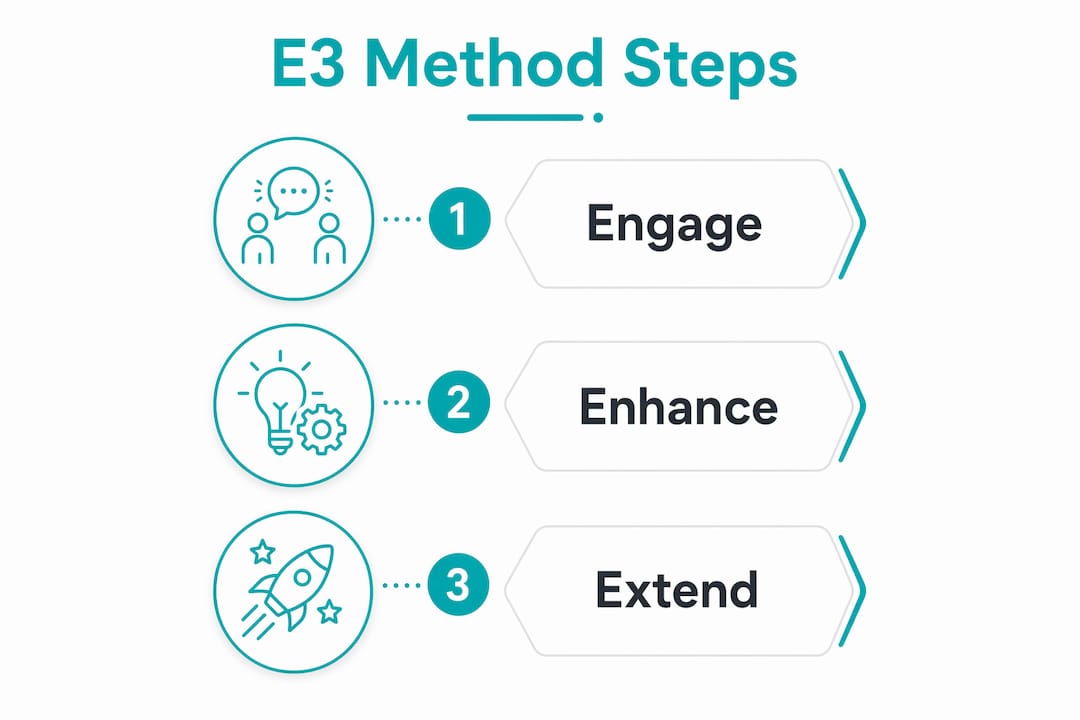
The Triple E Framework defines the E3 Method as three sequential learning goals: Engage, Enhance, and Extend. Each stage builds on the one before it, creating a progression from attention to deep understanding to real-life application. The framework does not treat technology or tools as the goal. It treats learning outcomes as the goal and asks whether any given tool or activity actually serves them.
Dr. Kolb’s framework is validated by ISTE standards and summarized in a six-page jump-start guide that educators use during lesson planning. The key word there is “during.” The E3 Method is a design filter, not an after-the-fact checklist. Educators ask three questions before a lesson: Does this activity help students focus? Does it deepen their understanding? Does it connect learning to their lives outside school?

This sequence matters because children, especially those who struggle in traditional classrooms, need more than engagement. They need experiences that build real competence and connect that competence to who they are becoming. That is the full arc of the E3 technique.
How does the E3 Method support student engagement and confidence?
Engagement, in the E3 framework, means focused attention and genuine motivation. It is not entertainment. A child who is entertained is passive. A child who is engaged is active in time-on-task learning, asking questions, making choices, and building momentum.
Research from 2025–2026 shows that modules built on Triple E meet established pedagogical standards and produce measurable improvements in student focus and content clarity. That result matters because focus is the foundation of confidence. A child who cannot stay with a task long enough to succeed never gets the experience of succeeding.
Practical strategies for building engagement include:
- Hands-on activities that require physical participation, such as experiments, building challenges, or role-play scenarios
- Social co-learning where children explain their thinking to peers, which deepens retention and builds communication skills
- Choice within structure so children feel ownership over their learning path without losing direction
- Screen-free discovery that removes digital distraction and puts attention back on the task and the child’s own reasoning
Teamgeniussquad builds every kit around this first stage. Children put on lab coats, receive badges, and step into the role of scientist before a single experiment begins. That identity shift is engagement by design, not by accident.
Pro Tip: Avoid tools that create the feeling of engagement without the substance. A child tapping through a colorful app may look focused but may not be thinking. The E3 Method asks whether the activity produces cognitive effort, not just attention.
In what ways does the E3 Method enhance learning beyond traditional approaches?
Enhancement is the stage where the E3 Method separates itself from surface-level instruction. Enhancement means shifting students from passive reception to active inquiry. It means asking children to analyze, evaluate, and create, not just recall.
The Triple E Framework differs from SAMR in one critical way. SAMR categorizes levels of technology use. The Triple E Framework measures how well any tool, digital or physical, supports learning objectives. That distinction protects educators from choosing flashy tools that impress but do not teach.
A case study on argumentative writing found that technology integration using Triple E allowed students to independently evaluate information rather than passively consume it. Students produced stronger arguments and showed better reasoning when the tools they used required them to think, not just input. Enhancement happened because the educator’s role shifted from lecturer to facilitator.
| Learning approach | Student role | Cognitive demand |
|---|---|---|
| Traditional lecture | Passive receiver | Low |
| Engagement-only tools | Active but surface-level | Moderate |
| E3 Enhancement stage | Independent analyst and creator | High |
The challenge in 2026 is generative AI. Many AI tools complete cognitive tasks for students rather than supporting students in completing those tasks themselves. The Triple E Framework acts as a filter that helps educators identify which tools promote student thinking and which tools replace it. That distinction is now one of the most important decisions an educator makes.
Pro Tip: Before introducing any new tool or activity, ask: “Is the child doing the thinking, or is the tool doing it for them?” If the answer is the tool, the activity may engage but will not enhance.
How does the E3 Method extend learning into real-world contexts?
Extension is the third and most often overlooked stage of the E3 Method. Extension means connecting what a child learns in a lesson to their life outside the classroom. It is the stage that turns knowledge into identity.
When a child applies a science concept to a problem in their neighborhood, writes a letter to a local organization, or teaches a family member what they learned, extension is happening. These are not bonus activities. They are the point. Extending learning opportunities bridges classroom concepts with students’ real lives and builds the soft skills that follow children into adulthood.
Research measuring extension effectiveness uses rubric scores to track how well students connect academic content to authentic tasks. The results show that extension is the stage with the most room for growth in most classrooms. Educators who plan for engagement and enhancement often run out of time before reaching extension. That gap is where confidence gets left behind.
| E3 stage | Classroom example | Real-world connection |
|---|---|---|
| Engage | Hands-on experiment with solar energy | Child notices solar panels in the community |
| Enhance | Student analyzes how solar panels work | Child explains the concept to a parent |
| Extend | Child designs a solution for a local energy problem | Builds identity as a problem-solver |
For counselors, extension is especially relevant. A child who sees their learning as connected to real life develops a sense of purpose. That sense of purpose is one of the strongest predictors of confidence and resilience. Teamgeniussquad’s hands-on STEAM kits are built to reach this stage, giving children certificates and reflection prompts that anchor their experience to their growing identity as innovators.
What are practical applications for implementing the E3 Method?
The E3 Method works best when educators and parents treat it as a living design strategy, not a one-time lesson template. Instructional modules built on Triple E show clear strengths and areas for continuous improvement, which means the framework rewards ongoing reflection and adjustment.
Here is how educators, parents, and counselors can apply the E3 Method effectively:
- Use it during planning, not after. Ask the three E questions before choosing activities, not as a post-lesson evaluation. This is the design-filter approach that produces the strongest outcomes.
- Tailor for diverse learners. Children with dyslexia, dysgraphia, or other learning differences benefit from E3-aligned activities that prioritize tactile and visual learning over text-heavy instruction. Teamgeniussquad’s kits were built with this in mind, inspired by a real family journey with neurodivergent learners.
- Shift the educator’s role. The E3 Method requires educators to move from content source to learning facilitator. That shift is uncomfortable at first but produces deeper student ownership.
- Avoid the checklist mindset. The framework is not a box to tick. It is a lens for asking whether children are truly growing at each stage.
- Integrate STEAM and literacy together. Writing, reflection, and reading reinforce all three E stages and give children multiple ways to demonstrate understanding.
For parents, the simplest application is asking three questions after any learning activity: “Were you focused?” “Did you understand something new?” “How does this connect to your life?” Those three questions mirror the E3 framework and build metacognitive habits that serve children across every subject.
Counselors can use the E3 structure to evaluate whether a child’s learning environment is meeting their developmental needs. A child who is only engaged but never enhanced or extended is not building the confidence that comes from real competence. Recognizing that gap is the first step toward addressing it. Resources like student agency in STEAM offer additional frameworks for counselors working in educational settings.
How does the life coaching E3 Method complement educational goals?
The personal development version of the E3 Method, created by Debi Borger, focuses on elevating mind, body, and world simultaneously. Where the educational Triple E Framework focuses on learning outcomes, this version focuses on life balance and sustainable personal growth.
The life coaching E3 Method avoids the perfection trap by emphasizing consistency over intensity. Small daily choices across all three pillars produce more lasting change than dramatic efforts in one area. For children, this translates directly. A child who is physically active, mentally stimulated, and socially connected is better positioned to engage, learn, and grow than one whose development is lopsided.
Counselors and parents who understand both versions of the E3 Method can support children more completely. The educational framework tells you how to design learning experiences. The life coaching framework tells you how to support the whole child who shows up to those experiences. Together, they create conditions where confidence is not just taught. It is lived.
Key Takeaways
The E3 Method is most effective when applied as a design strategy across all three stages: Engage, Enhance, and Extend, with each stage building genuine competence and confidence in children.
| Point | Details |
|---|---|
| E3 is a design filter | Apply the three E questions during lesson planning, not after, to produce stronger learning outcomes. |
| Enhancement requires cognitive effort | Choose tools and activities that make children think independently, not tools that think for them. |
| Extension builds identity | Connecting learning to real life turns knowledge into confidence and purpose. |
| Both E3 versions matter | The educational Triple E and the life coaching E3 together support the whole child’s development. |
| Continuous refinement is required | The framework works best when educators and parents adjust it regularly to match diverse learner needs. |
Why the E3 Method deserves more attention than it gets
Most conversations about learning frameworks focus on technology categories or curriculum standards. The Triple E Framework cuts through both by asking a simpler and harder question: is the child actually growing? I find that question more useful than almost any rubric I have encountered.
What strikes me most about the E3 Method for learning is how well it protects children from the illusion of progress. A child who completes a colorful digital activity, earns a badge, and moves on may feel successful without having understood anything. The E3 framework catches that gap at the design stage, before the lesson happens, which is where it matters most.
The life coaching parallel is equally underused. Counselors who understand that a child’s confidence depends on mind, body, and world in balance can see patterns that purely academic frameworks miss. A child who is exhausted, isolated, or overwhelmed will not engage deeply no matter how well the lesson is designed.
The most honest thing I can say is this: the E3 Method is not complicated. It is disciplined. It asks educators and parents to slow down and ask whether what they are offering a child is actually serving that child’s growth. That discipline, applied consistently, is what builds the kind of confidence that lasts.
— Tita
Teamgeniussquad’s kits put the E3 Method into a child’s hands
Teamgeniussquad builds screen-free STEAM discovery kits that bring the E3 framework to life for children ages 5–13. Each kit is designed to engage children through hands-on experiments, enhance their understanding through real scientific inquiry, and extend their learning through role-play, reflection, and identity-building tools like lab coats, badges, and certificates.

Inspired by a real family journey with dyslexia and dysgraphia, Teamgeniussquad’s kits are built for children who need more than a worksheet to believe in themselves. The experiment kits collection offers a curated range of hands-on activities that align directly with all three stages of the E3 Method. Whether you are an educator building a lesson, a parent looking for purposeful play, or a counselor seeking tools that build genuine confidence, these kits give children the experience of being a scientist, a creator, and a problem-solver.
FAQ
What is the E3 Method in education?
The E3 Method in education refers to the Triple E Framework developed by Dr. Liz Kolb, which focuses on engaging students in time-on-task learning, enhancing their understanding beyond passive instruction, and extending learning into real-world contexts. It is validated against ISTE standards and used as a lesson design filter.
How does the E3 Method differ from SAMR?
SAMR categorizes levels of technology use, while the Triple E Framework measures how well any tool supports specific learning objectives. The E3 Method prioritizes cognitive engagement over the sophistication of the technology used.
What are the three steps of the E3 Method?
The three steps are Engage, Enhance, and Extend. Engage means focused attention and motivation. Enhance means shifting students from passive reception to active analysis and creation. Extend means connecting learning to students’ real lives and building soft skills.
Can parents use the E3 Method at home?
Parents can apply the E3 framework by asking three questions after any learning activity: Was the child focused? Did they understand something new? How does it connect to their life? These questions mirror the three stages and build strong learning habits.
How does the life coaching E3 Method support children?
The life coaching E3 Method, developed by Debi Borger, focuses on elevating mind, body, and world through consistent small choices. For children, balancing all three pillars reduces stress and creates the conditions for deeper engagement and confidence in learning.



Leave a comment
This site is protected by hCaptcha and the hCaptcha Privacy Policy and Terms of Service apply.