

STEAM activities for special needs: inclusive guide
Every child deserves the chance to experience that spark of discovery, the moment an experiment works and their eyes light up with pride. Yet more than 2 million U.S. public school students receive special education services for learning disabilities, and the majority of STEAM activities were simply never designed with them in mind. This guide is for parents and educators who know their child is capable of so much more and are ready to find steam activities for special needs learners that genuinely work, building real confidence alongside real skills.
Table of Contents
- Understanding the challenges and benefits of STEAM for kids with special needs
- Designing sensory-friendly and manageable STEAM activities
- Effective accommodations: visuals, instructions, and environment setup
- Gamification and engagement strategies for diverse learners
- Sample hands-on STEAM activities for kids with special needs
- Fresh perspective: why accommodations empower instead of lower expectations
- Explore inclusive STEAM tools and kits to support your child’s learning
- Frequently asked questions
Key Takeaways
| Point | Details |
|---|---|
| Inclusive STEAM boosts confidence | Hands-on STEAM activities with proper accommodations significantly improve problem-solving and self-esteem for kids with special needs. |
| Short, sensory-friendly sessions | Keep activities to 10-15 minutes with sensory accommodations to prevent overload and maintain engagement. |
| Use clear visuals and environment setup | Visual schedules, step-by-step instructions, and quiet spaces reduce anxiety and help focus. |
| Gamification increases engagement | Game-like formats lower anxiety and provide feedback that supports neurodivergent learners’ motivation. |
| Resources support learning | Specialized STEAM kits and tools designed for accessibility encourage inclusive and effective hands-on learning. |
Understanding the challenges and benefits of STEAM for kids with special needs
Children with special needs often face a specific set of obstacles that make traditional STEAM instruction feel inaccessible rather than exciting. Multi-step verbal instructions, timed experiments, and crowded sensory environments are three of the most common barriers, and none of them reflect a child’s actual ability to think, create, or problem-solve.
The good news is that hands-on learning naturally bridges many of these gaps. When a child can touch, build, mix, and observe, abstract concepts become tangible. The brain processes physical experiences differently than it processes lectures, and for many neurodivergent learners, that tactile pathway is the one that truly clicks. Research confirms that hands-on STEAM activities, when properly accommodated, significantly boost confidence and problem-solving skills for learners with disabilities.
Common barriers for children with special needs in STEAM settings include:
- Multi-step instructions delivered verbally and all at once, which overwhelm working memory
- Sensory overload from bright lights, strong smells, or loud environments
- Time pressure that creates anxiety before a child even begins
- Unclear success criteria, leaving children unsure if they are doing it “right”
- Transitions between activities that are abrupt and poorly signaled
The critical insight here is that accommodations do not lower expectations. They remove friction. A child who cannot process five verbal instructions at once is not less capable of conducting a science experiment. They simply need those instructions delivered differently. When you apply activities that help children learn through multiple pathways, including visual, tactile, and auditory, you give every learner a real chance to succeed.
“The goal of inclusive STEAM is not to simplify the science. It is to clear the path so every child can reach it.”
Explore more boost STEAM confidence strategies to help your learner build self-belief alongside skills.
Designing sensory-friendly and manageable STEAM activities
Once you understand why accommodations matter, the next question becomes practical: how do you actually design a STEAM activity that works for a child who gets overwhelmed or fatigued quickly? Structure and brevity are your two most powerful tools.
Sensory-friendly STEAM activities should be kept short, typically 10 to 15 minutes for beginners, to prevent fatigue and sensory overload. This is shorter than most classroom lessons, and it is intentional. A child who succeeds in 12 focused minutes will want to come back tomorrow. A child who is pushed to 45 minutes and shuts down may not.
Follow these steps when designing your next session:
- Choose one concept per session. One material, one question, one experiment. Resist the urge to layer in multiple learning goals.
- Prepare all materials in advance. An organized, pre-set workspace signals predictability and immediately reduces anxiety before the child even sits down.
- Select sensory-safe materials. Avoid strong-smelling adhesives, scratchy textures, or materials that require tight gripping for children with fine motor challenges.
- Build in a midpoint break. Even a two-minute movement or breathing break between steps can reset a child’s nervous system and improve focus for the second half.
- End with a success moment. Design the activity so the final step produces something visible, a structure built, a color changed, a drawing finished, giving the child a concrete achievement to feel proud of.
For steam activities for neurodivergent kids, the physical environment matters as much as the activity itself. Dim the lights if your child is sensitive to fluorescence. Offer headphones. Give them a defined, personal space with clear edges so they always know where their “zone” begins and ends.
Pro Tip: Use a small sensory bin filled with rice or sand as both a calming fidget tool and a workspace boundary. Children can rest their hands in it between steps, which reduces restlessness without interrupting focus.
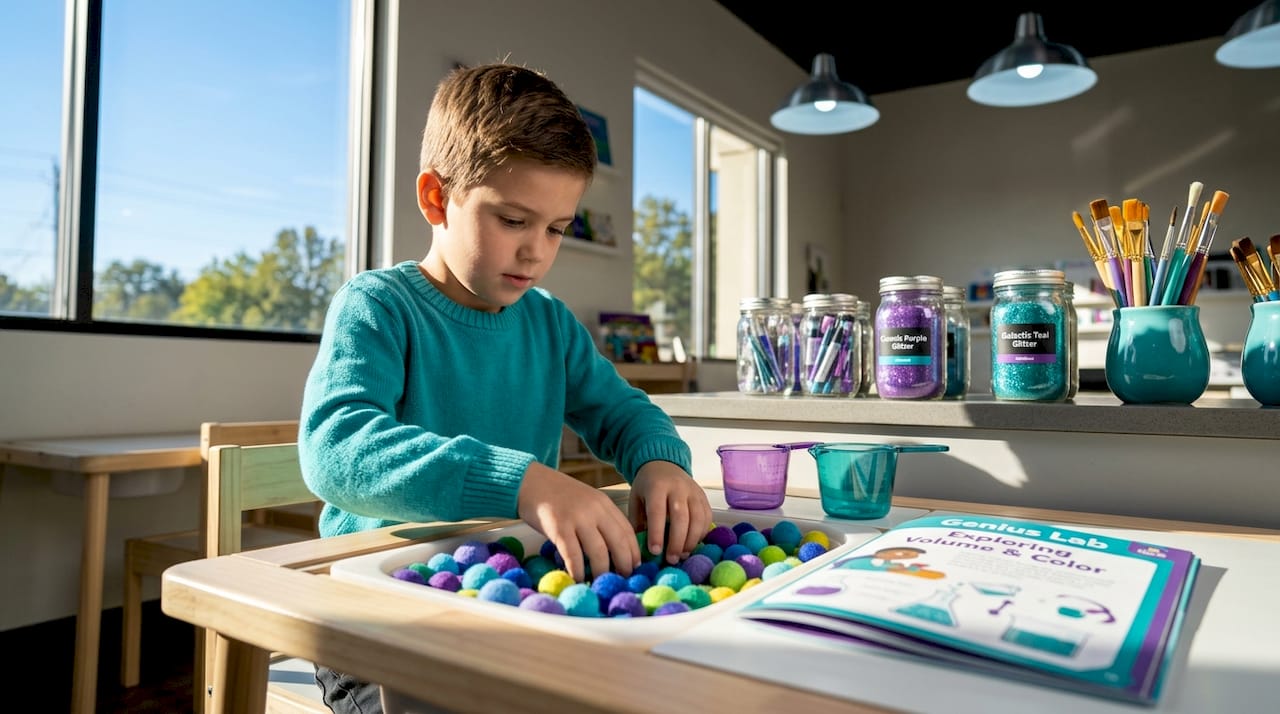
Pair these sessions with hands-on literacy activities to reinforce language skills alongside science concepts, creating a fuller learning experience.
Effective accommodations: visuals, instructions, and environment setup
This is where the difference between “an activity that frustrated my child” and “an activity they asked to do again” is usually made. Instructional and environmental accommodations are specific, research-backed, and often simple to implement once you know what to look for.
Visual schedules and first-then boards before a STEAM project significantly reduce anxiety and resistance in neurodivergent students. A first-then board simply shows two images: first we do this, then we do that. It answers the question every anxious child is silently asking: “What happens next?” Answering that question proactively removes the cognitive load of wondering, freeing up mental energy for actual learning.
Key accommodations that make a measurable difference include:
- Visual step cards with numbered images instead of written or verbal instructions
- Choice boards that let children choose between two or three versions of a material, giving them autonomy within structure
- Color-coded stations so children can navigate a workspace independently
- Noise-canceling headphones for children sensitive to ambient sound
- Dimmed or warm-toned lighting instead of overhead fluorescents
That last point deserves emphasis. Noise-canceling headphones or dimmed lights can be more effective than changing the project materials themselves. Many parents and educators default to simplifying the activity when sensory needs are the real barrier. Adjust the environment first, and you will often find the child is more than ready for the original challenge.
Pro Tip: Laminate your visual step cards and use a dry-erase marker so children can check off each step themselves. This simple act of physical completion builds executive function and gives an immediate sense of progress.
For a deeper look at how this approach compares to traditional instruction, see STEAM vs traditional education and what the research reveals about neurodivergent learners.
Gamification and engagement strategies for diverse learners
Gamified learning is not a soft alternative to real STEAM education. It is, for many children with ADHD and autism, the optimal delivery format. Gamified learning reduces performance anxiety and provides the immediate, structured feedback that students with ADHD and autism require to stay engaged and motivated.
Here is why that matters so much for this audience. Children who have experienced repeated difficulty in academic settings often carry what researchers call “failure anticipation,” a quiet dread that shows up before an activity even begins. Gamified formats short-circuit this cycle by making the stakes feel low and the wins feel frequent.
| Feature | Standard STEAM activity | Gamified STEAM activity |
|---|---|---|
| Feedback timing | End of activity | Immediate, step-by-step |
| Success indicators | One final outcome | Multiple small milestones |
| Anxiety level | Moderate to high | Low |
| Re-engagement rate | Variable | Consistently higher |
| Child-perceived autonomy | Low | High |
Additional benefits of gamified formats for steam activities for neurodivergent kids include:
- Structured rewards that celebrate effort, not just outcome
- Clear win conditions that eliminate ambiguity
- Role and identity assignment so children see themselves as scientists or engineers, not just students completing a worksheet
- Repetition without boredom since game mechanics make revisiting concepts feel fresh
Discover how screen-free STEAM kits use these principles to build lasting confidence in young learners.
Sample hands-on STEAM activities for kids with special needs
Theory only takes you so far. Here are concrete examples of steam activities for special needs children that combine sensory awareness, clear structure, and genuine scientific discovery.
Highly structured, predictable, and visually appealing projects like color mixing or building simple machines tend to be the most successful for children who need consistency to feel safe enough to explore.
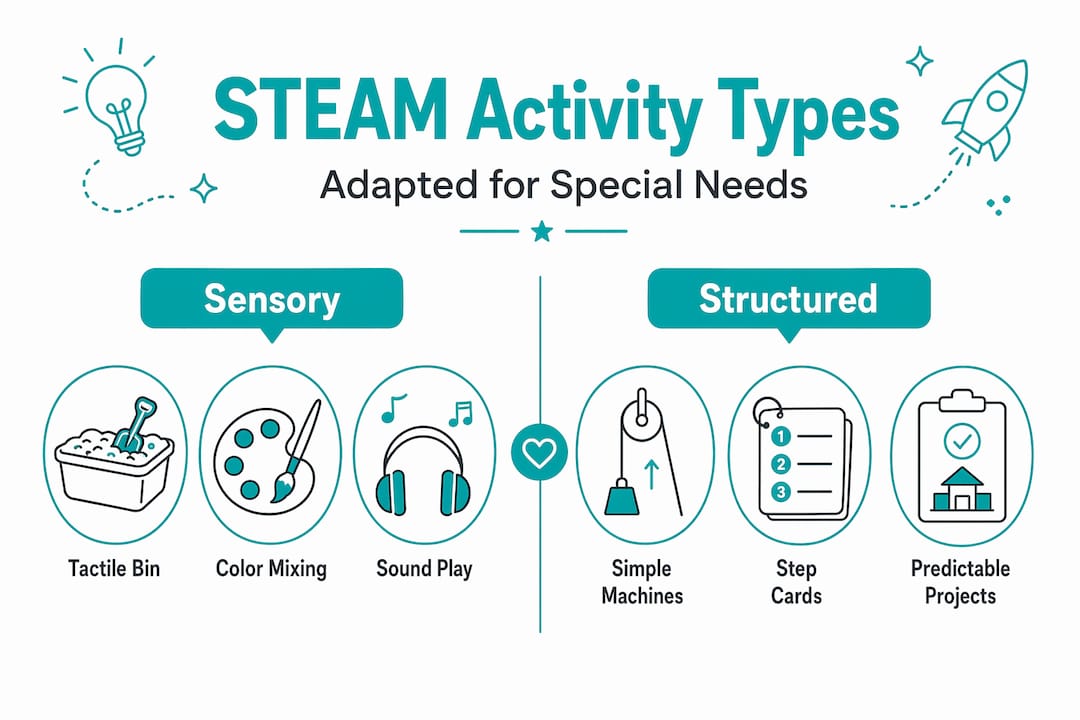
| Activity | Core STEAM concept | Best for | Sensory consideration |
|---|---|---|---|
| Scent trail mapping | Science, observation | Autism, sensory seekers | Use mild, familiar scents |
| Color mixing with droppers | Chemistry, art | Ages 5 to 8 | Low mess, high visual reward |
| Simple bridge building | Engineering | ADHD, kinesthetic learners | Tactile, no time pressure |
| Paper circuit cards | Technology, electronics | Ages 9 to 13 | Structured, step-by-step |
| Nature journaling | Science, literacy | Varied needs | Outdoor, calming |
Here is how to run the color mixing activity with full accommodations in place:
- Pre-set three cups of water with food coloring already added (red, yellow, blue) so the child arrives to an organized, visually inviting setup.
- Provide a laminated visual card showing three steps with images: scoop, pour, observe.
- Offer two dropper sizes and let the child choose, building autonomy into the very first action.
- Use a white tray as the mixing surface so color changes are vivid and immediately satisfying.
- End by asking the child to draw or stamp the color they created, integrating literacy without it feeling like “school work.”
Pro Tip: Build student interests directly into the theme. A child obsessed with dinosaurs can mix “dinosaur egg colors.” A child who loves space can create “planet colors.” The science is identical, but the motivation increases dramatically when the story resonates.
Explore more ideas through boost STEAM confidence activities and literacy-focused STEAM activities that weave reading and writing into hands-on discovery.
Fresh perspective: why accommodations empower instead of lower expectations
Here is the misconception that does the most damage: the idea that giving a child extra support means you expect less from them. It is worth saying directly, accommodations are not about lowering expectations but about removing barriers. Those are fundamentally different things.
Think of it this way. A brilliant scientist with a broken leg is not less capable of conducting research. They need a ramp, not a simpler experiment. The same logic applies to every child navigating STEAM with a learning difference, sensory sensitivity, or attention challenge.
What most educators and parents underestimate is the role of transitions. The moment between “we are getting ready to start” and “we are now doing the experiment” is where many neurodivergent children derail. Not because the activity is too hard, but because the shift in expectation happened without sufficient warning or support. A 30-second visual countdown, a consistent verbal cue, or a transition song can eliminate this barrier almost entirely.
The sensory environment is another area that rarely gets the attention it deserves. Parents often spend hours searching for the perfect activity, when what their child actually needed was dimmer lighting and a quieter room. Adaptive learning activities do not require exotic materials. They require thoughtful environments.
Gamification, too, deserves to be seen as a genuine pedagogical approach, not a consolation prize for children who “can’t handle” traditional learning. Neuroscience supports it. Children with ADHD and autism respond to immediate feedback loops in ways that align perfectly with how game mechanics work. Calling it “dumbed down” misses the point entirely.
At Team Genius Squad, this belief is baked into everything we create. The E³ Method, Engage, Encourage, Empower, exists because we know that when a child feels seen and supported, they do not just complete an activity. They step into a new identity. They begin fostering belief in themselves that carries far beyond the experiment table.
Explore inclusive STEAM tools and kits to support your child’s learning
Putting these strategies into practice is so much easier when the tools are already designed with inclusion in mind. Team Genius Squad builds hands-on, screen-free STEAM discovery kits specifically for children ages 5 to 13, with neurodivergent-inspired design at the core of every experience.

Each kit follows the E³ Method, guiding children from first curiosity all the way to confident self-expression. The electricity lab bundle is a standout option for older learners ready to explore circuits through tactile, step-by-step discovery. Browse the full experiment kits collection for age-appropriate projects built around clarity, confidence, and genuine excitement. You can also explore STEAM books and puzzles that pair reading and reflection with hands-on science, reinforcing literacy in a way that feels like play rather than schoolwork.
Frequently asked questions
What are some easy STEAM activities suitable for children with special needs?
Short, sensory-friendly projects like scent trails, color mixing, and simple building tasks with clear visuals are effective starting points. Highly structured, predictable projects tend to be the most successful for children who need consistency to feel safe enough to explore.
How long should STEAM activities be for neurodivergent kids new to hands-on learning?
Activities should stay around 10 to 15 minutes for beginners to prevent sensory overload and fatigue, with short breaks built in between steps. Sensory-friendly STEAM activities kept at this length help children finish feeling successful rather than exhausted.
What accommodations help children with learning differences succeed in STEAM projects?
Visual schedules, step-by-step picture cards, quiet zones, and noise-canceling headphones are among the most effective supports. A visual schedule or first-then board reduces anxiety before the activity even begins, and that early calm carries through the entire session.
Why is gamification beneficial for kids with ADHD and autism in STEAM learning?
Gamified learning reduces performance anxiety and delivers the immediate, structured feedback that children with ADHD and autism need to stay engaged. Gamified formats replace the fear of getting it wrong with the motivation to reach the next milestone, which changes how a child relates to learning entirely.


Leave a comment
This site is protected by hCaptcha and the hCaptcha Privacy Policy and Terms of Service apply.