
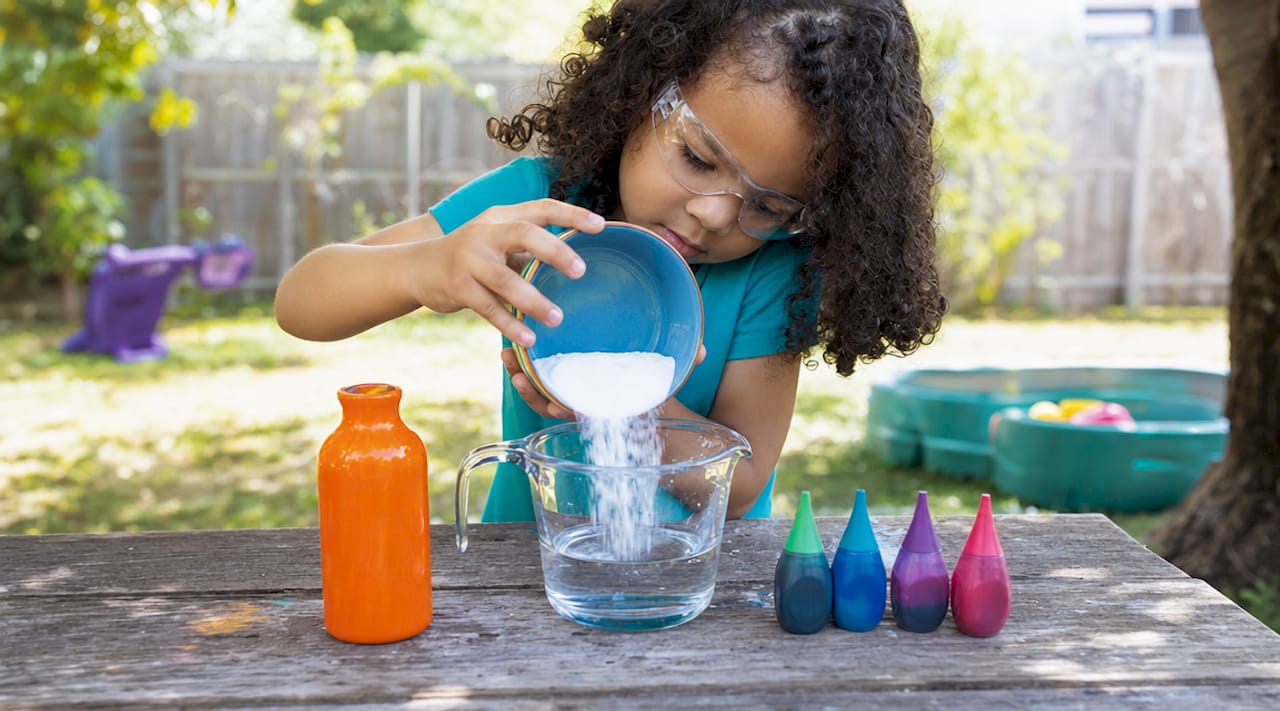
Sodium Hydrogen Carbonate for Kids' Science Experiments
Sodium hydrogen carbonate is the IUPAC name for sodium bicarbonate, the white crystalline powder most families know as baking soda, and it carries the chemical formula NaHCO3. You will find it in nearly every kitchen cabinet, yet it is also one of the most powerful teaching tools available for children ages 5 to 13. When combined with an acid like vinegar or exposed to heat, it produces dramatic, visible reactions that make abstract chemistry concepts click in a child’s mind. For parents and educators searching for safe, affordable, and genuinely exciting science projects, sodium hydrogen carbonate is the place to start.
How does sodium hydrogen carbonate react in classroom experiments?
The two reactions that make sodium hydrogen carbonate so valuable in education are the acid-base fizz and thermal decomposition. Both produce carbon dioxide gas, both are visible to the naked eye, and both teach children something real about how matter changes.
The acid-base reaction is the one most kids already know from volcano projects. When baking soda meets vinegar, the chemical reaction produces CO2 through this equation: NaHCO3 + CH3COOH → CH3COONa + CO2 + H2O. The fizzing happens because the acid donates a proton to the bicarbonate ion, forming carbonic acid, which is unstable and immediately breaks apart into carbon dioxide and water. That rapid gas release is what children see as bubbles. This reaction is fast, safe, and endlessly repeatable, which makes it perfect for classroom demos.
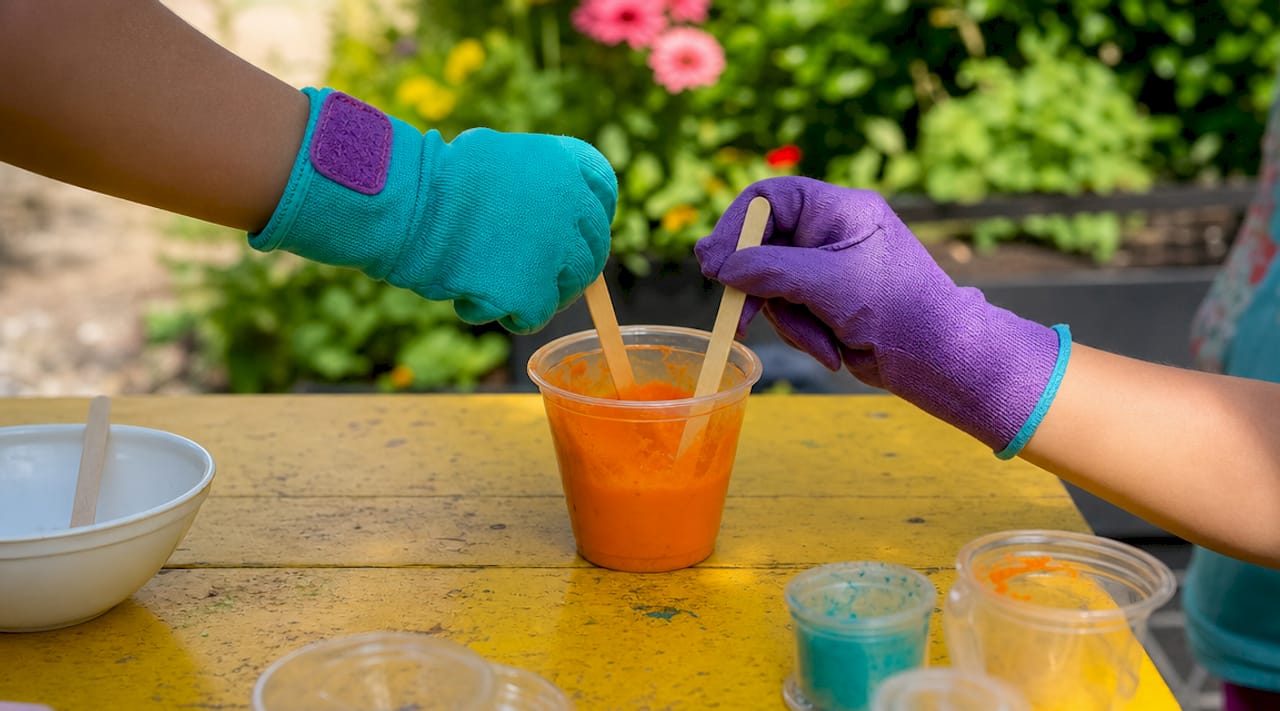
Thermal decomposition works differently. When sodium hydrogen carbonate is heated above 80 to 100 degrees Celsius, it breaks down into sodium carbonate, water vapor, and carbon dioxide. The equation is: 2 NaHCO3 → Na2CO3 + H2O + CO2. This reaction is slower and requires adult supervision with a heat source, but it introduces children to the concept of physical and chemical change through temperature alone.
One detail most classroom guides skip: sodium bicarbonate is amphoteric, meaning it can react with both acids and bases. This is why it works as a neutralizing agent in so many contexts, from baking to chemistry labs. Helping children understand this dual behavior builds a foundation for more advanced chemistry later.
Pro Tip: Try the acid-base reaction with lemon juice, orange juice, and white vinegar in separate cups. Stronger or more concentrated acids produce faster, more intense bubbling, giving children a direct comparison of acid strength without any dangerous chemicals.
- Pour 2 tablespoons of baking soda into a clear cup.
- Add 1/4 cup of vinegar slowly and observe the fizz.
- Repeat with lemon juice and compare the reaction speed.
- Record which acid produced the most bubbles in 10 seconds.
What safety considerations matter when using baking soda with children?
Safety is the non-negotiable starting point for any experiment involving sodium hydrogen carbonate, and the risks are real even though the compound itself is mild. Parents often assume baking soda is entirely harmless because it sits in the kitchen, but clinical reports document cases of metabolic alkalosis from overdose when children ingest too much. The risks are highest for young children, and the rule is clear: never give baking soda to children under 5 years old, and never encourage any child to taste experiment materials.
Beyond ingestion, the fizz reaction can splash liquid into eyes, and heating experiments carry burn risks. The following safety practices apply to every session:
- Always have children wear protective safety glasses before any experiment begins.
- Conduct heating experiments in a well-ventilated space, since CO2 buildup in a small, closed room is uncomfortable and potentially disorienting.
- Use small quantities, typically 1 to 2 teaspoons of baking soda per experiment, to limit the volume of gas produced.
- Keep a damp cloth and water nearby when using heat sources.
- Supervise children ages 5 to 8 directly throughout the experiment, not just at the start.
- Store sodium hydrogen carbonate in a labeled container away from other powders to prevent accidental confusion with similar-looking substances.
Safety glasses and adult supervision are the two most consistent recommendations across science education resources for children. These two steps alone eliminate the majority of common experiment accidents.
Pro Tip: Before any experiment, run a quick “scientist pledge” with your child or class. Have them repeat: “I will wear my glasses, I will not taste, and I will tell an adult if something goes wrong.” This builds safety habits as part of the scientist identity, not as a rule imposed from outside.
How to conduct classic baking soda experiments with kids
The baking soda and vinegar volcano is the most recognized sodium bicarbonate experiment in elementary education, but the way most families run it misses the best teaching moments. Here is a version designed to build real scientific thinking alongside the fun.
The fizz volcano experiment
- Build or shape a volcano form using clay, a plastic bottle, or a paper cup inside a tray.
- Add 1 tablespoon of baking soda to the inside container.
- Add a few drops of red food coloring and a small squirt of dish soap to the baking soda.
- Slowly pour 1/4 cup of white vinegar into the container and step back.
- Observe the reaction, then ask: “What do you think made the bubbles? Where did the gas come from?”
The dish soap slows the reaction slightly and creates foam, which makes the “lava” flow more dramatically. The food coloring makes the CO2 bubbles visible inside the foam. Both additions turn a simple fizz into a multi-sensory event that holds a child’s attention long enough for real questions to form.
The thermal decomposition experiment
This version is for children ages 9 and up, with direct adult supervision throughout.
- Weigh 2 grams of baking soda on a kitchen scale and record the mass.
- Place the baking soda in a small heat-safe dish.
- Heat gently over a low flame or in an oven set to 200 degrees Fahrenheit for 10 minutes.
- Remove from heat and allow to cool for 10 to 15 minutes.
- Reweigh after cooling/09%3A_Decomposition_Of_Baking_Soda/9.01%3A_Decomposition_Of_Baking_Soda_-_Experiment) and compare the new mass to the original.
The mass will be lower because CO2 and water vapor escaped during heating. This is the key insight: matter left the sample as gas, which is why the solid weighs less. Measuring before and after transforms a visual observation into quantitative data, which is a genuine scientific skill. According to Chemistry LibreTexts, cooling for 10 to 15 minutes/09%3A_Decomposition_Of_Baking_Soda/9.01%3A_Decomposition_Of_Baking_Soda_-_Experiment) before reweighing confirms that the conversion to sodium carbonate is complete.
- Ask children to predict the new mass before reweighing.
- Have them calculate the difference and discuss where the “missing” mass went.
- Encourage them to draw a before-and-after diagram of the molecules.
Pro Tip: Pair the thermal decomposition experiment with Teamgeniussquad’s acid-base activity book so children can record their predictions, observations, and conclusions in a structured format. Writing down results is the step that turns a fun activity into a real science experience.
How does sodium hydrogen carbonate compare to similar household chemicals?
Choosing the right compound for a children’s experiment matters more than most guides acknowledge. Baking soda, baking powder, and sodium carbonate all look similar and all produce CO2 under the right conditions, but their safety profiles and reaction behaviors are meaningfully different.
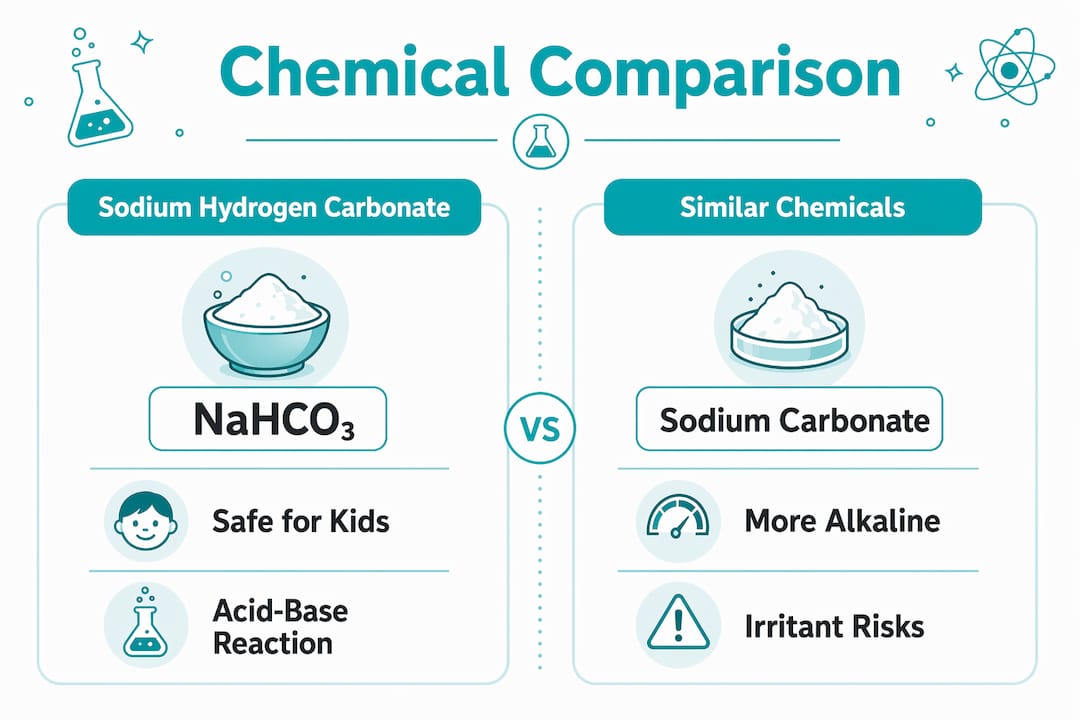
Sodium carbonate is more alkaline than sodium hydrogen carbonate and can cause skin and eye irritation more readily. It is not recommended for unsupervised use with children under 10. Baking powder contains sodium bicarbonate plus a dry acid, typically cream of tartar or sodium aluminum sulfate, which means it reacts on contact with moisture without needing added vinegar. This makes it less predictable in open experiments.
| Compound | Formula | Reaction trigger | Safety for kids | Best experiment use |
|---|---|---|---|---|
| Sodium hydrogen carbonate (baking soda) | NaHCO3 | Acid or heat | High, ages 5 and up with supervision | Fizz volcano, thermal decomposition |
| Baking powder | NaHCO3 + acid salt | Moisture or heat | Moderate, less predictable fizz | Pancake rise demonstration |
| Sodium carbonate (washing soda) | Na2CO3 | Water or acid | Lower, more caustic | Ages 10 and up, pH testing |
| Citric acid (paired with baking soda) | C6H8O7 | Water or moisture | High, ages 5 and up | Bath bomb making, fizz tablets |
For children ages 5 to 13, sodium hydrogen carbonate paired with white vinegar or citric acid is the safest and most controllable combination. The reactions are fast enough to be exciting and slow enough to observe clearly, and neither reactant causes harm on skin contact in typical experiment quantities.
Key takeaways
Sodium hydrogen carbonate is the safest, most versatile compound for children’s chemistry experiments because its acid-base and thermal reactions are visible, controllable, and genuinely educational.
| Point | Details |
|---|---|
| Chemical identity | Sodium hydrogen carbonate (NaHCO3) is the IUPAC name for baking soda, a mild alkaline powder. |
| Two core reactions | Acid-base fizz with vinegar and thermal decomposition above 80°C both release CO2 and teach distinct chemistry concepts. |
| Safety first | Never give baking soda to children under 5; always use safety glasses and adult supervision during experiments. |
| Measure, don’t just watch | Weighing before and after thermal decomposition teaches quantitative thinking, not just visual observation. |
| Best compound for kids | Among household alkaline chemicals, sodium hydrogen carbonate is the safest and most predictable for ages 5 to 13. |
Why hands-on chemistry changed how I see children’s learning
When I first watched a child’s face during a baking soda and vinegar reaction, what struck me was not the fizz. It was the moment right after, when the child looked up and asked, “But where did the bubbles go?” That question is the entire point of science education. The experiment did not just entertain. It created a genuine need to understand.
The instinct many parents and educators have is to protect children from complexity, to simplify until the science disappears. But sodium hydrogen carbonate experiments work precisely because they are real chemistry. The CO2 is real. The mass loss is real. The child who measures, predicts, and then checks their prediction against actual data is doing what scientists do. That experience builds a different kind of confidence than getting a right answer on a worksheet.
What I have seen, both through Teamgeniussquad’s work and through conversations with educators, is that children who struggle in traditional learning environments often shine in hands-on chemistry. The experiment does not care how fast you read. It rewards curiosity, patience, and careful observation. Those are skills every child can develop, and baking soda is one of the most forgiving and rewarding ways to start building them.
My honest advice: do not wait for the perfect setup. A cup, some baking soda, and a splash of vinegar on a kitchen table is enough to unlock something real in a child. The more you let them lead the observation, the more they own the discovery.
— Tita
Bring the science home with Teamgeniussquad experiment kits
Every experiment described in this article becomes even more powerful when children have the right tools, structured guidance, and the identity of a real scientist to step into. Teamgeniussquad designs hands-on, screen-free STEAM discovery kits built around the E³ Method, Engage, Encourage, and Empower, so children ages 5 to 13 do not just perform experiments. They become young innovators who believe in their own abilities.

Each kit includes age-appropriate materials, safety gear, and experiment guides that parents and educators can trust. Whether your child is doing their first fizz reaction or exploring thermal decomposition for the first time, Teamgeniussquad’s science experiment kits give them everything they need to discover chemistry with confidence. Explore the full collection and find the kit that matches your child’s curiosity.
FAQ
What is the sodium hydrogen carbonate formula?
Sodium hydrogen carbonate has the chemical formula NaHCO3. It contains one sodium atom, one hydrogen atom, one carbon atom, and three oxygen atoms bonded together.
Is sodium bicarbonate safe for kids to use in experiments?
Sodium bicarbonate is safe for children ages 5 and up when used in small quantities under adult supervision, with safety glasses worn throughout. It should never be ingested, and children under 5 should not handle it during experiments.
What happens when baking soda and vinegar are mixed?
Mixing baking soda and vinegar triggers an acid-base reaction that produces carbon dioxide gas, water, and sodium acetate. The CO2 release creates the visible fizzing that makes this one of the most popular classroom demonstrations in elementary science.
How is sodium hydrogen carbonate different from baking powder?
Baking powder contains sodium bicarbonate plus a dry acid, so it reacts on contact with moisture alone, making it less predictable in open experiments. Sodium hydrogen carbonate requires an added acid or heat to react, giving educators and parents more control over the experiment.
Can children measure the results of a baking soda heating experiment?
Yes, and measuring is the most educational part. Weighing the baking soda before and after heating shows children that mass decreased because CO2 and water vapor escaped as gas, turning a visual observation into real quantitative data.


Leave a comment
This site is protected by hCaptcha and the hCaptcha Privacy Policy and Terms of Service apply.