
Iron Nail Types, Sizes, and Uses: A Practical Guide
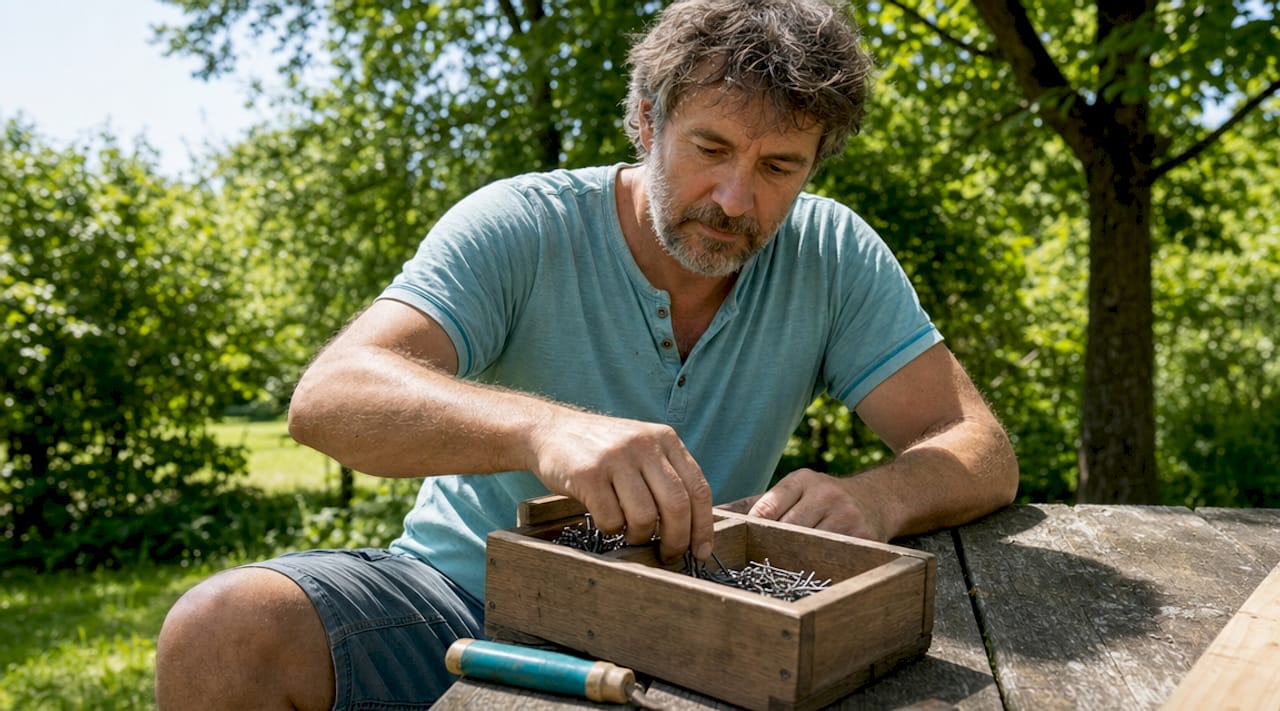
An iron nail is a metal fastener made primarily from iron, used in woodworking, carpentry, and general construction to join materials, hang objects, and assemble structures. The term “iron nail” is widely used in everyday language, though the industry standard term is steel fastener, since most modern nails are produced from low-carbon steel rather than pure iron. Understanding the difference between nail types, sizes, and coatings determines whether your project holds for decades or fails within months.
Iron nails are suited for light to moderate-strength tasks like framing, sheathing, crate assembly, and hanging objects, but they are more prone to rust than coated alternatives. Choosing the wrong nail for the wrong environment is one of the most common and costly mistakes in DIY and construction work. This guide covers everything you need to know to choose, use, and teach about iron nails with confidence.
What are the different iron nail types and sizes?
The nail aisle at any hardware store can feel overwhelming, but iron nail types follow a clear logic once you understand the system. Each nail type is designed for a specific task, and matching the nail to the job is the first rule of good fastening.
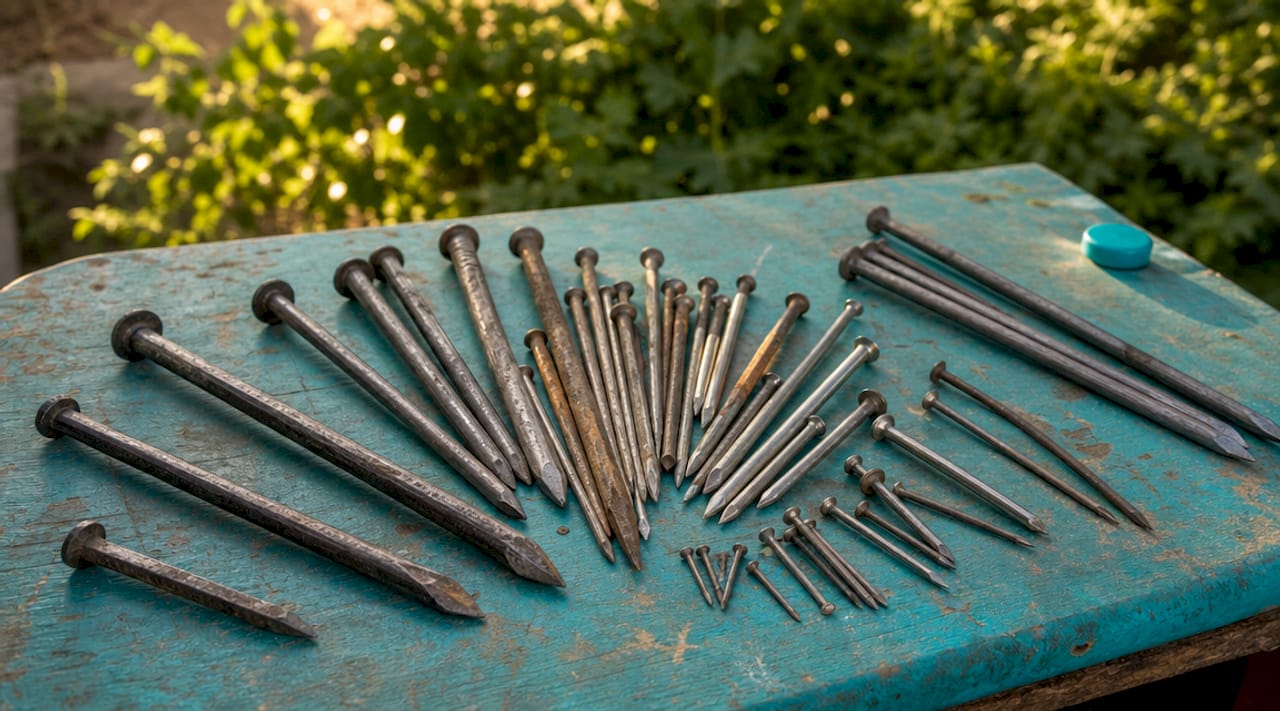
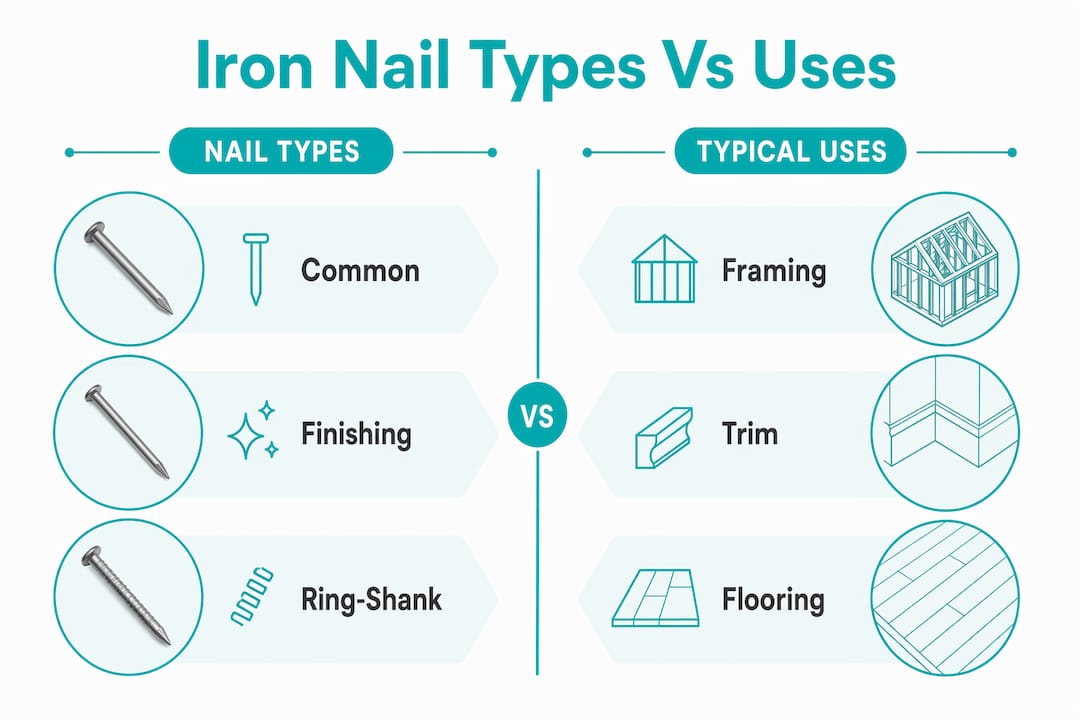
Common nail types include:
- Common round head nails: The workhorse of construction. Used for framing, sheathing, and rough carpentry where holding power matters more than appearance.
- Finishing nails: Smaller diameter with a narrow head that can be driven below the surface and concealed. Ideal for trim, molding, and cabinetry.
- Brad nails: Even thinner than finishing nails, used for delicate trim work and lightweight applications where splitting is a risk.
- Ring-shank nails: Feature spiral ridges along the shank that dramatically increase withdrawal resistance. The preferred choice for flooring and decking.
- Roofing nails: Wide, flat heads designed to secure shingles and roofing materials without tearing through.
Nail sizes follow the penny (d) sizing system, which ranges from 2d (approximately 1 inch) to 60d (approximately 6 inches). The most common residential sizes are 8d (2.5 inches) and 16d (3.5 inches), which cover the majority of framing and general carpentry needs. Gauge refers to the nail’s diameter, and a lower gauge number means a thicker nail.
| Nail Type | Common Size | Typical Use |
|---|---|---|
| Common round head | 8d to 16d | Framing, sheathing, rough carpentry |
| Finishing nail | 4d to 8d | Trim, molding, interior cabinetry |
| Brad nail | 18 gauge | Delicate trim, lightweight panels |
| Ring-shank nail | 8d to 16d | Flooring, decking, high-withdrawal applications |
| Roofing nail | 1 to 1.75 inches | Shingles, roofing underlayment |
Pro Tip: A general rule for nail length is that the nail should penetrate the receiving material by at least two-thirds of its total length. For a 2x4 framing joint, a 16d nail at 3.5 inches gives you the penetration depth needed for structural holding power.
How does corrosion affect iron nails, and which coating is right for your project?
Corrosion protection is the single most important factor separating a nail that lasts from one that fails. Uncoated iron nails begin oxidizing within 24 to 48 hours of moisture contact, with visible rust appearing in as little as 7 to 14 days in humid environments. That timeline matters enormously for outdoor projects, coastal builds, and any application where moisture is present.
The three main categories of nail corrosion protection are uncoated iron, galvanized, and stainless steel. Each offers a dramatically different service life.
| Nail Type | Salt Spray Performance | Expected Service Life |
|---|---|---|
| Uncoated iron/steel | Rusts within hours | 6 to 18 months outdoors |
| Electro-galvanized | Moderate resistance | 2 to 5 years indoors or semi-protected |
| Hot-dip galvanized | Red rust after 500 to 1,000 hours | 15 to 25 years in moderate environments |
| 304 stainless steel | No corrosion after 2,000+ hours | 25+ years in most environments |
| 316 stainless steel | No corrosion after 5,000+ hours | Decades in coastal or chloride-rich settings |
Galvanizing works through two mechanisms. The zinc coating creates a physical barrier against moisture, and it also acts as a sacrificial layer, meaning zinc oxidizes preferentially to protect the iron underneath. Even if the coating is scratched, the zinc continues protecting the nail cathodically, which prevents rust from spreading. This is why hot-dip galvanized nails are the industry standard for outdoor wood construction.
For coastal environments, the calculus changes. Grade 316 stainless steel nails are the recommended choice because chloride ions in salt air attack zinc coatings aggressively. In a C5 coastal exposure classification, galvanized nails last 7 to 12 years while uncoated steel lasts only 6 to 18 months. Stainless steel costs more upfront, but it eliminates repeated replacement costs and prevents the rust staining that ruins the appearance of coastal timber structures.
Pro Tip: Before purchasing nails for any project, assess the exposure category first. Dry interior work allows for bright or electro-galvanized nails. Outdoor or treated-wood applications require hot-dip galvanized. Anything within a mile of the ocean calls for 316 stainless steel.
What are the best practices for using iron nails in DIY and construction?
Knowing which nail to buy is only half the equation. How you drive a nail determines whether the joint holds or the wood splits. These principles apply whether you are building a bookshelf, assembling a raised garden bed, or teaching a child their first carpentry lesson.
Practical do’s and don’ts for iron nail applications:
- Do pre-bore pilot holes in dense or split-prone hardwoods like oak or maple. Pre-boring is especially recommended when using ring-shank nails in tight-grained timber.
- Do drive nails at a slight angle (called toe-nailing) when joining boards end-to-face for stronger mechanical connection.
- Do use ring-shank nails for flooring and decking where joint stability under repeated load is critical.
- Don’t use uncoated iron nails in outdoor, high-moisture, or pressure-treated lumber applications. The chemicals in treated wood accelerate corrosion and can cause structural failure.
- Don’t strike the nail with the edge of the hammer head. Use the full face of the hammer to reduce the risk of bending the nail or bruising the wood surface.
- Don’t place nails too close to the end grain of a board. A minimum distance of 10 times the nail diameter from the end reduces splitting risk.
Safety is non-negotiable when working with nails, especially in educational settings with children. Always wear protective eyewear when driving nails, since fragments and ricochets are real hazards. Teach children to hold the nail with a nail-setting tool or a piece of cardboard rather than their fingers during the first strike. Proper technique builds confidence and prevents injury simultaneously.
For educators introducing iron nail applications in classroom projects, simple activities like building small wooden frames or assembling balsa wood structures teach mechanical fastening concepts in a hands-on, memorable way. The iron nail becomes a gateway to understanding materials science, force, and structural integrity.
How are iron nails manufactured and what quality standards matter?
The quality of an iron nail is determined long before it reaches the hardware store. Iron nail production involves highly controlled manufacturing with advanced equipment and ISO 9001 certification to deliver consistent strength and reliability across applications. That certification is not just a label. It means the manufacturer follows documented quality control processes at every stage of production.
The manufacturing process moves from raw low-carbon steel wire through drawing, cutting, heading, and pointing operations. Precision at each stage directly affects the nail’s mechanical properties. Manufacturing quality, including precise dimension control and heat treatment, significantly influences tensile strength and holding power, often more than coating type alone. A poorly formed nail head can shear off under load regardless of how well it is coated.
Key quality indicators to look for when buying iron nails:
- ISO 9001 certification from the manufacturer
- Compliance with ASTM F1667 (the American standard for driven fasteners)
- Consistent shank diameter and head formation with no visible defects
- Coating thickness specifications for galvanized products (hot-dip galvanized should meet ASTM A153)
- Country of origin and traceability documentation for commercial or structural projects
When buying iron nails online or in bulk, request product data sheets that confirm material grade and coating standards. Reputable suppliers provide this information readily. For educators and parents sourcing nails for classroom projects, standard bright common nails from established brands like Grip-Rite or Maze Nails offer reliable quality at accessible price points.
Key takeaways
Selecting the right iron nail requires matching nail type, size, and corrosion protection to the specific demands of the project environment and mechanical load.
| Point | Details |
|---|---|
| Match nail type to task | Use ring-shank for flooring, finishing nails for trim, and common nails for framing. |
| Size by penetration depth | The nail should penetrate the receiving material by at least two-thirds of its total length. |
| Coat for the environment | Uncoated nails rust within days outdoors; hot-dip galvanized lasts 15 to 25 years in moderate conditions. |
| Coastal projects need stainless | Grade 316 stainless steel resists chloride corrosion where galvanized coatings fail within years. |
| Verify manufacturing quality | Look for ISO 9001 certification and ASTM F1667 compliance before purchasing for structural use. |
Why the nail you overlook is the one that fails you
I have seen beautifully built outdoor projects fall apart within two seasons, not because of poor woodworking, but because someone grabbed the cheapest bag of nails at the checkout. The iron nail is so familiar that people stop thinking about it. That familiarity is exactly where mistakes happen.
The most common error I observe, especially among first-time DIYers and parents building projects with their kids, is treating all nails as interchangeable. A bright common nail and a hot-dip galvanized nail look nearly identical in the bag, but their performance in a garden planter or a backyard deck diverges completely within the first rainy season. Rust staining, loosened joints, and structural creep are all symptoms of the same root cause: the wrong nail for the environment.
For educators, the iron nail is genuinely one of the best teaching tools in materials science. It illustrates oxidation, mechanical fastening, and the real-world consequences of material selection in a way that no textbook diagram can replicate. Letting children observe an uncoated nail rust in a glass of water next to a galvanized nail is a lesson in chemistry, engineering, and critical thinking all at once.
My honest recommendation: spend an extra two minutes assessing your project’s exposure conditions before you buy. Check whether you are working indoors or outdoors, whether the wood is treated, and whether you are near the coast. That two-minute decision can mean the difference between a project that lasts a decade and one that needs rebuilding in two years.
— Tita
Bring materials science to life with Teamgeniussquad
The curiosity that drives a child to ask “why does this nail turn orange?” is exactly the curiosity that Teamgeniussquad is built to nurture. Through the E³ Method (Engage, Encourage, Empower), Teamgeniussquad transforms concepts like oxidation, material properties, and hands-on construction into discovery experiences that build real confidence in young learners ages 5 to 13.

If your child or student is ready to go beyond observation and start experimenting, the STEM-STEAM Electricity Lab Bundle offers a screen-free, hands-on experience that connects material science concepts to real experiments. For classroom settings, the full experiment kits collection includes activities that make abstract science tangible, memorable, and genuinely exciting. Every kit comes with the tools young innovators need to see themselves as scientists, not just students. And for safe hands-on work, protective safety glasses designed for young learners make every experiment session safer and more professional.
FAQ
What is an iron nail made of?
Most nails sold as “iron nails” are made from low-carbon steel, which is an iron-carbon alloy, rather than pure iron. Pure iron nails are rare in modern construction because low-carbon steel offers better strength and workability.
What iron nail sizes are most common for home projects?
The most common sizes for residential use are 8d (2.5 inches) for general carpentry and 16d (3.5 inches) for framing. Finishing nails in the 4d to 8d range cover trim and interior cabinetry work.
How long do iron nails last outdoors?
Uncoated iron nails begin rusting within 24 to 48 hours of moisture exposure and typically last only 6 to 18 months in outdoor conditions. Hot-dip galvanized nails extend that service life to 15 to 25 years in moderate environments.
Are rust-resistant nails worth the extra cost?
Rust-resistant nails, whether hot-dip galvanized or stainless steel, are worth the investment for any outdoor, coastal, or high-moisture application. The cost of replacing failed fasteners and repairing damaged wood far exceeds the upfront price difference.
Can children safely use iron nails in school projects?
Children can safely use nails in supervised settings with proper protective eyewear and guidance on hammer technique. Using a nail-setting tool or a folded piece of cardboard to hold the nail during the first strike eliminates the most common finger-strike injury.


Leave a comment
This site is protected by hCaptcha and the hCaptcha Privacy Policy and Terms of Service apply.