Celtic Heart Knot: Meaning, History, and How to Tie It
The celtic heart knot is defined as a continuous interlaced loop shaped into a heart, symbolizing eternal love and unbroken connection between two people. Unlike decorative knots with loose ends, this design draws directly from the ancient Celtic tradition of continuous interlacing where no strand ever terminates. It blends medieval Insular knotwork with the universally recognized heart shape, making it one of the most emotionally resonant Celtic patterns in use today. Whether you encounter it on a pendant, a tattoo, or a handcrafted cord, the meaning runs deeper than aesthetics alone.
1. What the Celtic heart knot actually is
The Celtic heart knot is a modern love-knot variant built on the same structural principle as all traditional Celtic knotwork: one continuous strand that loops back on itself with no beginning and no end. The heart shape is a post-medieval addition, layered onto an ancient structural tradition rather than pulled directly from archaeological records. This distinction matters because it separates what the knot does structurally from what it means culturally.
Most makers and jewelers present the design as a symbol of eternal love and unity, and that framing is accurate to how the knot functions today. The heart shape added to traditional love-knots appears widely in jewelry and gifts, reinforcing romantic symbolism that resonates across cultures. The result is a design that feels ancient even when it is relatively new, because its structural DNA genuinely is ancient.
2. Historical background of Celtic knotwork
Celtic knotwork as a visual tradition peaked in the 7th through 9th centuries, appearing most prominently in illuminated manuscripts like the Book of Kells and on carved stone crosses at monastic sites across Ireland, Scotland, and Northumbria. These works were produced by monks who treated intricate interlacing as an act of spiritual devotion, not merely decoration. The unbroken strand was a deliberate visual statement about infinity and the continuity of life.
The core structural rule of Celtic knotwork is that every strand passes alternately over and under adjacent strands and returns to its origin without breaking. Early Irish thought adopted this unbroken line as a statement of eternity and life beyond death. That philosophical weight is what gives modern Celtic heart designs their emotional gravity, even when the heart shape itself is a later addition.
Key developments in the evolution of Celtic knotwork include:
- 7th to 9th century: Insular art flourishes in monasteries across Ireland and Scotland, with knotwork serving spiritual and devotional purposes.
- Medieval period: Stone carvings and metalwork carry knotwork motifs into secular life, expanding their cultural reach.
- Post-medieval era: Romantic and nationalist movements in the 18th and 19th centuries revive Celtic imagery, attaching new emotional meanings to old patterns.
- 20th and 21st centuries: Jewelers and craftspeople adapt the continuous-loop structure into heart shapes, creating what we now recognize as the Celtic heart knot.
Scholars note that exact medieval meanings for specific Celtic knot designs are uncertain, and most romantic interpretations are modern overlays rather than verified historical readings. That does not diminish the knot’s power. It simply means you are participating in a living tradition that has always evolved.
3. Symbolism and meaning of the Celtic heart knot
The symbolism of the Celtic heart knot operates on two distinct layers, and understanding both gives you a richer appreciation of the design. The first layer is structural: the continuous strand symbolizes eternity, a loop with no start or finish that represents love, life, and connection extending beyond time. The second layer is interpretive: the heart shape carries modern romantic meaning that most people recognize instantly.
“Celtic knot meanings typically involve two layers: historical eternal motifs and modern romantic interpretations, especially for heart designs.” — Walkers Celtic Jewelry
The meanings most commonly associated with the Celtic heart knot include:
- Eternal love: The unbroken loop represents a bond that has no end, making it a popular choice for wedding and anniversary gifts.
- Unity: Two strands woven into one continuous path suggest two lives becoming inseparable.
- Friendship and family: The knot is not limited to romantic love. Many people use it to honor deep friendships or family bonds that feel unbreakable.
- Spiritual connection: Rooted in a tradition of monastic craftsmanship, the design carries a quiet spiritual dimension for those who seek it.
- Celtic heritage: For people of Irish, Scottish, or Welsh descent, wearing or displaying the knot is an act of cultural pride and ancestral connection.
Modern product pages emphasize romantic symbolism aligned with Celtic tradition rather than verified historical origin, and that honesty is worth appreciating. The knot earns its meaning through use, intention, and the weight of a tradition that spans more than a thousand years.
4. How to tie a Celtic heart knot step by step
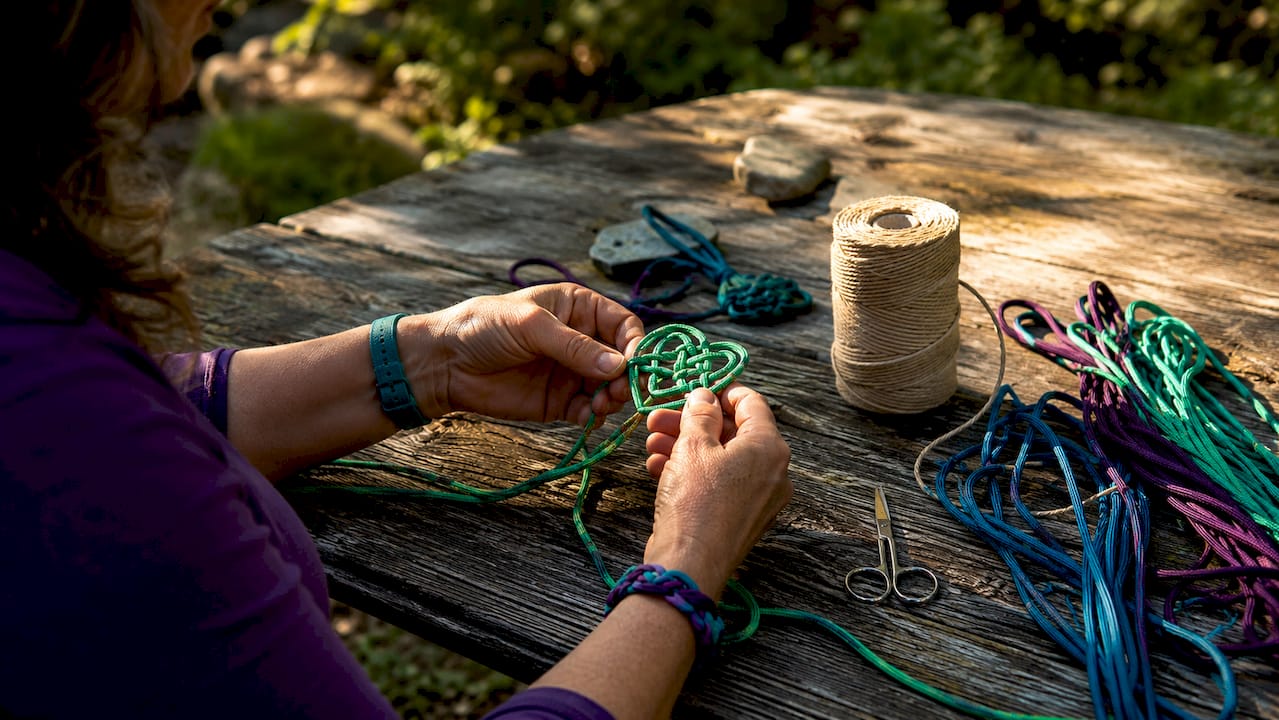
Tying a Celtic heart knot requires cord, patience, and a willingness to work slowly through the shaping phase. Paracord, macramé cord, or leather lacing all work well. A length of about 24 to 36 inches gives you enough material to work with without becoming unmanageable.
Tying the knot involves four distinct phases, each building on the last:
- Form the initial loops. Fold your cord so you have two equal working lengths. Create two overlapping loops side by side, leaving enough tail to work with. These loops form the foundation of the weave.
- Loop through the base. Take the right working end and pass it through the left loop from underneath, then over the top of the right loop. Repeat the mirror action with the left working end. This creates the interlaced structure that defines Celtic knotwork.
- Weave the loops together. Work each end through the structure using an over-under pattern, following the alternating path that is the hallmark of true Celtic interlacing. Take your time here. Rushing this phase creates tangles that are difficult to reverse.
- Shape the heart. This is the most demanding phase. Gently pull and nudge the top of the knot into two rounded lobes while pushing the bottom into a downward point. Shaping the heart clearly requires careful tension and patience, and expert makers stress gradual nudging of strands rather than forceful pulling.
Pro Tip: Pin your work to a foam board or corkboard as you shape. This lets you hold the structure in place while you adjust individual strands, and it makes the difference between a crisp heart and a lumpy oval.
The clarity of the heart shape depends far more on patient shaping and tensioning than on weaving skill alone. First-time makers often find the weaving straightforward but underestimate how long the shaping phase takes. Budget at least as much time for shaping as for the weave itself.
Recommended materials for beginners include 3mm macramé cord in a single color, which makes it easier to track the over-under pattern. Once you are comfortable with the structure, two-color cord creates a striking visual effect that highlights the interlacing.
5. Popular uses of the Celtic heart knot in jewelry, décor, and gifts
The Celtic heart knot appears across a wide range of applications today, from fine jewelry to handmade home décor. Its visual clarity and emotional resonance make it one of the most versatile Celtic patterns and symbols in contemporary use.
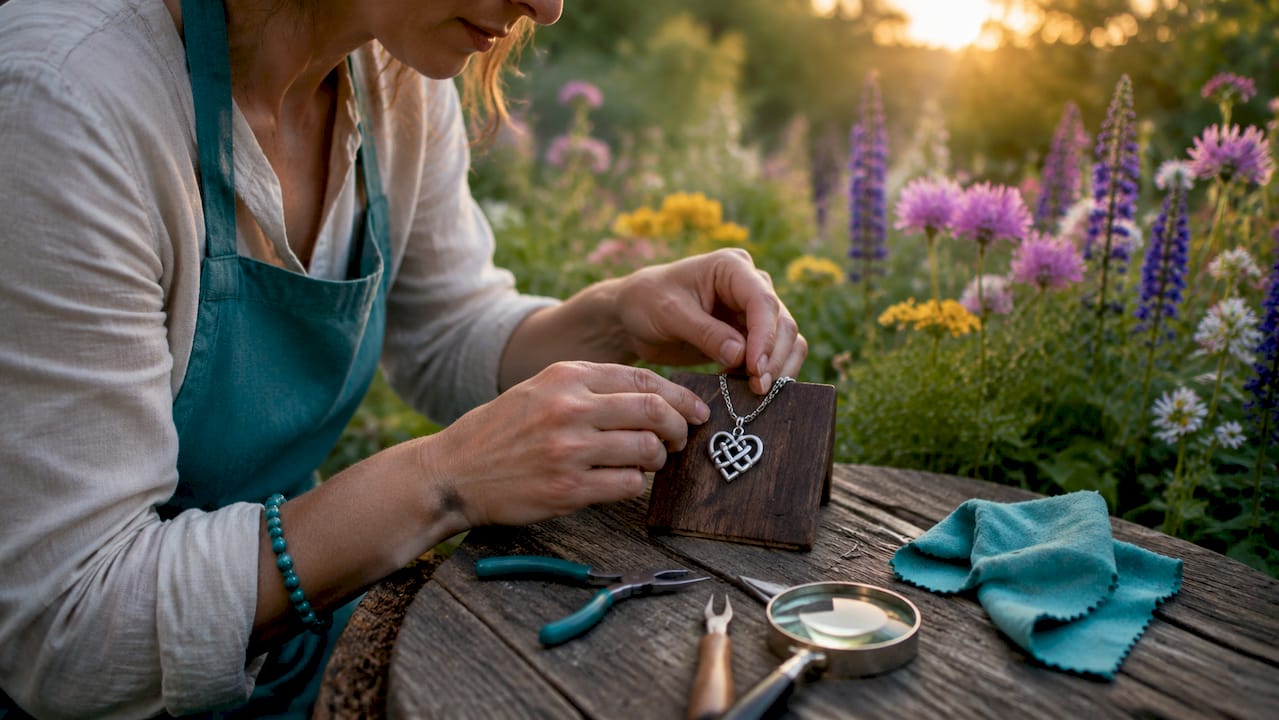
Jewelry is the most common application. Celtic heart knot rings, necklaces, and bracelets appear in sterling silver, gold, and knotted cord. Claddagh-inspired pieces sometimes incorporate the heart knot motif alongside the traditional hands and crown. Many jewelers in Ireland and Scotland offer personalized Celtic knot jewelry with the heart design as a centerpiece, and the pattern translates beautifully to both delicate fine jewelry and bold statement pieces.
Tattoos featuring the Celtic heart knot are a permanent declaration of love or connection. The continuous line translates well to ink, and skilled tattoo artists can render the over-under weave with remarkable precision. Placement on the wrist, forearm, or chest is common, and the design scales from a small minimalist mark to a large detailed piece.
Wedding and home décor uses include:
- Hand-fasted wedding cords tied in the heart knot pattern, symbolizing the binding of two lives.
- Framed Celtic heart art as a gift for couples celebrating anniversaries or engagements.
- Carved wooden or stone decorations featuring the heart knot motif for mantels and shelves.
- Holiday ornaments incorporating the design as a symbol of family bonds.
Gifts featuring the Celtic heart design carry built-in meaning that requires no explanation. A pendant, a key chain, or a framed piece of Celtic heart art communicates love and connection across generations and cultures. The knot’s visual simplicity makes it recognizable even to people with no background in Celtic patterns and symbols, which is part of why it has traveled so far from its origins.
Learning fashion craft projects for kids that incorporate knotting and weaving builds the same fine motor skills and pattern recognition that make Celtic knot tying accessible and rewarding for young learners.
Key takeaways
The Celtic heart knot earns its enduring appeal because it combines a genuinely ancient structural tradition with a universally understood symbol of love, creating a design that is both historically grounded and immediately meaningful.
| Point | Details |
|---|---|
| Structural origin | The continuous loop with no start or finish comes from 7th to 9th century Insular art, not modern invention. |
| Symbolic layers | The knot carries two meanings: historical eternity from the unbroken strand and modern romantic love from the heart shape. |
| Tying process | Four phases cover loop formation, weaving, and shaping; the shaping phase demands the most patience. |
| Material choice | Paracord, macramé cord, and leather lacing all work well; beginners should start with a single-color 3mm cord. |
| Modern applications | The design appears in jewelry, tattoos, wedding décor, and gifts, making it one of the most widely used Celtic patterns today. |
Why the Celtic heart knot still moves people
By Tita
What strikes me most about the Celtic heart knot is how honestly it earns its symbolism. Most decorative symbols borrow meaning from somewhere else. This one generates meaning from its own structure. The loop that never ends is not a metaphor someone invented. It is a physical fact of how the knot is built, and that structural truth is what gives the design its staying power.
I have watched children and adults alike slow down when they try to tie this knot for the first time. The shaping phase in particular demands a kind of focused patience that is rare in a world of instant results. There is something genuinely valuable in that experience, separate from the finished object. You learn that beauty requires attention, and that some things cannot be rushed without losing their form.
The scholarly debate about whether medieval Celts attached specific meanings to specific knots is real and worth knowing. Modern interpretations separate traditional knotwork symbolism of eternity from the love-focused meanings added in recent centuries. But I think that debate misses something. Every living tradition accumulates meaning over time. The heart knot means what it means today because generations of people chose to make it mean that. That is not a corruption of the original. It is how culture works.
If you are drawn to Celtic heart art, I would encourage you to try tying one before you buy one. The act of making it teaches you something about the design that no amount of reading can replicate.
— Tita
Bring Celtic-inspired creativity to life with Teamgeniussquad
If the Celtic heart knot has sparked your curiosity about hands-on pattern making and creative discovery, Teamgeniussquad is built for exactly that kind of learning energy. The brand’s E³ Method (Engage, Encourage, Empower) turns tactile crafting into a confidence-building experience for children ages 5 to 13, helping young creators see themselves as innovators from the very first project.

Explore the key chains collection for Celtic-inspired designs that make meaningful gifts, or check out the STEAM discovery bundles that bring the same hands-on spirit to science, technology, art, and math. Every kit is screen-free, purposeful, and designed to help children who learn differently discover what they are truly capable of building.
FAQ
What does the Celtic heart knot symbolize?
The Celtic heart knot symbolizes eternal love and unbroken connection, combining the continuous loop of ancient Celtic knotwork with the universal meaning of the heart shape. The unbroken strand represents a bond with no beginning and no end.
Is the Celtic heart knot historically ancient?
The continuous interlacing structure is genuinely ancient, rooted in 7th to 9th century Insular art, but the specific heart shape is a modern adaptation. Scholars note that exact medieval meanings for specific knot designs are uncertain, and romantic interpretations are largely post-medieval overlays.
What materials work best for tying a Celtic heart knot?
Paracord, macramé cord, and leather lacing all work well. Beginners benefit from starting with a single-color 3mm macramé cord, which makes it easier to track the over-under weave pattern during the tying process.
How is the Celtic heart knot different from a Celtic love knot?
The Celtic love knot is a broader category of continuous-loop designs associated with romantic bonds, while the Celtic heart knot specifically shapes those loops into a recognizable heart form. All Celtic heart knots are love knots, but not all love knots take the heart shape.
Where is the Celtic heart knot most commonly used today?
The design appears most often in Celtic knot jewelry such as rings, necklaces, and bracelets, as well as in tattoos, wedding décor, and handcrafted gifts. Its visual clarity and emotional resonance make it one of the most widely recognized Celtic patterns in contemporary use.

Leave a comment
This site is protected by hCaptcha and the hCaptcha Privacy Policy and Terms of Service apply.