Green Flame Science: Safe Experiments for Kids
A green flame stops kids in their tracks. It looks almost impossible, like something out of a science fiction movie, and that reaction is exactly what makes it such a powerful teaching moment. Most people assume fire just burns orange or yellow, so the appearance of a vivid green colored flame raises immediate questions: Why is it green? Is it dangerous? How does that happen? Those are precisely the right questions for young scientists to ask. This article explains the chemistry behind green fire, explores its surprising cultural significance, and gives parents and educators a clear, safe path to bringing this phenomenon into any learning environment.
Table of Contents
- Key takeaways
- Why flames turn green: the real science
- How to create green flame safely with kids
- The meaning of green flames across cultures
- Teaching kids about green flames through hands-on learning
- My perspective on teaching flame science to children
- Bring the science of green fire into your home or classroom
- FAQ
Key takeaways
| Point | Details |
|---|---|
| Green flames require specific metals | Copper, boron, and barium compounds produce green flames through electron energy release. |
| Safe materials exist for kids | Boric acid with alcohol creates green fire safely under adult supervision with proper equipment. |
| Green fire carries cultural meaning | Many traditions associate green flame with growth, renewal, and healing, enriching science lessons. |
| Combining science and symbolism works | Pairing chemistry experiments with cultural stories deepens children’s engagement and retention. |
| Safety comes first, always | Toxic compounds like thallium must never be used in educational settings, period. |
Why flames turn green: the real science
Most people learn that fire is orange or yellow and leave it there. What nobody tells you is that flame color is not about heat alone. It is almost entirely about chemistry. Every flame you see is the result of electrons releasing energy as light, and the color of that light depends on which atoms are burning.
Here is the core idea: when a metal compound gets hot enough, its electrons absorb energy and jump to a higher energy state. When those electrons fall back down, they release that energy as photons of light. Different elements release photons at different wavelengths, which is why each metal produces its own signature color. This is the principle behind the flame test, a classic chemistry method that uses unique emission spectra to identify metal ions like fingerprints.
For a green flame specifically, you need elements emitting photons in the 500 to 570 nanometer range, which is exactly where the human eye perceives green light. The most common metals that fall into this window include:
- Copper: Copper sulfate yields true green, while copper chloride shifts toward blue-green depending on the halide content.
- Boron: Boron compounds, including boric acid, produce a bright, lighter green and are among the safest options for classroom use.
- Barium: Barium compounds also produce green flames, though barium salts require careful handling and are better suited for supervised demonstrations.
What makes this so exciting for children is the visual proof that atoms are real and active. When a child watches a copper compound turn a flame green, they are literally seeing electrons at work. That connection between invisible chemistry and visible color is the kind of learning moment that sticks for years.
Pro Tip: When explaining this to younger children, ages 5 to 8, skip the word “electron” at first and say “tiny invisible parts of copper that glow green when they get excited.” Layer in the correct vocabulary once the wonder has already been sparked.
How to create green flame safely with kids
Knowing the science is one thing. Knowing which experiments are actually appropriate for children is something else entirely. Not every green flame source belongs in your living room or classroom, and being specific about what to use and what to avoid protects everyone involved.

Thallium produces a striking bright green flame but is highly toxic and has no place outside a regulated research lab. Setting that off the table immediately is not overprotection. It is responsible teaching.
The safest and most widely used approach for educational settings involves boric acid and a small amount of rubbing alcohol or methanol. Boric acid dissolved in alcohol produces a clean green flame when ignited under controlled conditions. Here is how to structure a safe demonstration:
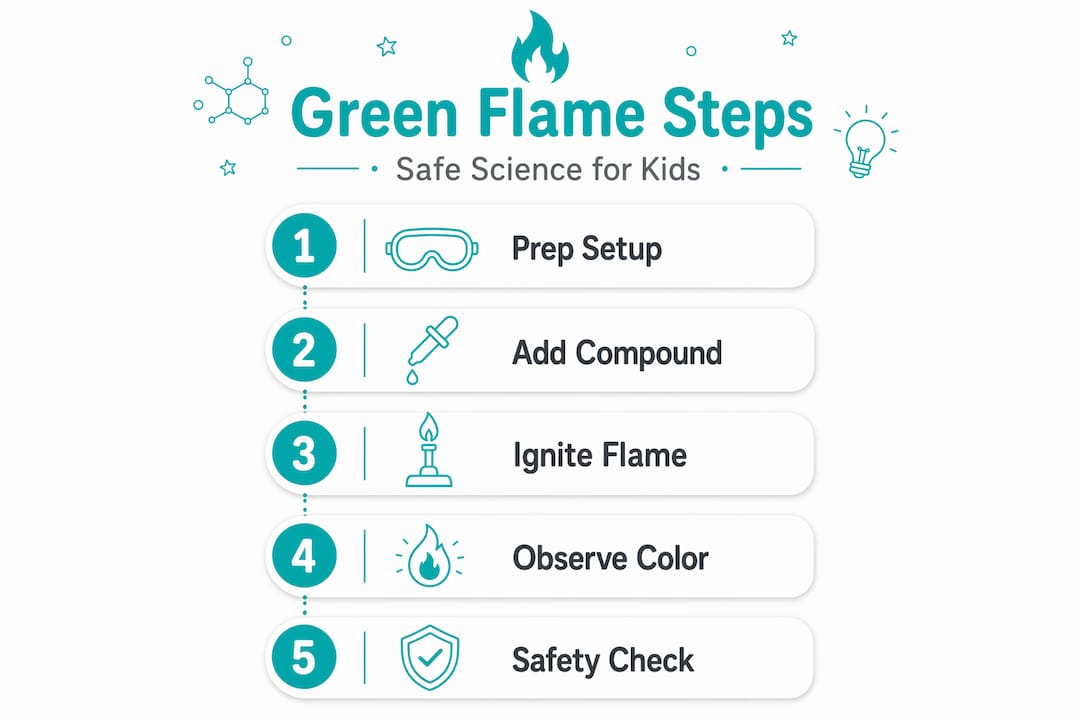
- Gather your materials. You need boric acid powder (available at pharmacies), rubbing alcohol or methanol, a heat-resistant dish, long-reach matches or a lighter, and proper protective equipment for every person in the room.
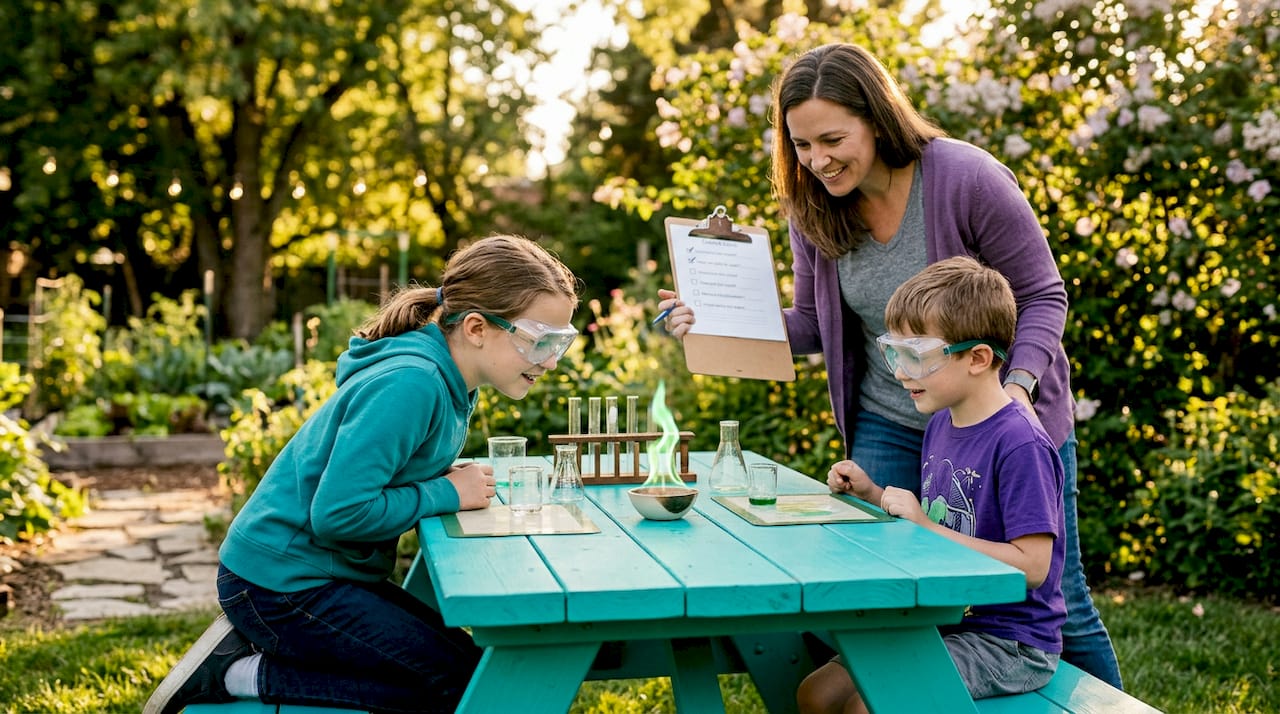
- Suit up before you start. Every child should wear lab safety glasses and keep their hair tied back. Adults wear the same. A youth lab coat not only protects clothing but builds the “I am a real scientist” identity that makes the lesson land emotionally.
- Prepare the mixture with adult hands only. Dissolve a small amount of boric acid into the alcohol in the heat-resistant dish. Children observe this step; they do not handle the chemicals.
- Conduct the ignition in a clear, open space. An outdoor table or a ventilated room with no flammable materials nearby works well. Light the mixture from arm’s length.
- Observe, record, and discuss. Let children sketch or describe the flame color in a science journal before extinguishing safely with a lid over the dish, never with water.
Pro Tip: Assign one child the role of “Chief Safety Officer” during the experiment. Give them a checklist to verify glasses are on, distance is maintained, and the extinguishing tool is ready. It builds responsibility and keeps every child engaged, not just the one closest to the flame.
Alternatives worth knowing about include copper sulfate flame demonstrations in more advanced settings and LED-based colored flame simulations, which are completely safe for the youngest learners in the group. These are excellent for introducing the concept before progressing to a live demonstration.
The meaning of green flames across cultures
Science does not exist in isolation, and neither do flames. Green fire has carried deep meaning across cultures for centuries, and weaving that context into a science lesson transforms a chemistry experiment into an interdisciplinary experience children remember far longer.
The green fire symbol appears across spiritual and cultural traditions as a marker of growth, renewal, healing, and transformation. In many belief systems, it connects directly to the heart chakra, representing emotional balance and compassion. That symbolism is not separate from science. It is a doorway into discussing why humans have always been drawn to fire and what they have projected onto its shifting colors.
“Green fire signifies spiritual cleansing and transformation in many traditions, serving as a powerful reminder that growth often requires a kind of burning away of what no longer serves us.”
Some specific cultural connections worth exploring with older children include:
- Celtic traditions: Green is the color of the natural world, and fire in green hues was associated with the renewal of the earth during seasonal festivals.
- Hindu traditions: Green connects to Anahata, the heart chakra, and fire rituals often carry meanings of purification and new beginnings.
- Native American beliefs: Many Indigenous traditions treat fire as a living teacher, with different flame colors interpreted as messages about the state of the natural world.
- Environmental symbolism: Green fire has even entered conservation language. The documentary Green Fire: Aldo Leopold and a Land Ethic for Our Time used the image to represent transformation of the land and humanity’s relationship with nature.
When you share these stories alongside the chemistry lesson, you show children that the same phenomenon can be understood through multiple lenses simultaneously. That is not confusion. That is exactly how scientists and thinkers actually operate in the real world.
Teaching kids about green flames through hands-on learning
Understanding the science and the symbolism is only the beginning. The real power comes from designing learning experiences that let children feel like investigators, not just spectators. The green flame in nature offers an unusually rich hook for this, because children can observe something visually startling and then be invited to explain it themselves.
Here is what works well in practice when bringing green flame science to life for children:
- Start with observation, not explanation. Show the green flame first. Let children react, guess, and theorize before you explain anything. Their initial hypotheses matter and build scientific thinking habits even when they are completely wrong.
- Pair the chemistry with a cultural story. Before or after the experiment, share one of the cultural meanings from Section 4 above. Ask children to draw a picture of what they think “a flame that means healing” would look like. Comparing those drawings to the actual green flame opens a rich conversation.
- Use the experiment to introduce atomic structure. For children ages 9 and up, the green flame is a concrete, visible entry point into discussing electrons, energy levels, and what atoms actually do. The flame test concept, each element producing its own color fingerprint, makes atomic theory tangible in a way textbook diagrams simply cannot.
- Build in safety as a learning objective, not a disclaimer. Teach children why we do not use thallium, why we wear goggles, and why we extinguish with a lid rather than water. These are real chemistry decisions, and treating children as capable of understanding them builds both confidence and genuine safety awareness.
- Document the discovery. A simple science journal entry asking “What I saw, what I think caused it, and what I want to know next” closes the loop on the experiment and integrates literacy into the science experience, which is central to how Teamgeniussquad designs every kit through the E³ Method.
Pro Tip: If you have children in the group who learn differently, perhaps through tactile input or visual storytelling rather than written notes, let them draw a comic strip or create a diagram of the experiment instead of a written journal entry. The goal is reflection, not format compliance.
Hands-on STEAM activities that combine discovery with identity building are the ones that create lasting confidence. When a child can say “I made a flame turn green and I know exactly why,” that is a child who believes science belongs to them.
My perspective on teaching flame science to children
I have sat with a lot of children during science experiments over the years, and I can tell you that the ones who light up the most are not always the ones who already love science. They are the ones who have never had a reason to believe they are good at it. A green flame does something remarkable to those children. It catches them off guard in the best possible way.
What I have found is that the biggest mistake educators make is over-explaining before the child has had a chance to wonder. You do not need to front-load the electron theory. Let the flame be strange and beautiful first. The explanation becomes something they reach for, not something they endure.
The interdisciplinary piece matters more than most teachers give it credit for. When I connect the chemistry to a cultural story or an environmental idea, I watch something shift. Children who tuned out during the science part lean in during the story. Children who struggled with the cultural narrative want to run back to the experiment. The meaning of green flames, both scientific and symbolic, is richer when both layers are present at once.
What I believe most strongly is this: safe exploration with real materials, conducted thoughtfully with adult guidance, does more for a child’s scientific identity than any worksheet or video ever will. The smell of the experiment, the visual surprise of a green colored flame, the pride of writing your own observation down, those are the experiences that make a child think, “Maybe I am a scientist.”
— Tita
Bring the science of green fire into your home or classroom
Ready to watch curiosity catch fire? Teamgeniussquad designs hands-on, screen-free STEAM discovery kits specifically for children ages 5 to 13, built to turn experiments like green flame demonstrations into confidence-building adventures. Every kit follows the proprietary E³ Method, Engage, Encourage, Empower, so children are not just doing science. They are becoming scientists.

Whether you are a parent looking for a weekend discovery project or an educator building a chemistry unit, the Team Genius Squad experiment kits give children the tools, context, and identity to own their learning. For a ready-to-go option, the STEM-STEAM Electricity Lab Bundle pairs beautifully with light and energy lessons, including flame color science. Pair any kit with a set of kids lab coats so every child steps into the role of innovator from the first moment.
FAQ
What causes a green flame when burning?
A green flame occurs when metal compounds containing copper, boron, or barium are heated, causing electrons to release photons in the 500 to 570 nanometer range that the human eye sees as green. Each element produces a specific wavelength based on its electron structure.
How to create green flame safely for a kids’ experiment?
The safest method is dissolving boric acid in rubbing alcohol and igniting it in a heat-resistant dish with adult supervision, proper ventilation, and safety glasses for all participants. Boric acid with alcohol is non-toxic compared to alternatives and produces a vivid green flame.
What is the meaning of green flames in spiritual traditions?
Green fire is widely associated with growth, healing, renewal, and the heart chakra across multiple spiritual traditions. The green fire symbol represents transformation and emotional balance in Celtic, Hindu, and various other cultural belief systems.
Why is thallium not used in classroom green flame experiments?
Thallium is highly toxic and is strictly avoided outside of regulated laboratory settings. Safer alternatives like boric acid produce comparable green flame results without any health risk to children or educators.
Can green flames appear naturally outdoors?
Green colored flames can appear in nature when wood or organic material containing copper-rich minerals or boron-containing compounds burns. Driftwood fires sometimes produce flashes of green for this reason, making green flame in nature a genuine and observable phenomenon for curious young scientists.

Leave a comment
This site is protected by hCaptcha and the hCaptcha Privacy Policy and Terms of Service apply.