

Calcium Sulphate: Uses, Properties, and Applications
Calcium sulphate is an inorganic salt defined by the chemical formula CaSO₄, and it exists in three distinct hydration states that determine its function across industries. The anhydrous form, calcium sulfate dihydrate (gypsum), and the hemihydrate known as plaster of Paris each behave differently when exposed to water, heat, or pressure. That difference in hydration state is the entire story of why this single compound builds walls, sets tofu, and regenerates bone tissue. Understanding which form you need, and why, is the foundation for using it correctly in construction, food processing, or dentistry.
What are the key properties of calcium sulphate?
Calcium sulphate’s physical and chemical properties are what make it so adaptable, and they are also what make it unforgiving when misapplied. Knowing these properties before selecting a grade or form is not optional. It is the difference between a product that performs and one that fails.
Solubility and the retrograde effect
Calcium sulfate exhibits retrograde solubility, meaning it becomes less soluble as water temperature rises. This is the opposite of most salts and explains why calcium sulphate scale forms inside boilers and heat exchangers rather than dissolving away with heat. At 25°C, gypsum dissolves at roughly 2.0 to 2.5 g/L, a moderate solubility that supports controlled release in both food and agricultural applications. For industrial engineers, this retrograde behavior is a design constraint, not a curiosity.
Crystal structure and hardness
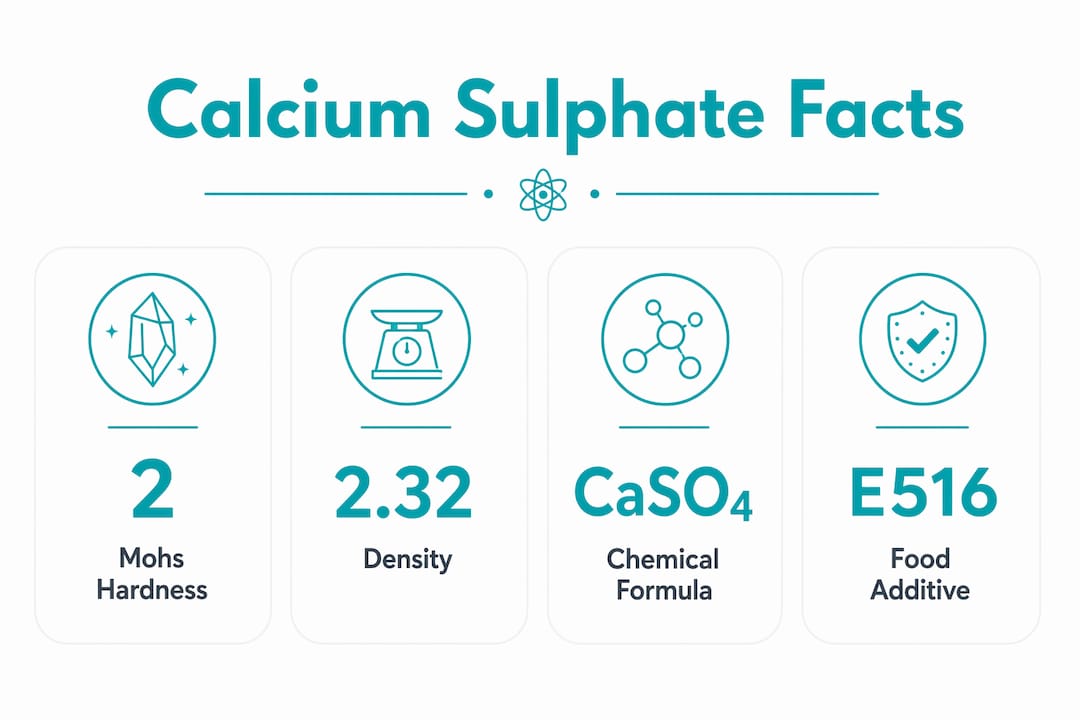
Gypsum, the dihydrate form, registers a hardness of 2 on the Mohs scale and carries a density of 2.32 g/cm³. Those numbers explain why gypsum plaster is workable by hand but still structurally useful once set. Anhydrite, the fully anhydrous form, is harder and denser, making it more resistant to moisture reabsorption. The crystal structure of gypsum consists of layers of calcium and sulfate ions separated by water molecules, and it is precisely those water molecules that drive the material’s thermal transitions.
Thermal transitions and calcination
Heating gypsum between 107°C and 170°C drives off three-quarters of its water to produce hemihydrate, the plaster of Paris used in construction and dental molds. Heating beyond that range produces anhydrous calcium sulfate, which is harder but less reactive and less useful for setting applications. The calcination temperature window is narrow by design. Overheating within that range produces a weaker, more brittle material that will not meet structural standards.
Pro Tip: When sourcing gypsum plaster powder for construction, always request the calcination temperature log from the manufacturer. Batches calcined above 170°C will show reduced flexural strength and inconsistent set times, even if the whiteness specification looks correct.
| Property | Value or Behavior |
|---|---|
| Mohs hardness (gypsum) | 2 |
| Density (gypsum) | 2.32 g/cm³ |
| Solubility at 25°C | 2.0 to 2.5 g/L |
| Calcination range for hemihydrate | 107°C to 170°C |
| Retrograde solubility | Less soluble as temperature increases |
How is calcium sulphate used in construction?
Construction is the largest single market for calcium sulphate, and the compound earns that position through a combination of fire resistance, workability, and cost efficiency that no synthetic alternative has matched at scale. Gypsum board, plaster, stucco, and ceiling tiles all rely on the controlled rehydration of hemihydrate back into dihydrate as their setting mechanism.

The calcination process that produces hemihydrate plaster is central to product quality. When hemihydrate is mixed with water, it rehydrates and crystallizes into interlocking gypsum crystals, releasing heat in the process. That exothermic reaction is what gives plaster its fire-resistant character: in a fire, the bound water in the set gypsum must be driven off before the wall assembly reaches dangerous temperatures, buying critical evacuation time.
Quality standards for construction-grade gypsum plaster powder are specific and measurable:
- Flexural strength must reach at least 8.5 MPa after solidification, confirming the crystal matrix has formed correctly.
- Whiteness must exceed 95%, indicating low contamination from iron oxides or organic matter.
- Setting time must fall within a controlled window, typically 5 to 30 minutes depending on application, to allow workable placement before hardening begins.
- Particle size distribution must be uniform to prevent uneven hydration and surface defects.
Impurity control matters as much as the base chemistry. Iron, magnesium, and silica impurities in raw gypsum reduce whiteness, weaken the crystal matrix, and cause surface discoloration in finished plaster. High-quality manufacturers test raw feedstock before calcination and maintain strict limits on these contaminants. For specifiers and procurement teams, requesting a full certificate of analysis rather than relying on grade labels alone is the only reliable approach.
- Fire resistance depends on the water content locked in the dihydrate crystal structure.
- Purity of the raw gypsum feedstock directly controls the whiteness and strength of the finished plaster.
- Water-to-solid ratio during mixing is a critical process variable. The water-to-solid ratio affects setting time and final hardness, and inconsistency prevents proper crystallization.
- Recycled or synthetic gypsum from flue gas desulfurization plants meets the same performance standards as mined gypsum when properly processed.
What roles does calcium sulphate play in food processing?
Calcium sulphate as a food additive carries the designation E516 in the European Union and is recognized as generally safe by the U.S. Food and Drug Administration. It functions as a coagulant, firming agent, and calcium fortifier across a range of processed foods, with tofu production being the most widely recognized application.
In tofu manufacturing, food-grade calcium sulphate (sold commercially as terra alba) is added to hot soy milk to precipitate soy proteins into curds. The reaction rate and curd texture depend directly on particle size distribution: finer, more uniform powder dissolves at a predictable rate, producing consistent curd formation across production batches. Coarser or irregularly sized particles create uneven coagulation, resulting in texture defects that cannot be corrected downstream.
Purity requirements for food-grade calcium sulphate are strict. High-purity powders contain fewer than 500 ppm of chloride and sodium impurities, thresholds that protect both flavor and the safety profile of the finished product. Chloride contamination at higher levels introduces off-flavors and can interfere with protein coagulation chemistry.
- Tofu coagulant: calcium sulphate produces a softer, smoother curd than nigari (magnesium chloride), which is why it dominates commercial tofu production in North America.
- Baking: added to flour as a dough conditioner and yeast nutrient, improving gluten development and fermentation consistency.
- Brewing: used to adjust water hardness in beer production, particularly for styles requiring high sulfate profiles like Burton-style ales.
- Calcium fortification: added to juices, cereals, and plant-based milks as a bioavailable calcium source.
Pro Tip: In food manufacturing, always specify the particle size distribution range alongside the purity grade when ordering calcium sulphate. Two suppliers can both meet a 99% purity specification while delivering powders with completely different reaction kinetics, leading to inconsistent product texture.
How is calcium sulphate applied in dentistry and medicine?
Calcium sulphate’s biomedical applications rest on two properties that most industrial materials cannot offer: biocompatibility and complete resorbability after implantation. The body does not mount a significant immune response to calcium sulphate, and the material resorbs gradually, releasing calcium ions that support new tissue formation. That combination makes it uniquely suited to bone regeneration and guided tissue applications.
In dentistry, calcium sulphate serves two distinct roles. As a dental impression material and mold medium, hemihydrate plaster sets rapidly and captures fine detail with dimensional accuracy. As a bone graft barrier membrane and void filler, pharmaceutical-grade calcium sulphate is placed directly into extraction sites or periodontal defects to support bone regeneration while preventing soft tissue ingrowth.
The medical-grade applications demand the highest purity specifications of any calcium sulphate use:
- Pharmaceutical grade requires fewer than 500 ppm chloride and sodium, with heavy metal content controlled to parts-per-billion levels.
- Particle size for bone graft applications is typically controlled between 150 and 500 microns to match the resorption rate with the rate of new bone formation.
- Sterility and endotoxin testing are mandatory for implantable forms, requirements that do not apply to construction or food grades.
- Controlled calcium release from resorbing implants creates a localized calcium-rich environment that promotes osteoblast activity and accelerates bone healing.
The resorption timeline for calcium sulphate bone grafts typically runs four to six weeks, which aligns well with the early phases of bone healing. This predictable timeline is a clinical advantage over synthetic hydroxyapatite, which resorbs much more slowly and can interfere with long-term bone remodeling.
Key takeaways
Calcium sulphate’s performance in any application depends on selecting the correct hydration state, purity grade, and particle size for that specific use.
| Point | Details |
|---|---|
| Hydration state determines function | Dihydrate, hemihydrate, and anhydrous forms each serve different industrial roles. |
| Retrograde solubility is a design factor | Calcium sulphate precipitates more in heated water, creating scale risk in thermal systems. |
| Construction quality is measurable | Flexural strength above 8.5 MPa and whiteness above 95% are the key benchmarks for plaster. |
| Food-grade purity is non-negotiable | Chloride and sodium impurities must stay below 500 ppm to protect flavor and coagulation performance. |
| Medical grade demands the most | Pharmaceutical applications require sterility, heavy metal controls, and precise particle sizing. |
Why calcium sulphate rewards the people who understand its chemistry
I have spent years watching the same mistake repeat itself across industries: buyers treat calcium sulphate as a commodity and select on price alone. The result is always the same. A construction team gets plaster that sets too fast or cracks on drying. A food manufacturer gets tofu with inconsistent texture that fails quality checks. A dental supplier gets a bone graft material that resorbs at the wrong rate.
The chemistry of this compound is not complicated, but it demands respect. The hydration state transitions that make calcium sulphate so versatile are also what make it sensitive to process variables. Calcination temperature, water-to-solid ratio, and particle size are not secondary specifications. They are the product. When you understand that the calcination window between 107°C and 170°C is the difference between a strong plaster and a brittle one, you stop treating gypsum powder as interchangeable with any white powder that sets hard.
What excites me about this compound is that it is genuinely one of the most instructive materials in science education. The transition from powder to paste to solid crystal is visible, tactile, and fast enough to observe in real time. That is exactly the kind of material that turns abstract chemistry into lived understanding, especially for young learners who need to see and touch a concept before it becomes real. The same hydration chemistry that builds skyscrapers can be explored on a kitchen table, and that accessibility is remarkable.
— Tita
Bring calcium sulphate chemistry to life with hands-on science
Understanding calcium sulphate properties is one thing. Watching hydration reactions happen in real time is something else entirely, and that direct experience is what makes science stick for young learners.

Teamgeniussquad designs hands-on, screen-free STEAM kits that let children ages 5 to 13 explore material science principles through real experiments, not worksheets. The Slime, Gel, and Goop experiment kit demonstrates hydration, setting reactions, and material state changes in a format that builds genuine scientific confidence. For families and educators who want a broader range of discovery experiences, the full experiment kit collection covers chemistry, physics, and material science through the E³ Method: Engage, Encourage, Empower.
FAQ
What is calcium sulphate made of?
Calcium sulphate is an inorganic salt composed of calcium, sulfur, and oxygen, with the chemical formula CaSO₄. It occurs naturally as gypsum (the dihydrate form) and anhydrite (the anhydrous form) in sedimentary rock deposits worldwide.
What is the difference between gypsum and plaster of Paris?
Gypsum is calcium sulfate dihydrate (CaSO₄·2H₂O), while plaster of Paris is the hemihydrate form (CaSO₄·½H₂O) produced by heating gypsum to between 107°C and 170°C. Plaster of Paris rehydrates and sets hard when mixed with water, which is why it is used in construction and dental molds.
Is calcium sulphate safe as a food additive?
Calcium sulphate is recognized as generally safe by the U.S. Food and Drug Administration and carries the E516 designation in the EU. Food-grade versions must contain fewer than 500 ppm of chloride and sodium impurities to meet safety and performance standards.
How does calcium sulphate work in bone grafts?
Calcium sulphate is biocompatible and fully resorbs after implantation, releasing calcium ions that create a favorable environment for bone tissue regeneration. The resorption timeline of four to six weeks aligns with early-phase bone healing, making it a predictable scaffold material in periodontal and orthopedic procedures.
Why does particle size matter for calcium sulphate applications?
Particle size controls how quickly calcium sulphate dissolves and reacts in both food and industrial settings. Finer, uniform particles promote consistent solubility and predictable curd formation in tofu production, while coarser or irregular particles cause uneven reactions and product defects.



Leave a comment
This site is protected by hCaptcha and the hCaptcha Privacy Policy and Terms of Service apply.