
Classroom Ready Recycled STEM Projects for Teachers, Ages 5–13
The strongest recycled STEM projects share three traits: they use cardboard, bottles, or household scrap that costs little or nothing, they build toward a testable result, and they fit inside a single class period. Cardboard towers, rubber-band rovers, balloon cars, and mini sorting machines top the list because each one teaches a distinct engineering concept, from load-bearing structures to material separation. These activities suit parents and educators working with kids ages 5 to 13, and most run 15 to 60 minutes with materials already sitting in a recycling bin.
TL;DR:
- Recycled STEM projects use low-cost materials like cardboard and bottles, fitting into a class period and teaching core engineering concepts.
- Cardboard is especially effective for structures and mechanical systems due to its rigidity when layered correctly, with tools for measuring energy transfer and force.
- Motion and energy projects, such as balloon cars and bottle rockets, focus on physics principles like thrust, friction, and optimal ratios, requiring safety precautions outside.
- Mechanical systems like levers and pulleys can be built from recycled parts, with clear demonstrations of how size or fulcrum positions affect performance.
- Pre-made experiment kits from Team Genius Squad provide structured, ready-to-use projects that facilitate student engagement, confidence, and inclusivity beyond DIY setups.
Table of Contents
- Why Recycled STEM Projects Work So Well for Kids
- Cardboard and Paper Engineering Projects Kids Can Build Fast
- Motion and Energy Projects That Teach Force and Friction
- Simple Machines and Mechanical Systems From Recyclable Parts
- Electricity and Sound Projects Using Recycled Housings
- Environmental and Renewable-Energy Projects Worth the Mess
- Recycling Science Experiments and Sorting Machine Challenges
- Matching Projects to Grade Level and Class Time
- What to Save, How to Prep It, and Basic Safety Rules
- How Team Genius Squad Extends These Projects With Structured Kits
- Making Recycled STEM Inclusive and Confidence-Building
- When a Kit Beats a DIY Bin, and When It Doesn’t
- Where These Projects and Lesson Plans Come From
- Sources
- FAQ
Why Recycled STEM Projects Work So Well for Kids
Recycled builds work because they mirror what real engineers do: define a problem, prototype a fix, test it, and improve it. That cycle, known as the engineering design process, gives a cereal box tower or a bottle rocket the same bones as a bridge inspection or a rocket launch. A context-based STEM approach that moves students through seven stages, from identifying a real problem to prototyping and testing a solution, has been shown to strengthen creativity and problem solving when the raw material is something ordinary, like recycled scrap. Tying the challenge to a real environmental issue also boosts engagement, since kids see their tower or rover as solving something instead of just filling class time.
Teachers can lift these learning targets straight into a lesson plan:
- Explain how shape and material choice affect structural strength.
- Collect and graph quantitative data (distance, height, load) across test trials.
- Identify at least one design flaw and propose a specific fix.
- Connect a hands-on build to a real-world recycling or environmental system.
Cardboard and Paper Engineering Projects Kids Can Build Fast
Cardboard is the workhorse material of recycled STEM activities, and three builds cover most of what elementary and middle school engineering standards ask for.
- Paper tower challenge: Roll or fold scrap paper into columns and test how base area affects maximum height before collapse.
- Paper bridge challenge: Span two desks or books with a folded paper bridge, then load it with coins one at a time until it fails, logging the weight at each stage.
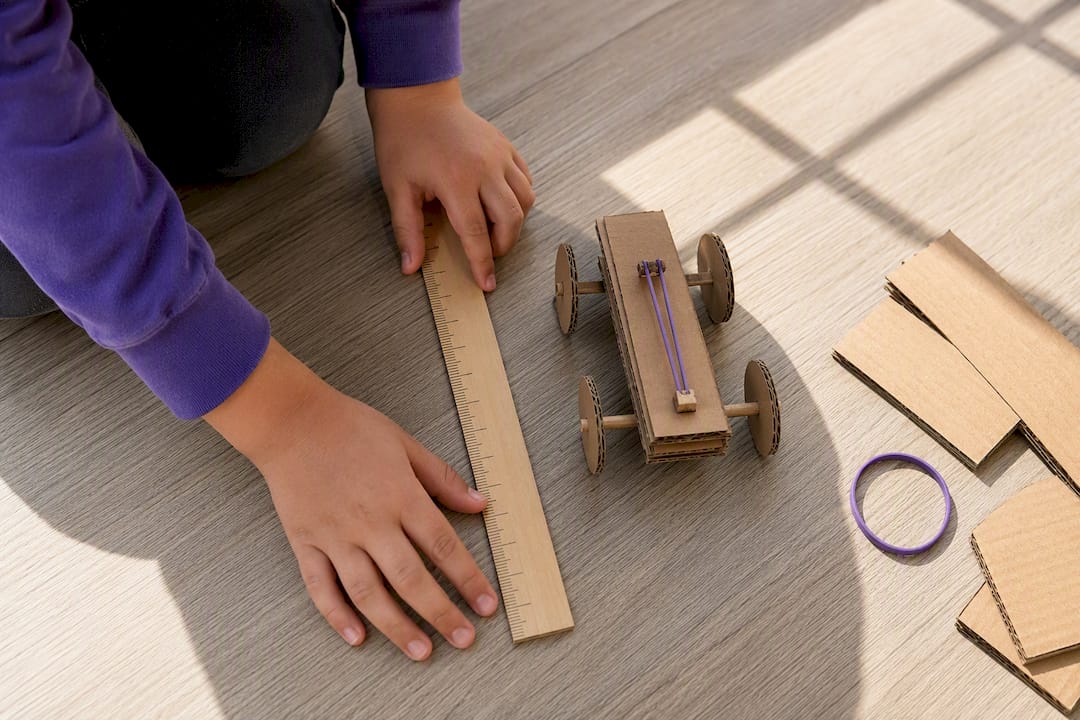
- Cardboard rover: Adapt the NASA JPL cardboard rover project, which uses corrugated cardboard, pencil axles, and a rubber-band drive train, then measure distance traveled across multiple trials without adding a microcontroller.
Corrugation orientation matters more than most builders expect. Cross-layering cardboard at 90 degrees measurably increases rigidity, which is why flattened boxes sag under load while a cross-layered panel holds steady.
Pro Tip: Have kids graph rotations of the rubber band against distance traveled, the same measurement NASA JPL suggests for its rover, and they’ll see energy transfer instead of just guessing at it.
Motion and Energy Projects That Teach Force and Friction
Motion builds turn recycled bottles and cardboard into rolling, launching, lab equipment. Each one isolates a different physics concept while staying safe enough for a kitchen table or classroom floor.
- Balloon car: Mount a balloon on a bottle-cap-and-straw chassis, release it, and measure distance across at least three trials to test how balloon size affects thrust.
- Rubber-band and wind-powered cars: Swap the drive mechanism (rubber band vs. a small fan blade) and compare which travels farther on the same surface, recording results in a simple table.
- Bottle rocket: Fill a plastic bottle with varying water levels, launch it outdoors with adult supervision, and record height or flight time to find the optimal water-to-air ratio.
Water-level testing works best outside, away from people, with safety glasses on and a countdown routine every time. Bottle rockets and balloon cars both reward patience over power. The car that finishes last in trial one often wins by trial three once kids adjust one variable at a time.
Simple Machines and Mechanical Systems From Recyclable Parts
Levers, pulleys, and gears turn recycled parts into working mechanical systems kids can actually operate, not just look at.
- Lever grabber: Build a claw from a paint stirrer and clothespin, then test how moving the fulcrum changes how much weight it can lift.
- Pulley winch: Rig a single pulley from a thread spool and string, then add a second pulley and compare how much force it takes to lift the same object.
- Cardboard gear train: Cut gears from cardboard circles, link them with candy or coin “teeth,” and measure how gear size trades speed for torque.
- Classroom extension: Attach a pulley winch to a rubber-band rover chassis so students combine two mechanical systems into one working model.
Electricity and Sound Projects Using Recycled Housings
Cardboard makes an excellent circuit housing because it’s easy to cut, safe to handle, and cheap to replace when a design fails.
- Cardboard circuit switch: Build a basic closed circuit with a coin cell battery, LED, and aluminum foil tape mounted on cardboard to teach conductors versus insulators.
- DIY flashlight: House the same circuit inside a toilet paper roll for a working flashlight kids can take home.
- Tissue-box guitar: Stretch rubber bands across an open tissue box to demonstrate pitch and vibration.
- DIY phone speaker: Cut a slot in a cardboard tube or bowl to amplify a phone’s sound without any electronics at all.
Pro Tip: Before any circuit project, walk through a battery and tool safety checklist out loud: no metal near battery terminals, adult-only scissors for tough cardboard, and hands away from mouths near small parts.
Environmental and Renewable-Energy Projects Worth the Mess
Sustainability concepts click faster when kids build the system instead of reading about it.
- Wind turbine model: Cut blades from a plastic bottle in different shapes and pitches, mount them on a skewer, and compare which design spins fastest in front of a fan.
- Plastic-bottle greenhouse: Cut a bottle in half, plant seeds inside, and track temperature and growth against an uncovered control plant.
- Water filter engineering challenge: Layer sand, gravel, and cotton inside a cut bottle, then compare filtration results against a second design and discuss how real Materials Recovery Facilities separate materials at scale.
Ask kids what trade-offs a real recycling plant faces, speed versus accuracy, cost versus purity, and let the discussion run past the experiment itself.
Recycling Science Experiments and Sorting Machine Challenges
A miniature sorting machine turns an abstract idea, industrial recycling, into something kids can hold and test.
- Build a sorting machine: Follow the Science Buddies sorting-machine lesson, using magnets to pull metal fragments and airflow (a straw or small fan) to separate paper shreds from heavier scraps.
- Crush test cardboard shapes: Compare a flat cardboard square against a folded or corrugated version under the same weight, noting which fails first and why.
- Assess with data, not just observation: Have students write a short lab report with a graph and one proposed design improvement, rather than a simple pass or fail summary.
Matching Projects to Grade Level and Class Time
A 45 minute period fits most single builds if materials are pre-cut and pre-sorted before kids arrive. Three reliable quick challenges: a paper tower height test, a balloon car distance trial, or a lever grabber demo, each with materials ready in a bin and a testing plan that takes five minutes to explain.
- Low-prep STEM bins: Fill labeled bins with pre-cut cardboard, rubber bands, bottle caps, and string, then rotate bins weekly so kids see a new mechanical challenge without new shopping.
- Grades K to 2: Focus on paper towers and simple lever grabbers, targeting basic cause and effect.
- Grades 3 to 5: Move to rubber-band rovers and pulley winches, targeting measurable data collection.
- Grades 6 to 8: Tackle sorting machines and wind turbine blade testing, targeting design iteration and trade-off analysis.
Ready-made bin rotations and age-tagged builds save the most planning time; a low-prep STEM bin guide or an age-mapped project list can shortcut the sorting work.
What to Save, How to Prep It, and Basic Safety Rules
Not every recyclable earns a spot in the bin. Cardboard, plastic bottles, egg cartons, clean cans, and old CDs cover nearly every project on this list and store flat or stack easily.
- Rinse and dry bottles and cans before storage to avoid odor and pests.
- Smooth sharp cardboard edges with tape, and reserve craft knives for adult use only.
- Label bins by material type (cardboard, plastic, metal, mixed) so kids grab the right supply fast.
- Keep a short safety checklist visible for cutting, launching, and battery-based activities.
Pro Tip: Store flattened cardboard vertically, like files in a cabinet, instead of stacking it flat. It stays cleaner and takes up a fraction of the shelf space.
How Team Genius Squad Extends These Projects With Structured Kits
Team Genius Squad builds on the same hands-on instincts these recycled projects tap into, just with more scaffolding built in. The trademarked E³ Method, Engage, Encourage, Empower, guides kids from a recycled-bottle rocket straight into a structured experiment kit that adds role-play, literacy prompts, and a confidence-building arc.
- Screen-free experiment kits pair naturally with circuit and energy builds, giving kids a next-level challenge once the cardboard version works.
- Lab coats and role-play elements turn a rover test into a mission a young scientist “reports back” on.
- Literacy integration through STEM storytelling connects the build to reading and reflection, not just the mechanics.
Making Recycled STEM Inclusive and Confidence-Building
Kids who struggle with traditional instructions often thrive with recycled builds because failure costs nothing. A cardboard tower that collapses is a data point, not a setback. Assess with process rubrics: did the child define a problem, try a fix, and explain what changed, rather than grading the finished object alone. Offer picture-based instructions alongside written steps for kids who process visually. Celebrate every attempt out loud, especially the ones that don’t work the first time.
— Tita
When a Kit Beats a DIY Bin, and When It Doesn’t
DIY recycled projects win on cost and flexibility, but they take prep time most teachers and busy parents don’t have on a Tuesday night. That’s the gap Team Genius Squad’s experiment kits fill: pre-measured materials, a lesson already written, and the E³ Method built into every step so kids move from curiosity to a finished experiment without you sourcing a single bottle cap.
If your DIY circuit project went well, the STEM-STEAM Electricity Lab Experience Bundle picks up right where the cardboard switch left off, with structured circuits and a role-play layer that turns the activity into a confidence-building event instead of a one-off. For kids who want to keep experimenting past the classroom, Meet Ava, the STEM Ambassador, offers a 30 minute one-on-one Zoom session for $50, a live extension of the same hands-on discovery these recycled builds start. Browse the full experiment kit shop to find the next structured challenge for your young engineer.
Where These Projects and Lesson Plans Come From
For step-by-step builds beyond what’s covered here, these sources go deeper into specific techniques:
- Make a Cardboard Rover, NASA JPL Education
- Build a Recycling-Sorting Machine, Science Buddies
- 40+ Recycled STEM Activities, Little Bins for Little Hands
- Recycling Bin STEM Challenge, Little Bins for Little Hands
Sources
FAQ
What are some good STEM project ideas using recycled materials?
Cardboard towers, rubber-band rovers, balloon cars, and mini sorting machines rank among the best because they teach a clear engineering concept and cost nothing to build.
What are some cool recycling projects for kids?
A cardboard rover modeled on NASA JPL’s design and a magnet-and-airflow sorting machine modeled on the Science Buddies lesson both turn ordinary trash into a working model of real engineering systems.
What are some ideas for 45-minute STEM activities?
A paper tower height test, a balloon car distance trial, or a lever grabber demo all fit inside 45 minutes when materials are pre-cut and sorted into a bin ahead of time.
What is the most profitable thing to recycle?
That depends on local scrap markets rather than classroom STEM value, but for teaching purposes, cardboard and plastic bottles offer the most project versatility per item saved.
Does Team Genius Squad offer kits that build on these DIY projects?
Yes. Team Genius Squad’s experiment kits and the STEM-STEAM Electricity Lab Experience Bundle extend circuit, energy, and structural builds with structured lessons and role-play elements. Current prices are listed on the site.


Leave a comment
This site is protected by hCaptcha and the hCaptcha Privacy Policy and Terms of Service apply.