The Best Egg Drop Challenge Ideas for Every Age and Budget
The most reliable egg drop strategy combines three things: cushioning to absorb the impact, a design that spreads force across the shell instead of concentrating it at one point, and something that slows the fall before the egg ever hits the ground. Get those three working together and almost any budget or skill level can produce a survivor.
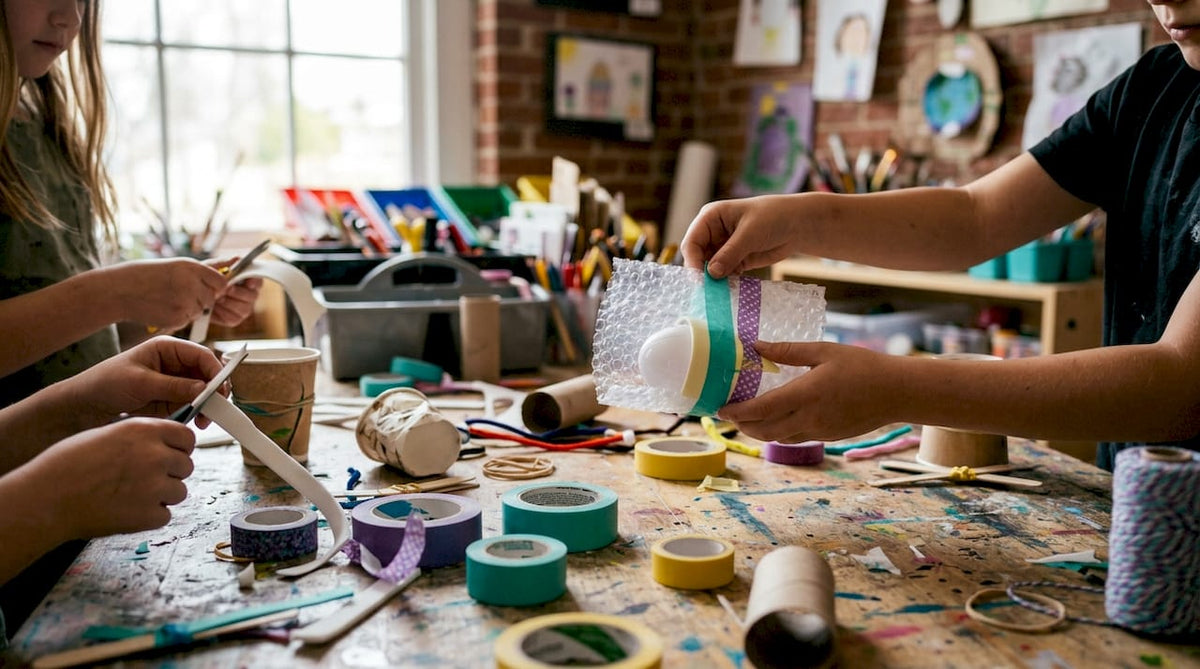
Two designs prove it immediately. For younger children, wrap an egg in bubble wrap and nest it inside a small box padded with cotton balls: simple, forgiving, and nearly impossible to mess up. For older children, build a plastic-bag parachute tied to a paper cup, with the egg suspended inside on a bed of shredded paper. Both tend to work well the first try.
- Bubble-wrap cradle in a box (ages 5–7): fast, cheap, low failure rate
- Parachute and suspended cup (ages 8–13): introduces drag and suspension physics
- Swap in a plastic egg or ping-pong ball for early test runs, and always drop over a tarp
Key Takeaways
The most reliable egg drop design combines cushioning, force distribution across the shell, and a way to slow the descent, and starting with low-cost substitutes lets kids iterate without wasting materials or patience.
| Point | Details |
|---|---|
| Combine three strategies | Pair cushioning, force distribution, and slowed descent for the highest survival odds. |
| Start with substitutes | Use plastic eggs or ping-pong balls for early trials before spending real eggs. |
| Watch for bounce | Elastic materials like rubber bands can rebound the egg; add containment walls. |
| Score beyond survival | Reward lightest design or most creative build, not just tallest drop. |
| Try Team Genius Squad kits | Their experiment kits pair worksheets and role-play tools with hands-on builds like this one. |
Table of Contents
- Egg Drop Challenge Materials and Prep Checklist
- How to Run an Egg Drop Challenge Step by Step
- Creative Egg Drop Designs Grouped by Method and Age
- The Physics Behind Every Egg Drop Design
- Competition Formats and Cross-Curricular Extensions
- Turning Trial and Error Into Real Learning
- Keeping the Egg Drop Safe and the Mess Manageable
- Where to Find More Egg Drop Lesson Plans and Rubrics
- A Low-Prep Way to Bring the Egg Drop Into Your Classroom
- Why This Activity Builds More Than Engineering Skills
- Sources
Egg Drop Challenge Materials and Prep Checklist
You don’t need a supply closet to run this activity, just a short list and a plan. Stock eggs (real ones for the final drop, plastic or ping-pong balls for early testing), tape, scissors, a measuring tape, cardboard boxes, bubble wrap, cotton balls, straws, rubber bands, and pool noodles if you have them.
Foam eggs work well for early trials too, though TeachEngineering notes that foam and other synthetic cushioning have environmental downsides worth discussing, whereas recycled paper and cardboard offer a reusable, low-cost alternative.
Before anyone builds anything, mark a drop zone, lay tarps underneath, and confirm an adult is spotting the drop. Print simple recording sheets so kids log height, materials, and outcome for each trial.
- Core kit: eggs, tape, scissors, tape measure, box, bubble wrap, cotton, straws, rubber bands
- Substitutes: plastic eggs, ping-pong balls, foam eggs for early testing
- Prep: drop zone marked, tarp down, supervision confirmed, recording sheets ready
A $12 budgeted version from Wyse/Grainger works well for older groups: give each team a fixed dollar amount to “spend” on materials, forcing real trade-off decisions instead of unlimited access to supplies.
Pro Tip: Run one practice round with a plastic egg before anyone touches a real one. It saves cleanup time and lets kids fail cheaply while they’re still learning what actually works.
How to Run an Egg Drop Challenge Step by Step
Running this well takes structure, not just supplies. Follow a sequence that keeps the activity fair, safe, and genuinely educational rather than chaotic.
- Set a starting drop height (a chair or step stool works for younger kids; a second-floor balcony or stairwell for older ones), and plan to raise it in stages for teams whose designs survive.
- Assign roles: a designer who sketches the plan, a builder who assembles it, a recorder who logs height and outcome, and a presenter who explains the design choices.
- Cap materials per group so budget constraints drive creativity instead of unlimited access.
- Allow one or two redesigns after the first drop. Science Buddies’ engineering design lesson treats redesign as the actual point of the exercise, not a consolation prize.
- Score using survival height, lightest surviving design, or most creative build, since a single “who wins” metric misses most of the learning.
- Practice with plastic eggs before spending a real one
- Log every trial, even failures, on the recording sheet
- Give a firm time limit per round so groups don’t stall on one idea
Creative Egg Drop Designs Grouped by Method and Age
Here’s a bank of tested approaches organized by the physics principle each one relies on, so you can pick based on what you want kids to learn, not just what looks fun.
Slow-descent designs
- Plastic-bag parachute. Tie four strings from a garbage bag or grocery bag to a cup holding the egg. Build tip: longer strings and a wider bag canopy both add drag. Materials: plastic bag, string, cup. Ages 8 to 13. Teaching question: why does a bigger parachute canopy slow the fall more than a small one?
- Paper-spiral ramp. Tape a spiral of cardstock inside a tube so the egg spins down slowly instead of dropping straight. Materials: cardstock, tape, cardboard tube. Ages 5 to 9. Teaching question: what happens to the egg’s speed when the path gets longer?
- Helicopter spin blades. Attach angled paper blades to a central shaft above the egg so it spins on the way down. Materials: cardstock, tape, straw. Ages 9 to 13. Teaching question: how does spin change the way air resists the fall?
Energy-absorption designs
- Bubble-wrap cradle. Wrap the egg fully, then nest it in a box with extra wrap on all six sides. Materials: bubble wrap, small box. Ages 5 to 7. Teaching question: why does more wrap layers mean a softer landing?
- Sponge-hole insert. Cut a hollow into a kitchen sponge and seat the egg inside it. Materials: sponge, tape. Ages 5 to 8. Teaching question: what does the sponge do to the force at the moment of impact?
- Packing-peanut cushion. Fill a box loosely with peanuts or dry cereal, then bury the egg in the middle. Materials: box, packing peanuts or cereal. Ages 6 to 10. Teaching question: does a denser or looser filling absorb more shock?
- Oobleck cup. Mix cornstarch and water into a thick paste and suspend the egg in a sealed cup of it. Materials: cornstarch, water, cup with lid. Ages 9 to 13. Teaching question: why does oobleck act solid on impact but liquid when still?
Force-distribution and suspension designs
- Rubber-band hammock. Weave rubber bands across a frame so the egg lands in a stretchy net instead of hitting a hard surface. Materials: rubber bands, popsicle sticks or a small frame. Ages 9 to 13. Teaching question: what could go wrong if the hammock is too bouncy?
- Straw cage or dodecahedron. Build a geometric cage of straws around the egg so impact spreads across many struts at once. Materials: straws, tape or string. Ages 10 to 13. Teaching question: why does a shape with more contact points protect the egg better than one flat wall?
- Nested cups with padding. Stack several paper cups with cotton or fabric between each layer, egg at the center. Materials: paper cups, cotton, tape. Ages 6 to 9. Teaching question: how does each layer slow the egg down a little more than the last?
Novelty and challenge variants
- Humpty Dumpty rescue. Frame the challenge as saving Humpty Dumpty from “the wall,” which the WeAreTeachers activity bank notes boosts engagement for younger kids without changing the physics at all.
- Disaster-relief packing. Ask kids to design packaging that could ship a “fragile supply” (the egg) to a disaster zone, which builds empathy for real-world design constraints.
- Bungee drop. Attach the egg to an elastic cord that stretches and stops it just short of the ground. Ages 10 to 13. Teaching question: what happens if the cord is too stretchy and the egg bounces back up?
- Pool-noodle pod. Slice a pool noodle, hollow out a pocket, and seal the egg inside with tape. Ages 6 to 10. Teaching question: why is a curved, springy material different from a rigid box?
- Water-bag test. Drop the egg inside a sealed bag of water to see whether the water cushions the fall better than air alone. Ages 9 to 13. Teaching question: does the water actually slow the egg down, or just distribute the force differently?
The Physics Behind Every Egg Drop Design
Every successful design leans on the same handful of principles, whether the builder knows it or not.
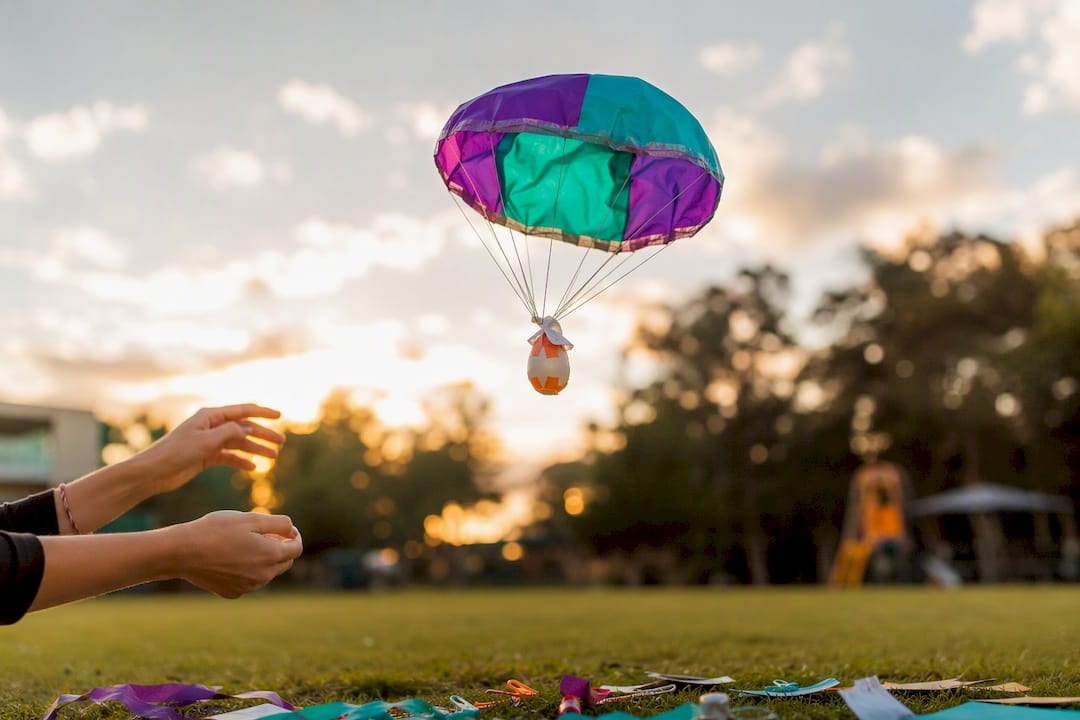
A parachute works because of drag: the more surface area pushing against the air, the slower the fall. That’s why a wide garbage-bag canopy beats a narrow strip of plastic every time.
Pressure equals force divided by area, and that single equation explains almost every cracked shell. Science Buddies frames this as the reason cradles and distributed supports outperform designs that let the egg strike a single hard point.
Cushioning works by extending stopping time. A longer stop means lower peak force on the shell, which is exactly what bubble wrap, sponges, and packing peanuts are doing mechanically.
Shell geometry matters too. Egg shells are strongest at their rounded ends, so orienting the egg vertically, resting on its stronger end, reduces breakage risk according to Science World’s classroom guide. One caution: elastic materials like rubber bands can absorb energy and then release it as a bounce, so add a containment wall if your design uses stretchy components.
- Drag from surface area slows the fall
- Spreading force across the shell lowers peak pressure
- Longer stopping time means lower impact force
- The egg’s rounded ends are its strongest points
Competition Formats and Cross-Curricular Extensions
A single-elimination height ladder, where surviving teams face a taller drop each round, keeps energy high through an entire class period. Category prizes (lightest design, most creative, tallest survival) reward more than one kind of success.
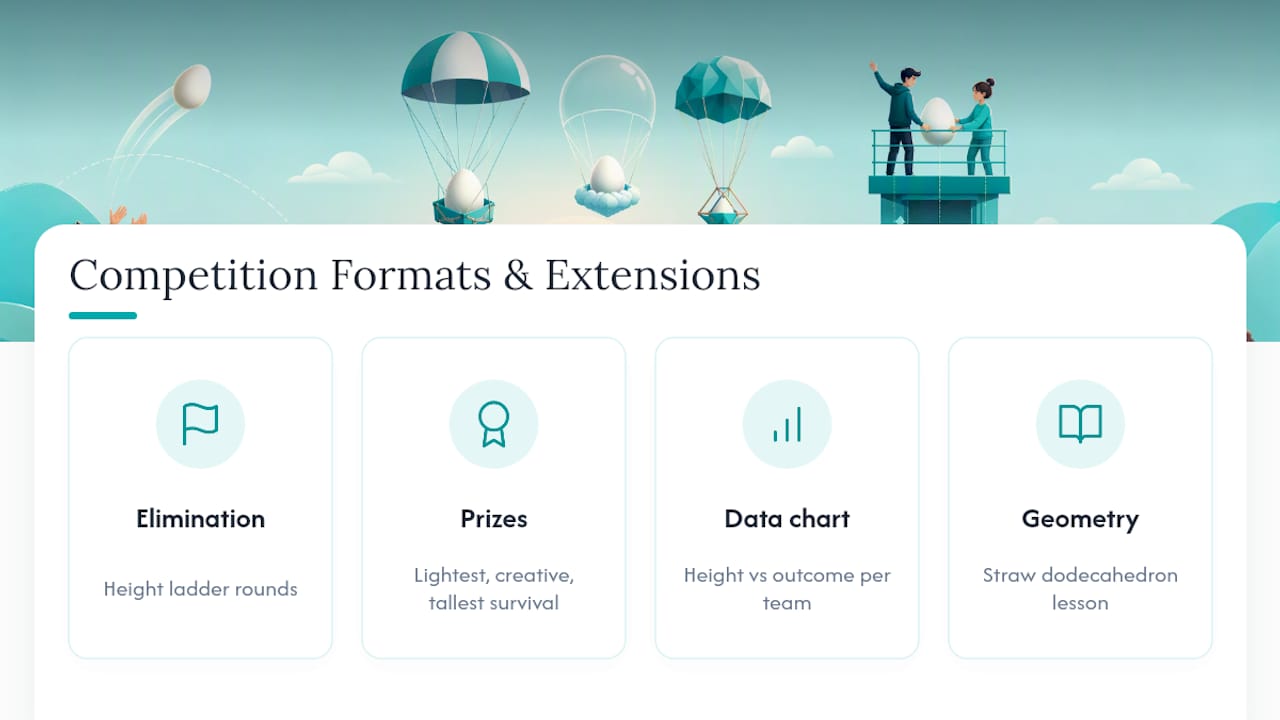
Pair the build with a reflective writing prompt about what failed and why, a data chart tracking each team’s height versus outcome, or a geometry lesson built around the straw dodecahedron. Rubrics scaled for grades K through 8 can weight creativity, teamwork, and iteration differently depending on age.
Turning Trial and Error Into Real Learning
Treat every drop as one loop in a cycle: plan, prototype, test, record, modify. What you record at each stage (materials used, height, outcome, and one specific fix) is what turns a fun afternoon into a real engineering lesson.
Watch for three failure patterns: bounce (add containment walls), a concentrated impact point (add a cradle or spread the padding), and a parachute that fails to open (check the string attachment points first). Staged heights and low-cost substitutes, as covered above, cut down on wasted eggs and frustrated kids.
- Record height, materials, and outcome at every trial
- Fix bounce with walls, not less elasticity
- Reserve real eggs for the final round, not early prototypes
Pro Tip: Keep a small stash of “identity-driven” prompts on hand, like asking kids to name their design or explain it “as the engineer.” It turns a science activity into a confidence exercise, which matters just as much as the physics.
Keeping the Egg Drop Safe and the Mess Manageable
Supervise every drop, mark a clear zone underneath it, and lay down a tarp or old sheet before anyone climbs a step stool. If real eggs raise food-safety concerns indoors, plastic eggs solve that instantly.
- Ziploc bags around real eggs cut down cleanup dramatically
- Bounce problem? Add a containment wall, not less padding
- Parachute failing? Check the string attachment before rebuilding the whole design
Pro Tip: Start every session with plastic eggs, then reserve real eggs for the final scored drop. It keeps the mess, and the tears, to a minimum.
Where to Find More Egg Drop Lesson Plans and Rubrics
- Science Buddies offers a full engineering design lesson plan with reflection prompts.
- TeachEngineering provides material trade-off notes and a scalable classroom rubric.
- Science World breaks down the three core survival strategies in plain language for younger readers.
- WeAreTeachers rounds up dozens of age-banded ideas and classroom variants in one list.
A Low-Prep Way to Bring the Egg Drop Into Your Classroom
If gathering bubble wrap, straws, and rubber bands for twenty-five kids sounds like its own project, Teamgeniussquad’s kits solve the prep problem without watering down the engineering. Every kit pairs real build materials with worksheets, role-play elements like lab coats and badges, and teacher notes that map directly to activities like the egg drop above.

The experiment kits collection gives teachers and parents a ready-made way to run scaffolded, NGSS-aligned STEAM activities without a supply run the night before. For structured units with rubrics and reflection prompts built in, the lesson plans page offers downloadable materials suited to classroom licensing or single-family use. Browse the collection and pick a kit that matches your next unit.
Why This Activity Builds More Than Engineering Skills
Watching a kid’s face when their design actually survives a drop tells you everything about why this challenge works. It’s not really about the egg; it’s about a child discovering they can plan something, watch it fail, fix it, and succeed on the second try. That loop of failure and revision, more than any single successful drop, is where real confidence gets built.
— Tita
Sources
- Egg Drop Engineering Design — Science Buddies (teacher resource)
- Naked Egg Drop Activity — TeachEngineering
- Egg Drop — Science World
- 26 Egg-cellent Egg Drop Challenge Ideas — WeAreTeachers

Leave a comment
This site is protected by hCaptcha and the hCaptcha Privacy Policy and Terms of Service apply.