
STEAM Trends in 2026: What Educators Must Know
STEAM education in 2026 is defined by the deep integration of AI-powered adaptive learning, early Industry 4.0 skill-building, and immersive hands-on experiences that prepare children ages 5–13 for careers that do not yet exist. The adaptive learning sector now drives a global STEAM market valued at over $5.2 billion, growing at 20% annually. These steam trends in 2026 are not incremental updates to existing curricula. They represent a fundamental shift in how children learn to think, create, and solve real problems. For educators, parents, and industry professionals, understanding these shifts is the difference between preparing children for the future and leaving them behind.
What are the biggest STEAM trends in 2026?
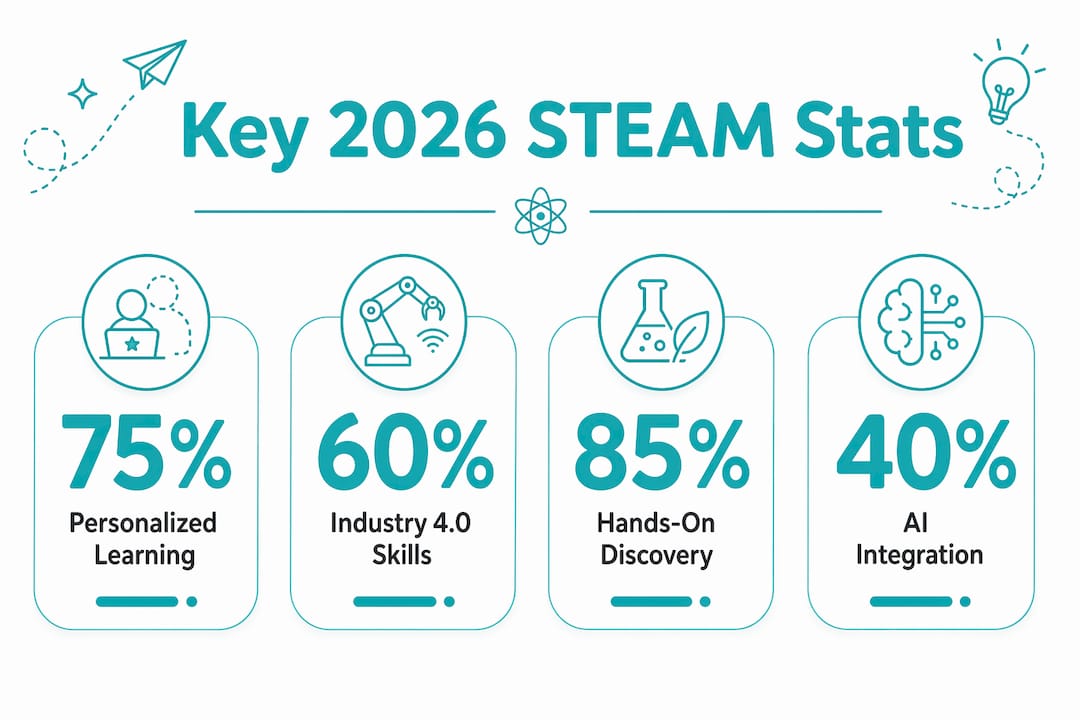
AI-driven personalized learning is the defining force reshaping STEAM classrooms for children ages 5–13 this year. 75% of STEM classrooms now integrate AI adaptive tutoring that delivers personalized learning paths, real-time feedback, and prompt engineering training. That figure signals a tipping point. AI is no longer a supplementary tool in STEAM education. It is woven into the daily learning experience.
The most effective AI applications in STEAM classrooms treat artificial intelligence as a co-pilot, not an answer machine. Tools like adaptive tutoring platforms guide children through problem-solving sequences, asking questions that build critical thinking rather than simply delivering solutions. This approach develops the reasoning skills that employers and universities will demand from the next generation of innovators.
Teacher readiness remains the largest barrier to realizing AI’s full potential in STEAM. Professional development must evolve continuously for educators to facilitate interdisciplinary AI-integrated learning effectively. A teacher who understands only the content of science or math is not equipped to guide children through the layered, cross-disciplinary thinking that 2026 STEAM demands.
- AI adaptive tutors provide individualized pacing, so a child who grasps electricity concepts quickly moves to circuit design while a peer solidifies foundational understanding.
- Prompt engineering training teaches children to frame questions clearly, a skill that transfers directly to writing, research, and professional communication.
- Real-time feedback loops reduce frustration and build confidence, especially for children who struggle in traditional test-and-grade environments.
- AI co-pilots model ethical problem-solving by presenting multiple solutions and asking children to evaluate tradeoffs.
Pro Tip: When evaluating AI tools for your classroom or home, ask one question: does this tool ask children to think, or does it think for them? The best platforms present a problem, offer scaffolding, and require the child to make the final decision.
Understanding the full distinction between STEM and STEAM matters here. The arts integration in STEAM is not decorative. It trains children to communicate ideas visually and verbally, which makes AI-generated outputs more meaningful and human-centered. You can explore the STEAM vs. STEM difference in depth to understand why this distinction shapes curriculum design in 2026.
How is industry 4.0 changing STEAM curricula for grades 4–8?
Industry 4.0 skills, including sensor technology, data analytics, robotics, and digital twins, are now embedded in grades 4 through 8 STEAM curricula as of mid-2026. More than 60% of edtech firms added AI-specific STEAM features in the prior 12 months alone. That pace of adoption means the gap between schools that have updated their curricula and those that have not is widening every semester.
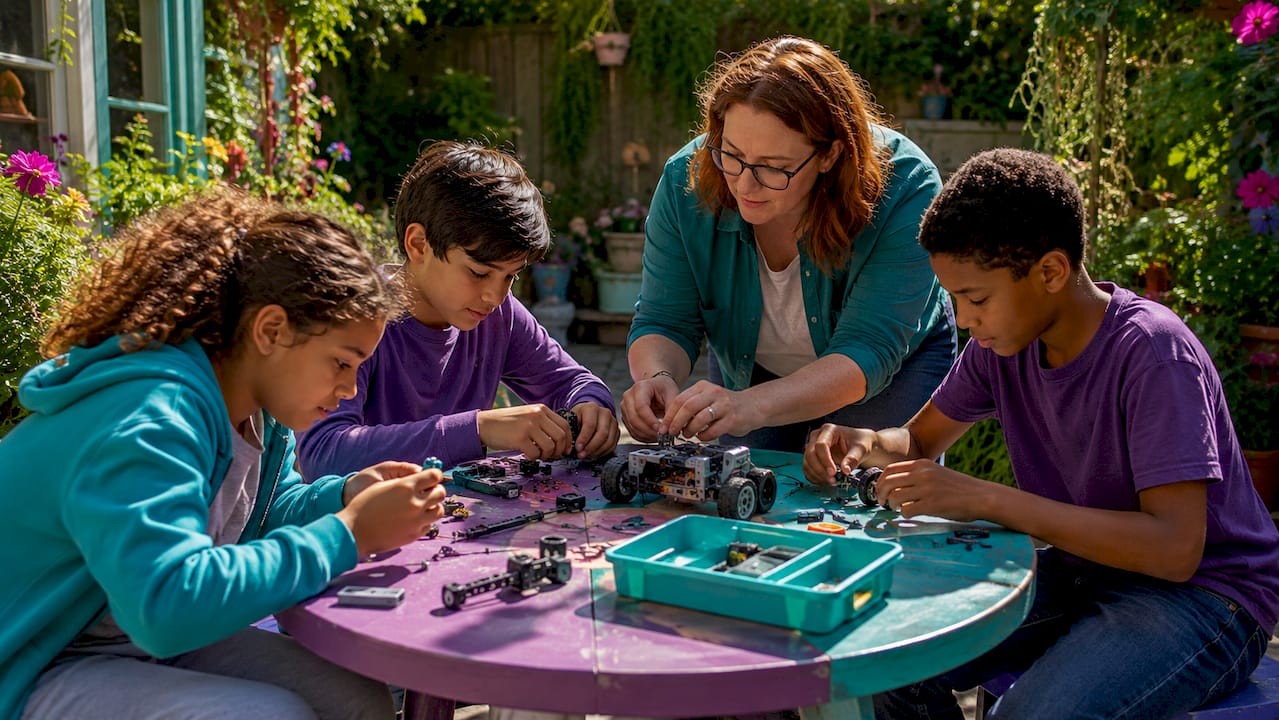
Robotics has undergone a significant transformation in its classroom role. Robotics in STEAM shifted from novelty toys to sophisticated skill-building tools that model real-world systems, including logistics simulations and ecosystem modeling. A child programming a robot to navigate a simulated supply chain is learning systems thinking, not just coding.
The following technologies now appear regularly in forward-thinking STEAM programs for children ages 8–13:
- Virtual Reality (VR) and Augmented Reality (AR): Students conduct chemistry experiments in virtual labs where mistakes carry no physical risk, building confidence before attempting real-world applications.
- Digital Twins: Children model physical systems digitally, testing changes to a bridge design or water filtration system before building the physical version.
- Internet of Things (IoT) Sensors: Simple sensor kits let students collect real environmental data, connecting classroom learning to authentic scientific inquiry.
- Robotics Platforms: Programs like those using LEGO Education SPIKE Prime or VEX Robotics teach mechanical engineering, programming, and iterative design simultaneously.
| Technology | Age Range | Core Skill Developed |
|---|---|---|
| VR/AR Labs | Ages 10–13 | Safe experimentation and spatial reasoning |
| Robotics Platforms | Ages 8–13 | Systems thinking and iterative design |
| IoT Sensor Kits | Ages 9–13 | Data collection and scientific inquiry |
| Digital Twin Modeling | Ages 11–13 | Predictive thinking and engineering design |
Sustainability is a recurring theme across all four technology areas. Children are not just learning to build systems. They are learning to evaluate whether those systems are responsible, efficient, and equitable. Graduates who engage in interdisciplinary STEAM problem-solving show over 95% employability, a figure that reflects how deeply these skills align with what the modern workforce requires.
Does every child have equal access to these STEAM advances?
Equity is the most urgent unresolved challenge in 2026 STEAM education. Resource constraints limit equitable access to AI-integrated STEAM tools, and without deliberate intervention, the gap between well-resourced and under-resourced schools will grow wider. School leaders report broad optimism about AI’s potential, but consistently name resource access as the primary barrier to implementation.
Universal Design for Learning (UDL) is now recognized as the standard framework for building accessible STEAM experiences. UDL requires that learning activities offer multiple means of engagement, representation, and expression, so that children with different learning profiles, including those with dyslexia, dysgraphia, or attention differences, can participate fully. The inclusive STEAM approach is not a workaround for struggling learners. It is better design for every learner.
- Low-floor, high-ceiling projects use everyday materials like baking soda, mirrors, or rubber bands to introduce concepts that scale to advanced digital applications, making them accessible regardless of school budget.
- Multilingual support in AI tutoring platforms removes language barriers that have historically excluded English language learners from full STEAM participation.
- Hybrid models that combine screen-free tactile discovery with digital tools ensure that children without consistent device access still build foundational STEAM skills.
- Adaptive learning tools designed for special needs learners provide scaffolding that benefits all children, not just those with identified learning differences.
Pro Tip: If you are designing a STEAM activity on a limited budget, start with a hands-on experiment using household materials and layer in a digital component only after the core concept is established. This sequence builds understanding first and uses technology to deepen it, not replace it.
Hybrid STEAM models that combine screen-free tactile discovery with AI-enhanced digital tools consistently yield the best learning outcomes. That finding matters for every educator and parent, regardless of budget, because it confirms that the most expensive technology is not always the most effective teaching tool.
How can educators and parents support the 2026 STEAM learner?
The most important shift in 2026 STEAM education is not technological. It is identity-based. Children who see themselves as scientists, creators, and problem-solvers engage more deeply, persist longer through challenges, and transfer their learning across subjects. Parental and educator collaboration is the key driver of this learner identity, supporting children’s confidence and innovative mindset alongside formal education.
Teacher training in AI-integrated STEAM is currently insufficient across most school systems. Successful programs involve continuous professional development focused on interdisciplinary facilitation, not just tool training. An educator who knows how to use a robotics platform but cannot connect it to math, writing, and social studies is missing the full power of STEAM integration.
“Children don’t just need to learn science. They need to see themselves as the kind of person who does science. That identity shift is what makes learning stick.” This principle, central to identity-driven STEAM pedagogy, explains why role play, storytelling, and confidence-building rituals matter as much as the experiment itself.
Parents play a more significant role than most realize. Reinforcing STEAM at home does not require expensive kits or advanced knowledge. Asking a child to explain what they built, what went wrong, and what they would change next time activates the same reflective thinking that professional engineers use. Resources like career pathway guides for parents help families connect their child’s STEAM interests to real-world career possibilities, making the learning feel purposeful and personal.
Educators benefit from understanding the professional landscape they are preparing children to enter. Reviewing resources on postsecondary STEAM teaching careers provides context for the interdisciplinary skills that will define future classrooms. The steam education trends 2026 are not just about what children learn. They are about how educators grow alongside them.
Key takeaways
The most effective STEAM education in 2026 combines AI-powered personalization, hands-on tactile discovery, and identity-building experiences to prepare children ages 5–13 for an interdisciplinary future.
| Point | Details |
|---|---|
| AI as co-pilot | Use AI tools that prompt children to think and decide, not tools that answer for them. |
| Industry 4.0 starts early | Robotics, IoT, and VR are now standard in grades 4–8 curricula, not optional enrichment. |
| Equity requires deliberate design | Low-floor, high-ceiling projects and hybrid models ensure all children access quality STEAM learning. |
| Learner identity drives outcomes | Children who see themselves as innovators persist longer and transfer skills more effectively. |
| Teacher growth is non-negotiable | Continuous professional development in interdisciplinary facilitation is the foundation of effective STEAM delivery. |
Why i think we’re getting one big thing wrong about STEAM in 2026
The conversation about steam trends in 2026 focuses heavily on technology adoption, and I understand why. The numbers are compelling, the tools are exciting, and the urgency is real. But the most important trend this year is not the technology. It is the question of who gets to use it.
Every time I see a school celebrate its new VR lab or robotics program, I ask the same question: what happens in the classroom down the road that cannot afford either? The risk in 2026 is not that AI will replace teachers. The risk is that AI-enhanced STEAM will become another marker of privilege, widening the gap between children who are being prepared for the future and those who are being left to catch up.
The solution is not to slow down adoption. It is to build from the ground up. Screen-free, hands-on discovery is not a consolation prize for under-resourced schools. It is the foundation that makes every digital tool more meaningful when it arrives. A child who has already built a working circuit with copper tape and a battery understands electricity in their hands before they model it in a simulation. That embodied knowledge is what makes the digital layer click.
Teamgeniussquad was built on exactly this principle. The E³ Method, Engage, Encourage, Empower, starts with physical discovery and builds toward confidence and identity. Technology can amplify that sequence. It cannot replace it. The educators and parents who understand this distinction will raise the most capable, resilient young innovators of the next decade.
— Tita
Bring 2026 STEAM trends to life at home or in your classroom
The steam education trends shaping 2026 are most powerful when children experience them directly, not just read about them.
Teamgeniussquad designs hands-on, screen-free discovery kits that align with the biggest shifts in STEAM education this year. The STEM-STEAM Electricity Lab Bundle puts real circuit-building, engineering challenges, and scientific inquiry directly into children’s hands, no screen required. For families and classrooms looking to explore a full range of experiment kits built around the E³ Method, Teamgeniussquad offers purposeful, confidence-building experiences that grow with your child from ages 5 through 13. Every kit is designed to help children see themselves as the scientists and innovators the future needs.
FAQ
What is STEAM education and how does it differ from STEM?
STEAM adds Arts to the traditional STEM subjects of Science, Technology, Engineering, and Math, integrating creative thinking, communication, and design into technical learning. This combination develops more well-rounded problem-solvers who can both build and communicate ideas effectively.
How is AI used in STEAM classrooms for young children?
AI functions as a co-pilot in effective STEAM classrooms, offering personalized learning paths, real-time feedback, and prompt engineering practice rather than simply delivering answers. 75% of STEM classrooms now use some form of AI adaptive tutoring to support this approach.
Are hands-on STEAM kits still relevant when digital tools are so advanced?
Hands-on, screen-free learning remains the strongest foundation for STEAM understanding because tactile discovery builds embodied knowledge that digital simulations reinforce rather than replace. Hybrid models combining physical and digital tools consistently produce the best learning outcomes.
How can parents support STEAM learning at home without expensive technology?
Parents can reinforce STEAM thinking by asking children to explain their experiments, describe what failed, and propose what they would change. Low-floor, high-ceiling projects using everyday household materials build the same foundational skills as classroom technology, and STEAM literacy integration resources offer practical guidance for home application.
What STEAM skills will matter most for children entering the workforce?
Interdisciplinary problem-solving, data literacy, systems thinking, and the ability to communicate ideas across disciplines are the skills most valued by employers in 2026 and beyond. Graduates who develop these skills through STEAM education show over 95% employability in current workforce data.



Leave a comment
This site is protected by hCaptcha and the hCaptcha Privacy Policy and Terms of Service apply.